

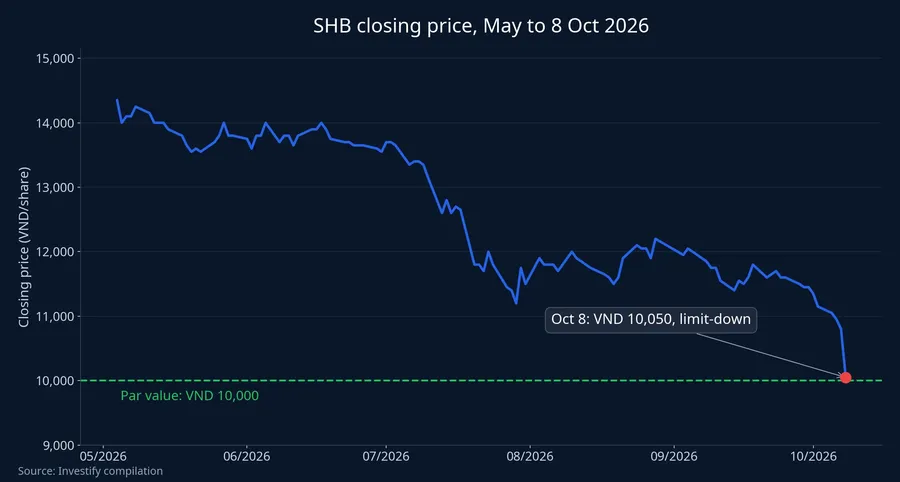
On October 8, 2026, SHB shares fell the full 6.94% daily limit to VND 10,050, just VND 50 above the VND 10,000 par value.CafeF That is below what almost every group paid for new SHB shares this year. For the 63,000-plus retail shareholders there is a second layer: the shares they bought through rights in May have still not started trading.
This piece follows three questions. Where does each group of buyers stand against the market price? What did the bank gain or lose? And when can the new shares actually be sold?
October 8: limit-down, heavy volume, small foreign net buying
More than 44.4 million SHB shares changed hands, placing the stock among the most liquid of the day. The VN-Index closed at 1,738.97, down 14.42 points (0.82%), with red spreading across banks, real estate and brokerages.CafeF
Foreign flows were the exception. Overseas investors were net sellers of about VND 448 billion across the market, their 12th straight net-selling session, yet they were net buyers of more than VND 24 billion in SHB alone.CafeF That is small next to the session's traded value. It suggests the selling came mainly from domestic investors, and it is not enough to say foreigners are placing a big bet on the stock.
Nor was the limit-down a one-off. From VND 11,750 on September 10, SHB has lost 14.47% over 21 sessions. Further back, the stock has slid from around VND 18,000 in October 2025.CafeF
What buyers paid during the 2026 capital raise
SHB raised capital heavily this year: charter capital rose from just under VND 46,000 billion to more than VND 53,400 billion after the issues.MarketTimes Each group bought at a different price, so VND 10,050 leaves them in very different positions.
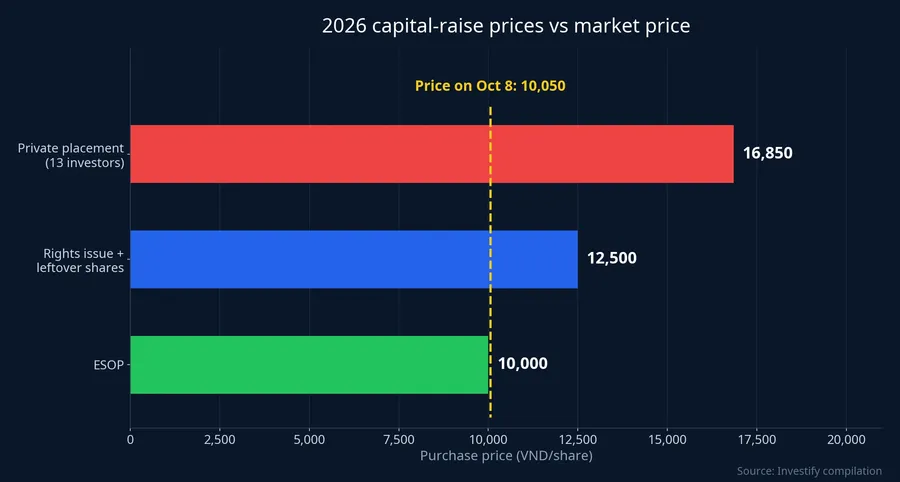
Thirteen investors in the private placement, at VND 16,850. In April SHB sold 200 million shares privately to 13 professional securities investors, raising VND 3,370 billion.CafeF The market price is now VND 6,800 below their purchase price per share, about 40.4%. Across the whole lot, the gap at market price is roughly VND 1,360 billion. Within the group, funds of Dragon Capital, Korea Investment Management, VinaCapital and Hanwha Life Vietnam bought nearly 59.5 million shares worth more than VND 1,002 billion, now about VND 404 billion under cost. PVI Fund Management and the PVI Infrastructure Fund bought 87.5 million shares for about VND 1,474 billion, now nearly VND 595 billion under cost.CafeF
More than 63,000 existing shareholders, at VND 12,500. The 100:10 rights offering closed on May 27, with 434.3 million shares distributed to 63,712 shareholders, 94.55% of the amount offered.MarketTimes At the October 8 price, each new share is VND 2,450 below what was paid, about 19.6%. Multiplied by the shares distributed, the gap across the lot is about VND 1,064 billion. The 25-million-plus leftover shares went to PVI Fund Management, the PVI Infrastructure Fund and the HPP Investment Fund at the same VND 12,500.FireAnt
Employees in the ESOP, at VND 10,000. SHB allocated 90.6 million ESOP shares to 3,240 employees.FireAnt They are the only group still above their purchase price, by just VND 50 per share.
All of these gaps are measured at market price and are not realized losses. As Kiến Thức notes, the comparison ignores rights and each investor's cost-basis adjustments.CafeF For existing shareholders, average cost also depends on the older shares they already held.
The bank has the cash; buyers carry the gap
The sell-off takes nothing back from the capital SHB has already raised. From the private placement alone the bank received VND 3,370 billion in cash at VND 16,850.CafeF That money is already in equity, whatever the share price does afterward. A lower price only changes the value of the investment on the buyers' side.
So the picture differs on each side. For the bank, the raise did its job of adding capital. For buyers, the current price is a test of their decision to pay above the market earlier in the year.
434.3 million shares are still off the board
According to MarketTimes, the 434.3 million shares existing shareholders bought through rights carry no transfer restriction. Even so, almost five months after the offering ended, they have not been listed on an additional basis and cannot trade.MarketTimes In other words, more than 63,000 shareholders paid in May, watched the price fall below their cost, and still cannot sell the new shares on the exchange if they wanted to. We found no source that explains the delay.
The other lots are locked under the terms of each issue:
- The 200 million-share private placement carries a one-year transfer restriction.MarketTimes It closed in April 2026, so the funds cannot sell before roughly April 2027.
- The 25-million-plus leftover shares sold to PVI and HPP are restricted for one year from the end of the offering, until around late May 2027.FireAnt
- The 90.6 million ESOP shares are restricted for 18 months from the May 22, 2026 allocation, until around late November 2027.FireAnt
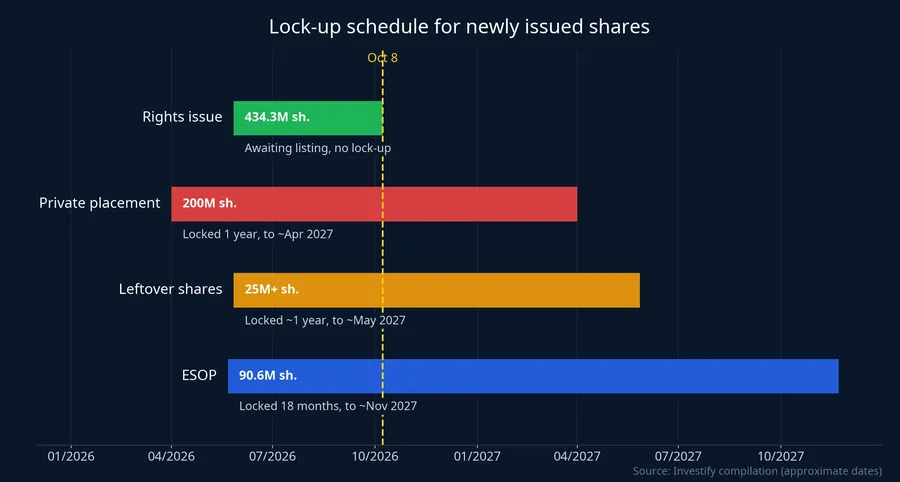
According to Kiến Thức, the private, rights and ESOP lots are all awaiting additional listing.CafeF We could not find an original SHB or HoSE notice giving a listing timetable for any of them.
The consequence for current holders sits in the 434.3 million-share lot. It equals about 9.4% of pre-raise charter capital and is nearly 10 times the volume traded on October 8. When it starts trading, the free-floating supply of SHB shares rises accordingly. Buyers at VND 12,500 would then have the option to hold or sell, which they lack today. The private, leftover and ESOP lots stay unsellable until their lock-ups expire, even once listed.
What no source answers
No source we read gives a direct cause for the October 8 limit-down. Same-day reports place it against a backdrop of prolonged foreign net selling and pressure across banks, but SHB fell far more than the sector. The listing delay is a notable detail, yet no data lets us say it explains this session. This piece therefore does not pin the drop on any specific event.
On fundamentals, we have left out first-half figures because they are too old against today's price action. Third-quarter results will be the first fresh data point.
Two milestones to watch
Two milestones will give SHB holders hard facts instead of guesses from price moves.
The first is the additional-listing notice for the 434.3 million shares of existing shareholders. Once HoSE approves and sets a first trading day, free-floating supply rises by almost a tenth.
The second is the third-quarter financial report. If profit and asset quality hold the pace of the first half, the gap between the share price and the capital-raise prices will be hard to explain by operating quality. If bad debt rises or profit slows, the market will have a more specific answer for the recent decline. Until then, VND 10,050 only says the market is paying less for SHB than institutional investors and existing shareholders agreed to pay a few months ago.