


On 8 October 2026, Japan's Rating and Investment Information (R&I) raised Vietnam's foreign-currency issuer rating from BB+ with a positive outlook to BBB- with a stable outlook.Tạp chí Kinh tế Tài chính According to a Ministry of Finance statement, it is the first time an international rating agency has placed Vietnam in the investment-grade group.Dân trí
BBB- is the lowest rung of investment grade, and BB+ is the top rung of sub-investment grade. The move is only one notch, but it carries Vietnam across the exact line that many investment rules use to sort assets. The news came after the close, when the VN-Index ended the 8 October session at 1,738.97, down 0.82%. The 9 October session is the first in which the equity market can react.
A headline such as "Vietnam enters investment grade" can read as if the job is done. In practice, R&I's rating and the Big Three's ratings serve different groups of users. This piece separates the two.
What R&I saw in Vietnam
Per the Ministry of Finance statement, R&I judged that Vietnam has sustained strong growth, higher than other Southeast Asian economies.Người Quan sát It expects high growth to hold as the economy shifts toward productivity and innovation, backed by public investment and foreign direct investment. The government's reform program, which includes streamlining the state apparatus, supporting the private sector, improving institutions and developing capital markets, was also assessed positively.
On fiscal policy, R&I said public debt to GDP remains relatively low, leaving room for more investment spending. It forecasts that the budget deficit and public debt will rise, but it is not worried about debt sustainability, since public investment should support growth while recurrent spending stays controlled.Báo Đầu tư Externally, the current account stays in surplus, FDI continues to flow and the external debt burden is low.
The Ministry of Finance said that during the April and May 2026 review it worked directly with R&I and supplied updated information on the macro economy, public finances, public debt and reform results.Tạp chí Kinh tế Tài chính
Who actually uses R&I's rating
A rating is worth only as much as the number of decisions that rely on it. R&I is a Japanese agency, so its heaviest users are Japanese banks, insurers and institutional investors when they lend or buy bonds.

For that group, BBB- has a concrete consequence. Ta Thanh Hoa, Head of Financial Markets at Standard Chartered Vietnam, said that when a loan's risk sits at BBB- rather than BB+, the capital the lender must set aside for it is about 50% lower.CafeF The same loan that ties up less capital lets a lender quote better pricing and extend larger limits.
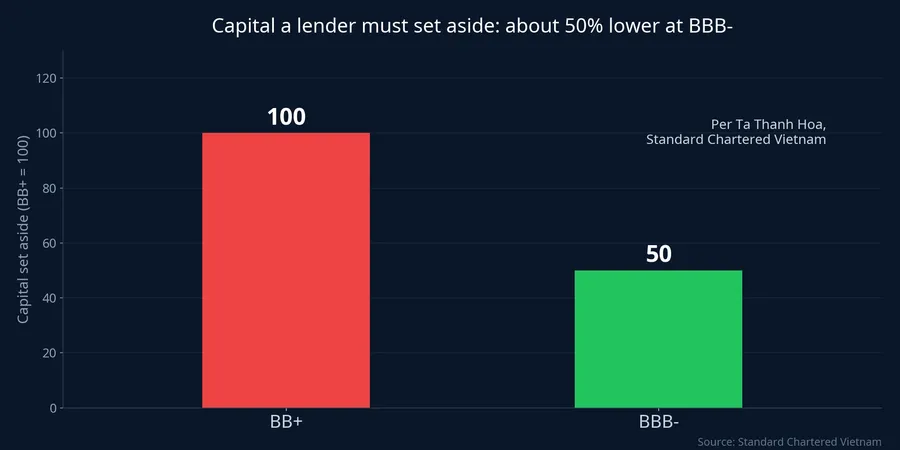
In other words, Vietnamese borrowers in foreign currency, including the government, banks and large companies, now hold an investment-grade rating to cite with lenders who use R&I's ratings. That is a real change, though narrower than the headline suggests. Hoa himself noted that the direct effect on domestic companies is limited, because foreign-currency borrowing is small relative to total balance sheets and not every company has the foreign-currency income to qualify.CafeF
The buyer base still turns on the Big Three
Most global funds, especially those allowed to hold only investment-grade assets, write their mandates around Moody's, S&P and Fitch. For them, R&I's rating does not change what they may buy.
Speaking at the Asia Securities Forum on 2 October, Hoa said Vietnam currently sits one notch below investment grade at S&P and Fitch, and two notches below at Moody's.CafeF The government's stated goal is Baa3 at Moody's or BBB- or higher at S&P and Fitch by 2030.CafeF
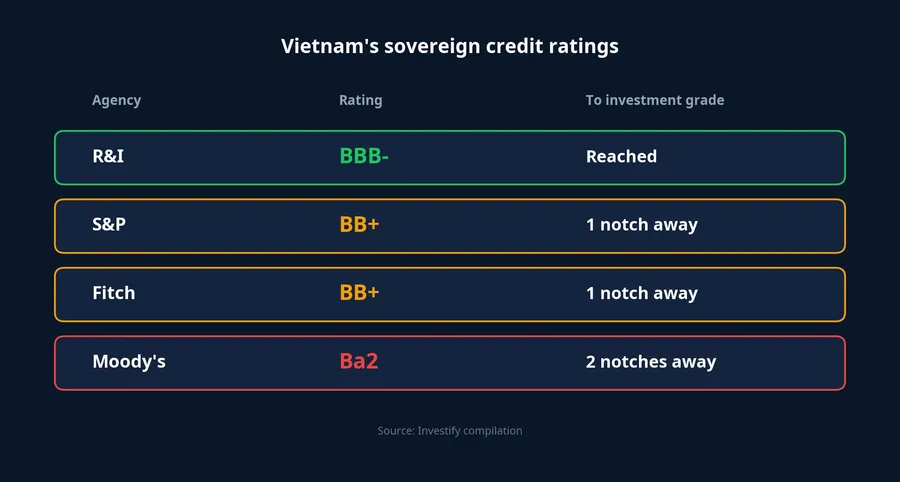
So the broad change in buyers, meaning global pension and insurance funds being allowed to hold Vietnamese bonds as investment-grade assets, still waits on the next reviews by these three agencies. R&I's rating signals that an international agency has judged Vietnam's profile across the line. It does not substitute for the other three's decisions.
An analysis in Báo Đầu tư argues that an upgrade could open the way to attract USD 10-20 billion into corporate bonds.Báo Đầu tư That is the newspaper's own view rather than an official figure, and it is tied to a scenario where the Big Three also upgrade, not to R&I's decision alone.
The flagged items all sit in banking
Alongside the upgrade, R&I said it will keep monitoring credit growth, bank liquidity, real estate lending, the financial system's capital adequacy and foreign-exchange reserves.Dân trí Apart from reserves, all of these sit inside the banking system. This is the part that could pull the rating the other way if conditions worsen.
Credit growth. According to State Bank of Vietnam (SBV) Deputy Governor Pham Thanh Ha at the government press briefing on 3 October, system-wide outstanding credit reached about VND 20.75 quadrillion at 30 September 2026, up 11.59% from end-2025 and up 16.69% from a year earlier.VNBA Ha said the pace fits the SBV's full-year target. For a rating agency, the question is how much faster credit is growing than the economy, and where the money goes.
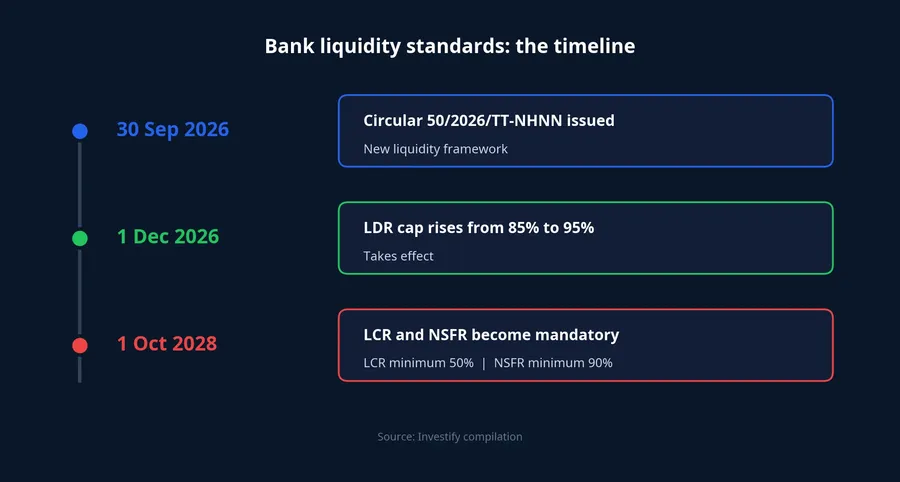
Bank liquidity. On 30 September the SBV issued Circular 50/2026/TT-NHNN, effective 1 December 2026, raising the maximum loan-to-deposit ratio (LDR) from 85% to 95%.Tạp chí Kinh tế Tài chính The same circular introduces two Basel III liquidity ratios, the liquidity coverage ratio (LCR) and the net stable funding ratio (NSFR), mandatory from 1 October 2028 with minimums of 50% and 90%.Mekong ASEAN The lending ceiling loosens first, while the international liquidity yardsticks arrive almost two years later. The stretch in between is when outsiders will watch how fast banks use the new headroom.
Real estate lending. At the same 3 October briefing, Ha said the SBV has issued guidance so that new lending for social housing, industrial parks, export processing zones, restaurants, hotels, tourist areas and resorts is not counted toward the real estate credit that must be controlled.Đại đoàn kết That counting method loosens room for prioritized segments. Still, the loans remain on bank balance sheets, and a rating agency assessing risk will look at all real-estate-related lending, not only the portion inside the controlled limit.

Capital adequacy. When credit grows quickly, banks' equity has to grow with it to keep ratios safe. This ties directly to the three points above: the faster credit runs, especially into higher-risk assets, the thinner capital becomes if retained earnings and fresh capital fail to keep pace.
What to take away
R&I's BBB- changes one concrete thing: Vietnamese foreign-currency borrowers have an investment-grade rating to show banks and investors who use R&I's ratings, mainly in Japan. For them, the same loan now ties up less capital. It does not yet change the portfolios of global funds that follow Moody's, S&P and Fitch. That step waits on the next reviews by the three agencies, where Vietnam is still one to two notches away.
The thesis here is that R&I has opened the door for a narrow group of buyers, while the wide door still depends on the quality of credit growth, which is also what R&I itself flagged. The nearest checkpoint is full-year 2026 credit data. If credit jumps in the final quarter relative to the 11.59% recorded over nine months, just as the 95% LDR ceiling takes effect on 1 December, that could be weighed on the risk side when other agencies assess Vietnam. If credit stays on target and real estate's share does not swell, the profile R&I has just taken across the line gives the others more to reference. The data here is not enough to say which way the Big Three will decide, or when.