


On October 7, the Hanoi People's Court ordered 188 defendants in the Pho Duc Nam (Mr Pips) case to stand trial at first instance. The trial is scheduled to open on October 26 and run for about 15 days, and more than 200 lawyers have registered to defend them.

Everything below is an allegation by the prosecuting authorities. There is no verdict, and no one has been found guilty. Still, the indictment itself answers a question many retail investors have asked after receiving a call inviting them to "invest in international stocks": why did people who deposited money into these sites have almost no chance of winning?
The real risk sits in three layers, and depositors usually see only the outermost one.
The outer layer: a business that looks real
According to the indictment, Pho Duc Nam played the role of mastermind and ringleader, responsible for 919 cases involving nearly VND 1,560 billion in misappropriated assets. He and Le Khac Ngo (Mr Hunter) are charged with fraudulent appropriation of property and money laundering. Nguyen Hoa Binh (Shark Binh), Chairman of the Board of Ngan Luong JSC, is charged with money laundering.
The indictment describes a carefully built operation. In 2017, Nam met a Turkish national, and the two agreed to set up 36 websites linked to the MT4 and MT5 trading apps, with English names resembling international exchanges. To have legal entities that could hire staff, Nam allegedly told employees to set up shell companies, which recruited staff, rented phone numbers and opened accounts to receive money. Offices were rented in Hanoi, Ho Chi Minh City, Da Nang and Binh Duong (former province). Ngo alone was put in charge of 20 offices to recruit customers, and is alleged to be responsible for 287 cases and nearly VND 340 billion.
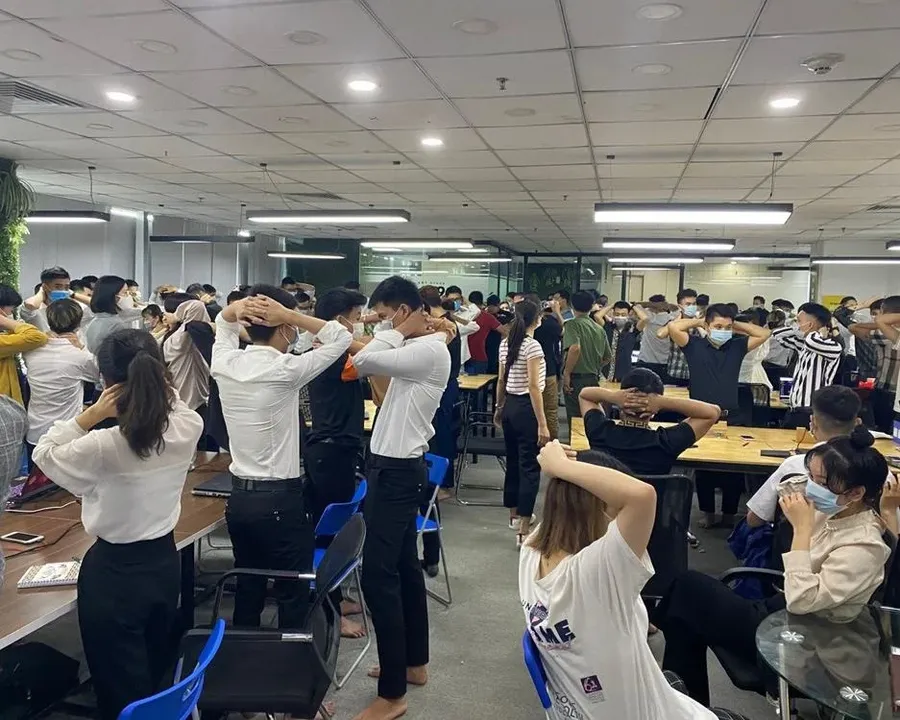
To the person on the other end of the phone, it all looked like a legitimate brokerage: offices, staff calling themselves specialists, a familiar trading app, and an exchange name that sounded like London or Sydney.
The middle layer: real software, a house on the other side
The easiest point to get wrong is the software. MT4 and MT5 are popular apps used by many brokers worldwide. The app itself tells you nothing about where your order goes. What matters is who sits on the other side of it.
According to the indictment, Nam's websites were all pre-programmed and did not route orders to world markets. When a customer placed a buy or sell order, it did not reach any overseas exchange. The customer was effectively trading against the operator who ran the system. Whatever the customer lost, the operator kept.
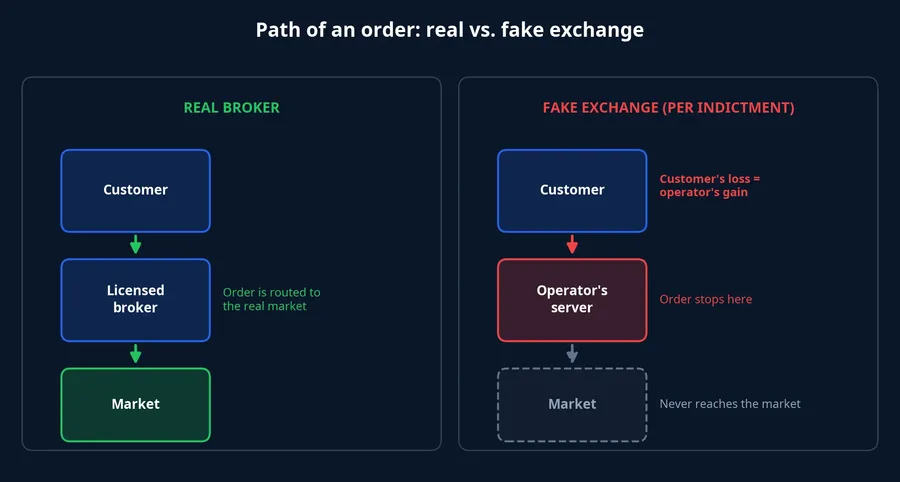
This reverses the incentives completely. A real broker lives on fees and has no need for clients to lose. Here, every dong a customer lost was revenue for the people guiding the customer's orders. Thanh Niên recounts the scenario laid out in the indictment: customers were first guided to trade small amounts, make profits and withdraw money. Staff then pushed them to raise their capital. Once customers had deposited a lot, staff fed them unfavorable information or steered them into trades that wiped out the account.
Forex is volatile and hard to profit from, but the indictment describes something different: a system programmed by the very party that profits from losses, with the person on the phone dictating each trade also working for that party. When your opponent writes the rules and sits next to you calling the moves, the outcome no longer depends on your skill. That is why customer losses here cannot be explained by a "bad market."
The bottom layer: whose name is the money going to
The third layer is the path of the money. According to the indictment, the shell companies opened 66 bank accounts and accounts at payment intermediaries tied to the platforms to receive victims' money. Customer deposits did not go into an account in the customer's name at a licensed brokerage. They went into accounts of entities the ring itself had created.
One of the payment intermediaries was Ngan Luong JSC, where Binh is Chairman of the Board. The ring's finance team opened wallets at Ngan Luong and then connected them directly to the trading platforms.
The indictment does not allege that Binh created or ran the platforms. He is charged over conduct after the platforms had come to police attention. From June 2020, Ngan Luong received official letters from police asking it to verify the wallets receiving customer money. According to the indictment, Binh knew the platforms were under verification and investigation but still directed that the wallets be kept to profit from transaction fees.
Prosecutors determined that from June 15, 2020 to the end of September 23, 2022, 232 victims transferred nearly VND 319 billion into Ngan Luong wallets. That figure is tied to the money laundering allegation against Binh.
The lesson for depositors: money passing through a well-known payment company does not make the recipient legitimate. A payment intermediary only moves money to the wallet the seller registered. If the seller is a fake exchange, the payment company's name only makes customers feel safer than they should.
From cash to homes, gold and foreign currency
The indictment also lists where part of the money ended up. To legitimize the origin of criminal proceeds, Nam is alleged to have used more than VND 560 billion: VND 378 billion on 32 properties, VND 141 billion on gold, VND 41 billion on USD 1,720,500 and VND 1 billion on SGD 67,744.CafeF
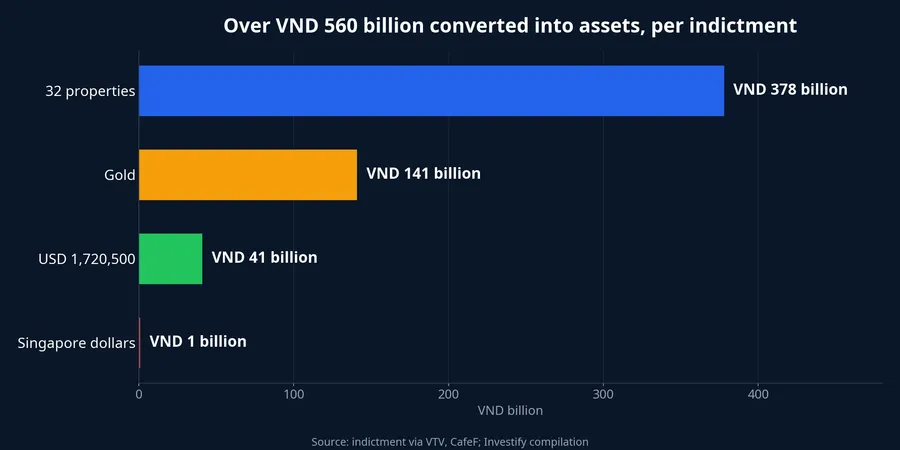
This list shows the money was converted into things that can be seized. It does not say how much victims will get back. The value of assets already seized, what they fetch when liquidated and how they are split across more than 900 cases are matters only a verdict can settle, so this article does not guess at that number.
Why victims can only look to the trial
Most victims in the case are retail investors recruited by phone and social media into "international stocks and forex." Under the Ordinance on Foreign Exchange, forex business is reserved for credit institutions licensed by the State Bank of Vietnam. Individuals may buy and sell foreign currency for legitimate purposes through banks, but no licensed forex exchange exists to take individuals' money for betting on exchange-rate moves.
The practical result: once money is deposited into a site like this, the depositor has no legitimate broker to complain to and no custodian holding assets on their behalf. What remains is to file a report and wait for the legal process. That is why October 26 matters to hundreds of people who lost money: the ruling on evidence and seized assets will show how far the homes, gold and foreign currency listed in the indictment can be used to compensate victims.
How a real securities account differs
Anyone who has not yet deposited can check in a few minutes, along the same three layers the indictment describes.
Who receives your order. A legitimate securities account is opened at a brokerage on the list licensed by the State Securities Commission. Look up the list yourself and match the legal entity, domain and phone number. Do not trust a license photo sent by the caller.
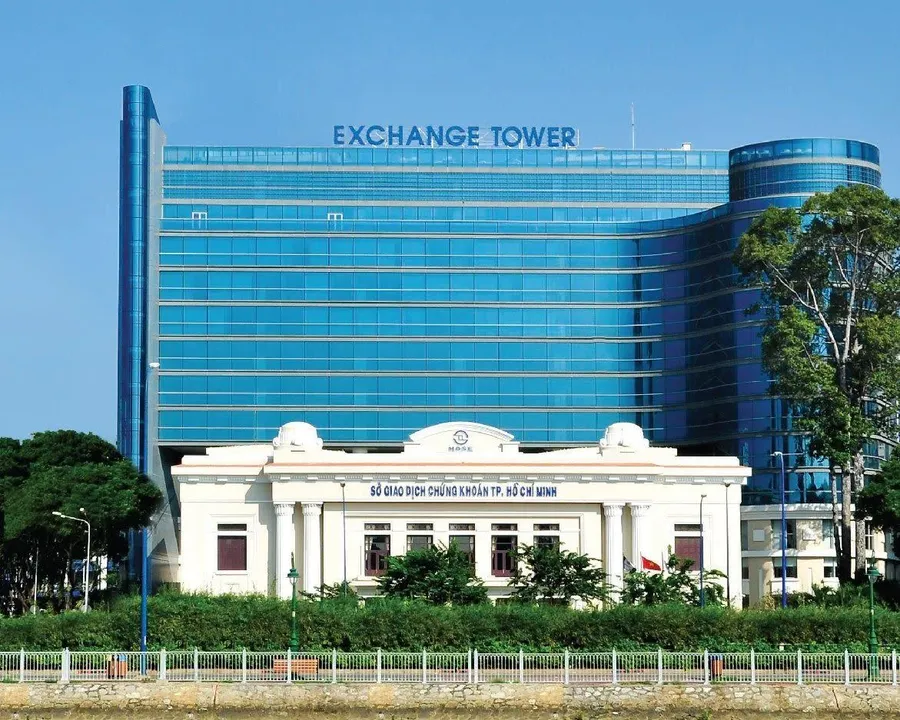
Where your order is matched. Orders for listed stocks are matched on HOSE or HNX, and the price in your app matches the exchange's public price board. The shares you own are held in custody at VSDC. On Mr Pips' sites, per the indictment, orders stopped at the operator's server.
Where your money sits. Money goes into a trading account in your name, through channels the brokerage itself publishes. The recipient is never an individual broker, an unfamiliar company, or an e-wallet link sent by a "specialist."
That gives a clear rule of thumb. An invitation to trade "international stocks" or forex sent to an individual in Vietnam, with a payment account in the name of a company that is neither a brokerage nor a bank, should be treated as outside the protection of the law, however professional the app looks. For those who have already deposited, the signal to watch is the asset-handling section of the first-instance verdict in the trial opening October 26.