
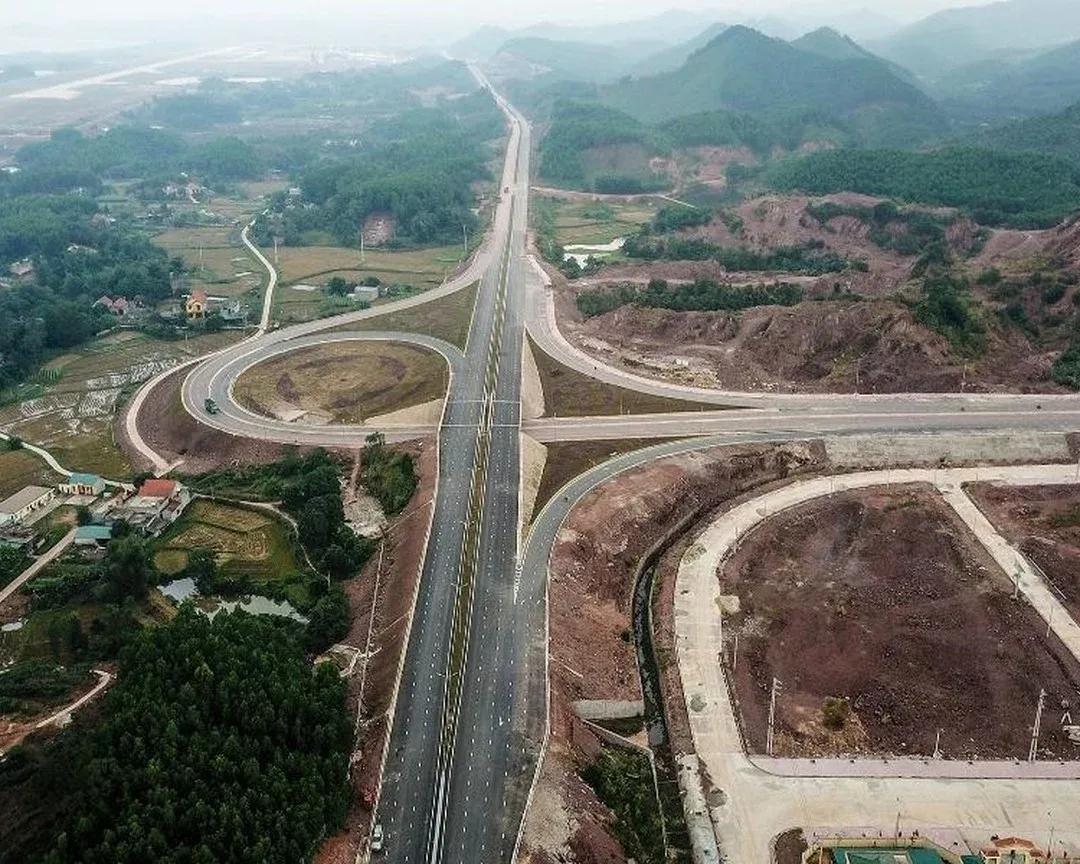

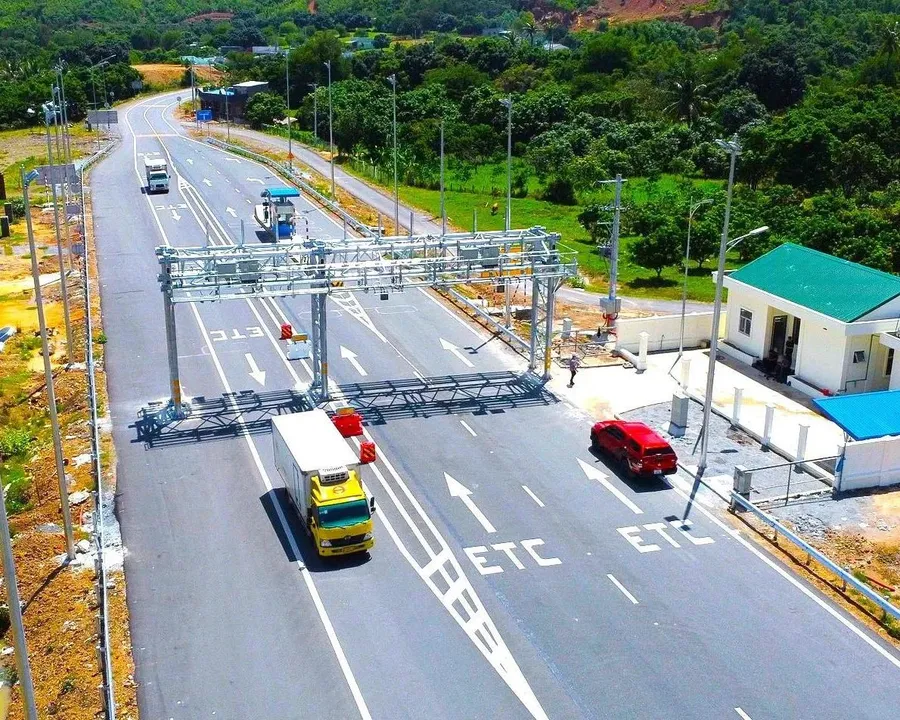
Toll collection on the Go Dau – Xa Mat expressway is planned to start in Q1 2029.VietnamMoi The money to build the road, however, has to go out starting now, and the share of Chuong Duong Joint Stock Company (HoSE: CDC) is being prepared through a convertible bond offering paying 10.4% a year. This piece walks through each layer of money behind the road, and stops at the layer CDC shareholders carry while no toll revenue has arrived.
What the board approved, and what it hasn't
According to news from October 8, Chuong Duong's board approved the terms of the BOT (build-operate-transfer) contract for component project 2 of phase 1 of the Go Dau – Xa Mat expressway.Vietstock The scope covers the main expressway and local access roads from Go Dau to Ninh Thanh ward in Tay Ninh province.VietnamMoi
The resolution authorizes Nguyen Ngoc Ben, Chairman of the Board of Chuong Duong Joint Stock Company (CDC), to keep negotiating, finalize the draft and handle signing procedures on the company's behalf, as a member of the CT32 Expressway Investment consortium. This is an approval of terms and a delegation of signing authority. The contract has not been signed, and the formal signing date will be the first marker of whether the project holds its schedule.
The CT32 consortium was selected as investor by the Tay Ninh People's Committee as of July 23. Chuong Duong leads it, alongside Tay Ninh Expressway Investment Co., Ltd., Bac Trung Nam Infrastructure Construction JSC and TERVIA Vietnam Co., Ltd.Fili
Layer one: what the State pays
The route runs more than 28 km, with four lanes and a 120 km/h design speed, linking the HCMC – Moc Bai expressway with provincial roads 799 and 781.VietnamMoi Preliminary total investment for phase 1 is VND 9,826 billion, excluding interest. State capital makes up 55%, or VND 5,404 billion, and investor capital the remaining VND 4,422 billion.Fili
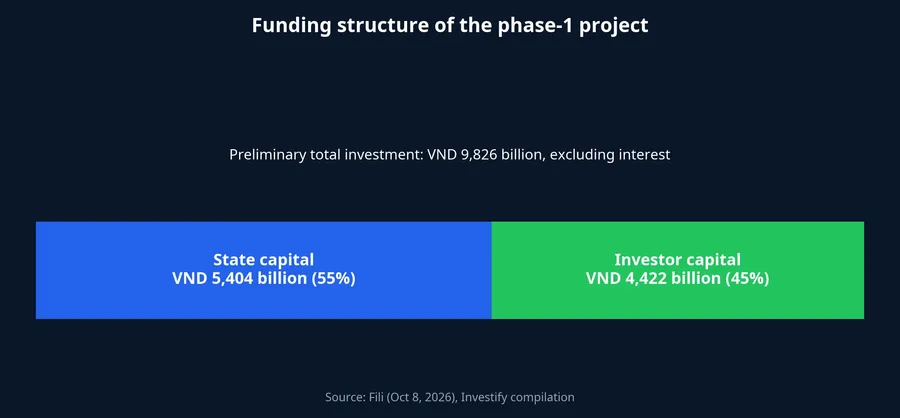
The VND 9,826 billion figure covers all of phase 1, which is split into two component projects: site clearance, and construction of the main route and access roads. Site clearance is handled by the Tay Ninh Land Fund Development Center, with more than 258 hectares expected to be reclaimed. The province aims to hand over all cleared land in December 2026. The CT32 consortium takes the second component.Fili
For a BOT investor the State's share has a clear meaning: more than half of the road's cost does not have to be recovered from tolls. Tolls only need to repay the capital the investor puts in.
Layer two: what the consortium must raise
Under the financing plan in the investor selection results, the consortium commits VND 680 billion of equity and says it can mobilize VND 4,422 billion of debt.VietnamMoi Together, total committed funding is VND 5,102 billion.Fili
A careful reader will notice that VND 4,422 billion appears twice with two meanings. In the total investment figure it is investor capital. In the financing plan it is the debt the consortium says it can raise. That is why total commitments of VND 5,102 billion exceed investor capital in the investment total. Available disclosures do not explain the gap. The investment total is explicitly stated to exclude interest, so construction-period interest may sit outside the VND 9,826 billion, but no source confirms that is the reason. This piece does not merge the two figures into one calculation.
What is firmer is the proportion: equity is the small part, debt the large part. That structure is common in BOT projects. The consequence is that future toll revenue must first service the banks' interest and principal, and only what remains reaches the project company's shareholders.
Layer three: what lands on Chuong Duong
Chuong Duong holds 31.7% of the CT32 consortium.VietnamMoi The project company's charter capital and the contribution schedule have not been disclosed, so the specific amount Chuong Duong must contribute cannot be calculated from available data. The company has lined up money along two tracks.
Convertible bonds. On September 16, shareholders approved an issue of VND 739 billion in convertible bonds. Of that, VND 700 billion is earmarked for the Go Dau – Xa Mat expressway and VND 39 billion for repaying bank debt.Doanh nhan Phap luat The shareholder consultation document, reported by the press in late August, describes the VND 700 billion as money for "business cooperation with the project company." That wording does not say whether the money will be booked as a capital contribution to CT32 or as a separate business cooperation contract.
The same document sets a 30-month term, a fixed 10.4% annual coupon, no collateral and no attached warrants. The bonds are offered to existing shareholders at a 100:7 ratio, meaning seven bonds with a VND 100,000 face value for every 100 shares held. Issuance is planned between Q4 2026 and Q2 2027, subject to regulatory approval.Báo Đầu tư Chứng khoán
Credit line. On September 18, the board approved a credit limit of up to VND 500 billion at Agribank's Thu Duc branch, comprising VND 400 billion in loans and VND 100 billion in guarantees and letters of credit, secured by several company assets in Ho Chi Minh City and Hanoi.Doanh nhan Phap luat The disclosure does not say the line is earmarked for the expressway. The press places it next to the project because the two decisions came at the same time.
Now set these against the company's size. According to the reviewed H1 2026 report, at June 30 Chuong Duong had total assets of VND 2,879 billion and total liabilities of VND 1,744 billion. Equity is therefore about VND 1,135 billion, and the VND 739 billion bond issue is roughly two-thirds of that. The company also just cut long-term debt sharply: long-term borrowings and finance lease liabilities fell from VND 734 billion at the start of the year to VND 19 billion, while short-term borrowings stand at VND 716 billion.Doanh nhan Phap luat The new bonds would put debt with a term of more than two years back on the balance sheet.
One question remains open. Chuong Duong is a construction contractor by trade, yet disclosures about the project mention only its role as an investor. Whether it will also win the construction work is not stated, and the two roles differ in cash flow: construction brings contracting revenue during 2026–2028, while an equity stake only pays back once the road earns tolls.
Layer four: how long until capital comes back
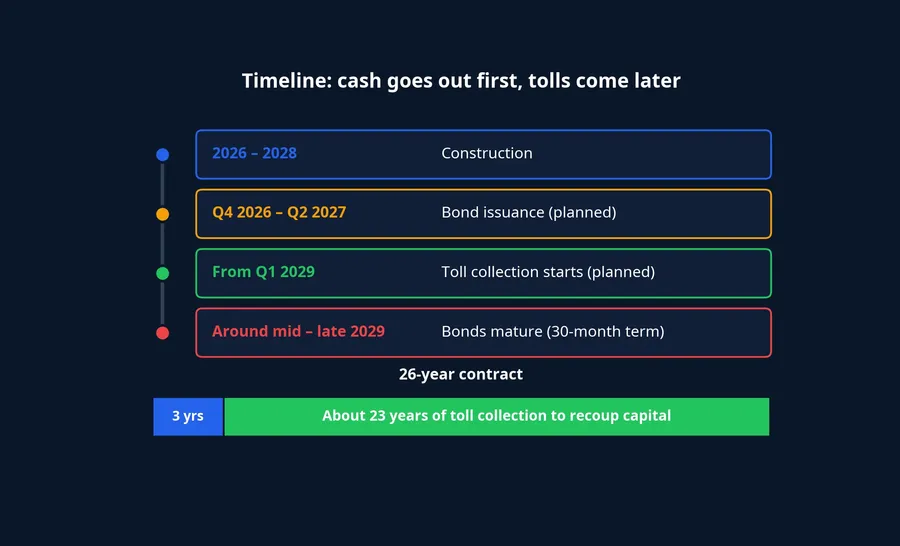
Under the plan, construction runs 2026–2028, with operations and toll collection from Q1 2029. The contract term is 26 years, of which about 23 years are planned for operating, running the business and collecting tolls to recoup capital.VietnamMoi
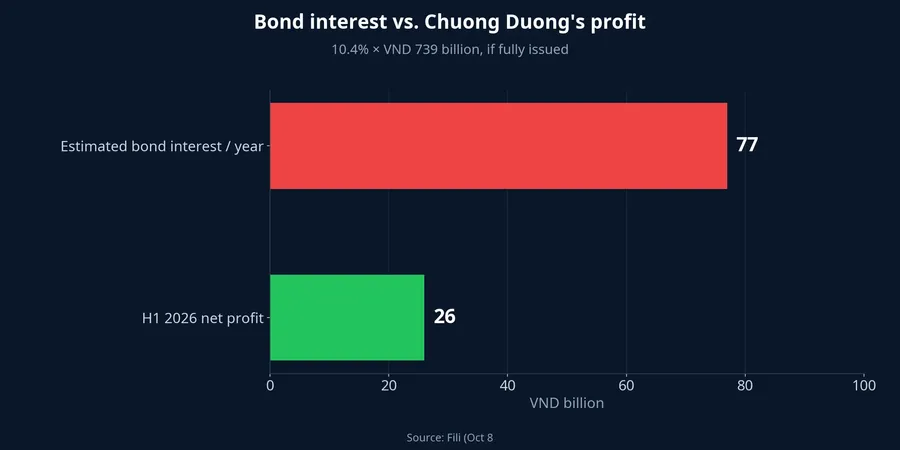
For Chuong Duong shareholders, the stretch that matters most is the first three years. If the bonds are fully issued, 10.4% a year on VND 739 billion works out to about VND 77 billion in interest annually. For comparison, the company's reviewed H1 2026 net profit was VND 26 billion.Doanh nhan Phap luat The two figures cover different periods (a year versus half a year), but they show the scale of the interest relative to current earning power. How the company will account for the interest, expensed directly or partly capitalized into the investment, has not been disclosed. Neither have the rate and term of the Agribank line, if it is drawn.
On the other side sits toll revenue that does not yet exist. If all goes to plan, it starts in Q1 2029 and flows first to the CT32 project company. It must service the project's debt, and only then is the remainder distributed to shareholders, Chuong Duong among them.
The bond schedule sits close to the toll start date. With a 30-month term and planned issuance between Q4 2026 and Q2 2027, the bonds would mature around mid to late 2029, only a few months after the planned toll start. They can then end in only two ways: converting into shares, or being repaid in cash. Cash repayment means Chuong Duong needs another source of funds, since first-year toll receipts will not have built up and belong first to the project company.
Dilution depends on a number that doesn't exist yet
According to the shareholder consultation document, the conversion price equals 75% of the average closing price of CDC shares over 30 consecutive sessions before the board approves the issuance.Báo Đầu tư Chứng khoán That date has not arrived, so the conversion price is not yet set.
The mechanism is clear. For the same VND 739 billion of bonds, the lower the conversion price, the more new shares are created, and Chuong Duong's profit is then divided across more shares. Because the price is set at 75% of the average market price, bondholders start with a built-in discount. If the share price when conversion becomes possible is not meaningfully below the price at the pricing date, converting will look more attractive than waiting to be repaid in cash. Since the bonds are offered to existing shareholders pro rata, a shareholder who buys their full allotment keeps their ownership percentage when the bonds convert. Those who don't see their stake shrink.
Our view on the company
The structure of the money behind the road is fairly clear. The State pays more than half. The consortium covers the rest, mostly with debt. Chuong Duong's share is being prepared mainly through bonds paying 10.4% a year that can convert into shares.
The consequence for CDC shareholders during 2026–2028 is that the company carries the cost of its capital contribution, including bond interest and possibly bank interest, with no toll revenue to offset it. When the bonds come due around 2029, that cost could turn into dilution if the bonds are converted into shares. This view would change only if later disclosures show Chuong Duong winning a construction share large enough for contracting revenue to cover its cost of capital, or if the VND 700 billion is structured to earn a return before the toll station opens.
Two milestones will fill in what is missing. The formal signing date of the BOT contract will show the real schedule and each consortium member's scope of work. The date the board approves the bond issuance will lock in the conversion price, from which the maximum number of new shares can be calculated.