
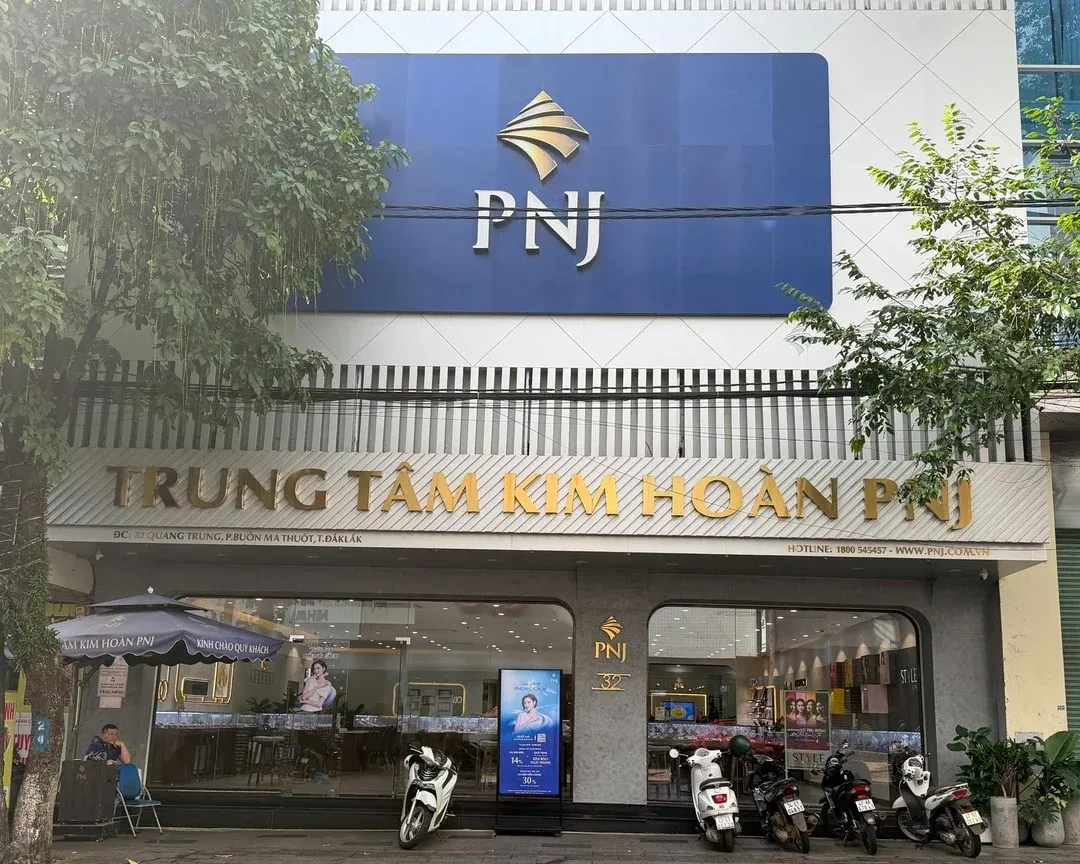

Funds linked to T. Rowe Price Associates sold nearly 5.5 million PNJ shares in the 2 October session, cutting their holding from 30.8 million shares (6.02%) to 25.3 million (4.95%) and dropping below the major-shareholder threshold.CafeF This is the same group that net bought almost 4.9 million shares in mid-August to push its stake above 6%. The disclosure reached the press on 7 October, the same session PNJ hit its floor price of VND 18,750 per share, the lowest since May 2017.CafeF
On the numbers, this trade is one link in a longer chain. Set against the flow of institutional money in and out of PNJ since July, it points to one thing: on-exchange buying by foreign funds has not produced a major shareholder willing to hold for long.
July: the diamond incident and the first outflow
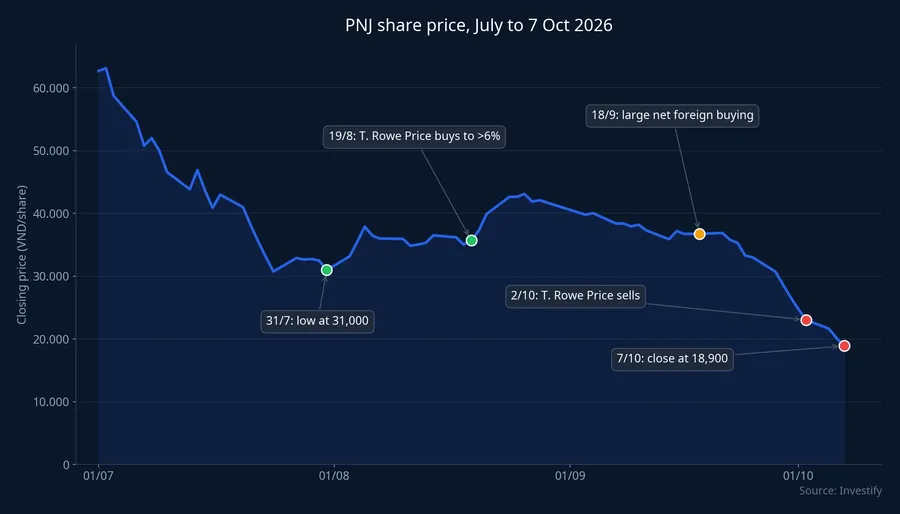
In early July, PNJ traded around VND 63,100 per share. A diamond incident at its subsidiary P-Lab sent a wave of customers back to sell their jewelry. According to disclosures at the end of July, PNJ bought back more than VND 7,060 billion of goods from customers in just the first 27 days of the month.CafeF
Institutions pulled out first: funds managed by Dragon Capital sold out of PNJ during this period. Across July, foreign investors net sold about VND 1,040.8 billion of PNJ shares, and the stock closed at VND 31,000 on 31 July.
August: foreign funds return to buy the low
From the end-of-July low, PNJ rebounded with three consecutive limit-up sessions in early August, then reached VND 43,100 on 26 August, about 39% above the 31 July close. Người Quan Sát described it as a recovery of nearly 40% after a six-year low.Người Quan Sát
Foreign capital came back on that same rebound. By 19 August, the T. Rowe Price group had bought almost 4.9 million more shares, lifting its stake above 6%.CafeF Together, the investors linked to T. Rowe Price and Sprucegrove Investment Management then held 56.63 million shares, or 11.06% of PNJ. On 14 August, the Vanguard International Value Fund added about 1.51 million shares, taking the Vanguard fund group's total to 5.04%.Người Quan Sát
Over all of August, foreign investors net bought about VND 523.2 billion. For anyone watching the price board at the time, it was an easy signal to read as "institutions are in, the price has support."
September: weaker numbers and the last big net buy
In September, the reviewed first-half financial statements showed profit after tax of only VND 729 billion, 38% below the self-prepared report. Foreign investors still posted a large net buy on 18 September, about VND 307 billion, yet the stock closed flat at VND 36,750 that day.CafeF
The turning point came at month-end. Documents for the extraordinary shareholder meeting set a 2026 profit-after-tax plan of roughly negative VND 6,270 billion after provisions for the trade-in policy, together with a private placement of up to 550 million shares, more than the roughly 511 million currently outstanding.CafeF PNJ fell to its floor price in consecutive sessions from 28 September, and according to Người Quan Sát, foreign investors turned net sellers from the 28 to 30 September sessions.Người Quan Sát
2 October: 10.6% of PNJ changes hands
After four floor-price sessions, the accumulated sell overhang was absorbed right at the open on 2 October.CafeF About 76 million shares traded over the session, nearly 15% of shares outstanding and the highest in the past 30 sessions by both volume and value. The price still closed at the floor of VND 23,050, down 6.87%.
Foreign investors sold 58.5 million shares and bought 4.2 million, a net sale of more than 54.3 million shares, equal to 10.6% of charter capital and worth over VND 1,300 billion. On the buying side, VNDirect data cited by Người Quan Sát shows 63% of matched volume came from active buy orders. At the floor price alone, 46.4 million shares changed hands, 76% of them active buys.Người Quan Sát Most of the shares sold by foreign investors moved to domestic buyers willing to pay the floor price.
T. Rowe Price was only one of several foreign institutions selling that day. Its roughly 5.5 million shares were about a tenth of the foreign net selling in the session. Before 2 October, foreign investors were estimated to hold more than 46% of PNJ.Người Quan Sát
7 October: the lowest floor price since 2017
In the 7 October session, PNJ touched the floor at VND 18,750 before closing at VND 18,900, down 6.20%, on about 51.3 million shares traded. Market capitalization fell to about VND 9,595 billion, nearly 48% below mid-September and about 77% below the late-January 2026 peak.CafeF
The 7 October drop should not be pinned on T. Rowe Price's trade alone. The group sold from 2 October and the sale was only disclosed on 7 October, while the price had been hitting the floor for days before that. The pressure also comes from the loss plan, from a placement larger than the entire share count, and from both foreign and some domestic investors selling at once. The available data does not allow the contribution of each cause to be separated.
What the trail says about the shareholder base
Lined up side by side, the milestones show a repeating pattern. In July, institutional money left. In August it came back and lifted expectations. At the end of September and in early October it left again, and faster than it had arrived. From 1 July to 6 October, foreign investors net sold a total of about VND 1,924.6 billion of PNJ shares, with the 2 October session alone accounting for about VND 1,270 billion. Each rebound drew bottom-fishing money, from retail investors to foreign funds, but after each one a lower price base was set.CafeF
There is a structural reason. A fund that buys on the exchange can sell on the exchange at any moment, so appearing on the major-shareholder list is not a commitment to hold. T. Rowe Price's August purchase was a decision made at a specific price with a specific set of information. Once the loss plan and the issuance proposal appeared, that information had changed.
A shareholder willing to hold long-term, if one appears, would come by a different route: the private placement of up to 550 million shares to professional securities investors. Shares bought in that placement face a transfer restriction of at least one year.CafeF The offer price cannot be below the average closing price of the 30 sessions before the board approves the price, nor below the book value per share in the latest audited or reviewed consolidated financial statements. Buyers in this route cannot exit within weeks the way funds have done with exchange-bought shares.
What remains unknown
The plan is still a proposal. The extraordinary shareholder meeting on 21 October will vote on whether to approve it. Even if it passes, the three facts that matter most to PNJ holders are still blank: who the investors are, the specific offer price, and how many shares are actually sold. The documents say only that the board will select professional securities investors by financial capacity, reputation and experience, and no list has been published.
So the trail of institutional money from July to now has answered one question: exchange-bought foreign fund money is not PNJ's long-term support. The other question, who the new long-term shareholders will be, can only be answered after 21 October, when the vote result is announced and the board names the investors and the offer price.