


At the Q3 2026 banking results press conference on the afternoon of October 7, State Bank of Vietnam (SBV) Deputy Governor Pham Thanh Ha said the average deposit rate on newly originated transactions stood at 6.38% a year as of September 20, up 1.15 percentage points from the end of 2025.Mekong ASEAN One line that came with the number deserves a careful read from savers and borrowers alike: "With these measures, the pace of interest rate increases is slowing and rates are broadly moving around a new baseline."VTV

The context matters. Since a meeting on April 9, 2026, the SBV has been working with commercial banks to push rates down.Người Quan Sát Six months later, deposit rates are still above where they started the year, and the result is described as rates rising more slowly, not rates falling. Why did deposit rates keep climbing, why are they settling around a new level, and what does that mean for your money through year-end?
What the 6.38% Figure Measures
Start with what the number is. The 6.38% is the average rate on newly originated deposits in the period, weighted by the amount actually deposited. It is not the posted rate of any single bank, and it is not the average across the entire existing deposit stock. Because it follows real transactions, it also captures large deposits that banks pay above their posted schedules through negotiated deals, a pattern FireAnt has described as a race over negotiated rates among banks short of funding.FireAnt
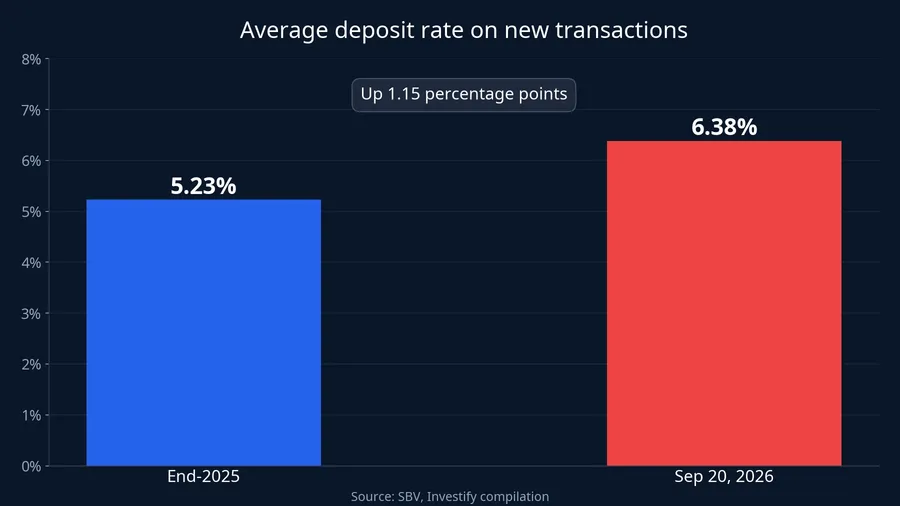
Subtracting the 1.15-point increase from 6.38% puts the end-2025 average at roughly 5.23% a year.Mekong ASEAN A new deposit today earns about a fifth more than it did at the start of the year.
The External Pull: Higher Global Rates and a Stronger Dollar
The deputy governor put external factors first: major central banks are wary of inflation returning, and some have raised rates. On September 16, the US Federal Reserve raised rates by 0.25 points to a 3.75%-4.00% range. The European Central Bank hiked for the second time this year on September 10. The Bank of Japan lifted its policy rate from 1% to 1.25% on September 18, the highest in 31 years.CafeF
He added that high rates and safe-haven demand have pushed the dollar sharply higher again, putting pressure on monetary policy in open emerging economies such as Vietnam.Mekong ASEAN When dollar, euro and yen rates all rise, holding dong becomes less attractive if dong rates stand still or fall, so the SBV has little room to let them drop quickly. The USD/VND rate closed at 26,002.5 on October 6, below the 26,300 recorded at end-2025, so the dong has not weakened against the dollar this year. That link is our own reading, not an SBV conclusion: exchange-rate stability may be paid for, in part, with higher dong interest rates.
The Domestic Pull: Credit Is Outrunning Deposits
The second push comes from loan demand. As of September 30, system-wide outstanding credit reached VND 20.75 quadrillion, up 11.59% from end-2025 and 16.69% year on year.Người Quan Sát The deputy governor said nine-month GDP is estimated to have grown 9.01%, the highest in 15 years, so the economy is hungry for capital.CafeF
Funding has not kept pace. Per Statistics Office data cited by FireAnt, as of September 28 credit institutions' deposit mobilization was up 9.78% from end of last year, while credit was up 10.89%.FireAnt When banks lend faster than deposits come in, they have to pay more to keep and attract funds. That is the shortest route from credit demand to savings rates.
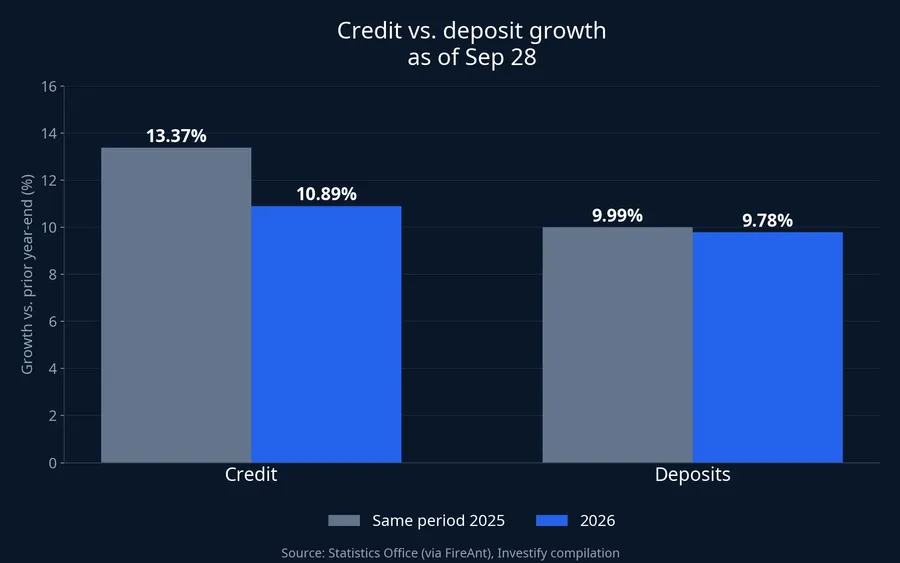
The gap alone does not explain everything, though. In the same period of 2025 the two growth rates were 13.37% and 9.99%, a wider gap than this year, yet deposit rates at end-2025 were still around 5.23%.FireAnt This year the gap is narrower but rates rose more. Domestic capital demand is a real driver, but the extra increase in 2026 is hard to separate from the rise in global rates. Some experts quoted by FireAnt also point to a long-running mismatch between short-term funding and long-term loans. The rise in deposit rates has several causes acting at once.
What the SBV Has Done, and Why It Has Only Slowed the Climb
According to the press conference, the SBV has used four groups of measures to stabilize rates:CafeF
- Holding policy rates steady, so credit institutions can draw low-cost funding from the SBV. It is also running open market operations flexibly to ensure liquidity, which helps interbank rates trend lower.
- Instructing banks to keep rates stable and to keep publishing lending rates online for customers to compare.
- Working directly with commercial banks, asking them to cut deposit rates on new transactions with terms of six months or more, as well as posted and lending rates. This request dates from the April 9 meeting and is not a new directive issued on October 7.
- Tasking regional SBV branches with meeting local bank branches and checking that rate cuts are being carried out.

What these tools share is that they slow the increase without changing the balance of supply and demand for funds. Injecting liquidity does not create more household deposits. Administrative requests make posted rates hard to raise, but competition can shift to negotiated rates off the schedule, which is exactly what a transaction-weighted average like 6.38% captures. As long as credit grows faster than deposits and global rates stay high, administrative measures mainly stop rates from rising further; they are not enough to pull them down.
What "a New Baseline" Means
The key word in the October 7 remarks is "around." In early April the stated goal was to bring rates down; by October the achievement is described as a slower pace of increase. That wording suggests the current high level is no longer presented as a short-lived funding squeeze that will soon pass, but as the baseline the market is operating around.
For savers, this is good news. Deposits maturing between now and year-end will likely be rolled over at rates near today's level, clearly above those at the start of the year. The deputy governor's remarks do not imply further increases, so the reasonable scenario is rates holding sideways at a high level rather than waiting for another leg up.
For borrowers and those planning to borrow, the picture is less bright. Lending rates tend to follow funding costs with a lag. With funding costs up 1.15 points and now treated as the baseline, the October 7 remarks give no sign that lending rates will return to early-year levels soon. Heavily indebted companies and homebuyers on floating rates feel it first, when their next repricing date arrives. Even the preferential credit package for small and medium enterprises launched in August is anchored to the general level: its rate is at least 1% a year below the lending bank's own average rate for the same term, so as the average rises, the concession rises with it.VTV
The Missing Data and What to Watch
One gap should be stated plainly: press reports of the October 7 briefing do not record an average lending rate on new transactions as of September 20. So it is not yet possible to know how far lending rates have followed deposit rates up.
Two data sources will answer that. The first is the average lending rate on new transactions that the SBV publishes next. If the increase from end-2025 approaches the 1.15 points seen in deposit rates, funding costs have largely passed through to borrowers. If it is clearly smaller, banks are absorbing part of it and their net interest margins will come under pressure in Q4 results. The second is the posted rate schedule of the state-owned commercial banks, which usually lead when the SBV wants to steer the baseline. If they hold or cut rates for terms of six months or more, the April request is working on the posted side. If they raise them, the "new baseline" may not be the stopping point.
Our conclusion: deposit rates have moved from a spike to a higher baseline, held there by both global rates and domestic capital demand. Savers are on the side of being paid more than at the start of the year. Borrowers have grounds to assume lending rates will not return to early-year levels until the next average lending rate figure shows otherwise.