
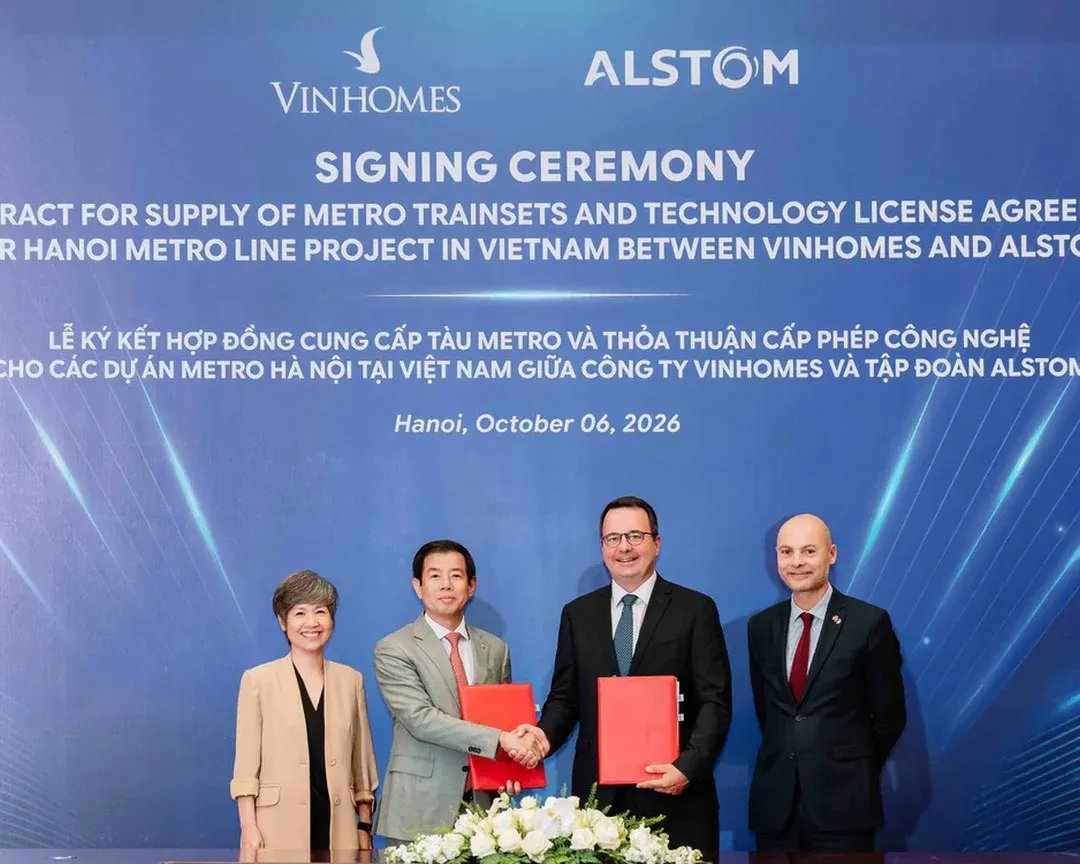

Hanoi's Nhon – Hanoi Station metro line currently runs on 10 trainsets supplied by Alstom.VnExpress On October 6, 2026, Vingroup, through Vinhomes, signed a contract with the same French group for 200 trainsets, 20 times the fleet of the first Alstom-built metro line in the capital.Media OutReach More than half of them, 117 trainsets, will be assembled by Vingroup in Vietnam.CafeF
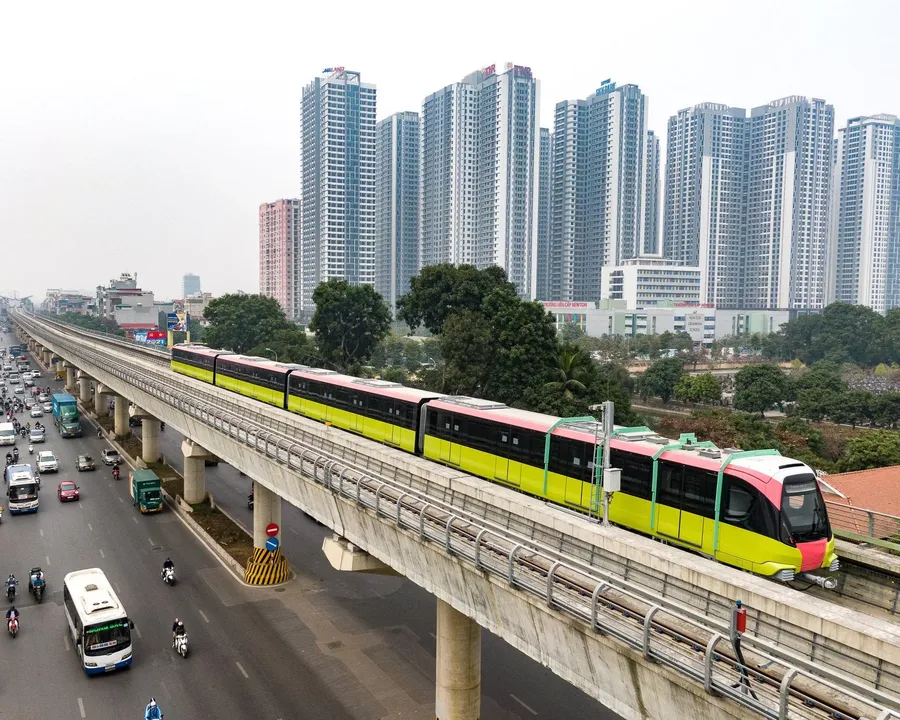
For anyone holding VIC shares, the contract deserves a close read because it takes the group into a new stage of the chain: not just laying track and building stations, but building the trains. Hanoi's target is to open the 5 lines in 2030, so this work will soon call for concrete capital and factory space. This piece covers what has been quantified, Vingroup's role in the Hanoi metro project, and the items nobody has disclosed yet.
What the October 6 contract contains
According to Vingroup's press release, the two sides signed a trainset supply contract and a technology licensing agreement.Media OutReach On the Vietnamese side, the signatory was Ms. Nguyen Thu Hang, CEO of Vinhomes JSC. For Alstom it was Mr. Yann Maixandeau, Managing Director for East Asia at Alstom. The ceremony took place at Vingroup's headquarters in Hanoi.
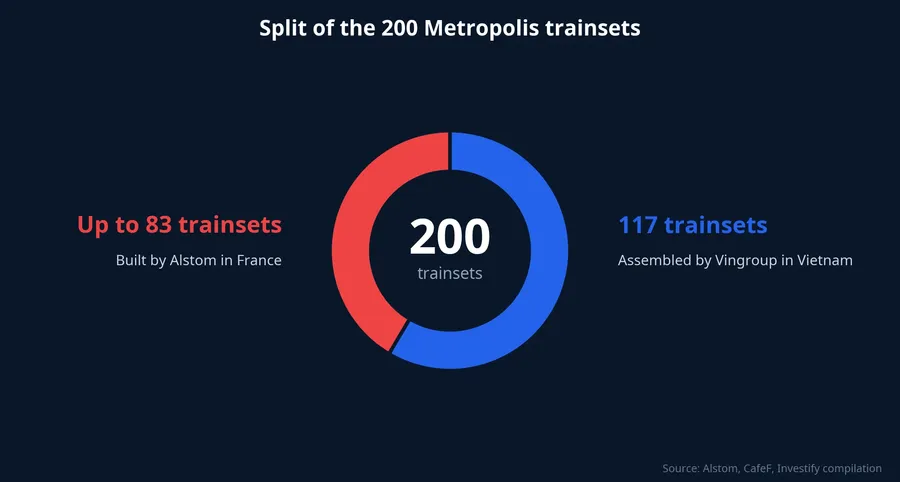
The entire fleet is the 5-car Metropolis, with aluminum-alloy bodies, running fully driverless at GoA4, the highest level of automation. Production is split in two. The first 83 trainsets are designed and built complete by Alstom at its Valenciennes Petite-Forêt site in France.CafeF Alstom's own release words this as "up to 83 trainsets". The remaining 117 are assembled by Vingroup in Vietnam, with Alstom providing technology, technical expertise, equipment support and core components.Alstom
The fleet serves the 5 Hanoi metro lines that Vingroup's companies are taking on, Lines 1, 2, 8, 10 and 14, totaling 303.5 km.VnExpress Looking further out, the capital's master plan envisions an urban rail network of 979 km across 18 lines by 2045.Alstom That is why Alstom calls Vietnam one of the fastest-growing transport markets in the world.
Mr. Nguyen Viet Quang, Vice Chairman and CEO of Vingroup, said in Alstom's release that the contract is a step in the group's strategy of making infrastructure a new pillar of the business.Alstom
Where Vingroup now sits in the rail chain
Set beside the high-speed train contract signed earlier, the Alstom deal shows Vingroup entering several parts of the rail industry at once, in roles that differ sharply on who pays.
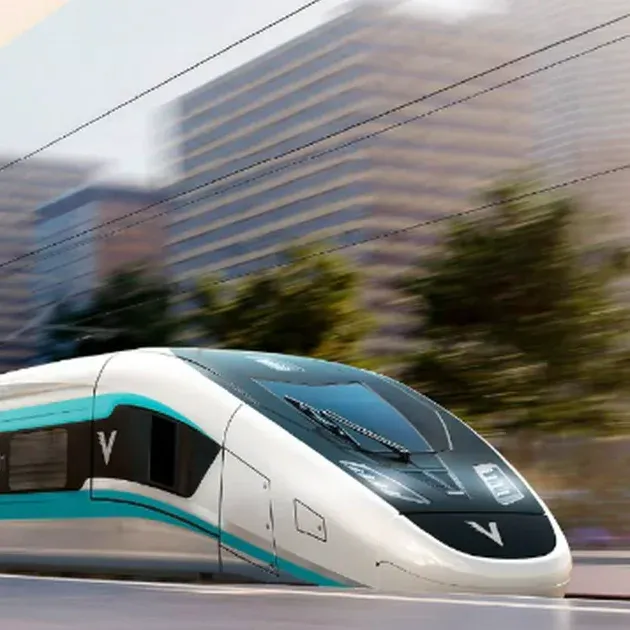
In high-speed rail, Vingroup is the investor. VinSpeed, a Vingroup subsidiary, is the investor in two lines: Hanoi – Quang Ninh at 120 km and Ben Thanh – Can Gio at 54 km.VnExpress VinSpeed has signed a turnkey contract worth up to €1 billion with Siemens Mobility.Người Quan Sát Siemens supplies 10 Velaro Novo trainsets running at up to 350 km/h, plus signaling, electrification and communications systems.CafeF VinSpeed handles project development, track and infrastructure. In this model, the money for the trains comes out of Vingroup's side.
In the Hanoi metro, Vingroup is the contractor. Vingroup's release says the group is the general contractor for Hanoi's metro projects through Vinhomes.Media OutReach The project owner is the city. In other words, the ultimate payer for the metro trains is the budget, and Vingroup buys the trains to deliver them to the works it has taken on.
The new piece is building the trains itself. This is what the Alstom contract adds. With 117 trainsets assembled domestically, Vingroup steps into heavy industry, which needs factories, production lines and a dedicated engineering team.
The train order runs ahead of the paying contract
In a footnote at the end of its release, Alstom says it books an order only once financing is finalized.Alstom So for Alstom, the 200 trainsets are not yet an official order on its books until the project's funding is arranged.
On the city's side, the contract that would pay for the 5 lines has not been signed either. According to Người Quan Sát, the Standing Committee of the Hanoi Party Committee issued Resolution 30-NQ/TU on October 5, 2026 on the policy of signing and making advance payments under turnkey contracts for the 5 lines. The resolution agrees that the city will keep considering the selection of a consortium of Vinhomes and SGC Investment and Construction JSC as a designated contractor, then negotiate and sign the contract. Total investment for the 5 lines is more than VND 1.3 quadrillion, with a target to begin operating in 2030.Người Quan Sát
On funding, the resolution agrees to prioritize enough capital for advance payments, including the city's 2026 budget. The city is also asked to review the remaining funding gap and propose that the central government consider support and advances. This points to two things. First, money for the metro fleet should in principle flow through the city's turnkey contract, not out of Vingroup's own pocket. Second, the funding scale has not been fully balanced, so the pace of advance payments will determine how much Vingroup must front itself.
One caveat: the VND 1.3 quadrillion figure is the project's total investment. It is not the consortium's contract value, and certainly not Vingroup's revenue. The value of the work the consortium receives has not been disclosed.
What has no number yet
None of the published sources state the following.
- The Alstom contract value. Neither Vingroup's nor Alstom's release gives this figure. The price per trainset is unknown, as is the amount of components Vingroup must buy back from Alstom for the 117 domestically assembled units.
- The assembly plant. Location, capacity, capital outlay and start-up date have not been disclosed. The 117/200 ratio is a share by trainset count, not a localization rate by value.
- Delivery schedule. There is no delivery timetable for the units built in France, while the target for operating the 5 lines is 2030.
- The turnkey contract with the city. Not signed, no value and no specific advance-payment terms.
Each gap maps to a different risk for VIC shareholders. The Alstom contract value shows how much Vingroup is committing to its supplier. The plant shows how much separate capital the train-building business needs. And the city's advance-payment terms show how long Vingroup must carry the funding before it is paid.
How VIC shareholders can read this contract
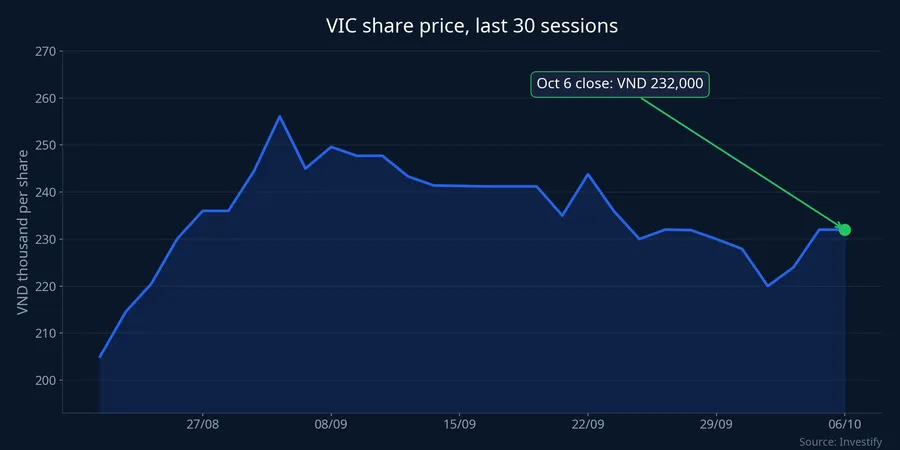
On October 6, VIC closed at VND 232,000 per share, unchanged from the previous session. There are a few ways to explain a flat price. The market may already have known that Vingroup is general contractor for the metro, since that role was mentioned before the signing date. Investors may also be waiting for a contract value before repricing. The available data cannot say which explanation is better, and a single session is too short to conclude anything.
What can be said with confidence is the direction of the group. In infrastructure, Vingroup is at once investor in high-speed trains, contractor on the metro, and now a train assembler. These three roles use capital in three different ways. High-speed rail uses the group's own capital and earns through long-term operation. The metro uses budget funds but depends on the rhythm of advance payments. The assembly plant needs upfront capital and earns revenue only when orders are delivered.
So the most important signal to watch is the date Hanoi signs the turnkey contract with the consortium, along with the contract value and the advance-payment level. If the advance is large enough to cover most of the train purchase, the Alstom order is mainly budget money passing through a contractor's hands. If the advance is small, Vingroup will have to front a substantial sum for the fleet, on top of the capital to build the plant, and that is the part that will show up on the group's balance sheet.