


On the morning of October 7, anyone holding GMD shares will open their trading app and see a reference price roughly a third lower than the day before. The number of shares in the account stays the same, and the bonus shares that make up the difference have not arrived yet. Put simply, you are just as wealthy as yesterday; the wealth is sitting in two places instead of one. This piece walks through each date of the bonus issue so you know what to expect on screen.
What the bonus issue involves
According to Gemadept's September 29 announcement, the company will issue more than 216.4 million bonus shares at a 2:1 ratio: for every 2 shares held, shareholders receive 1 new share. The total at par value is nearly VND 2,164.5 billion, drawn from share premium in the audited 2025 standalone financial statements.CafeF Each shareholder's entitlement is rounded down to a whole number and any fraction is cancelled. Bonus shares carry no transfer restrictions.
Earlier, on September 28, Đầu tư Chứng khoán reported that Gemadept had received a letter from the State Securities Commission on its issuance filing, in which the regulator asked the company to disclose information and carry out the issue.Đầu tư Chứng khoán If completed, charter capital rises from nearly VND 4,329 billion to nearly VND 6,493.4 billion. At a par value of VND 10,000, shares outstanding go from about 432.9 million to about 649.3 million.
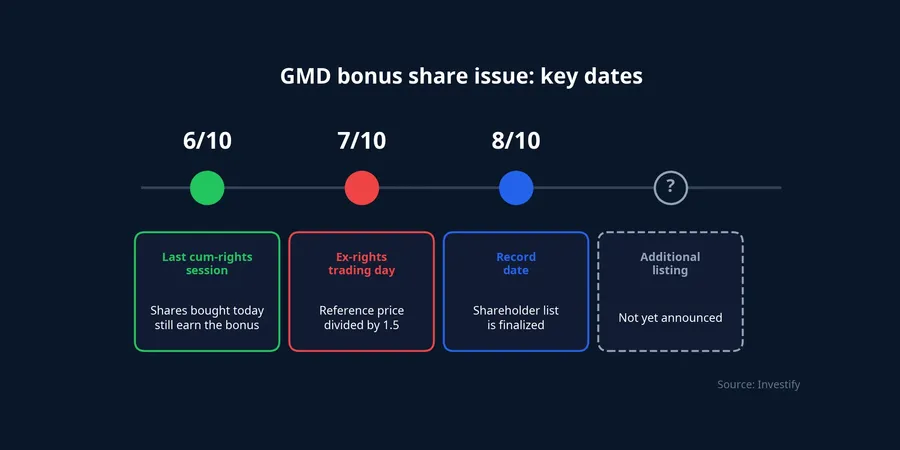
First date: October 6 is the last session in which buyers still get the bonus
The record date is October 8 and the ex-rights trading day is October 7, according to the October 5–9 dividend and rights calendar compiled by Nhân Dân.Nhân Dân The two dates differ because shares bought on the exchange take two business days to settle into the buyer's name. A purchase matched on October 6 settles on October 8, in time to make the list. A purchase matched on October 7 settles on October 9, after the record date, so the buyer misses the bonus.
The reverse also holds. Anyone who sells GMD on October 7 still receives bonus shares for the shares just sold, because on October 8 those shares had not yet left their name.
Second date: October 7, the reference price is divided by 1.5
Bonus shares are issued at zero price, so the reference-price adjustment reduces to one step: the October 6 closing price divided by 1.5. The price on the board falls by about a third purely because of this arithmetic, not because anyone is dumping the stock.
Take the latest close with data, October 5, when GMD stood at VND 77,800. If October 6 closes at the same level, the October 7 reference price would be about VND 51,870 before the exchange rounds to its price step. The real figure depends on the October 6 close.
An account holding 1,000 GMD shares at the end of October 6, at that example price, is worth about VND 77.8 million. On the morning of October 7, the shares already held show only about VND 51.9 million. The remaining VND 25.9 million sits in the 500 bonus shares the account will receive. Add them up and 1,500 shares at the adjusted price still come to about VND 77.8 million. Total value is unchanged at the moment of adjustment; only the form changes, from a higher price to more shares.
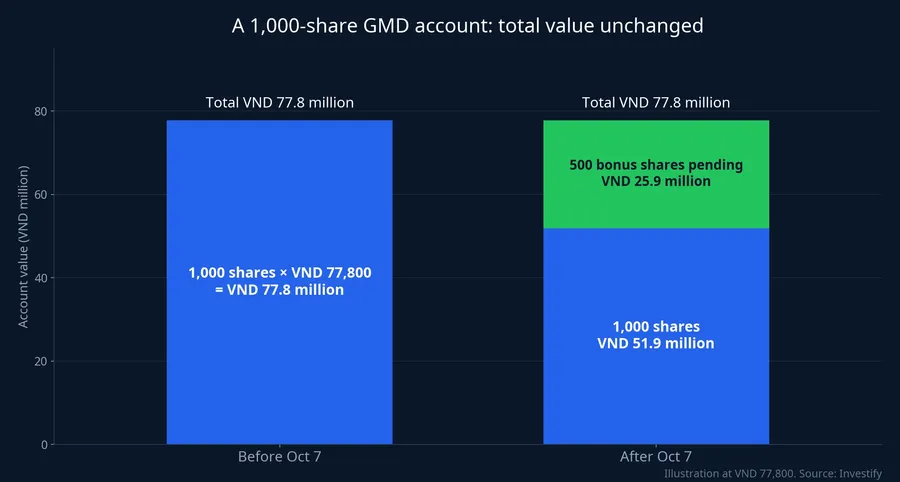
At many brokerages, during this waiting period the bonus shares typically appear under "pending rights" or "pending securities" and are not yet counted in sellable shares. Newer investors can glance at the profit-and-loss figure in the app and think they just lost a third. The right way to read it is to add the pending portion back before comparing with the previous day.
Cancelled fractions: the only real loss
The reference price is divided by 1.5 for every share, but bonus shares are paid out only in whole numbers. Holders of odd lots therefore bear a small but real loss.
Take an account holding 333 shares. At 2:1 it is entitled to 166.5 bonus shares, rounded down to 166, and the 0.5 share is cancelled under Gemadept's announcement. At the example price of VND 77,800, the account held about VND 25.91 million before the split. Afterwards, 499 shares at about VND 51,870 come to about VND 25.88 million. Roughly VND 25,900, half a share at the new price, disappears.
For a single account the amount is small. What matters is that the fraction is not compensated in cash. You can check whether your share count is divisible by 2.
Third date: when the bonus shares arrive and become sellable
As of writing, Gemadept has not announced the date the bonus shares reach accounts or the date of additional listing on HoSE. According to Đầu tư Chứng khoán, the issue is expected to be carried out in September and October 2026.Đầu tư Chứng khoán After the record date, the company must still report the issuance results, register the new shares with the depository and list them on the exchange. Only once the bonus shares are listed and tradable can holders sell them.
In the meantime, holders can sell their existing shares as usual, just at the adjusted price. Anyone who sells all their old shares during the wait keeps the right to the bonus shares, because that right was fixed on October 8.
Why Gemadept receives no new money
Share premium is the money investors paid above par value in the company's earlier share issues. That cash entered the company long ago and already sits in shareholders' equity. The bonus issue simply moves about VND 2,164.5 billion from the share premium line to the charter capital line on the balance sheet. Total equity is unchanged, the company's cash is unchanged, and shareholders pay nothing extra.
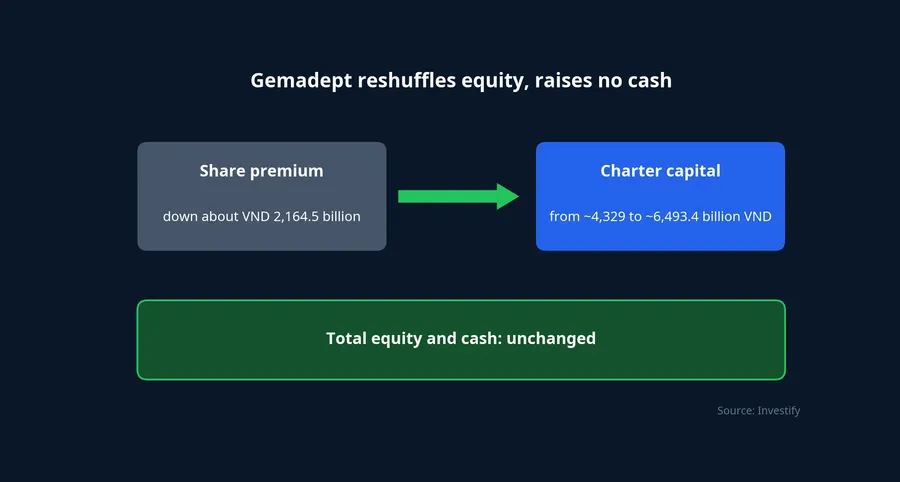
Compare this with the most recent issue. Ending July 31, 2026, Gemadept distributed nearly 6.4 million shares to employees at VND 10,000 each, raising nearly VND 64 billion for working capital.CafeF The bonus issue is more than 30 times as many shares, yet brings in no cash at all.
Because every shareholder receives exactly 50% more shares than they hold, each person's ownership percentage stays the same. Apart from cancelled fractions, someone holding 1% of Gemadept before the bonus still holds about 1% afterwards.
Per-share profit will shrink
The clearest change on the reports is in per-share metrics. In the first half of 2026, according to the reviewed consolidated financial statements, Gemadept posted net revenue of nearly VND 3,214 billion, up 16% year on year, and profit after tax of VND 1,938.61 billion, up 71.3%.Đầu tư Chứng khoán
Dividing that profit simply by the roughly 432.9 million current shares gives about VND 4,478 per share. Dividing by the roughly 649.3 million shares after the bonus gives about VND 2,986, exactly a third lower. This is an illustrative calculation on total profit after tax; it does not strip out minority interests and does not use weighted-average shares as official EPS does. Still, the direction is the same: total profit is unchanged and the number of shares splitting it grows.
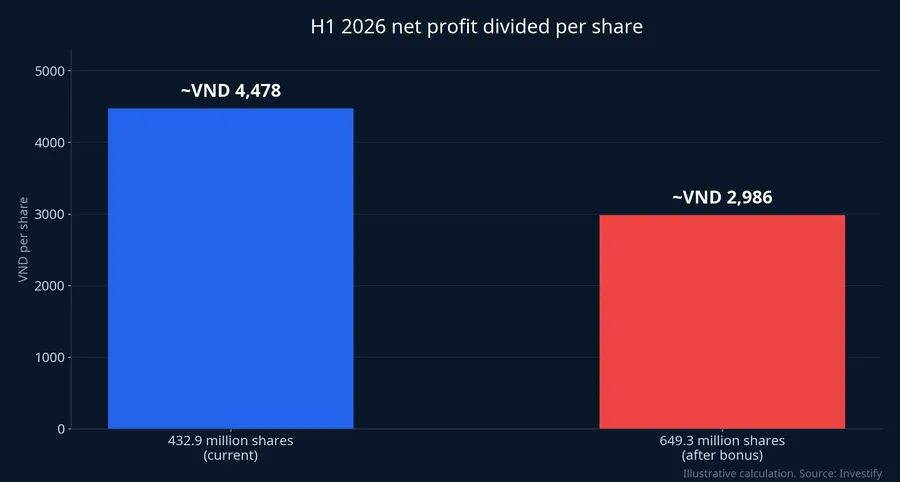
For anyone following GMD, EPS in reports after the bonus will look much lower than in earlier periods, so past figures need restating for the new share count when comparing across years. The P/E ratio is unchanged at the moment of the split, since the price and per-share profit both fall by a third.
What GMD holders should check
First, see whether the number of shares you hold at the October 6 session is divisible by 2, to know whether a fraction will be cancelled. From the morning of October 7, read your account by adding the pending bonus shares to the shares already held, rather than looking at the price on the board alone. After October 8, watch for announcements from Gemadept and HoSE on the additional listing date, since that is when the bonus shares become sellable.
The bonus issue does not change Gemadept's value and brings no new money into the company. It splits the same ownership and the same profit across more shares. What determines GMD's real value is still business performance in the coming quarters.