
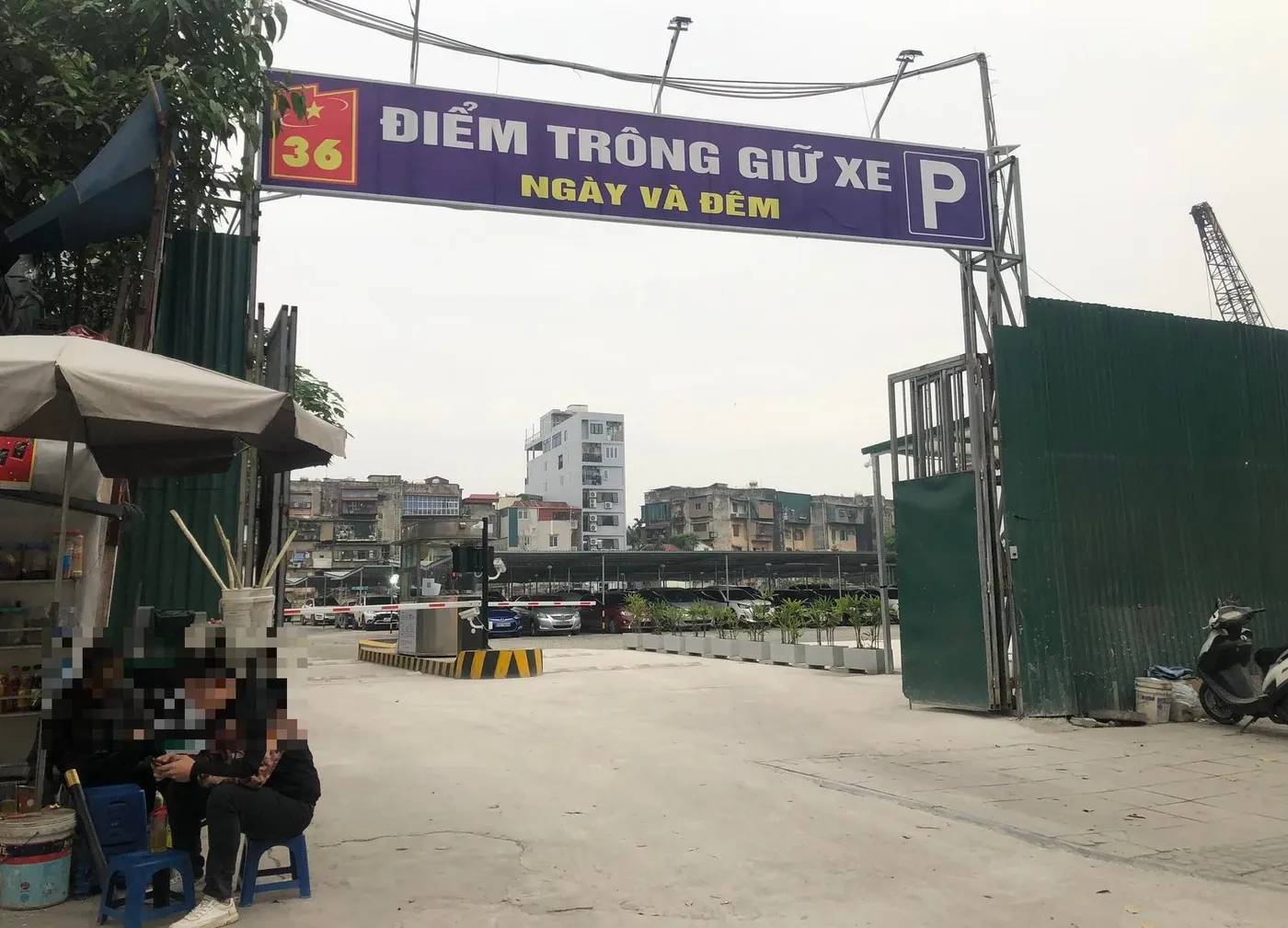

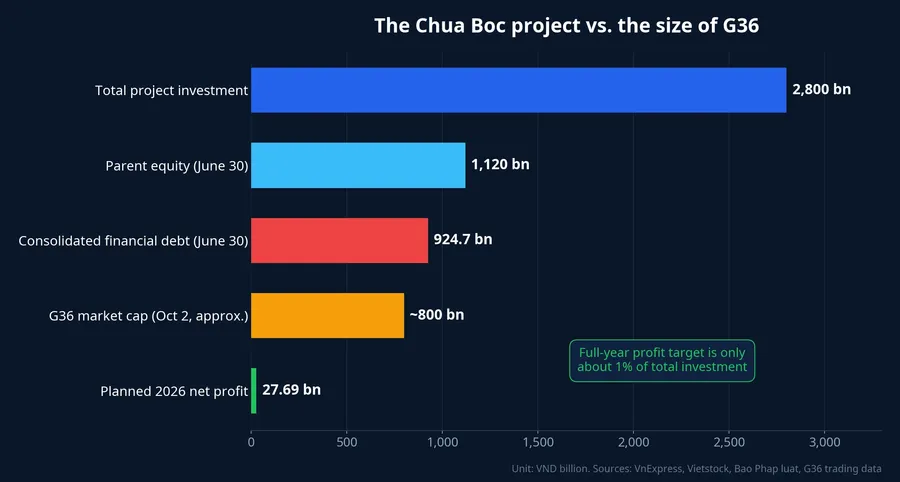
The high-rise housing project at 6-8 Chua Boc carries a total investment of about VND 2,800 billion.VnExpress Its developer, Corporation 36 (G36), is targeting net profit of just VND 27.69 billion for the whole of 2026.Bao Phap luat Put side by side, the project is roughly 100 times the profit the company itself expects to earn this year.
That ratio tells you what Chua Boc means to G36: it is both the company's largest asset and its largest funding need. The decision signed on September 30 settles the land paperwork. What it leaves open is the part that matters most to shareholders: how much G36 will have to pay in land-use fees. That figure has not been calculated yet.
Decision 5397 splits the site into three parts
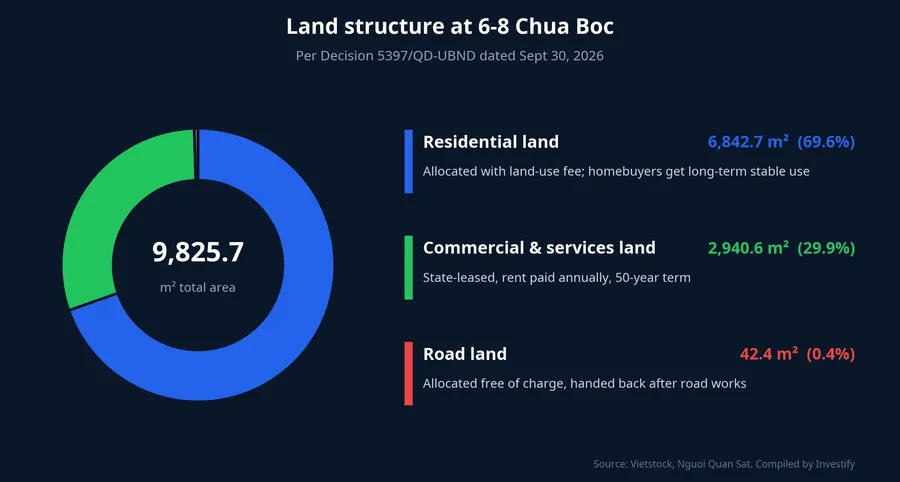
Under Decision 5397/QD-UBND dated September 30, 2026, signed by Bui Duy Cuong, Vice Chairman of the Hanoi People's Committee, G36 may convert 9,825.7 m² of land at 6-8 Chua Boc Street, Kim Lien Ward, into a high-rise residential project with commercial and service space.Bao Phap luat The notable detail is that the site is not granted under a single arrangement. Each part comes with a different financial obligation, and those differences shape G36's cash outflows.
The largest part is 6,842.7 m² of residential land, allocated by the State with a land-use fee.Vietstock G36 may use it for 50 years from the date of the decision, while homebuyers who receive land-use rights with their apartments get long-term, stable use.Nguoi Quan Sat For anyone weighing an apartment purchase in the area, this is the most important line in the document.
The commercial and services plot covers 2,940.6 m² and is earmarked for offices, a hotel and retail. It is leased from the State with rent paid annually over a 50-year term.Vietstock So G36 pays for this portion year by year rather than upfront. The remaining 42.4 m² or so falls within the road boundary and is allocated free of charge for road works, then handed back to the local authority.Nguoi Quan Sat
The decision states that the land prices used to calculate the land-use fee and the land rent will be "determined under current regulations." G36 must work with Hanoi's Department of Agriculture and Environment, Department of Finance and tax authority to complete the land procedures and financial obligations.Vietstock In other words, the September 30 document tells G36 which charges it owes, not how much.
A decade from the ASEAN Hotel site to a housing project
The site sits between Ring Road 1 and Ring Road 2. It previously belonged to Military Commercial Joint Stock Bank (MB) and housed the ASEAN Hotel. On July 8, 2016, MB transferred the land-use rights and the assets on the land to G36. The original approval was for a 21-storey commercial, office and hotel complex. Under G36, the project was redesigned as high-rise housing with commercial space: 24 floors above ground, four basements and a maximum building density of 45%.Vietstock
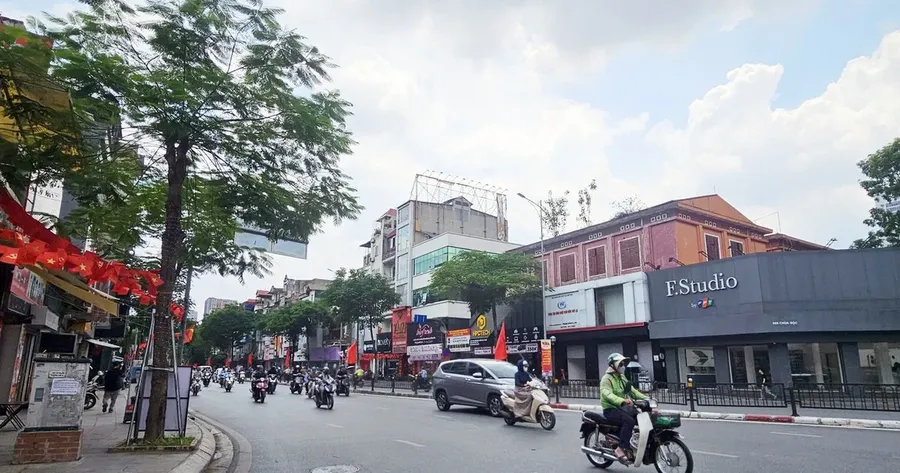
The switch from hotel and offices to housing is the most important business change. Apartments can be sold for cash, while a hotel takes years of operation to pay back. For a company of G36's size, that difference in how fast money comes back matters a great deal.
The project's price tag has also moved. In June 2023, when G36 approved the project with partner Truong Loc Construction and Trading, total capital was announced at about VND 1,868 billion, with the investor's own capital accounting for 20%.Tin nhanh Chung khoan By the 2025 annual report, the total investment had risen to about VND 2,800 billion, with completion scheduled for Q4 2029.VnExpress Public sources have not explained where the additional VND 930 billion or so comes from, and G36 has not disclosed a funding structure matching the new figure.
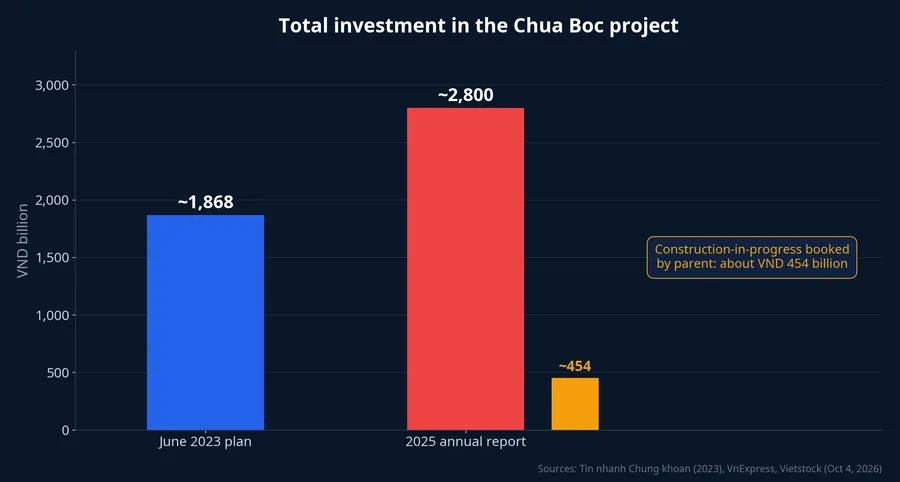
The most recent legal milestone before September 30 was Decision 26/QD-UBND of January 6, 2026, which approved the investment policy and named G36 as investor. The project runs under a 2017 investment cooperation contract with Truong Loc, An Phu Company and VCapital. So far, the G36 parent has booked about VND 454 billion in construction-in-progress for the project, less than one-sixth of the total investment.Vietstock
G36's financial capacity next to the project
G36 began as a construction unit of the Ministry of National Defence and has built major works such as Terminal T1 at Noi Bai Airport and the CT36 Tower, Metropolitan and B6 Giang Vo apartment buildings. The company itself calls Chua Boc its flagship real estate project, marking its shift from contractor to developer. Its latest results, however, show a business that is still small relative to that ambition.
Consolidated revenue for the first half of 2026 came in at VND 441.1 billion, down 45.9% year on year. First-half net profit was VND 18.76 billion, down 21.2%, or 67.7% of the full-year target. In Q2 2026 alone, net profit fell to VND 2.89 billion, down 48.9% from Q2 2025.Bao Phap luat Progress against the profit target looks respectable, but the full-year revenue plan is VND 1,875.2 billion. Six months in, revenue has covered less than a quarter of the way.
On debt, G36's consolidated financial borrowings stood at VND 924.7 billion at the end of Q2 2026, equal to 84.4% of equity, including VND 510.6 billion of short-term loans. Bao Phap luat also reported that G36 signed a one-month loan of VND 252 billion at 9.4% a year from the younger brother of Nguyen Dang Giap, Chairman of the Board of Corporation 36, to fund business operations.Bao Phap luat A short-term loan from a related party suggests the company already needs cash for day-to-day operations, before the project even enters the picture.
At the parent level, the reviewed separate interim financial statements show equity of VND 1,120 billion and financial borrowings of VND 621 billion, down nearly 35% from the start of the year.Vietstock That makes the roughly VND 2,800 billion total investment about 2.5 times the parent's equity.
The market also values G36 far below the scale of the project. On October 2, G36 shares closed at VND 7,700, for a market capitalization of about VND 800 billion. Total project capital is therefore about 3.5 times the value of the entire listed company. The share price held flat at VND 7,700 from September 29 through October 2. That says little about how the market will react, though, because the decision only reached the press on Sunday, October 4. The October 5 session is the first in which the news is public.
Why the land-use fee is the deciding number
For the 6,842.7 m² of residential land, G36 must pay the land-use fee in one lump sum. The amount depends on the specific land price the competent authority sets for the project, and only payments made before the authority accepted a complete dossier can be deducted. No public source has yet given a specific land price or the amount G36 owes. This article does not attempt an estimate either, because a figure not based on an official land price is easily mistaken for the real one.
What can be said with confidence is that if the fee runs into the hundreds of billions of dong, it will exceed what G36 can fund on its own. Planned profit for the year is only a few tens of billions, and the parent's equity of about VND 1,120 billion already carries debt. The money will therefore have to come from new borrowing, from the investment cooperation partners, or from buyer deposits once the project qualifies for sales. G36 has not yet announced which of these routes it will take to fund a project of about VND 2,800 billion.
There is another way to read the story. Given its central location, the site can be seen as worth far more than G36's current market capitalization, with the September 30 decision as the step that unlocks that value. The argument has merit, since residential land inside Ring Road 2 is scarce. But the land's value only turns into cash for shareholders once the project clears the land fee, the building permit, construction and sales, in that order. Every one of those steps needs capital before any revenue arrives.
Signals to watch
The conclusion here is straightforward: the September 30 decision is real legal progress, but it is not enough to judge what the project will deliver for shareholders. The document that will answer the biggest question is the financial obligation notice Hanoi's tax authority issues once the specific land price is set. When that number appears, the simplest test is to set it against the parent's equity of about VND 1,120 billion and its existing debt.
If the land fee lands in the low hundreds of billions and G36 announces a matching funding source, the project has a reasonably clear path to its Q4 2029 completion target. If the fee approaches most of the parent's equity, G36 will likely need to borrow more or raise capital. In that case, existing shareholders would face pressure from interest costs or dilution well before the project generates revenue.
For prospective apartment buyers, what is settled after September 30 is that units on the residential land come with long-term, stable land use. What remains pending is the building permit and the point at which the project qualifies to sell off-plan homes.