

From Friday, October 9, shares of Viet Phat Import Export Trading Investment JSC (VPG) will carry the "controlled" flag on the HoSE price board. The exchange's reason is brief: the company's reviewed half-year 2026 financial statements are more than 30 days overdue.CafeF In the same batch, HoSE moved two other tickers, PLP (Pha Le Plastics) and DRH (DRH Holdings), to controlled status for the same reason and with the same effective date.
Most VPG holders will want to know one thing: what changes in my account on October 9? The short answer is almost nothing. The risk sits elsewhere: in a 15-day clock that keeps ticking, in an exit condition that many investors misread, and in more than VND 2,000 billion of receivables that the company itself names as the reason its report is stuck.
Controlled status is not the first blow
VPG did not jump straight from normal trading into controlled status. Before the late half-year report, the stock was already on the warning list for two other reasons. First, the auditor issued a qualified opinion on the 2025 financial statements. Second, retained earnings on the audited 2025 consolidated statements were negative.Người Đưa Tin
The biggest practical hit to shareholders came then. Under a notice dated July 2, 2026, VPG was placed on the list of securities ineligible for margin trading because it was under warning. Since early July, anyone holding VPG has been unable to pledge it as collateral for margin loans.
Then the deadline for the reviewed half-year report passed without a filing. HoSE sent a first reminder on September 4 and a second on September 11.Vietstock The reminders went unanswered, so once the delay passed 15 days, VPG was put under warning once more, effective September 23, 2026.Tin nhanh Chứng khoán
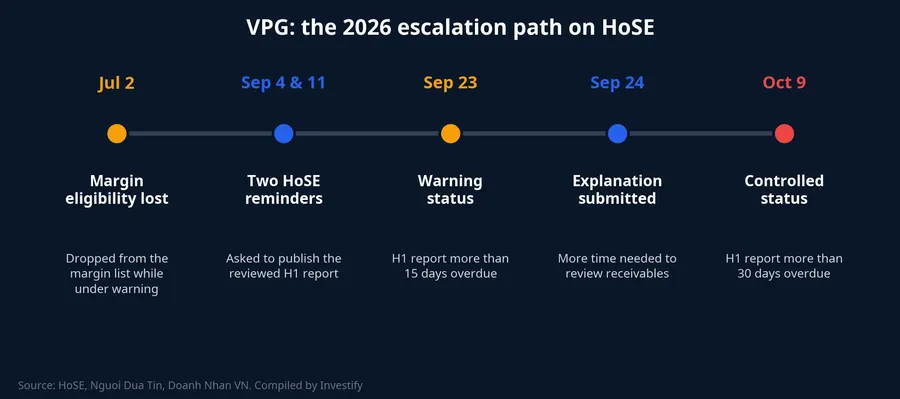
On September 24, Viet Phat sent an explanation to the State Securities Commission and HoSE. The company said the review was taking longer than expected because it needed more time to examine, explain and finalize documentation on certain receivables and payables. It promised to publish as soon as the report is issued, but gave no date.Người Đưa Tin
On October 9, the account barely changes
HoSE issued the decisions on October 2, moving VPG, PLP and DRH from warning to controlled status, all effective October 9. The legal basis is point g, clause 1, Article 41 of the listing rules: a report more than 30 days late.Doanh Nhân VN When the decision was announced, VPG traded at VND 1,370 per share, for a market capitalization of about VND 121.1 billion. The other two stocks were at VND 1,500 (DRH) and VND 3,490 (PLP).Doanh Nhân VN
Article 41 sets no special trading hours or matching method for controlled stocks. The exchange displays the controlled flag and discloses the status to the market.HoSE Margin eligibility on VPG was already gone in July. Looking at October 9 alone, a VPG holder will not see any difference in their account.
That apparent calm is exactly what invites complacency. The real changes are two obligations and a clock. Within 15 days of entering controlled status, Viet Phat must submit to HoSE and publish its remedial measures and timeline (clause 3, Article 41). If it fails to explain itself and present a remedy within the deadline the exchange sets, the stock may be temporarily halted under point c, clause 1, Article 43. The clock is the number of days the report is overdue, and it is still running.
The receivables behind the stuck report
The phrase "reviewing certain receivables and payables" makes more sense next to Viet Phat's own numbers. According to its self-prepared, unreviewed statements, net revenue for the first half of 2026 fell to VND 191.62 billion, down about 97.9% from VND 8,994.87 billion a year earlier. The company posted a first-half net loss of VND 65.96 billion, against a profit in the same period of 2025.
In the second quarter alone, consolidated net revenue was only about VND 386 million, down 99% year on year. Thermal coal, coking coal and ore generated almost no sales. The company lost VND 34.07 billion after tax in the quarter, compared with a VND 26.3 billion profit in Q2 2025.Người Đưa Tin In other words, nearly all first-half revenue came from Q1.
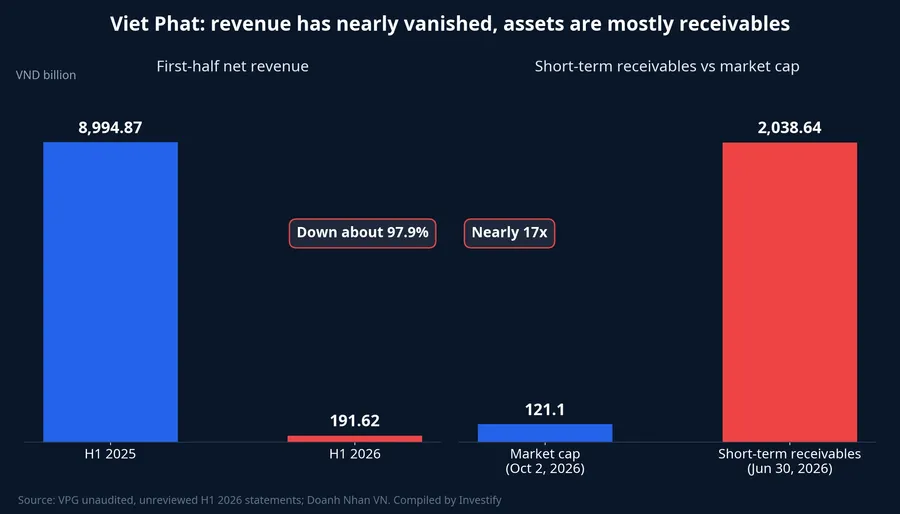
Viet Phat itself blames the Q2 loss on collections. According to the company, customer payments came in slower than planned, which delayed repayments on bank loans, so financing costs did not fall in line with revenue. As of June 30, 2026, short-term receivables still stood at VND 2,038.64 billion. That is nearly 17 times the company's market capitalization of about VND 121.1 billion.
What the self-prepared statements cannot tell you is how much of that VND 2,000-plus billion will actually be collected. When a company has almost stopped selling and its assets are mostly money owed to it, the auditor's questions are specific: which balances are recoverable, and which need provisions. Every additional provision deepens the loss. That is the most plausible explanation for why the review is stuck on receivables, and it is also the reason the company itself gives.
Other explanations deserve a hearing. Late half-year reports are not unique to Viet Phat this season. Besides PLP and DRH in the same batch, HoSE also moved Truong Thanh Wood's TTF to controlled status from October 7 for failing to file its reviewed half-year report.Vietstock Part of the delay may stem from audit-firm capacity, or from the senior management changes Viet Phat itself cited when explaining the revenue collapse. Even so, the public record so far points to only one concrete cause: the receivables.
A ladder with a schedule
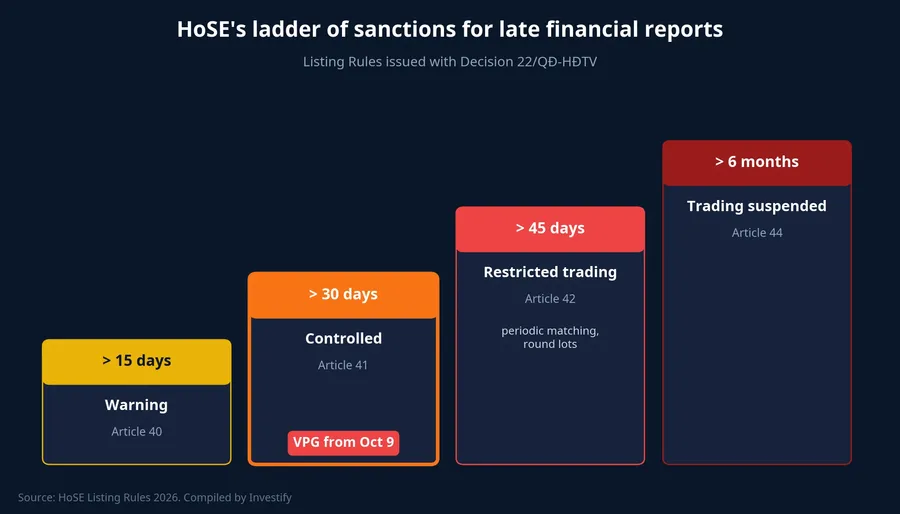
The listing rules issued with Decision 22/QĐ-HĐTV of March 16, 2026 tie each sanction to the number of days a report is late, with 15 days between steps.HoSE
- More than 15 days: warning (point g, clause 1, Article 40). VPG passed this step on September 23.
- More than 30 days: controlled (point g, clause 1, Article 41). VPG enters this step on October 9.
- More than 45 days: restricted trading (point a, clause 1, Article 42). This is the first step that changes how orders are matched.
- More than 6 months: trading suspended (point a, clause 1, Article 44).
The restricted-trading step has a recent precedent. From May 26, 2026, Duc Giang Chemicals' DGC could still trade throughout the session, but only in round lots via periodic call matching.Nhịp sống Kinh doanh Periodic matching means orders are pooled and filled in batches rather than continuously. For a stock that is already illiquid, batch matching leaves sellers with less control over both timing and price.
If Viet Phat publishes the report before the 45-day mark, VPG stops at controlled status. If not, at a pace of one step every 15 days, holders could face thinner order matching as soon as October.
Filing the report is not an exit
This is the most commonly misread point. For stocks controlled because of a late report, point đ, clause 4, Article 41 sets two conditions. The listed company must fully remedy the cause. It must also go at least six consecutive months without breaching disclosure rules, counted from the control decision or from the most recent violation.
So even if the reviewed report comes out next week, the controlled flag will stay on VPG's quote until roughly early April 2027 at the earliest. And after those six months, VPG still won't be back to normal. The two warning grounds from the 2025 report remain, so the best short-term outcome is a return to warning status.
One more provision deserves attention. Point d, clause 1, Article 41 places a stock under control when the auditor qualifies the annual report two years in a row. Viet Phat's 2025 report was already qualified. If the 2026 report is qualified too, VPG could remain under control on new grounds, even after the late-filing issue is resolved.
What will decide VPG's path
For holders of VPG, PLP or DRH, October 9 does not change their accounts right away. What matters is that these stocks now sit on the second rung of a ladder with a clear schedule, and the third rung is the one that changes how orders are matched.
For VPG specifically, everything comes back to the VND 2,038.64 billion in receivables. The timing of the reviewed half-year report determines whether the stock is pushed into restricted trading. The content of the review conclusion on those receivables shapes the longer story. A clean conclusion with clear provisioning paves the way for a cleaner 2026 audit. A qualification on receivables, by contrast, would be an early signal that the annual report could be qualified a second time, which is exactly the condition that would keep VPG under control for longer.
Signals worth watching over the next few weeks: the remedial plan Viet Phat must publish within 15 days of October 9, the date the reviewed report is released, and the auditor's paragraph on receivables.