
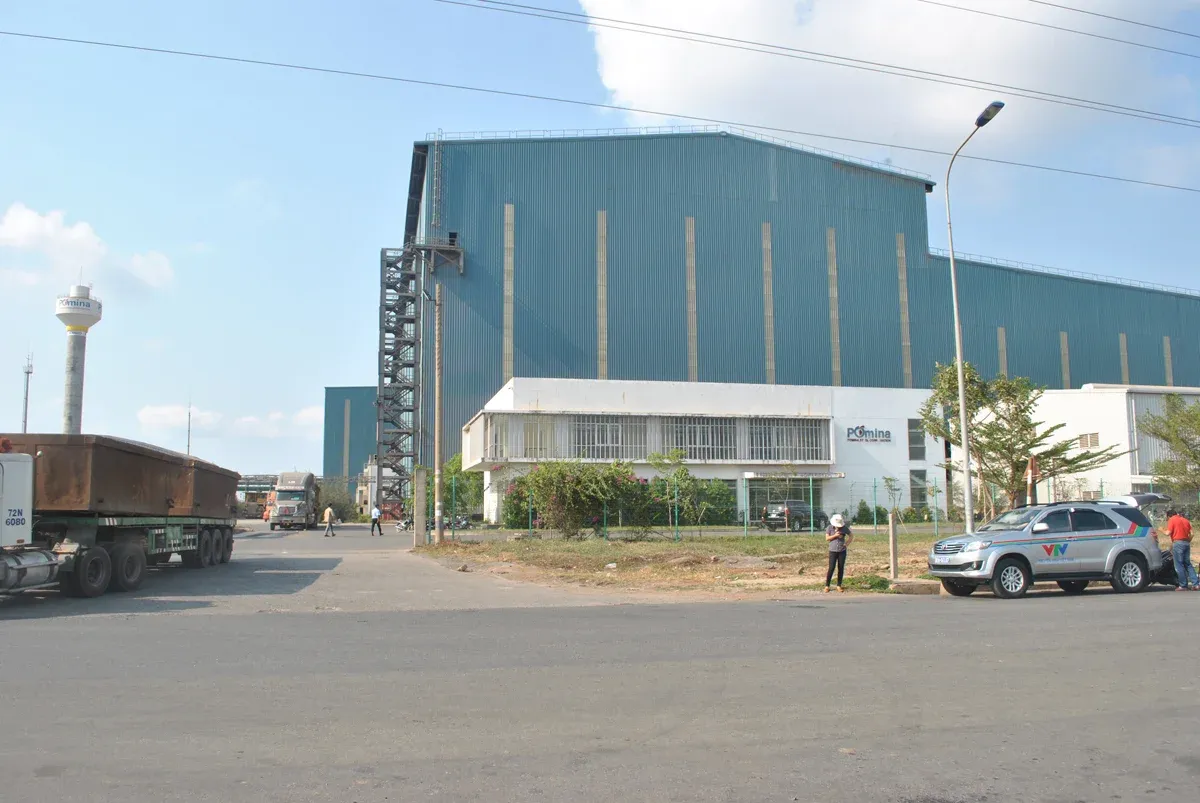

When a company borrows from a bank, it repays in cash. Pomina Steel (POM) is in a very different arrangement: the party funding Pomina is also the party buying Pomina's steel, and that funding can be recovered through the very shipments Pomina delivers.
The detail sits in framework contract No. 3101/2026/HĐK/VHM-POMINA, signed on January 31, 2026 between Vinhomes and Pomina.CafeF Pomina posted the document on its website on September 29, and it appeared on the HNX disclosure system on October 1, roughly eight months after signing. The amount Vinhomes has already disbursed is not news; it was in the half-year report. What is new is the facility ceiling and the repayment mechanism. This post puts both against Pomina's balance sheet to answer a specific question: where does the company stand, and how dependent is it on a single partner?
The contract terms: interest-free funds, repaid in goods
Under a Pomina board resolution dated January 28, 2026, Vinhomes provides working capital to the Pomina group with a total ceiling of VND 1,352 billion. Notes to the reviewed consolidated H1 2026 financial statements state that the support carries no interest for two years, and the contract runs until December 31, 2027.CafeF The money goes toward working capital and supplier payments for the parent company and its three plant branches, Pomina 1, Pomina 2 and Pomina 3.
This puts into practice a plan Vingroup announced in November 2025: 0% interest working capital for Pomina for up to two years, plus a place for Pomina among the preferred suppliers to Vinhomes, VinFast, VinSpeed and other units in the ecosystem.CafeF On Pomina's side, the board assigned Mr. Đỗ Tiến Sĩ, Vice Chairman of the Board and CEO of Pomina Steel JSC, to negotiate and sign the detailed terms.Báo ĐTCK
The clause worth reading closely is the repayment one. The contract says the funds are recovered through goods transactions between Vinhomes and Pomina, or from Pomina's other revenue sources. Put simply, Pomina ships steel to Vinhomes and the value of those shipments can be netted against the money it received. The offset schedule has not been disclosed, so it is not yet possible to say how much will be repaid in steel and how much in cash.
The numbers: over 80% of the facility already drawn
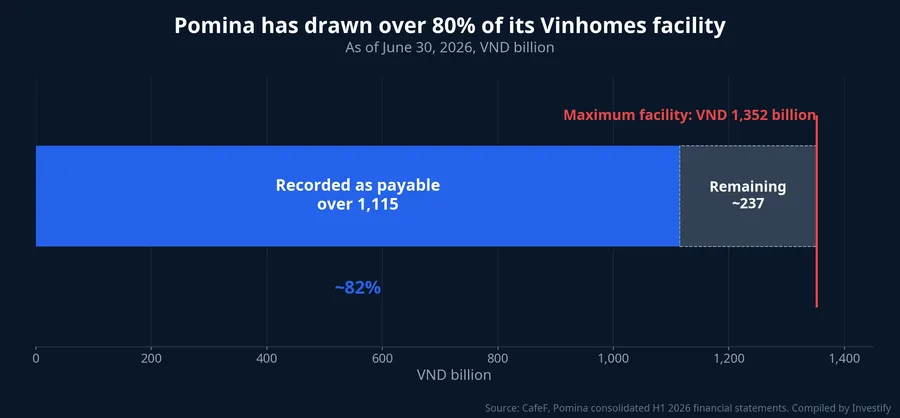
As of June 30, 2026, Pomina carried more than VND 1,115 billion in long-term payables to Vinhomes, a line that did not exist at the end of Q1.CafeF Against the VND 1,352 billion ceiling, only about VND 237 billion remained undrawn at that date. Pomina used more than 80% of the facility within roughly five months of signing, which shows how much working capital the restart required.
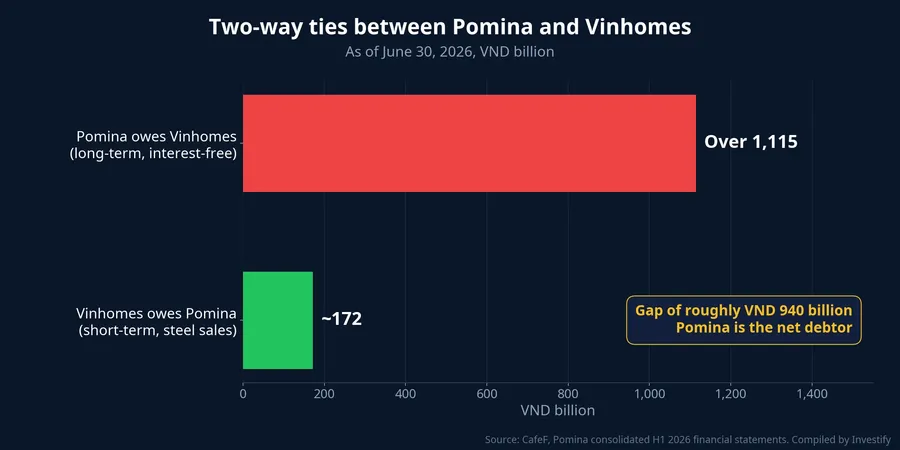
Flip the relationship and Vinhomes is a customer. At the end of June, Pomina recorded about VND 172 billion in short-term receivables from Vinhomes.CafeF At the end of Q1, a "receivable from Vin" line under other receivables stood at over VND 202 billion.CafeF
Net the two directions and Pomina owes Vinhomes considerably more than Vinhomes owes Pomina: a gap of roughly VND 940 billion based on the two disclosed figures. Because the payable is classified as long-term, Pomina faces no repayment pressure this year. But it also means part of its future orders from Vinhomes may bring in no fresh cash, if the value of the steel delivered is used to offset funds already received.
This is where shareholders can misread the story. Higher sales into the Vingroup ecosystem do not necessarily mean new cash to service bank loans. The financial statements do not yet break out how much revenue comes from Vinhomes orders, so the size of this effect cannot be measured yet.
The plants are running but losses persist: the burden is financing costs
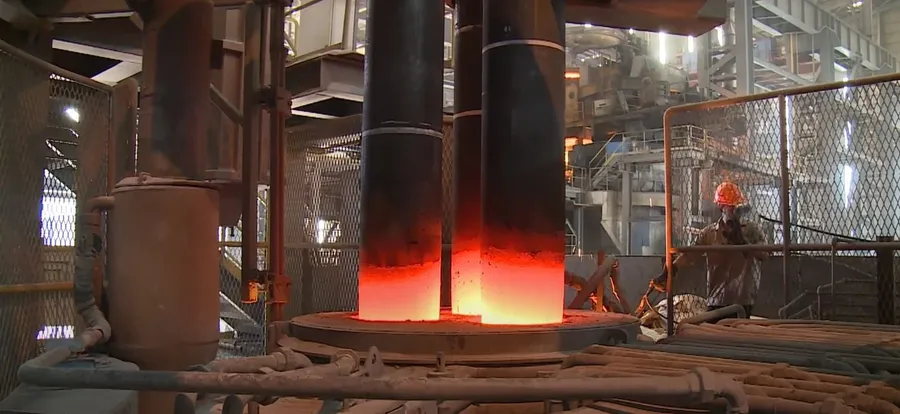
Since March 2026, the Pomina 1 and Pomina 2 steel plants have partially restarted. According to the reviewed consolidated half-year report, Pomina booked about VND 1,946 billion in net revenue for the first six months but still lost more than VND 329 billion.CafeF
The recovery shows most clearly in Q2. On a parent-company basis, Q2 revenue reached VND 1,711 billion, up 270.5% year on year. Cumulative H1 revenue from the same source was VND 2,176.9 billion, meaning Q2 accounted for nearly four-fifths of the half, consistent with the March restart.Báo ĐTCK Note that these are parent-company figures, distinct from the VND 1,946 billion consolidated number, so the two should not be added or subtracted directly.
Revenue nearly quadrupled, yet Q2 gross margin fell from 10.5% to 7.5%, and the parent company still lost VND 146.2 billion in the quarter. Pomina attributes the loss to persistently high financing costs, mainly loan interest plus interest and penalties for late payments to suppliers.Báo ĐTCK
Those costs trace back to legacy debt. Total borrowings at the end of June were about VND 5,744 billion, comprising over VND 5,097 billion in short-term loans and about VND 647 billion in long-term loans.CafeF The more than VND 1,115 billion of interest-free money from Vinhomes equals only about 19% of that debt. Interest-free funding lets the plants buy raw materials and pay suppliers, but borrowings more than five times larger remain untouched on the balance sheet.
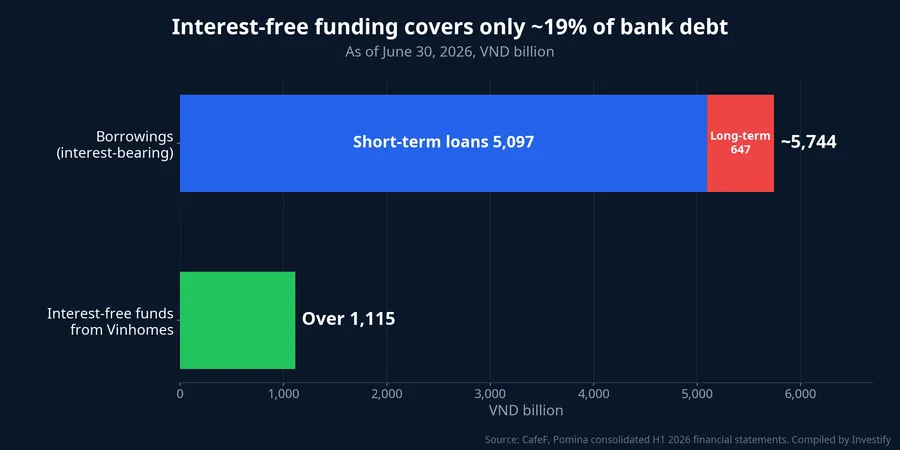
In other words, the support solves an operating problem, not a debt problem. On the margin squeeze, two explanations are both plausible. One is that the plants have only just restarted, so utilization is low and fixed cost per tonne is still high. The other is that pricing to a large customer sits below the market. The disclosed data are not enough to separate the two. On the loss itself, the company's own explanation, interest expense, is the most direct.
What POM shareholders actually own
Continued losses pushed Pomina's accumulated deficit to about VND 3,822 billion at June 30, 2026 on a consolidated basis.CafeF Per figures cited by Báo Đầu tư Chứng khoán, the accumulated deficit equals 136.19% of charter capital, and owners' equity is negative VND 947.7 billion.Báo ĐTCK
| Item (as of June 30, 2026) | Value |
|---|---|
| Consolidated net revenue, 6 months | about VND 1,946 billion |
| Consolidated loss, 6 months | over VND 329 billion |
| Accumulated deficit | about VND 3,822 billion |
| Owners' equity | negative VND 947.7 billion |
| Borrowings | about VND 5,744 billion |
Negative equity means that if every asset were sold at book value to pay off all liabilities, shareholders would be left with nothing and the company would still be nearly VND 1 trillion short. The value of POM shares therefore does not rest on net assets. It rests on the expectation that the business keeps operating and gets restructured.
That expectation has not been endorsed by the auditor. In the half-year review report, AFC Vietnam Auditing Co., Ltd. again issued a qualified conclusion related to going concern. According to the auditor, at the time the report was issued, the company had not provided a complete and feasible plan demonstrating it could improve its financial position and secure funding to keep operating.CafeF
Management still prepared the statements on a going-concern basis. Its stated grounds are a 2026-2027 business plan built on the cooperation agreement with Vinhomes, plus ongoing talks with domestic and foreign investment partners, with a concrete plan to be drawn up before September 30, 2026.Báo ĐTCK That deadline has passed, and press coverage of Pomina on October 2 and 3 mentions no plan having been announced.
In the market, POM trades on UPCoM and closed at VND 3,100 on October 2, down 6.06% on the day. Liquidity is thin: many sessions in the preceding two weeks saw no matched trades.
Dependence on one partner, and what remains unknown
Put the pieces together and the picture is clear. Pomina is operating thanks to a single partner playing two roles at once: supplying interest-free working capital and buying the output. Because the funding is recovered through goods transactions or other revenue, Pomina's cash flow is tightly linked to the order pace of the Vingroup ecosystem. Steady orders keep the plants busy and gradually pay down the Vinhomes balance in steel. If orders thin out, Pomina loses its offtake and must also find other money to repay before December 31, 2027, while its bank debt keeps accruing interest every day.
My read is that this funding keeps the plants alive but does not fix negative equity. Without it, the plants likely could not have restarted this year. Fixing the balance sheet, however, requires fresh equity or a plan to deal with the bank debt, and neither has been announced so far.
POM holders are missing two key pieces of information. The first is how much steel Vinhomes has actually bought from Pomina, and how much of that has been netted against the payable. The second is what the investor plan Pomina promised by September 30 will look like.
The Q3 2026 financial statements will answer the first question. When they come out, put two lines side by side: the long-term payable to Vinhomes and the receivable from Vinhomes as of September 30, compared with the more than VND 1,115 billion and about VND 172 billion of June 30. If the payable falls while revenue holds its Q2 pace, Vinhomes orders are genuinely being used to repay the funding in steel. If the payable rises toward the VND 1,352 billion ceiling, Pomina is still drawing more money to keep running, and its dependence on one partner is growing rather than shrinking.