


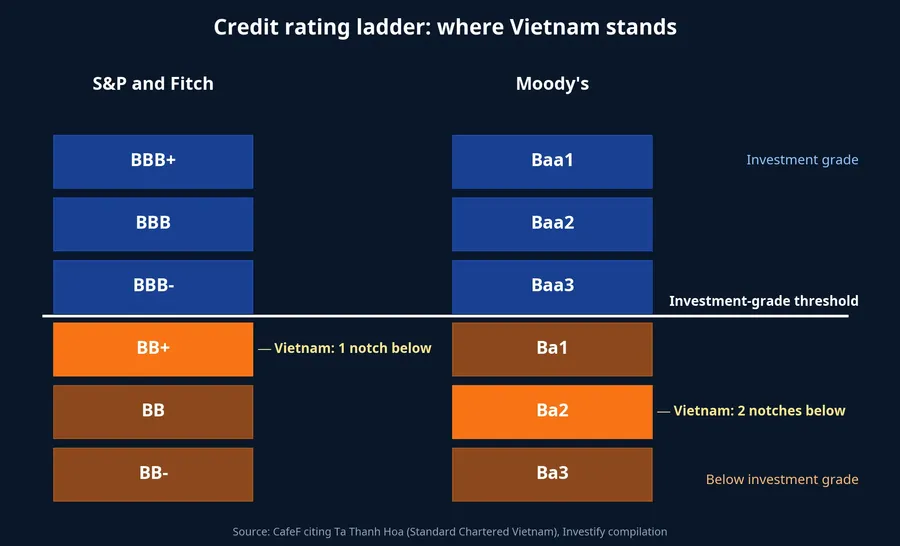
Not every rung on the credit rating ladder is worth the same. Vietnam now sits one notch below investment grade at S&P and Fitch, and that last notch is the one that can reprice capital for the whole economy. According to an IMF study cited this week by Ta Thanh Hoa, Head of Financial Markets at Standard Chartered Bank (Vietnam) Limited, when a country crosses that line, its government bond spreads narrow by about a third. Upgrades that stay below the line do not deliver a comparable shift.CafeF
The same week, on October 2, 2026, Deputy Prime Minister Nguyen Van Thang signed Decision No. 1919/QD-TTg, amending the national credit rating improvement plan to 2030 that was first approved in March 2022. The destination is unchanged: a rating of Baa3 from Moody's or BBB- from S&P and Fitch, or better, by 2030. What is new is a refreshed set of targets for 2026–2030.Báo Chính phủ
One point needs to be clear up front. This is a document that sets goals and measures; it does not upgrade anything. Ratings are decided by S&P, Fitch and Moody's through their own review cycles. The more useful question is why the government is concentrating on this particular notch, and where the new targets are aimed.
The remaining gap: one notch, or two
Speaking at the 31st Asia Securities Forum, Hoa said Vietnam is one notch below investment grade at S&P and Fitch, and two notches below at Moody's.CafeF On the S&P and Fitch scale, the step just below BBB- is BB+, the top of the sub-investment-grade band that global markets still call speculative. At Moody's, there is one more step between Vietnam's position and Baa3.
Put simply, a single upgrade from either S&P or Fitch would put Vietnam in investment grade with that agency. Moody's would need two. That is why the 2030 goal is phrased with an "or": reaching the line at one agency counts.
Why the last notch is different
Per Hoa, the IMF study of around 30 emerging markets shows the impact is not spread evenly across notches. When a country moves from sub-investment grade into investment grade, its government bond spread falls by about a third. A one-notch upgrade that stays within the lower band has a smaller effect.CafeF
The reason is that this boundary is not drawn by market mood. It is written into the investment mandates of many of the world's largest institutions, and it works through two mechanisms that point the same way.
Mechanism one: a different set of buyers
Hoa said most international funding for Vietnamese issuers still comes through syndicated loans, meaning it relies mainly on bank balance sheets. Once a country reaches investment grade, the buyer base can widen to pension funds and insurers. These institutions operate under strict investment limits and, in many cases, may only hold investment-grade assets.CafeF
Think of it this way. Moving from BB to BB+ leaves you with the same buyers. Crossing into BBB- lets an entirely new class of buyer in. Demand rises, and borrowers no longer need to pay as much extra to compensate for risk.
Those new buyers also bring long tenors, something bank funding usually lacks. According to Hoa, the shift could help extend funding maturities to 5 or 10 years.CafeF For an economy with many infrastructure projects that need capital for decades, tenor matters as much as price.
Mechanism two: cheaper capital for lenders
On the international bank side, Hoa estimated that when a loan to a bank is rated BBB- rather than BB+, the capital the lender must set aside for it is about 50% lower. The same financing ties up less capital, so lenders can price more competitively and extend larger limits to the sovereign and to domestic counterparties.CafeF
New buyers lift demand, while existing lenders spend less capital per dollar lent. Both forces push the cost of funding down, which is why the final notch is worth more than any notch beneath it.

The sovereign rating as a ceiling for banks and companies
The story does not stop at government bonds. Hoa said most Vietnamese issuers remain constrained by the sovereign rating ceiling. In practice, a bank or company is rarely rated above the country it operates in, however strong its own finances. When the sovereign rating rises, that ceiling rises with it.CafeF
He also flagged a limit. For USD loans, the direct impact on domestic companies would be modest, since foreign-currency borrowing is still small and not every company has foreign-currency revenue. In his view, the broader effect could come through the dong market: banks raise funds abroad, swap them into VND on the interbank market, and lend to domestic customers at a lower cost.
In other words, banks are the channel that passes cheaper funding into the real economy. That explains why Decision 1919 devotes a full set of targets to the banking sector.
Where Decision 1919 sets its targets
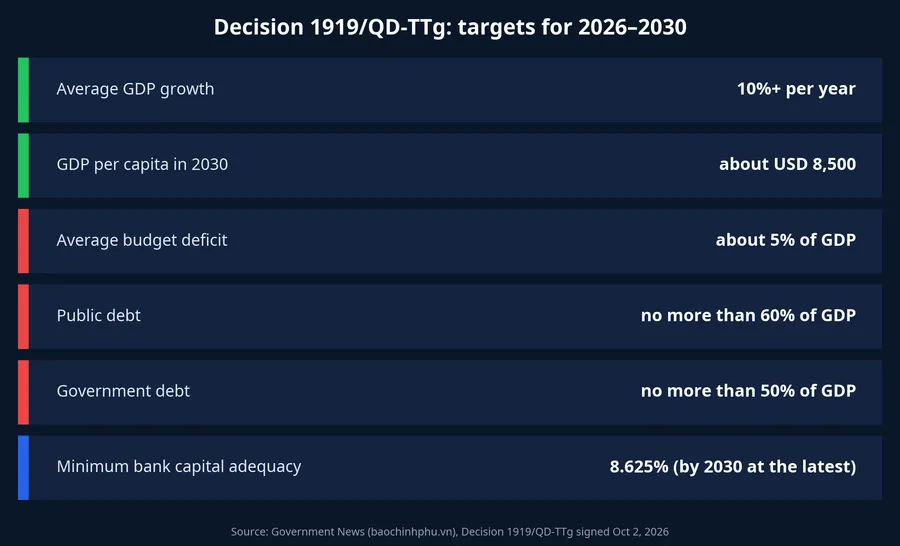
On the macro side, the document targets average GDP growth of 10% or more per year, GDP per capita of about USD 8,500 by 2030, and total social investment averaging about 40% of GDP, with public investment at 20–22%. On the fiscal side, it sets an average budget deficit of about 5% of GDP, public debt of no more than 60% of GDP and government debt of no more than 50% of GDP, along with tighter management of contingent liabilities from government guarantees, public-private partnerships and state-owned enterprises.Báo Chính phủ
For banks, the minimum capital adequacy ratio of commercial banks must move toward Basel III standards, reaching 8.625% by 2030 at the latest. The document states plainly that the aim of this group of measures is to strengthen banks and state-owned enterprises so as to reduce contingent liability risks for the state budget.Báo Chính phủ
The final group of measures sounds procedural but deserves attention. Leaders of relevant ministries and agencies, including the State Bank of Vietnam and the Ministry of Industry and Trade, are assigned to personally chair review meetings with rating agencies, and must improve the quality and frequency of published data.Báo Chính phủ Ratings are not scored on debt and deficit numbers alone. Agencies also judge whether they understand where policy is heading, and putting ministry-level leaders directly in front of review teams targets that qualitative piece.
The hardest part: spending big while staying disciplined
Taken together, the logic is clear. Rating agencies look at the state's debt-carrying capacity, at hidden risks that could turn into budget liabilities, and at policy credibility. Decision 1919 places targets or measures on all three.
The two sets of goals, however, pull in opposite directions. Growth of 10% a year and total investment of about 40% of GDP require a great deal of capital, while caps of 60% of GDP on public debt and 50% on government debt limit how much can be borrowed to fund it. The document's chosen wording is "proactive, flexible but prudent," and it requires expansionary fiscal policy to be targeted at key projects. No single target is enough to earn an upgrade on its own, because agencies assess the full picture.
What this means for individual investors
If Vietnam reaches investment grade, borrowers benefit first: the government borrows more cheaply and for longer, and banks raise international funding at lower cost. For individual investors, the effect travels through asset prices along familiar lines.
Holders of government bonds, corporate bonds or bond funds should remember that the price of an outstanding bond moves inversely to the yield the market demands. If spreads compress as the country crosses the line, bonds issued earlier at higher coupons would be worth more. That is simply how bonds work, not a forecast of any particular price.

For bank stocks, the 8.625% capital adequacy target applies directly to commercial banks. Banks with thin capital buffers may need to raise capital or retain more earnings, while banks with thick buffers are better placed. For borrowers and businesses, loan rates do not fall on the day a document is signed. They can only fall once the rating is actually upgraded and cheaper funding actually flows through the banks.
Signals to watch on the road to 2030
Decision 1919 is a plan. It says where the government wants to go and where it is imposing discipline, but it cannot say when Vietnam will cross the line. That answer rests with the three rating agencies.
The first signal is the next scheduled reviews from S&P, Fitch and Moody's. Alongside the rating, each review carries an outlook. A shift to "positive" is often a precursor to an upgrade, while "stable" means the rating will likely hold through the next cycle.
The second signal is annual execution data: actual deficits, public debt and government debt against the new caps, plus bank capital adequacy ratios quarter by quarter. Year-by-year results will show whether fiscal discipline holds as public investment accelerates.
In short, the last notch is the costliest because it changes both the buyers and the cost of capital at once, something the earlier notches cannot do. Decision 1919 has aimed its targets at exactly what rating agencies measure. Between now and 2030, what decides the outcome is the execution data and the coming reviews, not the document itself.