
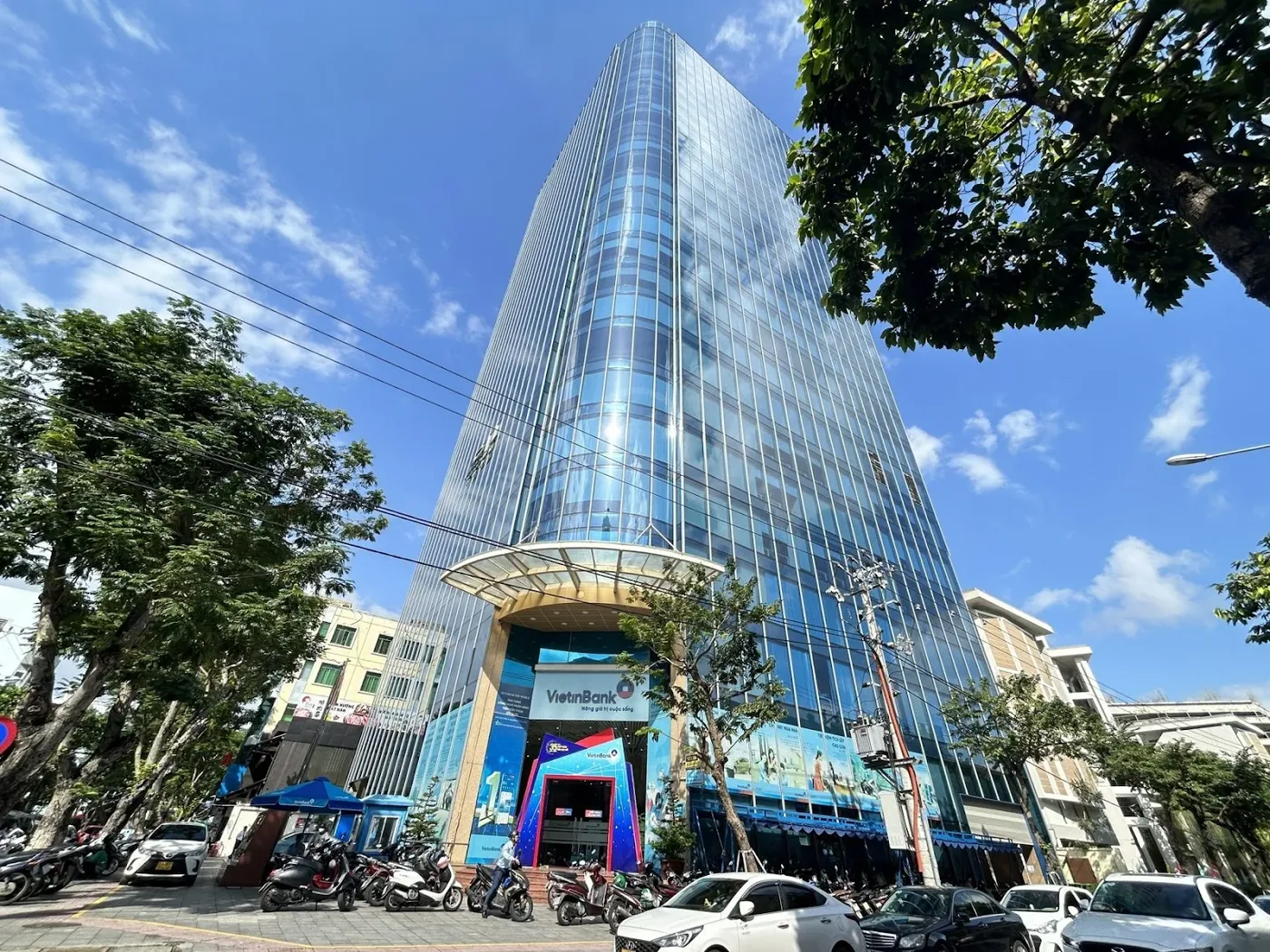

Remember the ATM card you opened as a student, or the one your old employer used for payroll? You may have forgotten about it, but the annual fee has kept ticking. From Monday, October 5, 2026, if that card is a VietinBank debit card with fees still outstanding, part of the money in your payment account may be frozen until you settle them.VietinBank
On the same day, Agribank introduces a new card fee schedule for individual and corporate customers, and HSBC Vietnam applies new terms to term deposits and savings deposits.CafeF One thing to be clear about upfront: none of these comes from a regulator. Each is a bank's own notice, and each affects a different group of customers. Below, we walk through them one bank at a time, then pull together what you can check for yourself before Monday morning.
VietinBank: a freeze is not a deduction
VietinBank's change comes in two steps. Since August 17, 2026, debit card fees under the bank's fee schedule, when incurred, have been collected from customers' VietinBank payment accounts. The second step starts on October 5, 2026: for fees that remain unpaid, the bank adds the option of freezing the corresponding amount in the payment account.VietinBank
Put simply, the difference between a deduction and a freeze is where the money goes. With a deduction, the money leaves your account and your balance drops. With a freeze, the money stays in your account, but the locked portion can't be transferred, spent or withdrawn. Think of it as a drawer in your own house that's temporarily locked: everything is still inside, you just can't take it out yet.
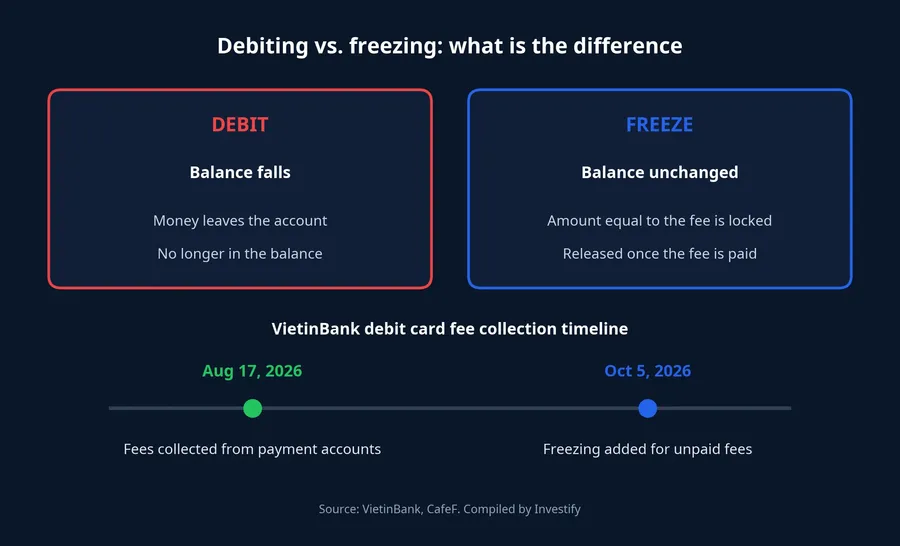
Two details should ease the worry. First, only the amount matching the unpaid fee is locked, not your whole balance. Second, the frozen amount is released once the customer has paid the outstanding fees.CafeF
The legal basis is Article 11 of Decree 52/2024/ND-CP on cashless payments, in effect since July 1, 2024. It allows part or all of a payment account balance to be frozen under a prior agreement between the account holder and the payment service provider, and lifting the freeze likewise follows the parties' agreement.VCCI In other words, VietinBank's right to freeze funds rests on terms customers accepted when they signed up. CafeF also notes that the mechanism operates on the basis of regulations and the agreements made as customers use the service.CafeF
VietinBank's notice leaves out a few things customers will want to know: the exact fee for each card type, how long it takes for funds to be released after payment, and how the bank will notify customers when a freeze happens. The bank points customers to its website, branches, or its hotline at 1900 558 868. On these questions, it's better to ask the bank directly than to guess.
Who is most likely to find cash locked
The most exposed group is people who opened a card and then forgot about it. According to CafeF, customers who rarely use a card but keep it active should pay attention, because fees left unchecked for a long time can build into a payment obligation and lead to the matching amount being frozen.CafeF A card from your school days, one opened alongside a loan, or a payroll card from a previous job all fit the profile.
For investors, this has a very concrete consequence for your wallet. A bank payment account is often where cash waits before moving to a brokerage account, or where proceeds from selling shares land. If part of the balance is frozen, a transfer for the exact amount you planned may not go through in full, right when you need to fund your account. Card fees are usually small, so the locked amount is small too. Still, that's enough to derail a transfer sized right up to your balance.
Agribank: a VND 50,000 minimum makes small withdrawals expensive
Agribank's new card fee schedule is split by product group. All figures below exclude VAT. Press reports don't give the previous fees, so this piece doesn't say whether any fee has gone up or down.Nguoi Quan Sat

For individual domestic debit cards, the most common type, the annual fee is VND 15,000–20,000 per card depending on tier. Withdrawing at an Agribank ATM costs VND 1,000 per transaction, while withdrawing at another domestic bank's ATM costs VND 3,000. Issuing a card at the counter costs VND 30,000–100,000, issuing through digital channels costs VND 30,000, and virtual cards are issued free.Nguoi Quan Sat
Individual international debit cards carry a primary-card annual fee of VND 100,000 a year for the Standard tier and VND 150,000 for Gold.CafeF Individual international credit cards have primary-card annual fees of VND 150,000, VND 300,000, VND 2 million and VND 3 million a year across their respective tiers.Nguoi Quan Sat
The line worth reading most carefully is on credit cards. Withdrawing or advancing cash with a credit card at an Agribank ATM costs 3% of the amount, with a minimum of VND 50,000 per transaction. At ATMs outside the Agribank network, the rate is 4%, with the same VND 50,000 minimum.Nguoi Quan Sat
That minimum is what pushes the effective rate on small withdrawals far above the 3–4% printed in the schedule. Withdraw VND 500,000 at an Agribank ATM and 3% comes to just VND 15,000, but the minimum lifts the fee to VND 50,000, roughly 10% of the amount. Withdraw VND 1 million at another bank's ATM and 4% is VND 40,000, yet you still pay VND 50,000, or 5%.
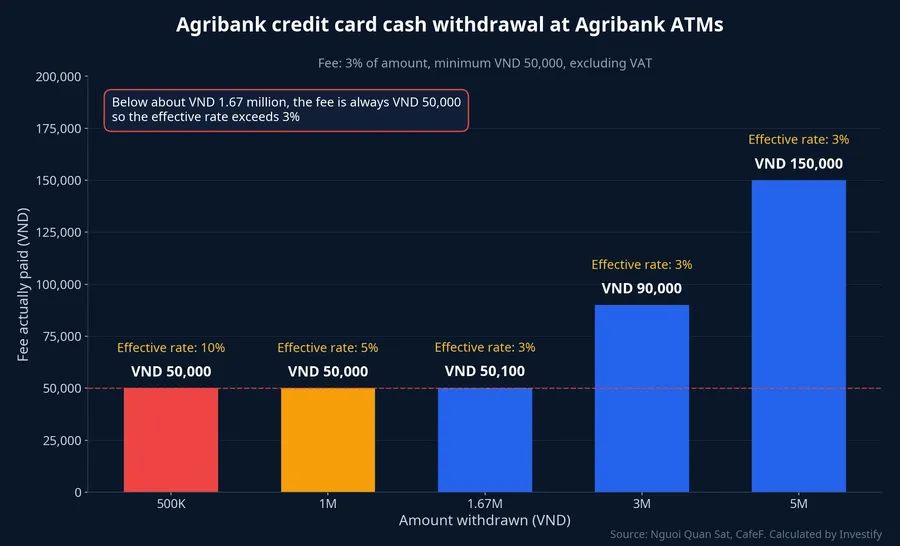
Working backwards gives two thresholds worth remembering. At Agribank ATMs, the 3% rate only exceeds the minimum once you withdraw about VND 1.67 million or more. At ATMs outside the network, the threshold is VND 1.25 million. Below those levels, every withdrawal costs VND 50,000 before tax.
Late payment fees on credit cards follow the same logic: 3% of the overdue amount, with a VND 50,000 minimum.CafeF A VND 300,000 late payment still incurs a VND 50,000 fee, about five times the 3% rate. Changing your credit limit without changing card tier costs VND 50,000 each time.Nguoi Quan Sat Keep in mind these are fees only. The published schedule doesn't mention the interest charged on cash drawn from a credit card, so check your own card's terms before working out the full cost of a withdrawal.
HSBC: the bank may fix errors by closing and reopening a deposit
The third change concerns savers at HSBC Vietnam. HSBC adds Article 16 on error correction and reopening deposit accounts. If a system failure or operational error on the bank's side, such as a mistake in opening the account, booking interest, or applying the value date or interest rate, leaves an account out of line with the customer's original instructions, HSBC may close, settle and reopen the account, or make an equivalent adjustment, to restore the transaction to its intended state.CafeF
This power has clear limits. It applies only to genuine system or operational errors by the bank, and it cannot be used to change customer instructions or agreed terms. Before making a correction, HSBC must send written notice to the registered email, setting out the error, the proposed fix and the impact on the deposit: reference or account number, principal, value date, term and interest rate. On reopening, the customer may receive a new account number, and the principal may be adjusted to reflect the original parameters.
The simple takeaway: to know whether the bank fixed things correctly, you need your original record to compare against. That means the deposit date, term, locked-in rate and account number. Under the same terms, HSBC still doesn't allow partial early withdrawals. If there is no instruction at maturity, the deposit automatically rolls over, principal and interest together, at the rate prevailing at rollover rather than the previous term's rate.CafeF
What you can check before Monday morning
None of these changes require you to open or close a card at any bank. What they do require is knowing exactly what you hold. With the time left before October 5, these are the most useful checks:
- Count your active cards. Open your banking app, go to the cards section and list every card, including ones you haven't used in years. An active card still incurs an annual fee.
- Look for outstanding fees. For VietinBank debit cards, these are what could trigger a freeze from October 5. If you can't find them in the app, call the hotline at 1900 558 868.
- Look at your available balance, not just your balance. Before moving money to a brokerage account or making a large payment, the number that matters is the available balance, the amount left after any frozen funds.
- For Agribank credit cards, remember the two thresholds. Cash withdrawals below about VND 1.67 million at Agribank ATMs, or below VND 1.25 million at other banks' ATMs, always cost VND 50,000 before tax.
- For HSBC savings, keep your original instructions and make sure your registered email still works, since that's the channel the bank uses to notify you before correcting an error.
Taken together, all three changes shift more of the monitoring onto customers. VietinBank no longer has to wait for customers to pay fees themselves. Agribank charges a fixed minimum on small transactions. HSBC may close and reopen a deposit when errors occur, provided it gives notice by email. None of this is a major shock to your wallet, but it rewards people who know their cards, their available balance and their deposit instructions. The open question is how quickly VietinBank will release frozen funds once fees are paid, and the first weeks of the new rule should provide the answer.