


On October 2, Nam A Commercial Joint Stock Bank (Nam A Bank, ticker NAB on HoSE) released its results for the first nine months of 2026. Pre-tax profit came in above VND 4,700 billion, up 25% year on year.Dân trí That is close to 80% of the full-year target.Tin nhanh Chứng khoán NAB shares closed the session at VND 12,500, up 1.21%, on a day the VN-Index fell 0.66% to 1,737.71 points.
Before reading the numbers, it helps to be clear about what they are. These are figures the bank published through the press, not its third-quarter financial statements. Most of them will be confirmed when the statements come out. The NPL ratio, however, carries the qualifier "pre-CIC", and that qualifier changes how the number should be read more than most readers assume.
Profit: Q4 needs less than Q3 already delivered
The arithmetic toward the annual target is straightforward. Under its AGM resolution, Nam A Bank set a 2026 pre-tax profit target of VND 6,200 billion, up 18% from 2025.Tin nhanh Chứng khoán Subtract the nine-month figure of more than VND 4,700 billion and less than VND 1,500 billion remains.
The half-year financial statements show pre-tax profit of VND 3,158.8 billion: VND 1,642.9 billion in Q1 and VND 1,515.8 billion in Q2. That means Q3 alone brought in more than VND 1,540 billion. Put differently, the bank can hit its full-year target with a fourth quarter slightly weaker than its third.
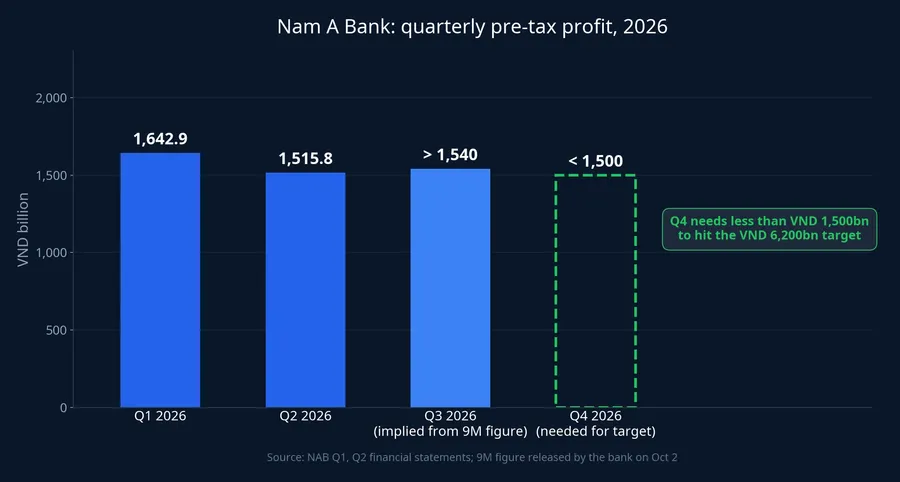
The bar is not high against last year either. Nam A Bank earned VND 5,254 billion before tax in 2025,Tin nhanh Chứng khoán of which VND 3,811.4 billion came in the first nine months. Q4 2025 therefore contributed about VND 1,443 billion, and this year's Q4 only needs to beat that by roughly 4%. Nine-month profit is growing 25%, well ahead of the 18% the annual plan assumes. Barring an unusually large provision charge in Q4, the target is all but secured.
Where is the profit coming from? Loans grew 10.8% year to date, while funding from businesses, households and valuable papers reached nearly VND 254,000 billion, up almost 20% from end-2025.Dân trí Non-interest income made up 26% of total operating income, and the securities business grew 30%, contributing 5% of pre-tax profit.Tin nhanh Chứng khoán Lending is still the main engine. Securities are growing fast but remain a small slice.
Provisions: the piece the release leaves out
The line that stands out in the Q2 statements is provisioning. In Q2, pre-tax profit rose 17% to VND 1,515.8 billion, yet pre-provision profit fell 13.4% as operating expenses climbed 47.3%. The gap was closed by credit loss provisions falling 77.4% to just VND 139 billion.Báo Mới
The nine-month release does not break out Q3 provisions. So for now there is no way to tell how much of the 25% growth came from the core business and how much from setting aside less. That is the first question the Q3 financial statements will answer.
What "pre-CIC" means for the NPL ratio
According to the bank, its NPL ratio at September 30 stood at around 1.5% (pre-CIC), down 1.1 percentage points year on year. Group 2 loans, the "special mention" category, were 0.6%, and the NPL coverage ratio rose 12.6 percentage points from a year earlier.Dân trí
The CIC is the State Bank of Vietnam's Credit Information Center, which pools the loan classifications of every credit institution. Each month, banks classify their own loans and report the results to the CIC. Under the SBV's Circular 31/2024, if a borrower has been placed in a worse debt group by another lender, the bank must move that borrower's loan up to the group the CIC reports.LawNet
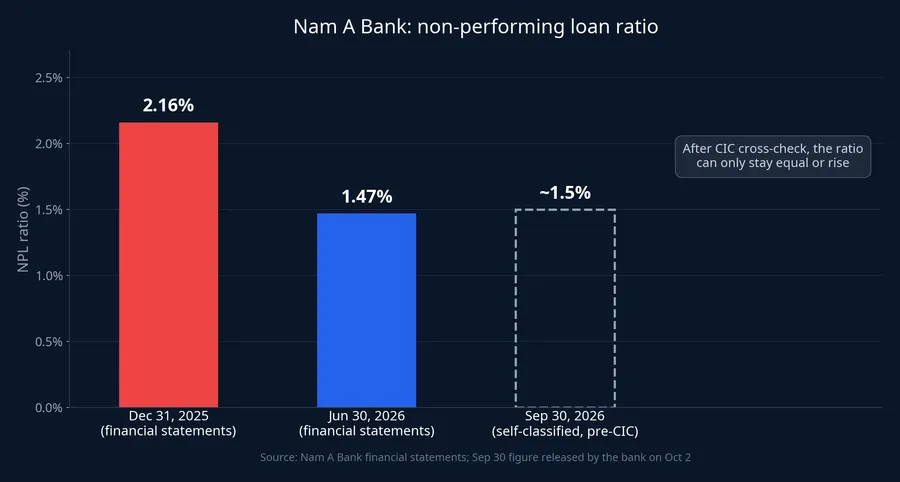
The key point is that this cross-check only works in one direction. It can push a loan from group 1 or 2 into a bad-debt group, but it never pulls a loan back to a better one. The post-CIC NPL ratio can therefore only be equal to or higher than the pre-CIC figure. How much higher depends on how many Nam A Bank borrowers also owe money elsewhere and are classified worse there, and that number has not been disclosed.
Setting the nine-month figure next to the Q2 statements adds one more detail. At June 30, the reported NPL ratio was 1.47%, down from 2.16% at end-2025.Việt Báo Three months later, the self-classified figure is around 1.5%. Most of the 1.1-point year-on-year improvement therefore happened before July. In Q3, the NPL ratio was roughly flat.
Group 5 loans dominate the bad-debt book
The mix inside the bad-debt pile deserves a closer look than the headline ratio. The Q2 statements show total NPLs down 24.4% to VND 3,222 billion, driven mainly by group 4 loans falling 82.1% to VND 277.3 billion. Group 5 loans, the "potential loss" category, moved the other way: up 5.6% to VND 2,584.9 billion, or 80.2% of all NPLs.Báo Mới
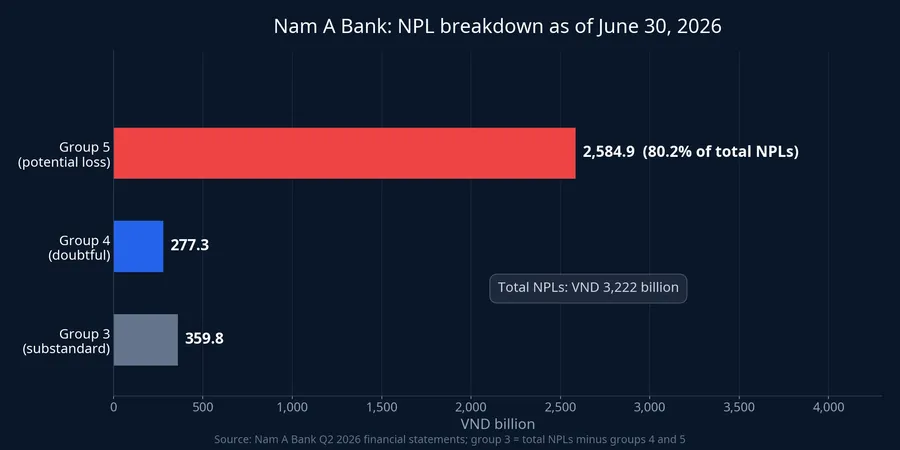
Group 5 carries the highest provisioning requirement. It grew in the same quarter that provision expense dropped sharply, so how it moves in Q3 will show whether low provisioning can last.
To be fair, the coverage ratio went up, which means the reserve buffer was thicker before provisions were cut. Part of the low provisioning may simply reflect reserves already built in earlier periods rather than risk being pushed into the future. The available data is not enough to favor one explanation over the other.
Capital: most of the plan is done, the private placement is pending
Nam A Bank has already completed most of its 2026 capital plan. It paid a 20% stock dividend, adding more than VND 3,400 billion in share capital, and issued nearly VND 4,150 billion in Tier 2 bonds.Dân trí The 100 million-share employee issue at VND 10,000 per share is also done, lifting charter capital from just over VND 20,588 billion to just over VND 21,588 billion.FireAnt As a result, the capital adequacy ratio reached 11.3% at end-September, up 0.2 percentage points from end-2025 and above the 8% minimum.Tin nhanh Chứng khoán
What remains is a private placement of 100 million shares to fewer than 100 professional investors, approved in principle at the AGM.Mekong ASEAN The bank has not yet announced the offer price or timing.
For current NAB holders, the calculation that matters is ownership. NAB has 2,158,822,282 shares outstanding. If all 100 million new shares are sold, the total rises to about 2.26 billion, an increase of about 4.6%. A shareholder holding 1% of the bank would end up with about 0.956%, meaning their stake shrinks by about 4.4%. At the same level of profit, earnings per share (EPS) thins out by the same proportion.
That is not the whole story. The placement brings in fresh capital, and if it is lent out at a return close to the current ROE of nearly 20%, future profit will be larger and offset part of the dilution.Dân trí How much it offsets depends on the offer price: the closer it is to, or the higher it is above, the market price, the less existing shareholders give up.
What is settled and what the Q3 report will answer
The nine-month numbers show Nam A Bank very close to its full-year profit target. Q4 needs less than VND 1,500 billion, below what Q3 delivered, and capital has been strengthened, with the capital adequacy ratio more than 3 percentage points above the minimum. Only an unusually large Q4 provision charge would overturn that conclusion.
The quality of the 25% growth is the open question, and three signals are worth watching:
- Q3 provision expense. If it stays as low as in Q2, a meaningful part of the profit growth comes from setting aside less, not just from the business itself.
- The post-CIC NPL ratio and group 5 loans. A ratio clearly above the roughly 1.5% figure, or group 5 loans continuing to swell, would signal that provisioning pressure could return in 2027.
- The private placement price. This determines how well existing shareholders are compensated for their diluted stake.
The first two will appear in the Q3 financial statements, expected in October. The third has to wait until the bank publishes the detailed offering plan.