


Credit policy usually moves in two stages. First comes the commitment: banks register a lending quota and the headline number makes the news. Then comes disbursement, when money actually lands in a company's account. Vietnam's low-rate loan package for small and medium-sized enterprises (SMEs) has just produced its first stage-two numbers, and the distance between the two stages is still very wide.
At the regular government press briefing on the morning of October 3, Phạm Thanh Hà, Deputy Governor of the State Bank of Vietnam (SBV), said the credit program targeting growth drivers and SMEs now has 19 commercial banks on board, with registered capacity of about VND 409,000 billion.VnExpress Of those, 10 banks have lent to about 12,900 customers, with loans outstanding of about VND 18,600 billion.Hà Nội Mới Divide 18,600 by 409,000 and roughly 4.5% of the registered capacity has turned into actual loans. Put differently, for every VND 100 of preferential capital pledged, only about VND 4.50 is in borrowers' hands.
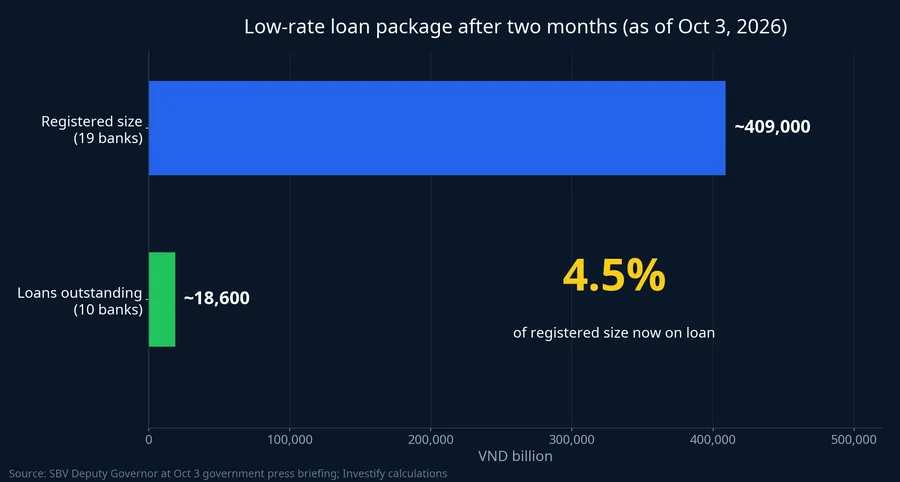
To read that 4.5% correctly, it helps to go back to where the program started.
Early August: four state-owned banks go first
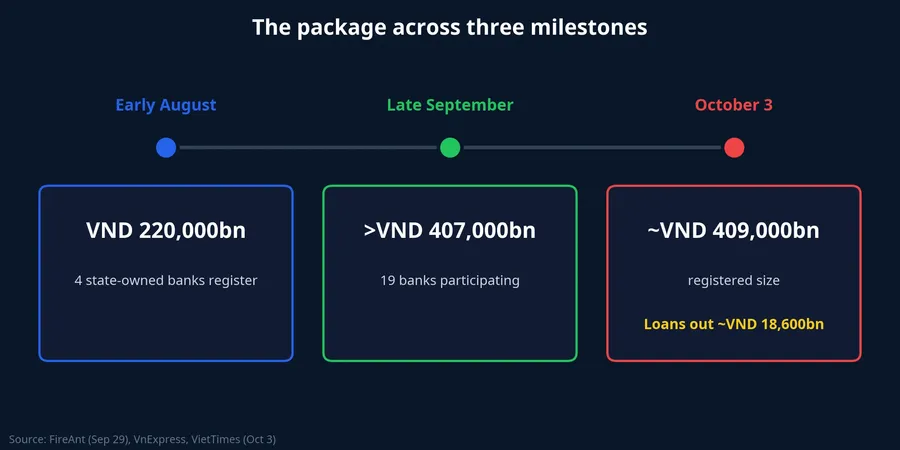
According to Mr. Hà at the briefing, from early August the SBV directed and encouraged commercial banks to sign up for the program.Nhịp sống kinh doanh The first movers were the four state-owned commercial banks, Agribank, Vietcombank, BIDV and VietinBank, with an initial registration of VND 220,000 billion.FireAnt
Eligible borrowers are SMEs and sectors considered growth drivers for the economy. The interest-rate condition is worth noting. A preferential loan only has to be cheaper than the same bank's normal lending rate; there is no single fixed rate across the system. So two firms both using the "low-rate package" may pay quite different rates at different banks.
Underwriting has not changed either. According to a September 29 roundup, banks still assess the business plan, repayment capacity, cash flow, credit history and collateral under their own policies.FireAnt The package lowers the cost of capital, but the approval bar stays exactly where it was.

Late September: committed capacity nearly doubles
In little more than a month, participation grew from 4 banks to 19. By the end of September, total announced quotas had passed VND 407,000 billion, nearly double the VND 220,000 billion the four state-owned banks started with. At that point, the discount banks commonly advertised was 1–2 percentage points a year below their average lending rate for the same tenor.FireAnt
This was the phase in which the package grew on paper. The added amount reflects quotas banks pledged to set aside, not money already transferred to businesses. A complete list of the 19 banks with each one's quota has not yet been published in full, so readers cannot tell how the increase splits between state-owned and private lenders.
October 3: the first disbursement figures
The October 3 briefing was the first time figures on money actually lent became available. Registered capacity edged up to about VND 409,000 billion, yet only 10 of the 19 banks have loans outstanding under the program.VietTimes In other words, nearly half the participating banks have not booked a single loan under it.
Dividing about VND 18,600 billion by about 12,900 customers gives an average of roughly VND 1.44 billion per borrower. That is only an average, so it may hide some much larger loans and some much smaller ones. The source also counts "customers" without separating businesses from other borrowers.
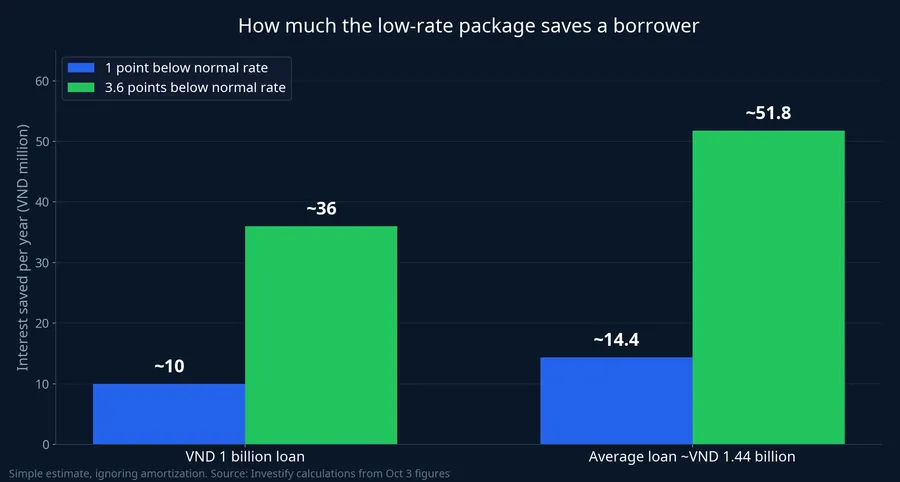
The most notable change is the size of the discount. Mr. Hà said rates on the loans already disbursed are 1–3.6 percentage points below the participating banks' own normal lending rates.VnExpress The low end matches the 1-point minimum requirement, while the high end is well beyond the 1–2 points banks were advertising just days earlier.
In cash terms the math is simple. On a VND 1 billion loan, a rate 1 point lower saves about VND 10 million in interest a year; at 3.6 points the saving rises to about VND 36 million. On the average loan of about VND 1.44 billion, the saving works out to roughly VND 14–52 million a year. For a small business running on thin margins, that is meaningful money.
At the same briefing, Mr. Hà also mentioned a separate program: lending for linked production, processing and sale of high-quality, low-emission rice in the Mekong Delta. That program has disbursed about VND 5,000 billion at rates at least 1 point below comparable regular loans.Nhịp sống kinh doanh That figure is not part of the VND 18,600 billion in the SME package.
Against the size of the whole credit system
To judge whether VND 18,600 billion is big or small, set it against total lending in the economy. As of September 30, system-wide credit stood at about VND 20.75 million billion, up 11.59% from the end of 2025 and 16.69% year on year.VnExpress From that 11.59% growth, new lending over nine months comes to roughly VND 2.15 million billion.
The preferential package therefore accounts for about 0.09% of total outstanding credit and less than 1% of the credit added since January. SMEs alone had more than VND 4.1 million billion in outstanding loans as of August 28, about 20% of the total.FireAnt Against that base, preferential-rate lending is under half a percent. The two figures are dated differently, so the comparison shows scale, not an exact ratio.
The bottom line: most SMEs with bank loans are still paying normal rates. The package has reached about 12,900 customers, and for them interest costs have fallen noticeably.
Why so slow: the data cannot say yet
None of the available sources offers figures explaining why disbursement sits at this level. At least three explanations are plausible. First, two months is short for a program whose quotas run for several years at some banks. Second, 15 of the 19 banks joined after the four state-owned lenders, so they have had less time to roll it out. Third, businesses' capacity to absorb new credit, a question raised in the September 29 roundup, may be limited.
No figure yet separates delays caused by paperwork, by weak loan demand, or by when each bank joined. Reading 4.5% as a progress marker is therefore more accurate than reading it as proof the program has failed.
Q4: the next checkpoint
Mr. Hà said that in the final months of the year the banking sector will step up five groups of credit programs, led by preferential-rate lending for growth drivers and SMEs.Nhịp sống kinh doanh The others cover agriculture, forestry and fisheries, rice lending in the Mekong Delta, credit for power and transport infrastructure and strategic technology, and social housing loans.
If outstanding loans keep the pace of the first two months, about VND 9,000 billion a month, the total would reach roughly VND 45,000–47,000 billion by year-end, or about 11% of registered capacity. That is an assumption-based calculation from the October 3 figures, not a forecast. Its value is as a benchmark line. If upcoming figures clearly beat it, the program is accelerating as the Q4 guidance intends. If they track it or fall short, most of the VND 409,000 billion will still be a pledge going into 2027.
My read is that the package is at the early stage of its rollout, and there is not yet enough data to call it a success or a failure. The answer will come from upcoming briefings and the SBV's year-end report, through three indicators:
- Program loans outstanding, against the October 3 mark of about VND 18,600 billion.
- Number of banks that have disbursed, against 10 out of 19. If lending grows while this number stays flat, money is still flowing through a small group. If it rises, the package is spreading wider.
- Number of customers, against the mark of about 12,900.
For investors holding bank stocks, this adds one more line to check when banks report Q3 results in October: which banks break out their lending under the program, and how large that figure is relative to the quota each bank registered.