

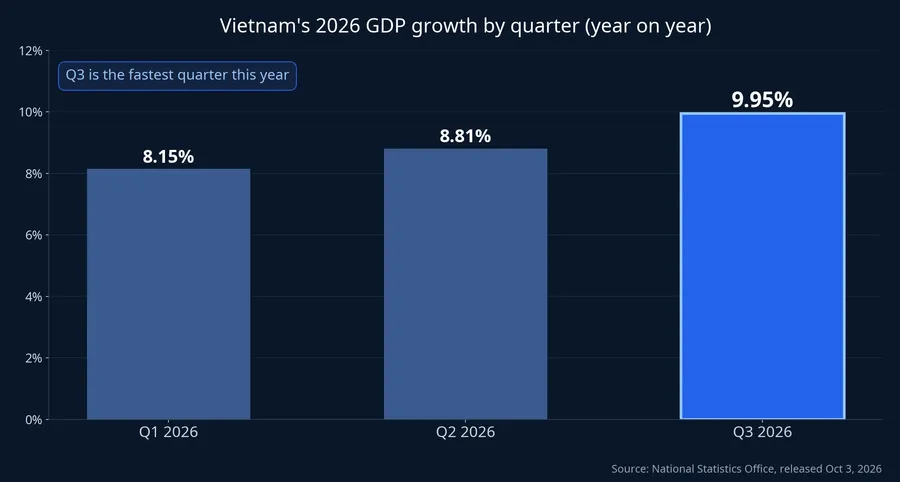
At a press conference on the morning of October 3, Nguyễn Thị Hương, Director General of the National Statistics Office (Ministry of Finance), announced that Vietnam's GDP grew an estimated 9.95% year on year in the third quarter of 2026. That makes Q3 the fastest quarter so far this year, ahead of 8.15% in Q1 and 8.81% in Q2. For the first nine months, GDP is estimated to have grown 9.01%.Báo Đầu tư
The headline number only tells you how much bigger the economy got. For shareholders, wage earners and small business owners, the more useful question is where that extra output came from and where the money is going. This morning's release answers that fairly clearly if you read it in two layers. The production side shows which industries generated the growth; the expenditure side shows what the growth was spent on. Both layers point the same way: this year's expansion is running through factories and construction sites far more than through household wallets.
Production side: industry and construction delivered almost half
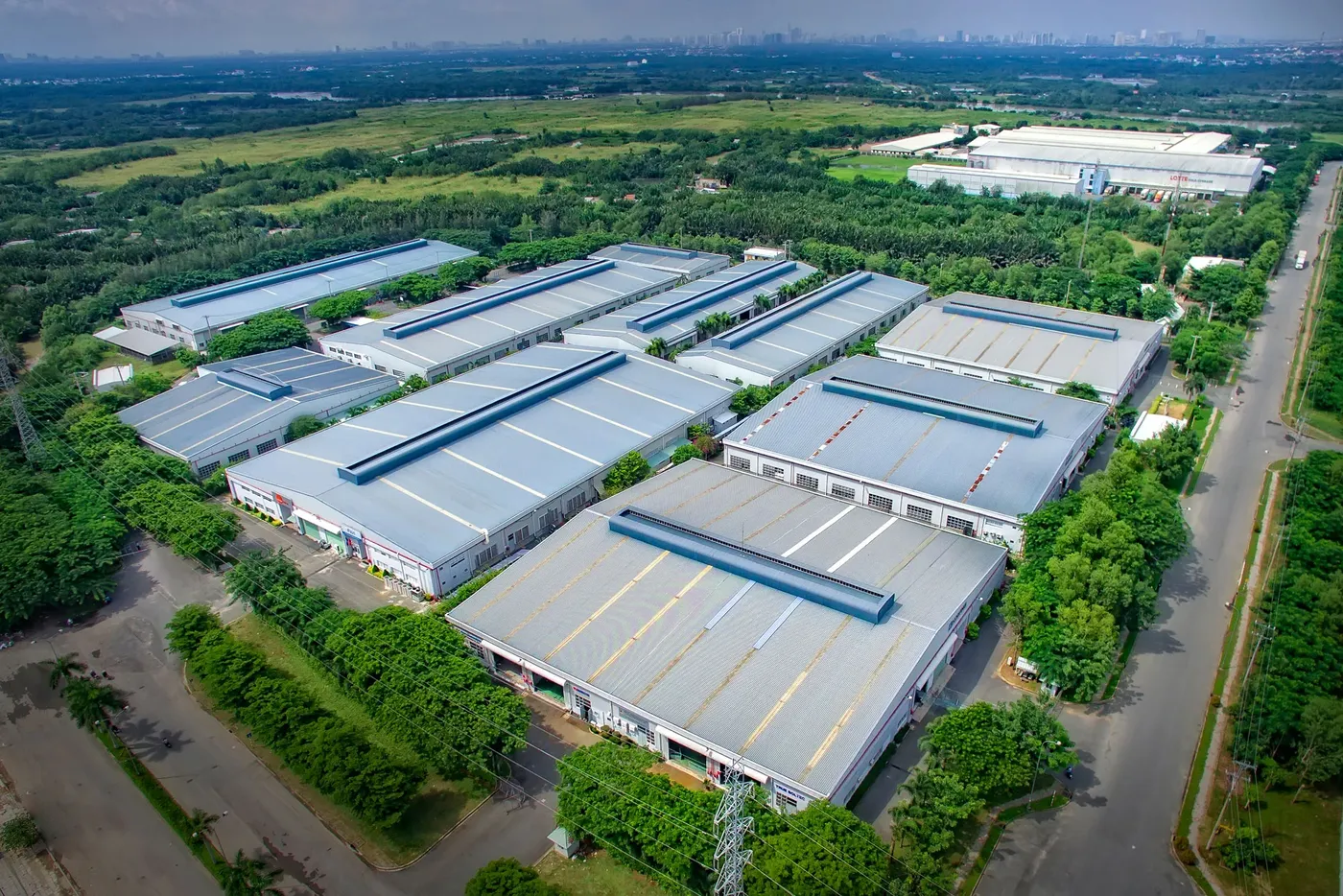
Over nine months, industry and construction grew 11.21% and accounted for 49.62% of the economy's total value-added growth.Báo Đầu tư The sector makes up only 38.35% of the economy, yet it produced nearly half of the gain. Its share of GDP also edged up from 37.47% a year earlier.Doanh nghiệp Hội nhập
Within that, manufacturing grew 11.36% and contributed 33.85%. Put simply, roughly one in every three extra dong the economy generated came out of a factory. Construction grew faster still, at 12.22%, contributing 8.23%.Báo Đầu tư In Q3 alone the pull was even stronger than the nine-month average: industry and construction grew 12.50% and contributed 51.57%, more than half of all growth.Doanh nghiệp Hội nhập
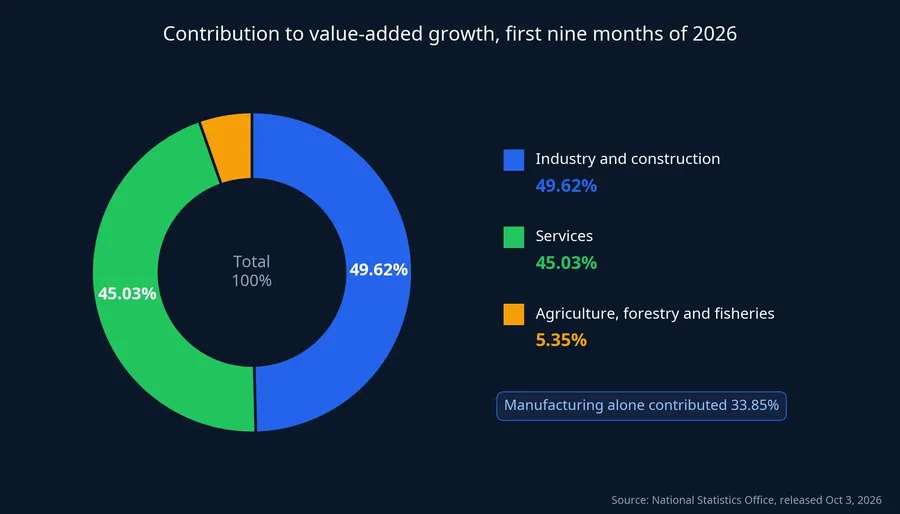
Services grew 8.69% over nine months and contributed 45.03%, below the pace of overall GDP.Báo Đầu tư But services did not move in lockstep. Transport and warehousing grew 11.03%, matching the factories, because it hauls goods in and out of plants and ports and tracks production and trade more than consumer spending. Wholesale and retail grew 9.85% and contributed 11.99%, still the largest contributor among services. Finance, banking and insurance grew 9.45%.VnEconomy
Agriculture, forestry and fisheries grew 4.02%, contributing 5.35%, and their share of the economy slipped from 11.33% to 10.65%.Doanh nghiệp Hội nhập The regional map tells the same story. Twelve of 34 provinces and cities posted GRDP growth of 10% or more, led by Quảng Ninh at 12.54%, Hà Tĩnh at 12.36%, Hải Phòng at 12.08% and Bắc Ninh at 11.81%.VnEconomy All of them are home to large industrial parks or seaports.
Expenditure side: capital formation is growing twice as fast as consumption
The imbalance is even clearer on the expenditure side. Over nine months, gross capital formation grew 17.88% while final consumption grew 8.51% year on year.Báo Đầu tư Capital formation is what the economy puts into new plants, machinery, infrastructure and additional inventory. Final consumption is household spending plus the government's recurrent spending. The first is growing at twice the rate of the second.
Q3 suggests the gap is widening, not closing. In the third quarter alone, capital formation grew 21.39% while final consumption grew 8.96%, below the 9.95% pace of GDP.Doanh nghiệp Hội nhập
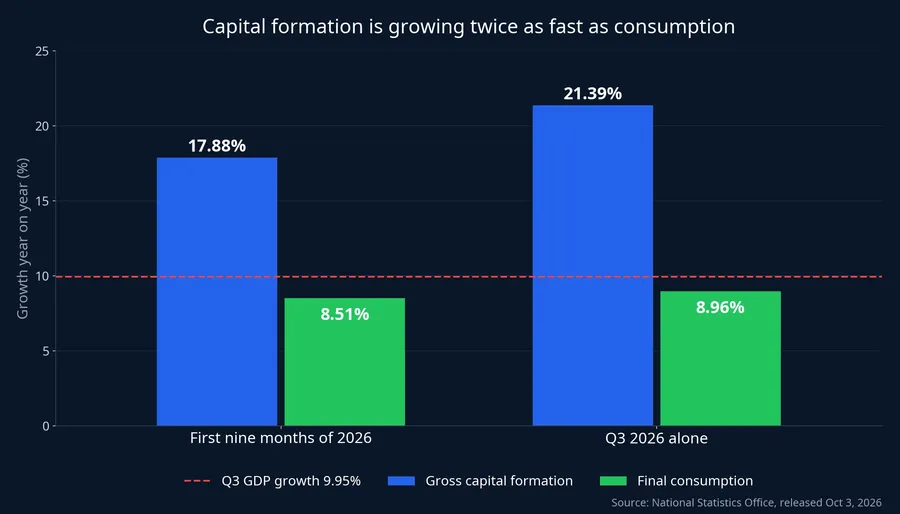
To be clear, consumption is not weak. Growth of 8.51% is respectable, and wholesale and retail remain the biggest contributor among services. What the data shows is that consumption is growing more slowly than GDP. The part of GDP growth above 9% is therefore coming from investment and goods production, not from household purchasing power.
Trade data points the same way. On the expenditure side of GDP, exports of goods and services rose 21.29% over nine months and imports rose 27.19%.Báo Đầu tư Imports outpacing exports usually worries currency watchers, but the mix shows these are mostly production inputs. Goods imports for the nine months reached USD 454.59 billion, up 36.9%. Capital and intermediate goods such as machinery, components, fuel and raw materials came to USD 411.59 billion, or 90.5% of the total.Báo Công Thương
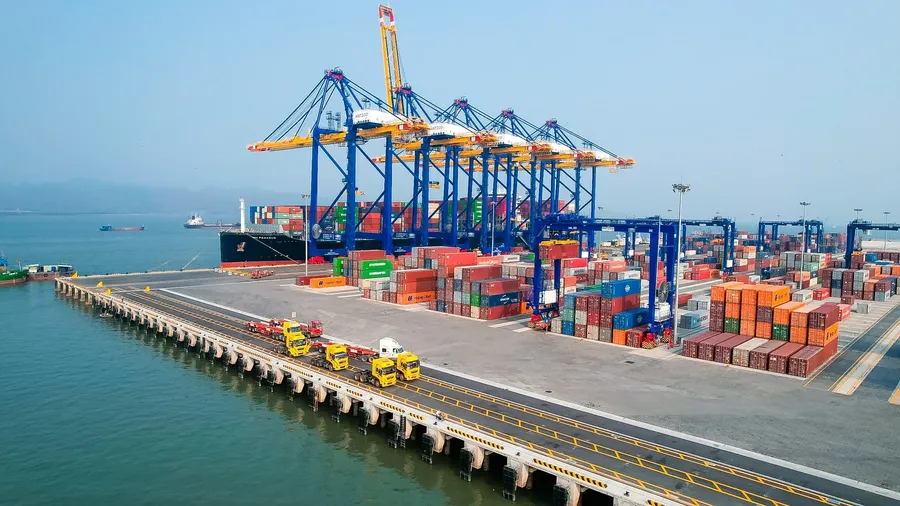
Inputs imported for assembly and processing tend to leave again as exports in later quarters, so today's import surge may support industrial output later in the year. The downside is that the trade balance has flipped. With nine-month goods exports at USD 432.76 billion, up 24%, Vietnam ran a goods trade deficit of about USD 21.83 billion.Báo Công Thương That is why anyone tracking the dong should keep an eye on the trade balance in the final months of the year.
Who is behind the investment surge
Capital formation is being pushed from several directions, and the data allows a rough weighting of each. The statistics office itself attributed the solid industrial performance to several large projects coming online, a recovery in export orders and faster public investment.Báo Đầu tư
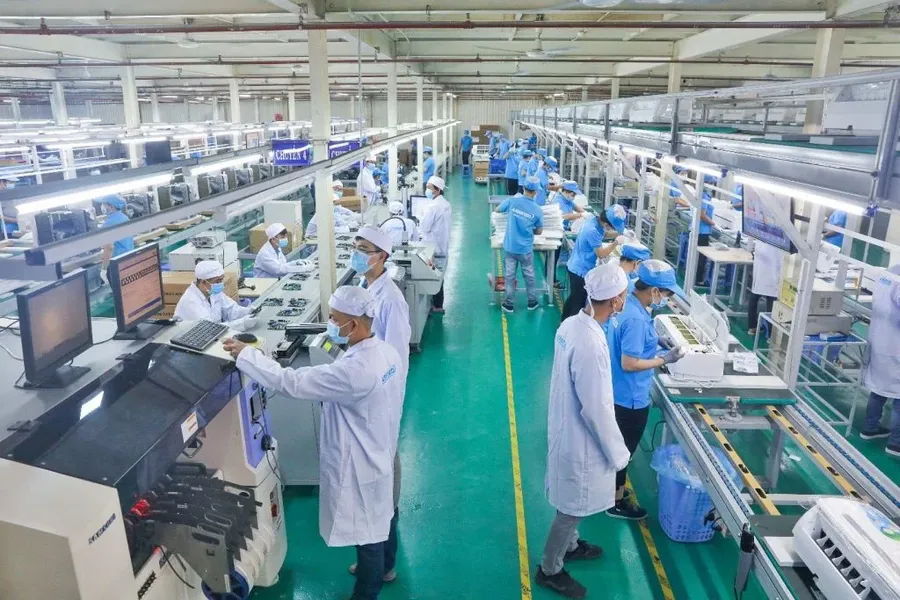
The force that leaves the clearest trace in the data is the foreign-invested sector. In the first nine months, FDI firms exported USD 350 billion, up 29.2% and equal to 80.9% of total exports. Domestic firms exported just USD 82.8 billion, up 6.1%.Báo Công Thương When four-fifths of outbound goods come from foreign-invested companies, it is likely that most of the imported machinery and components also feed their production lines.
The second force is public investment. As of September 17, disbursed public investment reached VND 540,597.2 billion, or 52.9% of the plan assigned by the Prime Minister.FireAnt That is real support for construction. Still, with nearly half the plan undisbursed eight and a half months into the year, public investment cannot yet be the dominant source.
The remainder is harder to measure: inventories. Capital formation includes goods that companies stockpile, but the statistics office did not break this out in this morning's release. So it is not yet possible to say how much of the 17.88% is genuine plant and machinery and how much is goods waiting to be sold or fed into production.
Weighing these together, the evidence points to the FDI sector as the main driver, with public investment in a supporting role. The implication for equity investors is that much of the "factory" in the growth figure belongs to foreign companies that are not listed in Vietnam. Listed firms mostly capture the spillover through industrial parks, construction, transport, warehousing, power and building materials.
The gap to the full-year target
The government has set a 2026 GDP growth target of 10% or higher.Vietstock With nine-month growth at 9.01%, the economy is roughly 1 percentage point short, so Q4 would need to grow considerably faster than Q3 to close the gap. The statistics office did not offer an updated Q4 scenario at this morning's briefing.
If Q4 does accelerate, the engine will most likely be the same one that has run all year: industrial production, construction and the remaining public investment budget. Consumption, growing steadily at around 8.5% to 9%, is unlikely to deliver that kind of jump on its own within a single quarter.
What it means for shareholders
Read by sector, the nine-month data splits listed companies into two groups with different business foundations.
Companies whose revenue is tied to the fast-growing segments. These include infrastructure contractors and building-materials producers, which benefit directly from 12.22% construction growth and the public investment still to be spent this year. Next come industrial park developers and factory landlords, linked to FDI capital that is expanding production. Finally, there are transport, port and logistics firms, riding goods flows that are growing by more than 20%.
Companies whose revenue is tied to consumption. These are retailers, consumer staples, restaurants and hospitality. This group still has a growth base, since 8.51% consumption growth is not weak. But it is not being pulled along as hard as the headline GDP figure, and expecting its Q3 earnings to grow in line with 9.95% would be a misreading of the data.
Our view is that nine-month growth leans toward factories and construction rather than household purchasing power. At the sector level, industrials, construction and transport therefore have a firmer business foundation than consumer retail right now. This is not a recommendation to buy or sell any stock; each company within these groups still depends on its own margins, debt and valuation.
What would reverse this view is final consumption catching up with GDP growth. On its usual schedule, the statistics office will publish full-year data in early January 2027. If Q4 consumption grows as fast as or faster than GDP by then, growth will have started reaching household wallets, and retailers will have a case for a rerating. If the gap between capital formation and consumption stays as wide as it was in Q3, the story of 2026 remains a story of factories and construction sites.