

Take one project site and price it two ways. Switch from the residual method to the provincial land price table multiplied by an adjustment coefficient, and the land use fee, or the one-off lease payment, could come out roughly 2–2.6 times higher.Người Quan Sát That estimate comes from the Ho Chi Minh City Real Estate Association (HoREA), in its comments on the draft amended Land Law reported by the press on October 2. It is not an official government figure. For land leases paid annually, HoREA estimates the increase could be roughly 2–3 times the 2020 level.Vietstock
The more consequential part of HoREA's submission is not the headline number. The association proposes adding to Clause 3, Article 77 of the draft the three components of the land price adjustment coefficient: a market-movement coefficient, a zoning coefficient and an "other factors" coefficient, with the Government tasked to issue detailed rules. It reads like a technicality. In practice it determines whether developers can forecast their land bill in advance, and through that, what homebuyers end up paying for an apartment.
From project-specific valuations to a price table times a coefficient
Until recently, land use fees for large housing projects were usually set through a project-specific land valuation, most often using the residual method. The logic is intuitive: estimate the total revenue a project could generate, subtract the full cost of developing it (infrastructure, construction, financing costs and a reasonable developer margin), and treat what remains as the value of the land. The method tracks each project closely, but it leans heavily on assumptions. Change one input and the land value moves, which is why valuation files often dragged on and invited disputes.
The new mechanism works the other way around. National Assembly Resolution 254/2025/QH15 and Decree 49/2026/ND-CP, issued on January 31, 2026, introduced a formula that takes the provincial land price table and multiplies it by an adjustment coefficient, commonly called the K coefficient.Chính phủ The draft amended Land Law, prepared under the lead of the Ministry of Agriculture and Environment, proposes making this approach permanent in statute and dropping the separate rules on project-specific valuation. According to the summary report presented to the National Assembly Standing Committee on the afternoon of October 1, the draft has been trimmed to 13 chapters and 115 articles, down from 16 chapters and 260 articles in the 2024 Land Law. It keeps only matters of principle and leaves the detail to the Government, ministries and provinces.VOV
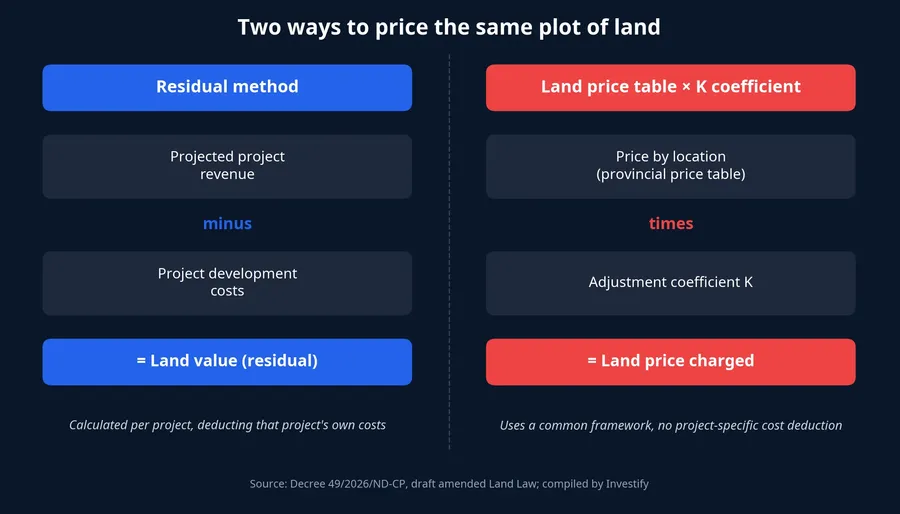
The core difference is whether a project's own costs get deducted. The residual method subtracts the project's development costs before arriving at a land value. A price table assigns a fixed price to each location and then applies a multiplier. If that multiplier is a single blanket number, with no separate components for zoning, market movement or site-specific features, a project that must spend heavily on infrastructure would pay the same land charge as a cheaper project at the same location. HoREA calls this "mechanical application", and the 2–2.6x estimate is calculated under that scenario.
Three components, and why they belong in the law
The three components HoREA proposes are not new. They mirror the structure already in Article 8 of Decree 49/2026/ND-CP, under which the coefficient is set using market land price data, valuation methods and the current price table, while the zoning coefficient is set by land type and floor-area ratio.Người Quan Sát In plain terms:
The market-movement coefficient captures how far actual land prices have drifted from the price table since it was issued.
The zoning coefficient reflects that, at the same location, a plot permitted to build taller and denser is worth more.
The "other factors" coefficient covers site-specific features the first two do not capture.
Since the structure already exists in a decree, the real question is whether to elevate it into the law itself. HoREA's argument is that if the law stops at a bare "price table times coefficient" framework without concrete guidance, each province may interpret and apply it differently. The association wants the line "The Government shall provide detailed regulations and guidance on the implementation of this Article" added, so that provinces have a legal basis for building their price tables and coefficients.Vietstock
Nguyễn Quốc Hiệp, Chairman of the Vietnam Association of Construction Contractors (VACC), takes the same view. Even if the Government can issue guidance, he argues, the law should still set the basic principles: how long a coefficient applies, when the price table is revised, and what market conditions and degree of price movement justify adjusting the K coefficient. His reasoning is that investors need to be able to anticipate costs before assessing whether a project pays off.Vietstock

The request is not coming from industry alone. At the Standing Committee session on October 1, the standing body of the Economic and Financial Committee, which reviews the bill, also recommended that the law clearly set out the principles for issuing land price tables and adjustment coefficients, leaving the Government to provide detailed guidance for provinces.VOV Two parties with different interests are making the same ask: the principles have to be in the statute.
Ho Chi Minh City split the coefficient three ways but uses only one
Ho Chi Minh City shows how the mechanism works in practice. Decision 45/2026/QD-UBND, effective from July 1, 2026, sets the coefficient as K = K1 × K2 × K3, covering market movement, zoning and other factors respectively. For 2026, the city has set both K1 and K3 at 1.00. That leaves K2, the zoning coefficient, as the only source of variation between projects: from 1.00 to 1.30 for low-rise housing, industrial parks and industrial clusters, and from 1.00 up to a maximum of 1.70 for high-rise projects with a floor-area ratio above 10 up to 11.MarketTimes
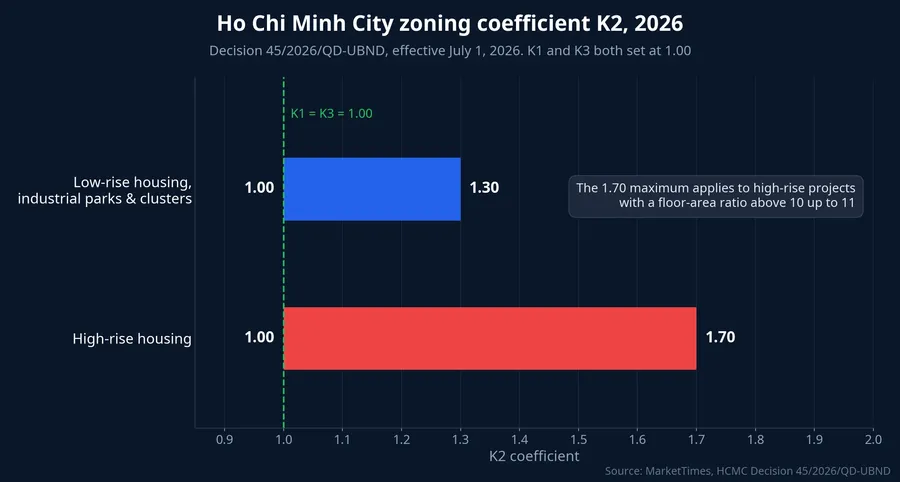
Holding K1 and K3 at 1.00 can be read as a cautious step, since the city has not yet passed market price movements through to land charges. It also shows that the three components are only a framework. The actual value assigned to each one is what determines the bill, and for now each province sets those values itself.
HoREA points to another gap. According to the association, Decision 45 does not apply the adjustment coefficient when calculating land use fees for organisations allocated land by the State, nor for lease payments when the State leases land and collects the full-term rent upfront.Vietstock This is HoREA's reading of the decision's scope, and the association uses it to argue that scope and implementation mechanics should be spelled out in the law. If a major city that has already split out all three coefficients still leaves organisational projects unaddressed, other provinces drafting their own coefficient tables could diverge even further.
Who absorbs the extra land cost
In HoREA's view, a sharp rise in land costs could be passed into total investment and product pricing, including home prices and rents for warehouses and factories.Người Quan Sát The impact falls differently on each group.
Buyers of homes in new projects. Land cost is part of what an apartment costs to build. For projects whose land obligations are not yet finalised, any gap between the two methods is likely to be priced into the sale price, to whatever extent the market will bear.
Businesses paying annual land rent. This is the group for which HoREA estimates increases of roughly 2–3 times the 2020 level. Warehouses and factories cannot pass costs on to customers as quickly as apartment developers can, so the increase may eat into the tenant's own margins first.

Developers still waiting on land charges. For shareholders, the price-table-and-coefficient approach cuts both ways. On the plus side, approvals should move faster, since there is no longer a project-by-project valuation built on contested assumptions. On the minus side, the bill may be larger, and when each province sets its own coefficients without common principles, developers struggle to build the figure into their financial plans early.
The 2–2.6x figure also deserves a sober reading. It is an estimate from an association representing property developers, made during policy consultation and based on a mechanical-application scenario. There is another way to read it: a large gap between the two methods may partly reflect the residual method, which is sensitive to revenue and cost assumptions, often producing low land values. On that reading, part of the "increase" is the State collecting closer to what the land is actually worth, rather than an unreasonable cost burden. Public data is not yet sufficient to separate the two effects project by project.
The milestone to watch from October 17
The bill is still a draft. The National Assembly Standing Committee gave its comments at the October 1 session. The 2nd session of the 16th National Assembly is scheduled to open on October 17 and to consider 43 laws and resolutions for passage.Báo Xây dựng The amended Land Law is one of three property-related laws submitted at the session, alongside the amended Housing Law and Real Estate Business Law.Thanh Niên The final wording of Article 77 will only be settled when the National Assembly deliberates and votes.
That timeline sets up two scenarios. If the law as passed spells out the coefficient's components along with the principles, timing and thresholds for adjusting it, developers will be able to calculate land charges before setting sale prices, and the gap between provinces may narrow. If the law only says "land price table times coefficient" and leaves everything else to secondary legislation, actual land charges will depend on how each province sets its coefficients. In that case, the mechanical-application risk HoREA warns about is likely to shift onto buyers in new projects and businesses leasing land.
The deciding factor, then, is not the 2–2.6x estimate but the wording of Article 77 when it leaves the chamber. For shareholders in property developers, the question worth tracking after the session is whether a company's main projects have already finalised their land obligations, and which province those projects sit in.