

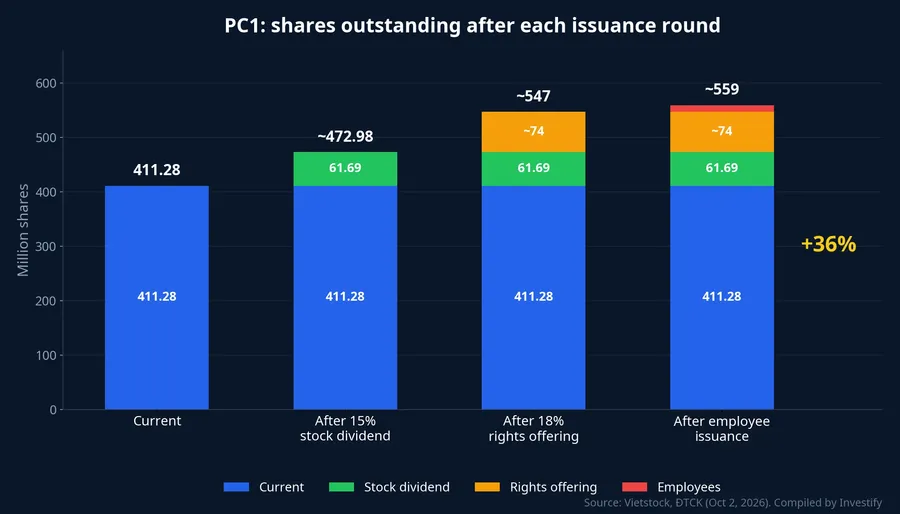
The headline number in PC1 Group's 2026 capital plan is the share count: it is set to rise by about 36%, from just over 411 million to 559 million shares. But those new shares do not all bring in the same amount of money. The first round, a 15% stock dividend just approved by the board, adds nothing to the company's cash. The real fresh capital sits in the rights offering to existing shareholders, and the question worth tracking is whether that money can earn enough, soon enough, to offset the larger share base.
The 15% stock dividend comes first
On October 1, PC1's board approved the plan to issue 61.69 million shares as its 2025 dividend, a 15% ratio worth nearly VND 616.9 billion at par value.ĐTCK The shares are funded from undistributed after-tax profit on the audited 2025 financial statements.CafeF Issuance is expected in 2026, once the State Securities Commission notifies the company that it has received a complete issuance report.Vietstock
The record date has not been announced. The board has authorized its Chairman to decide the issuance timing and the shareholder record date.ĐTCK This is the first of three rounds in the capital plan approved at the 2026 annual general meeting. The other two are a rights offering to existing shareholders and an employee share issuance.Vietstock
Once this round is done, PC1's shares outstanding will rise from just over 411.28 million to about 472.98 million, and charter capital from about VND 4,112.9 billion to nearly VND 4,729.8 billion.ĐTCK The key point is that the roughly VND 617 billion simply moves from undistributed profit to charter capital on the balance sheet. PC1's cash is unchanged, and so is total equity.
The same holds for shareholders. Take someone holding 1,000 shares: at the October 2 close of VND 19,250, the position is worth about VND 19.25 million. After the dividend, they hold 1,150 shares, while the reference price on the ex-rights date is adjusted to about VND 16,700. The total value stays around VND 19.25 million.
Fresh money comes from the rights offering
New capital comes mainly from the second round. PC1 plans to offer up to just over 74 million shares to existing shareholders at VND 20,000 each, an 18% ratio based on shares outstanding at December 31, 2025, raising nearly VND 1,481 billion.Vietstock That figure is a ceiling. The actual proceeds depend on how many shareholders exercise their rights and how the company handles any unsubscribed shares.
Under the plan PC1 published, nearly VND 125 billion goes to energy projects already under investment, VND 306 billion to new renewable energy projects and VND 120 billion to residential real estate. The remainder, nearly VND 930 billion, is labeled "other purposes".Vietstock Disbursement is expected over 2026–2027.
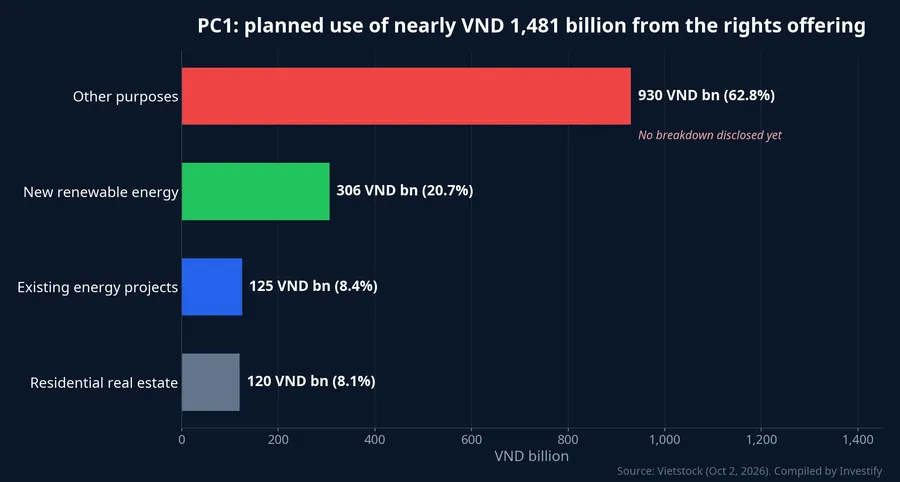
"Other purposes" accounts for nearly 63% of the expected proceeds, more than the three named categories combined. Press coverage of the plan has not specified what it covers, such as debt repayment or working capital. For investors this matters: how those VND 930 billion are deployed largely decides whether the new money adds to earnings, and how quickly.

The third round is much smaller. PC1 plans to issue just over 12.3 million shares to employees, equal to 3% of shares outstanding at end-2025, worth nearly VND 123.4 billion at par.Vietstock The proceeds will go to working capital.
Shares arrive now, earnings take time
If all three rounds are completed, PC1's shares outstanding will rise from just over 411 million to 559 million, and charter capital from nearly VND 4,113 billion to more than VND 5,590 billion.Vietstock That increase of about 36% feeds straight into EPS, which is profit divided by the number of shares.
According to its reviewed consolidated financial statements for the first half of 2026, PC1 posted after-tax profit of nearly VND 477.6 billion, up 54.2% year on year.ĐTCK To keep each share's slice of profit unchanged with roughly 36% more shares, half-year profit would need to reach about VND 650 billion. Put differently, the company needs about VND 170 billion of extra profit every six months just to hold EPS flat.
The timing is lopsided. The share count rises as soon as each round closes, while the energy and real estate projects need construction time before they generate cash. In that gap, EPS faces downward pressure unless profit from existing operations keeps growing strongly.
Where first-half profit came from
That makes the 54.2% jump worth a closer look. Net revenue for the six months was only VND 4,206 billion, down 12.3% year on year.ĐTCK Profit rising sharply while revenue falls shows the growth did not come from selling more.
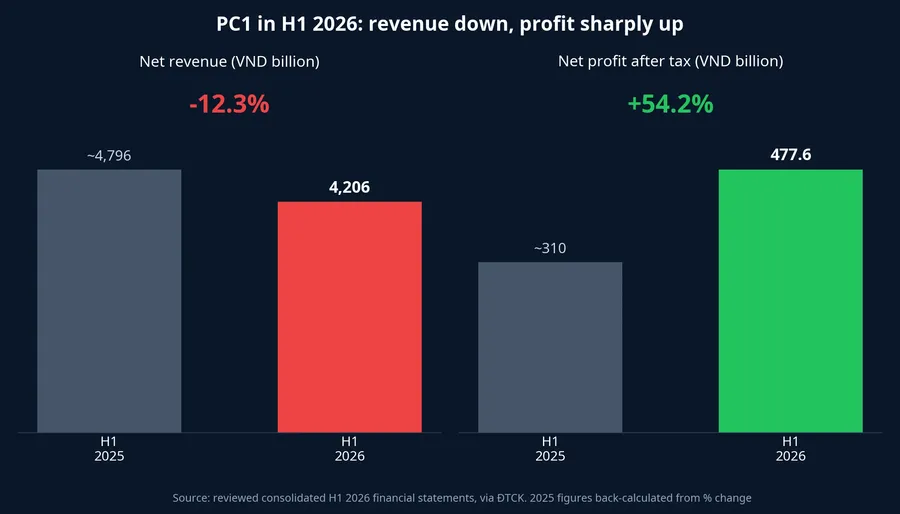
In its explanation, the company attributed the profit increase mainly to its residential real estate arm booking revenue and profit from the Tháp Vàng (Golden Tower) project, which was still under development a year earlier. PC1 also cited higher dividends from subsidiaries, which earned more than a year ago, and favorable exchange rate movements.ĐTCK
These sources differ in durability. Real estate revenue follows the handover schedule of each project, so once handovers finish, that stream ends. FX gains move with the currency market and can reverse next period. The company did not disclose how much each factor contributed, so it is not yet possible to say how much of the 54.2% increase will recur.
Alongside the capital plan, PC1's board issued a resolution on September 29 to sell its entire 1.2 million-share stake, or 40% of capital, in Tân Thanh JSC, with the deal expected in Q3–Q4 2026.ĐTCK No sale price has been disclosed, so its effect on profit cannot yet be estimated.
The documents that will fill the gaps
My read: the capital plan makes PC1's share count rise with certainty and up front, while the matching profit still depends on how the company deploys roughly VND 1,600 billion of fresh money from the rights offering and the employee issuance. EPS holds only if profit grows by roughly 36%, and that growth needs to come from repeatable business. A single project handover or an FX gain is not a sound base for that expectation. The evidence so far does not settle it either way, so the deciding factor is what PC1 discloses next.
Signals worth watching in the coming months:
- The record-date notice for the stock dividend, once the State Securities Commission notifies PC1 that the filing is complete. It sets the date the reference price is adjusted.
- The rights offering documents, including the final offer price, the subscription window and how unsubscribed shares will be handled. They may also break down the nearly VND 930 billion in "other purposes".
- Q3 financial statements, to see whether net revenue has stopped falling and how much profit still relies on real estate and FX.