
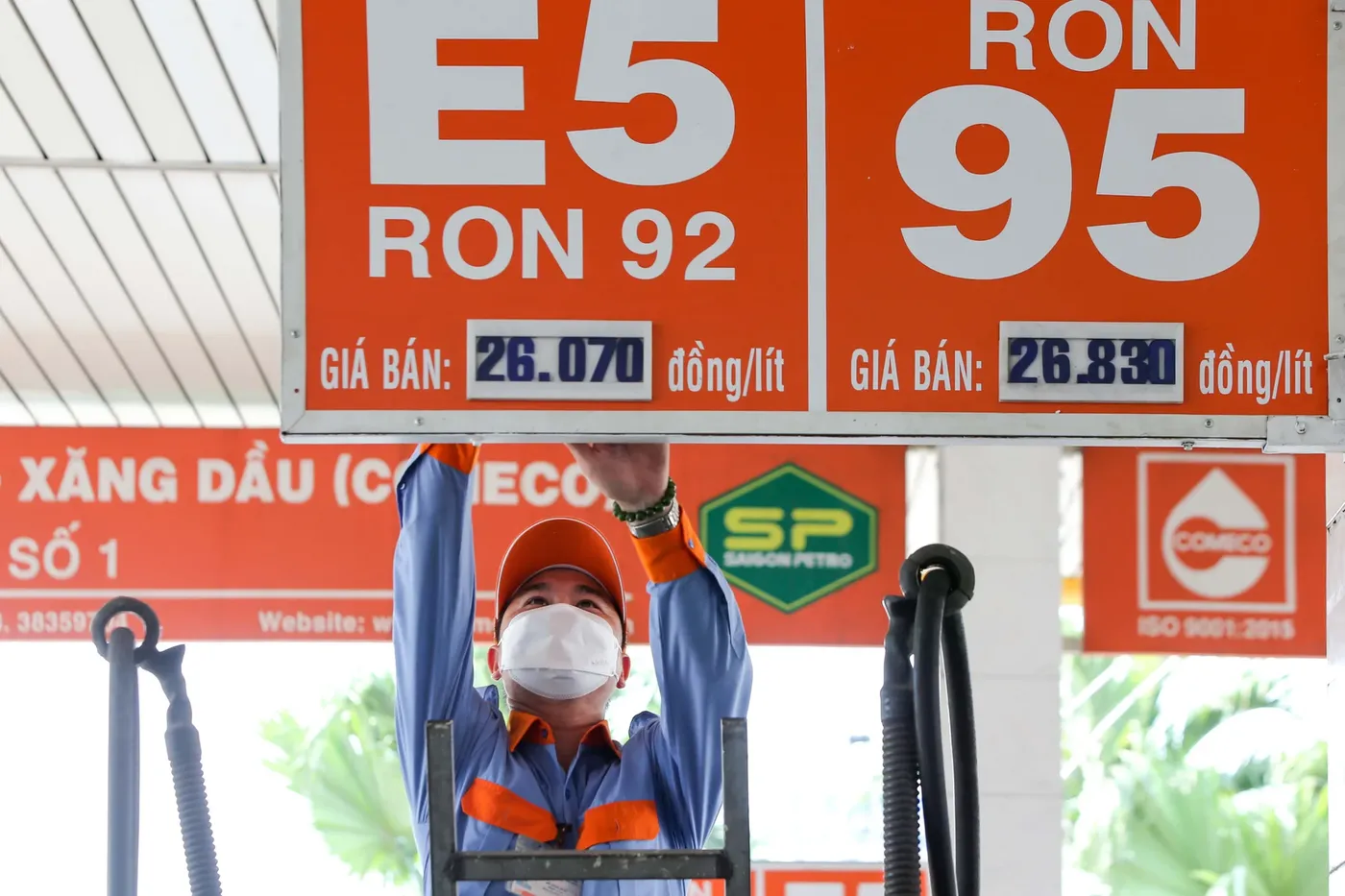

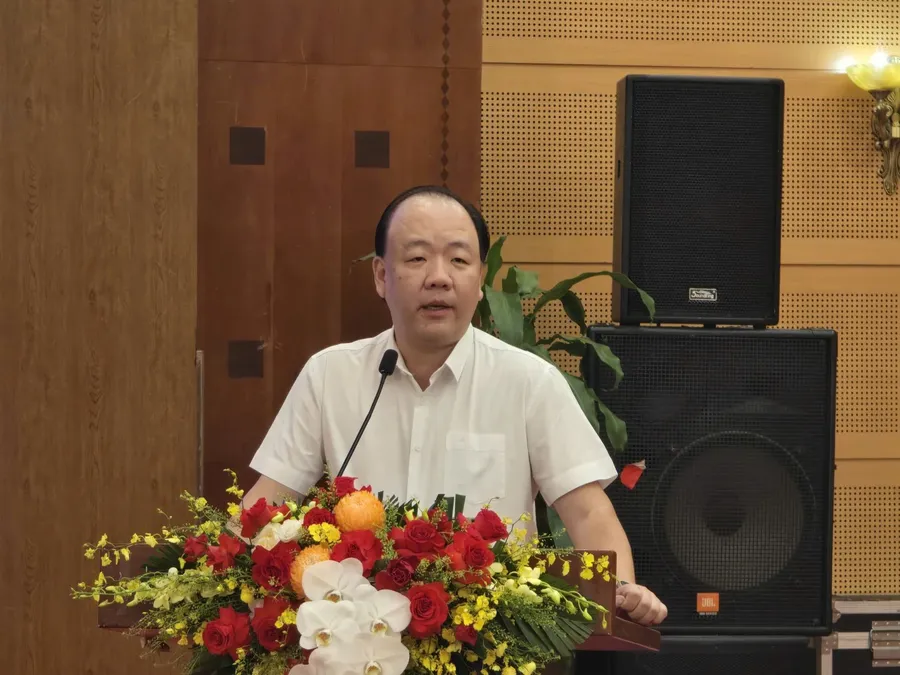
Picture filling up in the morning at one price, coming back to the same station in the afternoon to find a different one, while the station across the road posts a third. That is the scene Trần Hữu Linh, Director of the Domestic Market Management and Development Department at the Ministry of Industry and Trade, said consumers would have to get used to if the new decree takes effect. He was speaking at a public consultation conference on the morning of September 30 on a draft decree that would replace Vietnam's existing decrees on petroleum trading.Vietstock
First, where this document actually stands. This is the 14th version of the draft, refined after four rounds of consultation with members of the government.VTV It is still under consultation, has not been issued and has no effective date. Every change analysed below only becomes reality if the final version the ministry submits to the government keeps these provisions.
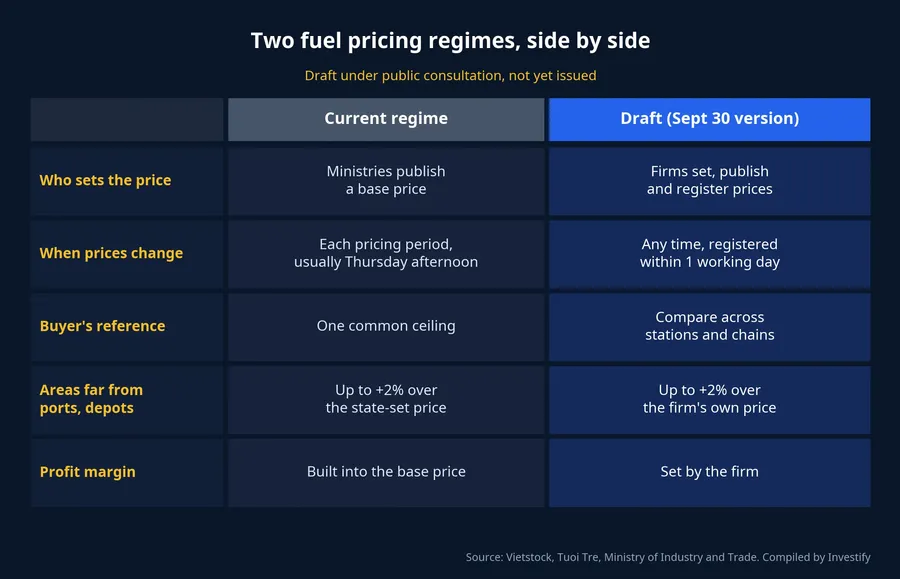
When tracking a policy shift like this, the most useful approach is to put the current system and the draft side by side and ask the same questions of both: who sets the price, when it changes, what buyers compare against, how much more remote areas can be charged, and which tools the state keeps.
The current system: a ceiling that became the common price
Today, the Ministry of Industry and Trade and the Ministry of Finance jointly publish a base price each pricing period, usually on Thursday afternoon. Legally, companies may set their own retail prices as long as they stay at or below the state-published level.Tuổi Trẻ
In practice, that ceiling has become the common price. In the September 24 pricing period, Petrolimex, PV OIL and Saigon Petro all listed E5 RON 92 gasoline at VND 26,390 per litre, exactly the base price.Tuổi Trẻ Associate Professor Ngô Trí Long, an economist, observed that consumers usually see stations change prices at almost the same moment and to the same level.Vietnamnet
The strength of this system is obvious: buyers always have one number to check against. The weakness is just as clear. Prices only move on the pricing calendar, and low-cost sellers have no reason to undercut the ceiling.
Who sets the price: from one number to a formula
Under the draft, the state would stop publishing a periodic base price and shift to inspection and supervision. Qualified wholesale importers (known in Vietnam as "đầu mối") and distributors would set, publish and register their own selling prices.Vietstock
Retail prices would still follow a formula made up of purchase cost, sourcing cost, standard operating cost, profit and taxes. What the draft changes is who controls each piece. Companies would determine purchase and sourcing costs themselves and decide their own profit. Standard operating cost would start from a ministry-published level, which companies adjust annually for CPI, with the ministry reviewing it every three years based on independent audit reports.Vietstock Taxes and fees remain set by the state.
Linh summed it up at the conference: companies would fully decide retail prices, while the state would only set the standard operating cost.VTV Deputy Minister of Industry and Trade Nguyễn Việt Sơn emphasised that the goal is for fuel prices to reflect market movements relatively fully, while the state steps up disclosure, transparency and oversight.Vietstock
Prices can change any time, and buyers do the comparing
This is the change drivers would notice first. Instead of waiting for Thursday afternoon, prices could move whenever a company sees fit. The draft requires firms to publish prices before each adjustment, register them within one working day and connect their price data to the regulator.Vietstock
Authorities would move to after-the-fact checks: whether companies apply the pricing formula correctly, how they post prices and, in particular, their e-invoices.Znews In other words, price monitoring would no longer sit in one public announcement but in the data each company submits.
The upside is that domestic prices would track world prices more closely, avoiding the build-up of gaps that then snap all at once on pricing day. The downside is that buyers lose a single reference number to tell whether they are paying too much. Linh was blunt that consumers would need to compare stations and chains themselves before buying.Vietstock
Remote areas: the 2% stays, the baseline moves
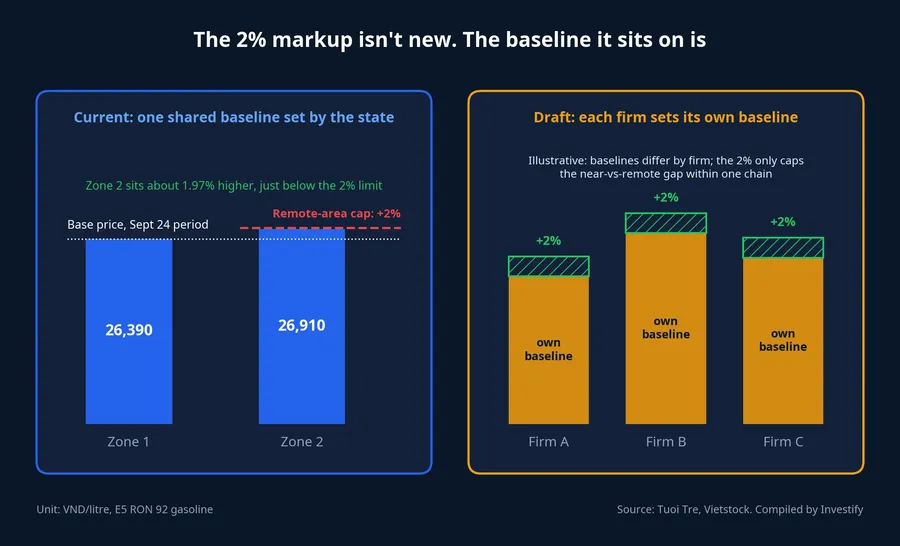
The draft lets wholesale importers charge more in areas far from ports and depots, but by no more than 2% above the price the company itself publishes at the same time.Vietstock Many readers took that 2% as a new rule. It is not. Under current regulations, importers may already charge up to 2% above the state-published price in remote areas.Znews
That is where Vietnam's "Zone 2" prices come from. In the September 24 period, one company listed E5 RON 92 at VND 26,390 per litre in Zone 1 and VND 26,910 in Zone 2, about 1.97% higher and just below the 2% limit.Tuổi Trẻ
The real change is the baseline the 2% is added to. Today that baseline is the state price, identical for every company, so people in remote areas know the most they can be charged. Under the draft, the baseline becomes each company's self-published price. Once firms set their own baseline, the 2% limit only caps the gap between near and remote areas within one chain. It no longer caps the absolute price.
Protection for people with few stations nearby therefore shifts from a ceiling to competition, and competition is weakest in exactly those places. Linh himself noted that the new mechanism could create price gaps between regions, especially where there are few companies or stations.Vietstock
The draft adds one backstop: distributors may not price above the highest-priced wholesale importer in the area.Vietstock But that ceiling is still set by the importers themselves. There may also be fewer of them. The draft tightens licensing conditions, including maintaining 20 days of reserves and a minimum allocated supply of 300,000 m³ a year for two consecutive years, with licences revoked for those who fall short.Công Thương According to Vietnamnet, applying this immediately would leave only 14 to 15 importers, and Long warned that in a highly concentrated market, price liberalisation may simply move pricing power from the state to a handful of large companies.Vietnamnet
Retailers and importers: who gets the margin
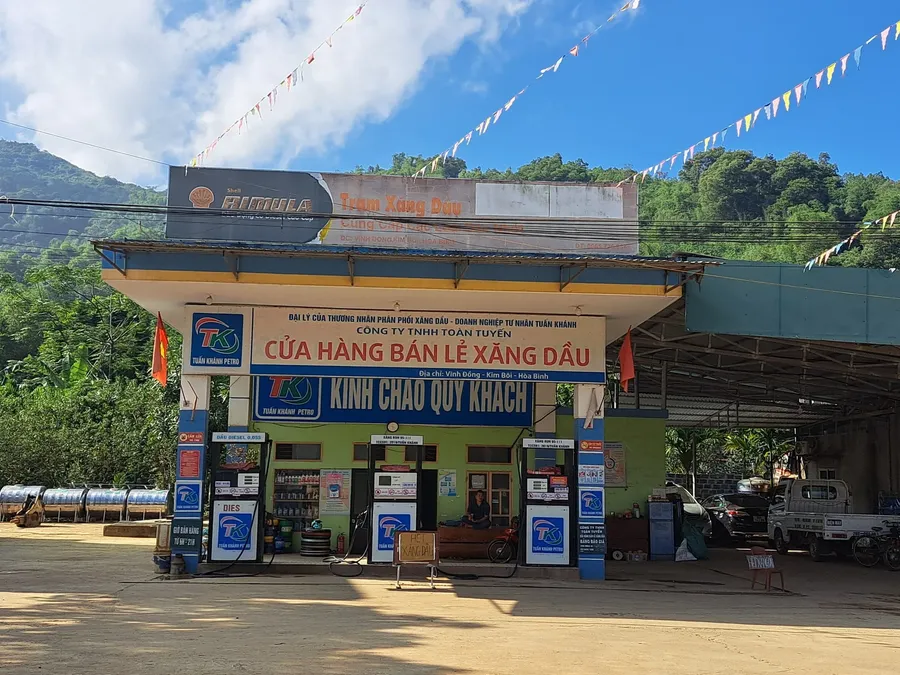
For retail stations, the current system is already painful. According to Nhân Dân, many distributors are operating on discounts squeezed to zero and making no profit.Nhân Dân With retail prices capped at the ceiling and wholesale prices running close to it, there is sometimes almost nothing left for the station.
Linh argued the new mechanism would give stations more room to manage discounts and operating costs.Vietstock Distributors see a different risk. Nguyễn Xuân Thắng, Director of Hải Âu Phát Petroleum Co., Ltd., worries that if importers decide the profit component, retail discounts could be pushed very low, even to zero. He proposed letting each trader set its own profit margin.Vietnamnet
Petrolimex, the largest importer, raised a related point. Its representative noted that if a distributor adjusts prices and the importer cuts its own price right afterwards, the distributor could end up priced above the importer, breaching the backstop through no fault of its own. The company asked for clear rules on the timing and mechanics of price changes.Vietstock
For investors, the two listed importers are Petrolimex (PLX on HoSE) and PV OIL (OIL on UPCoM). The most significant change for them is the profit line in the pricing formula, which would move from an amount embedded in the base price to one the company decides. That power cuts both ways: it opens up margin where competition is thin, but forces price cuts where competition is fierce. The net effect depends on the final decree and how the market responds, so it cannot yet be translated into a specific earnings figure.
The tools the state keeps
The draft does not abandon price stabilisation. It could be triggered when prices rise or fall continuously for one to four weeks, or move cumulatively by 15–20% or more within a short period.Nhân Dân Petrolimex proposed a single fixed threshold instead of a 15–20% range.Vietstock That matters: an open range leaves discretion with the regulator, while a fixed threshold lets both companies and buyers know in advance when the state will step in.
The ministry also proposed moving the price stabilisation fund from importers' books into an account at the State Treasury managed by the ministry. According to Linh, the order of priority would be taxes, fees, national reserves and minimum supply allocation, with state financial resources used for stabilisation only in special cases.Znews
Tax is the tool already in use. On September 30, the government issued Resolution 43/2026/NQ-CP, effective from October 1 through December 31, 2026.24h It keeps the MFN import duty, environmental protection tax and VAT on fuel at zero. Special consumption tax still applies: 10% on mineral gasoline, 8% on E5 and 7% on E10.VnExpress In the new formula, taxes remain the only component fully set by the state, which makes them the fastest lever regulators still hold.
Who wins, who pays
Side by side, the September 30 draft does not make fuel uniformly cheaper or more expensive. What it does is redistribute gains and losses according to how much competition exists in each place.
Drivers in cities, where several chains compete, are the clearest winners. With no common ceiling to anchor to, low-cost sellers have a reason to undercut, and buyers have choices along their route.
People in areas with few stations or far from depots carry the most risk. They lose the state-set ceiling and are left with a 2% cap on top of a price the company sets itself, with few rivals nearby to pull prices down.
Retail stations sit in the middle. They escape the squeeze between the retail ceiling and wholesale prices, but if importers control how the margin is split, discounts can still fall to zero. Large importers with infrastructure and low costs gain the most tools: they set their own profit, use price to win customers, and stricter entry rules may thin out the competition.
That direction only changes if the final version submitted to the government revises the key provisions. Worth watching: whether the stabilisation trigger is fixed or stays at a 15–20% range, whether the draft adds timing rules for price changes as Petrolimex requested, and how profit is split between importers and distributors. If the final text adds a requirement for real-time, station-level price disclosure, protection for people in low-competition areas would be stronger. Meanwhile, until December 31, fuel taxes stay at zero under Resolution 43, however fast or slowly the new decree moves.