

According to estimates released on the morning of October 2 by the Vietnam Association of Seafood Exporters and Producers (VASEP), pangasius exports reached about USD 214 million in September 2026, up 18.6% year on year. The seafood sector as a whole grew only 11.9% in the same month, to roughly USD 1.135 billion.TNCK It is tempting to read that number and conclude that pangasius exporters are heading into a strong quarter.
Between sector-wide export revenue and the bottom line of any single company, though, sit several filters: which markets a company sells into, the duty it pays to enter the US, and the price of raw fish. The second quarter showed how much weight those filters carry. This piece works down from the 18.6% headline through each of them, and ends with the data point that will settle the question.
One month's figure, not a full-year trend
Start with the time frame. Over the first nine months, pangasius exports reached about USD 1.74 billion, up 10.7%. Shrimp, which accounts for roughly 41% of seafood exports, reached USD 3.75 billion, up 11%.TNCK On a year-to-date basis, pangasius is still growing slightly slower than shrimp. The gap only really opened up in September.
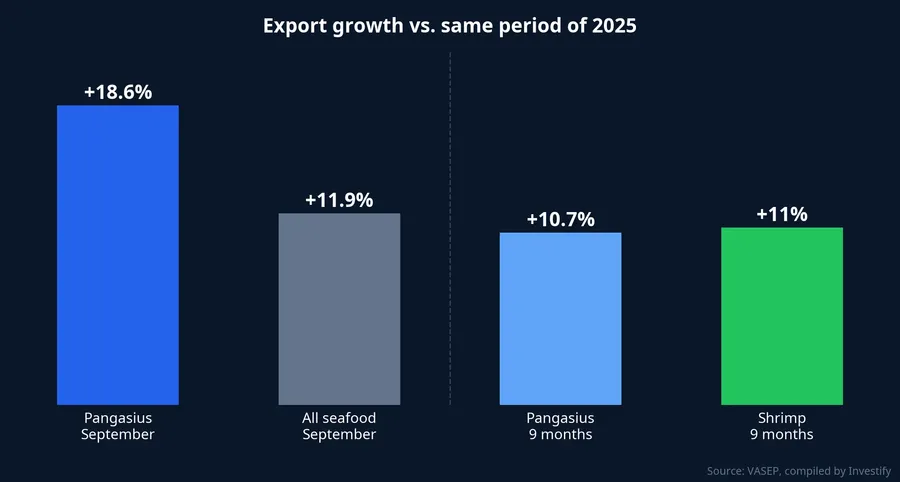
So the 18.6% figure is best read as a one-month signal, not an established trend. It is also an industry association estimate rather than official customs data. Neither point makes the number worthless, but both should shape how much weight investors put on it.
Why pangasius is outpacing the sector
The biggest force, according to VASEP, is on the global supply side. Supplies of some wild-caught whitefish species are tightening, pushing buyers toward substitutes.TNCK Pangasius is a natural candidate: it is also a whitefish, it is cheaper, and farmed supply is steadier than ocean catch. The association says that price advantage and supply reliability are drawing more interest to the fish.
In Japan, seafood group Kyokuyo continues to introduce pangasius through professional distribution channels. VASEP calls this a notable signal, while stressing that the market remains small, so it should not be treated as a main driver of the September numbers.
The remaining factor is where the goods are going. Across the entire seafood sector, China and Hong Kong imported about USD 315 million in September, up 39.9%, while ASEAN took nearly USD 84 million, up 45.4%. Going the other way, the US fell 3.4% to USD 176 million, the EU dropped 12.8% and Japan fell 13.7%.CafeBiz By VASEP's calculation, the additional sales to China and Hong Kong account for about 62% of the sector's overall growth.
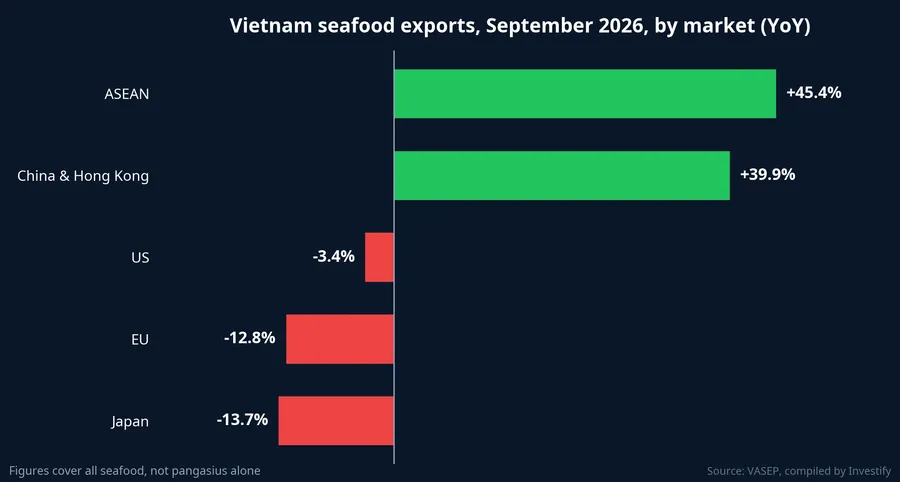
These are sector-wide figures, so they cannot tell us how much pangasius shipments to each country grew. The latest pangasius-specific data are for August: shipments to the US fell 54.8% to just USD 12.5 million, while China had already become the largest market, up 26.5% over eight months.TNCK Pangasius is moving in the same direction as the sector: more to Asia, less to the US.
The gains are not shared evenly
The 18.6% figure is an average. Individual companies sell into different markets and face different duties at the US border, so each one captures a different share of the upside.
The sharpest difference is anti-dumping duty. On August 12, the US Department of Commerce announced the final results of its 21st administrative review, setting Nam Viet (ANV) at USD 0.84/kg, more than 3.6 times the preliminary USD 0.23/kg. Since August 13, that has been the new cash deposit rate on Nam Viet's shipments to the US.Vietstock Vinh Hoan (VHC) is in a very different position as the only pangasius exporter exempt from anti-dumping duty.TNCK
That tariff advantage comes with a catch. Vinh Hoan's August report shows US revenue still at VND 231 billion but down 15% year on year, while China contributed only VND 113 billion despite growing 56%.Nhipsongnhadat In other words, Vinh Hoan's edge is in the very market that is shrinking, while its fast-growing China business is still a small slice of revenue. Nam Viet does not publish monthly revenue by market, and I.D.I (IDI) has no recent public breakdown either, so their exposure to each market cannot yet be quantified.
In the October 2 morning session, share prices were not following that logic. Nam Viet, the company facing the higher US duty, was sitting at its daily limit-up price of VND 17,000, up 6.92%, with nearly 2 million shares matched, more than four times the whole of the October 1 session. Vinh Hoan was up 1.2% and I.D.I up 2.44%, while the VN-Index was down 0.94%. There are several possible explanations. Short-term money may be trading on the sector headline, and a smaller-cap stock like ANV tends to react more sharply to news. The market may also be betting that Nam Viet can redirect shipments to Asia faster to sidestep the US duty. The available data cannot tell us which explanation is right, and a price move right after VASEP's release is not proof of cause and effect.
Higher revenue does not guarantee higher profit
This is what the export figures cannot answer. In Q2 2026, Nam Viet's revenue rose 12% to about VND 1,937 billion, but net profit fell nearly 60% to VND 134.8 billion. The reason was gross margin compressing from about 27.9% to 15.6%.TNCK In the same quarter, Vinh Hoan grew revenue 7.8% to VND 3,457 billion, and its gross margin improved from 19.7% to 20.5%.
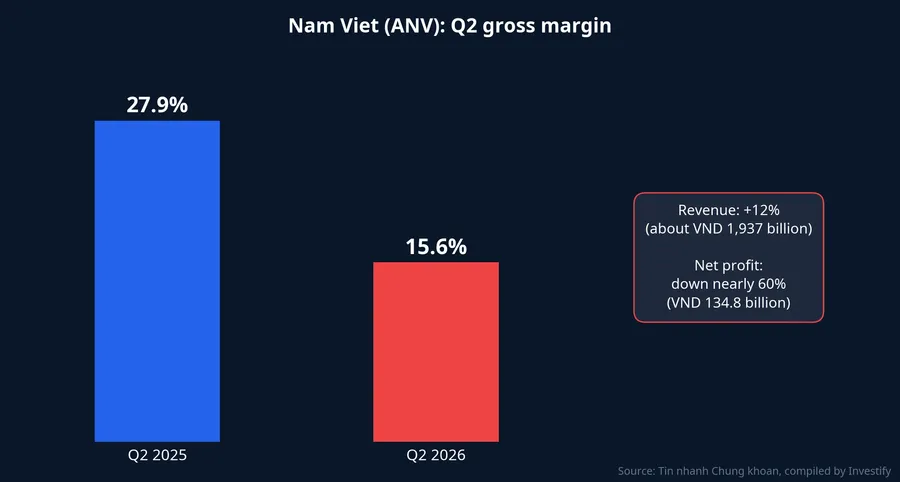
Both companies grew revenue, yet their profits moved in opposite directions. Notably, the gap appeared before the USD 0.84/kg deposit rate took effect in mid-August, which means Nam Viet's Q2 did not yet reflect the full cost of the new duty.
Input costs are part of the story. Farm-gate pangasius prices stood at VND 30,500/kg on October 1, 2026, about 15% above the VND 26,500/kg recorded on the same date last year. When raw fish gets more expensive, processors have to raise selling prices just to hold their margins. That is harder when Chinese buyers have more options: VASEP notes that China reopened fishing in the Yellow Sea and Bohai Sea in early September.CafeBiz Strong growth in that market may therefore come with pressure on selling prices.
VASEP itself expects Q4 to slow
The association does not treat September as the start of a new growth cycle. VASEP expects fourth-quarter exports to slow because many orders for year-end consumption shipped early, and puts full-year exports at around USD 12 billion. It also says shrimp, pangasius and tilapia are all facing raw material constraints.TNCK Even where demand holds up, exporters' ability to fill orders may be capped.
Put the pieces together and the picture is fairly clear. Pangasius is benefiting from tighter wild-caught whitefish supply and from trade shifting toward Asia. Those gains are uneven. The exporter with a US tariff advantage is watching the US market shrink, while the one facing a high duty has to push volume into markets where prices risk being squeezed. Above all, rising export revenue has not yet proven rising profit, as Nam Viet's Q2 showed.
The data point that will decide it
The current data are not enough to conclude that pangasius has entered a new profit cycle. The answer lies in the Q3 financial statements of listed pangasius exporters, expected in October. Q3 is also the first quarter to reflect the USD 0.84/kg deposit rate on Nam Viet's US shipments.
The number to watch is Q3 gross margin against Q2's 15.6%. If Nam Viet's margin edges up while revenue keeps growing, export gains are starting to turn into profit. If the margin keeps shrinking, September's 18.6% mostly reflects volume shipped, not earnings flowing to shareholders. For Vinh Hoan, the question is whether China becomes a large enough share of revenue to offset the decline in the US.