


Every piece of banking regulation comes with two dates worth remembering: the day it takes effect, and the day it actually binds a given bank. For Circular 50/2026/TT-NHNN, the gap between those two dates can stretch to almost two years. That is why the headline "banks can now lend up to 95% of deposits", which ran across Vietnamese media on October 1, deserves a slower read.
Skim it and you might conclude that every bank gains 10 percentage points of lending headroom from December. Read the text and the picture changes. The new cap sits inside a multi-year roadmap tied to two liquidity standards that most of the system only has to adopt from October 2028. The formula behind the ratio has also been rewritten, so the new 95% cannot be compared directly with the old 85%. This post walks through each milestone to answer one practical question: which cap will the bank you hold shares in face, and from when?
The circular is issued, but the new cap does not apply automatically
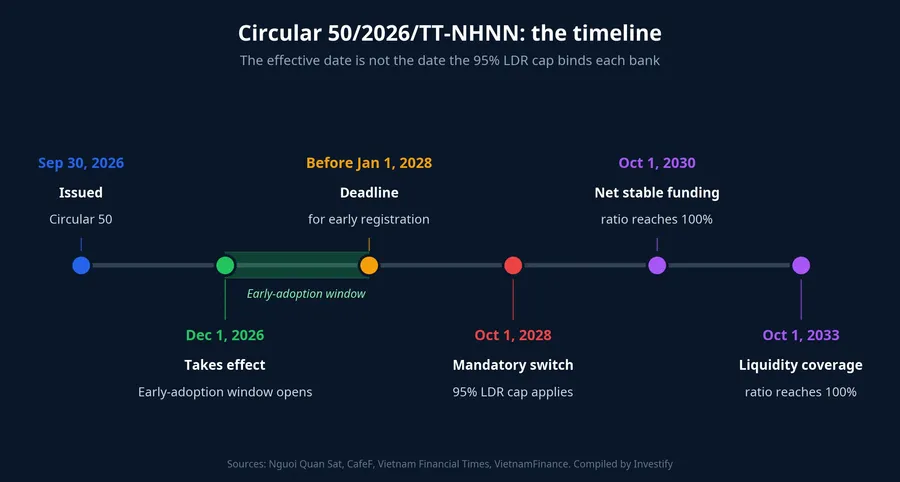
On September 30, 2026, the State Bank of Vietnam (SBV) issued Circular 50, which sets prudential limits and safety ratios for commercial banks and foreign bank branches.Người Quan Sát The document runs to 3 chapters, 38 articles and 4 appendices. It builds on Circular 22/2019 and aligns with the Basel III international risk management framework.Thời báo Tài chính
The most quoted provision is Clause 6 of Article 12: banks must keep their loan-to-deposit ratio (LDR) at a maximum of 95%.CafeF The cap currently in force under Circular 22/2019 is 85%.Thanh Niên However, Article 12 itself defers the timing of the LDR requirement to Article 13, and Article 13 is where you find out which banks the 95% actually reaches.
The circular takes effect on December 1, 2026.Thời báo Tài chính Article 13 ties the new LDR cap to a bank's switch to two Basel III liquidity ratios. Banks that have not switched stay under Circular 22/2019 and its 85% cap.VietnamFinance In other words, no bank automatically gets to lend up to 95% of its deposits on December 1.
What the two new liquidity ratios measure
To see why a lending cap depends on liquidity, look at the two ratios Circular 50 introduces. The liquidity coverage ratio asks whether a bank holds enough easily sold assets (cash, deposits at the SBV and certain eligible securities) to cover its net cash outflows over 30 days. The net stable funding ratio compares the stable funding a bank actually has with the stable funding it needs to support its assets and off-balance-sheet exposures.Người Quan Sát
Put simply, the first ratio tests how well a bank can withstand a short-term run on deposits. The second tests how well the maturities of its funding match the maturities of its loans. The circular's logic is straightforward: a bank that can prove a sturdier liquidity base earns a looser lending cap.
The early-adoption window: December 1, 2026 to before January 1, 2028
This is the period that decides which banks get the new cap ahead of the rest of the system. From the effective date until before January 1, 2028, banks may apply in writing to the SBV to adopt the two liquidity ratios ahead of the mandatory date.VietnamFinance They can register either to follow the phase-in schedule set out in the circular or to apply the 100% threshold for both ratios straight away.Thanh Niên
The paperwork is demanding. An application must include an assessment by the board of directors (or by the general director, for a foreign bank branch) and a report from an independent auditor confirming that the bank fully met both ratios on the last day of each month for 3 consecutive months before applying.VietnamFinance The registered thresholds apply from the first day of the following month.Người Quan Sát
Three audited months in a row means this window is really open only to banks that have already built the data systems and funding structure in advance. None of the October 1 reports named a bank planning to apply. We will not guess either, since outsiders do not yet have bank-by-bank figures for the two new ratios.
October 1, 2028: the whole system moves to the new framework
Under the circular's roadmap, from October 1, 2028 every bank that has not adopted early must apply the two new liquidity ratios.Thời báo Tài chính The starting minimums are 50% for the liquidity coverage ratio and 90% for the net stable funding ratio.CafeF
Once a bank has switched to these ratios but has not yet reached the 100% thresholds, it applies the 95% LDR cap. In exchange, it no longer has to comply with three ratios under Circular 22/2019: the old-style liquidity ratio, the cap on using short-term funds for medium- and long-term lending, and the old LDR.Thời báo Tài chính
The second item gets little attention but deserves some. The limit on funding long-term loans with short-term money is a familiar constraint for banks heavy in mortgages and project lending. Once it is replaced by the net stable funding ratio, the way these banks manage the maturity profile of their funding will have to change too.

Why the new 95% is not the old 85% plus 10 points
The LDR formula in Article 12 changes both the numerator and the denominator.CafeF The numerator is on-balance-sheet loan principal on which the bank bears credit risk, including entrusted loans. Loans to other credit institutions and SBV refinancing that is not for liquidity support are excluded.
The denominator is where the biggest changes are, and they pull in opposite directions. On the plus side: charter capital, reserve funds, share premium, undistributed profit, foreign borrowings (including bonds issued on international markets), domestic bonds that qualify as Tier 2 capital, and entrusted funds on which the bank bears the risk. On the minus side: deposits from other credit institutions, margin deposits, earmarked funds, all demand deposits and 80% of term deposits from the State Treasury (or another ratio set by the Governor from time to time).Thời báo Tài chính The denominator is then reduced by non-loan credit extensions and by holdings of corporate bonds, except bonds issued by domestic credit institutions and VAMC special bonds.CafeF
The upshot is that the same bank can produce two very different LDR figures under the two methods. A bank with a thick equity base, plenty of foreign borrowing and a lot of Tier 2 bonds outstanding gets a larger denominator and a lower ratio. A bank that relies heavily on State Treasury deposits or holds a large corporate bond book sees its denominator shrink and its ratio rise. Người Quan Sát notes that the gap between the two caps cannot be translated directly into actual lending capacity.Người Quan Sát To know whether a given bank gains or loses headroom, you have to wait for that bank to recalculate under the new formula. So far, no outlet has reported a recalculated figure for any bank.
The 2030 and 2033 end points: the right to be exempt
The net stable funding ratio rises to 95% from October 1, 2029 and 100% from October 1, 2030. The liquidity coverage ratio rises by 10 percentage points a year and reaches 100% from October 1, 2033.Người Quan Sát The stable funding requirement therefore reaches its target three years earlier.
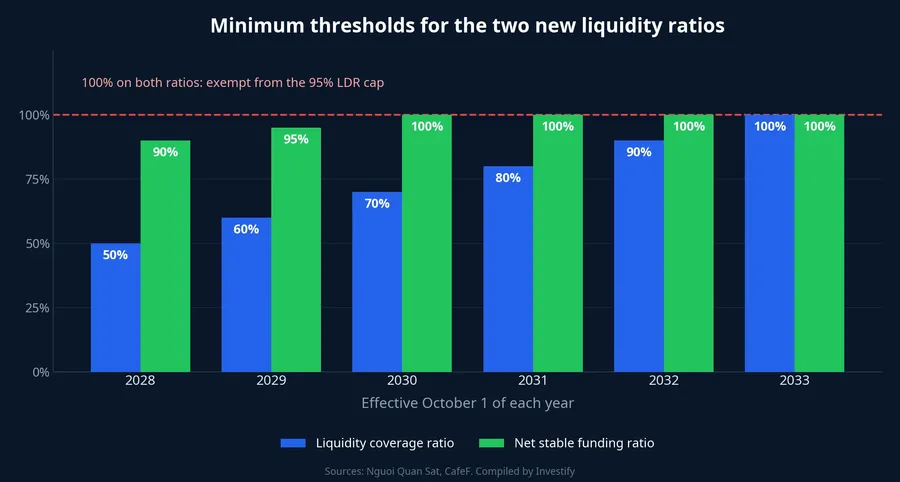
The 100% mark matters because it unlocks an exemption. A bank applying the 100% minimum on both ratios does not have to comply with the 95% LDR cap, although it must still calculate and report the ratio.CafeF A strong enough bank need not wait until 2033: it can register for the 100% thresholds straight away during the pre-2028 window.
Nor is the exemption permanent. Based on inspection and supervision findings, the SBV may require an exempt bank to comply with the LDR again, and may impose limits tighter than those in the circular depending on each bank's risk profile.Người Quan Sát
Where bank shareholders stand
On October 1, the day the news broke across the press, the VN-Index closed at 1,749.30 points, down 1.09%. The decline was broad-based, and there is no basis for pinning it on the circular alone, since the rules are still two months from taking effect.

Our central reading is this: in Q4 2026, Circular 50 does not change any bank's lending headroom. The rules only take effect on December 1, and a bank wanting to adopt early needs three consecutive audited months of compliance before it can even apply. Anyone planning a mortgage or a business loan should likewise understand that this regulation is not a new source of credit for the end of this year.
Differences between banks will only start to surface once the first applications are approved. Early adopters will move to the 95% cap under the new formula and shed Circular 22's limit on funding long-term loans with short-term money. Everyone else stays on the old framework until October 1, 2028. Even for the early movers, the benefit depends on whether each bank's new denominator grows or shrinks, so "adopting early" does not automatically mean "lending more".
The signals worth tracking all come from the banks themselves: disclosures of an application to the SBV, what management says at shareholder meetings and investor briefings, and whether financial statement notes start reporting the LDR under the new method. The registration window closes before January 1, 2028. Any bank that has not applied by then will follow the standard roadmap from October 2028.