
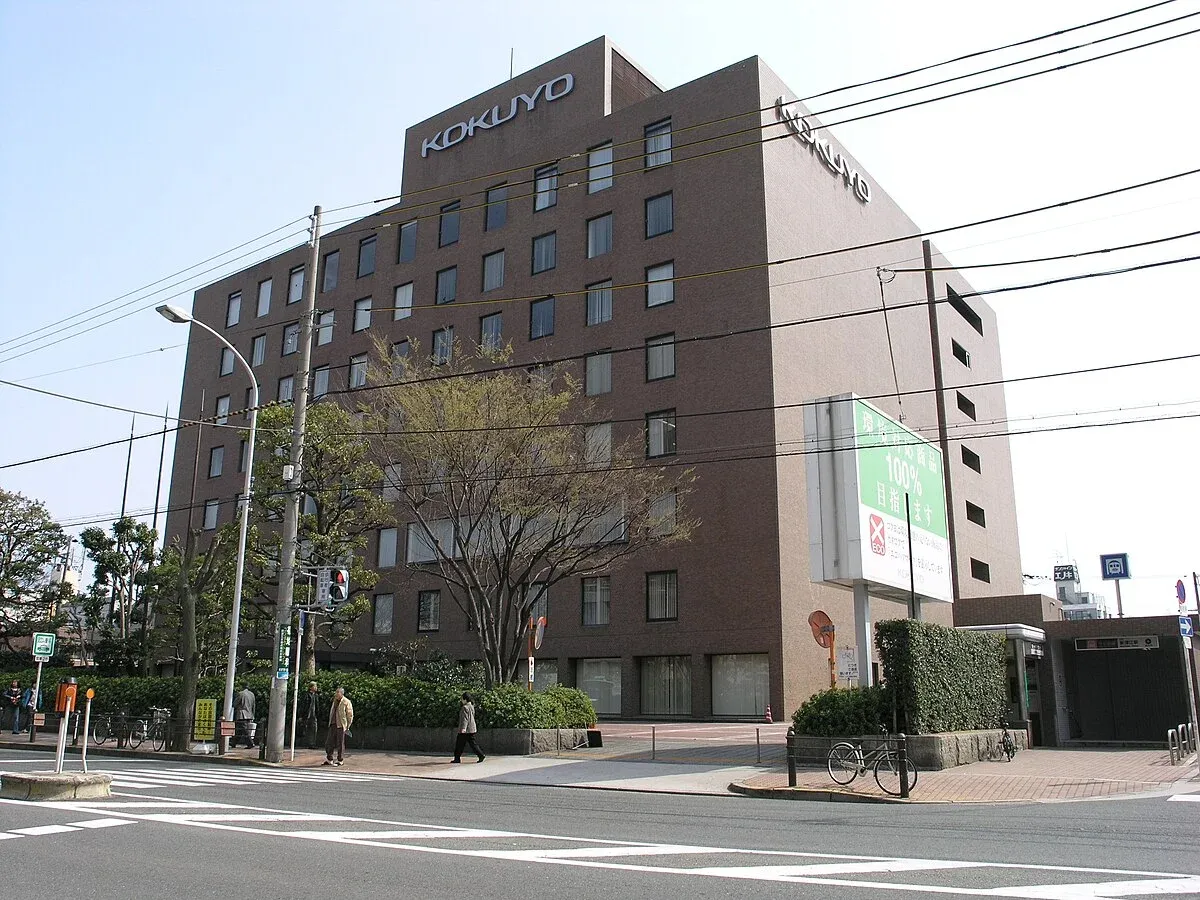

On September 30, 2026, the board of Kokuyo, the Japanese stationery group, approved a JPY 28 billion capital injection (roughly VND 4,460 billion at Vietcombank's October 1 exchange rate) into the Singapore vehicle it set up to buy 65% of Thien Long Group (TLG).Vietstock A number that large naturally makes TLG holders think about the share price. Put simply, though, this is news about progress, not price. The deal has moved one step forward, and the only step that reaches small shareholders, a tender offer for up to 18.19% of the company, still has neither a price nor a timetable.Người Quan Sát
This post walks through the milestones since late 2025, pins down where a TLG holder stands today, and explains how the tender offer will work once it arrives.
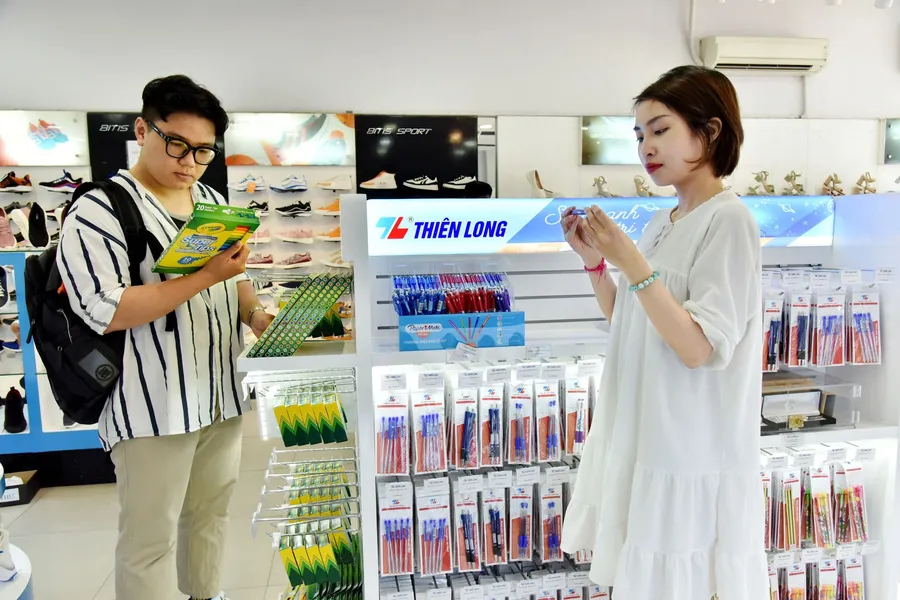
A two-step plan from late 2025
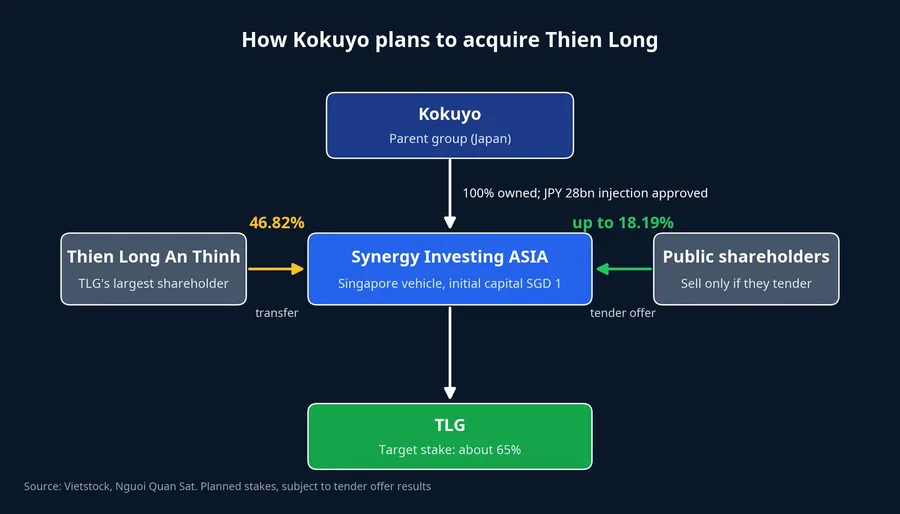
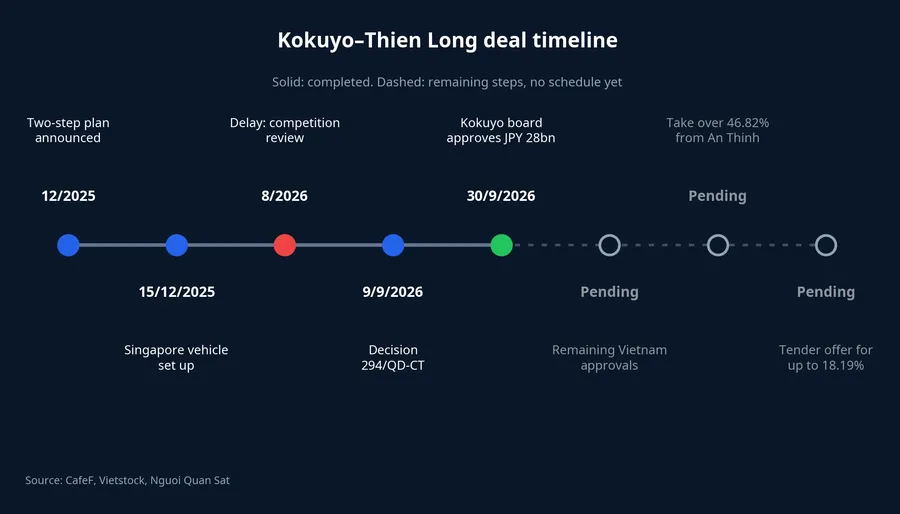
Kokuyo unveiled the plan in December 2025 with a two-step structure.CafeF First, it would take over the 46.82% TLG stake held by Thien Long An Thinh Investment JSC. An Thinh is TLG's largest shareholder and another business of Mr. Cô Gia Thọ, Chairman of the Board of Thien Long Group JSC and the company's founder. Second, Kokuyo would launch a public tender offer for up to 18.19% more, lifting its holding to about 65% and making Thien Long a subsidiary.Người Quan Sát
On December 15, 2025, Kokuyo set up Synergy Investing ASIA in Singapore, wholly owned, with starting capital of just SGD 1.Vietstock Think of it as an empty wallet opened in advance: it will be the named buyer of the Thien Long shares, and the real money gets loaded in later. At the time, Kokuyo put the total deal value at about JPY 27.6 billion and expected to close the An Thinh leg in August 2026, followed by the tender offer in October and November 2026.CafeF
The schedule slipped on competition review
The August 2026 milestone came and went. According to Vietcap Securities, Kokuyo said at an investor meeting that month that the process would take longer because the review under the Competition Law was running past its expected timeline.CafeF
The delay is not hard to understand. Kokuyo is a stationery group, and Thien Long is Vietnam's leading pen maker. When two companies in the same industry combine, regulators treat it as an economic concentration, and the National Competition Commission has to clear it before it can proceed.
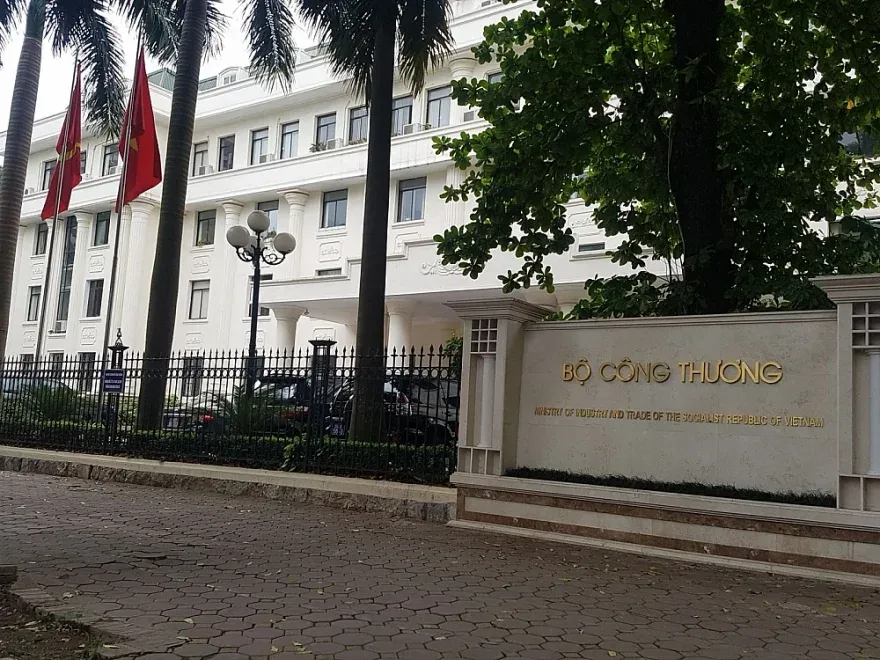
On September 9, 2026, the Chairman of the National Competition Commission (under the Ministry of Industry and Trade) issued Decision 294/QD-CT, classifying the deal as a conditionally permitted economic concentration.Người Quan Sát The decision allows the transaction to go ahead. It does not mean Kokuyo already controls Thien Long.
The strings attached to the clearance
In return for the green light, the post-deal group takes on a set of commitments. Per Người Quan Sát, the main conditions are:
- Report on request on pen market share, average buying and selling prices, trade discount policies and sales support programs.
- Adopt internal rules on competition-law compliance, with annual staff training.
- File a plan before December 31 each year covering technology adoption, recycled-material ratios, workforce, new product lines and international competitiveness.
- Raise R&D spending by VND 3 billion each year over the previous year, for five consecutive years.Người Quan Sát
Against Thien Long's size, an extra VND 3 billion a year is small: TLG booked net revenue of VND 2,353.6 billion in the first half of 2026 alone. The real weight of these conditions lies elsewhere. Once the ownership changes, Thien Long reports not only to its shareholders but also to the competition authority on pricing and discounts in its pen business, a mechanism for checking whether a market leader is using its position to squeeze prices.
The money is approved, not yet transferred
Three weeks after the competition decision, Kokuyo's board approved the JPY 28 billion injection into Synergy Investing ASIA, slightly above the original JPY 27.6 billion estimate. After the injection, the Singapore vehicle's capital will exceed 10% of Kokuyo's own, making it a material subsidiary of the group.Vietstock
TLG holders should read this milestone carefully on two points. First, JPY 28 billion is capital put into an intermediate vehicle, not a disclosed per-share price. It says nothing about what Kokuyo pays An Thinh for its block, and even less about the tender offer price, so dividing it out to guess a price is not meaningful.
Second, the money has not moved yet. According to Kokuyo's disclosure, the timing of the injection is undetermined and depends on necessary approvals from the competent authorities in Vietnam.Người Quan Sát Kokuyo has not specified which approvals these are.
Where a TLG holder stands now
Per Vietcap, the remaining work is to complete the An Thinh transfer, launch and complete the tender offer, and then consolidate TLG into Kokuyo's financial statements.CafeF In sequence, three steps still lie ahead of a TLG holder:
- Remaining approvals in Vietnam. These are the precondition for Kokuyo's money to flow into the Singapore vehicle.
- Transfer of the 46.82% block from Thien Long An Thinh. This is a deal between two institutions; small shareholders play no part.
- A tender offer for up to 18.19%. This is the only step in the whole deal where TLG holders on the exchange are asked whether they want to sell.
How a tender offer works
A tender offer is like the buyer posting a notice to every shareholder: "I want to buy up to this many shares, at this price, within this window." It differs from quietly accumulating on the order book, because anyone who wants to sell must register and receives the same price, regardless of who they are. Under current rules, TLG holders should understand four things.
Kokuyo sets the price, but there is a floor. The offer price cannot be lower than the average reference price over the 60 trading days before the tender offer registration is filed. If the bidder raises the price midway, the new price applies to every shareholder who has registered to sell.VCCI
The filing goes through the State Securities Commission. Kokuyo will submit a tender offer registration, and the processing time has been cut from 15 days to 7 working days under Decree 245/2025.Báo Chính phủ The price and schedule only become official once the offer disclosure is published.
The sign-up window is limited. An offer runs for at least 30 and at most 60 trading days from the first day of registration.VCCI Shareholders register through the brokerage that holds their shares in custody, following the instructions in the disclosure.
If the offer is oversubscribed, purchases are prorated. When more shares are tendered than Kokuyo is seeking, each shareholder sells only a portion, in proportion to the shares they tendered, with no priority for early registrants.VCCI Whatever isn't bought stays in your account.
Tender or hold: where each path leads
This post does not say which choice is better, because the answer depends on an offer price nobody knows yet. What it can do is lay out where each path leads.
If you tender, you receive the offer price for whatever portion Kokuyo buys. If many holders sign up and the total exceeds 18.19%, purchases get prorated, so you are unlikely to sell your entire position. The rest keeps trading on the exchange as usual.
If you hold, you become a minority shareholder in a Kokuyo subsidiary. With Kokuyo at about 65% and Mr. Thọ and related parties at about 10%, all other shareholders together would hold only about a quarter of the company.Người Quan Sát That slice includes long-term fund holders, so the shares actually changing hands could be thinner still.
Holding has two consequences. The first is liquidity: in September 2026, TLG traded only about 205,000 shares per session on average, and a shrinking free float makes large trades harder. The second is control. With about 65%, Kokuyo can pass most AGM resolutions on its own, including dividend policy and investment plans. On the management side, Mr. Thọ said at the 2026 AGM that he expects to stay with the group for at least the next three years.CafeF
How the market is reading the deal
On the chart, TLG has essentially round-tripped. It closed at VND 53,900 on October 1, 2026, only about 1.8% above the adjusted VND 52,928 of December 3, 2025, just before the Kokuyo news broke. The initial reaction last December was strong: TLG rose 4.98% on December 5, 2025 on more than 1.56 million matched shares, then peaked at VND 57,603 on December 8 before pulling back. When news of the competition decision came out, TLG fell 1.47% on September 22, 2026 even as volume climbed to 698,100 shares.
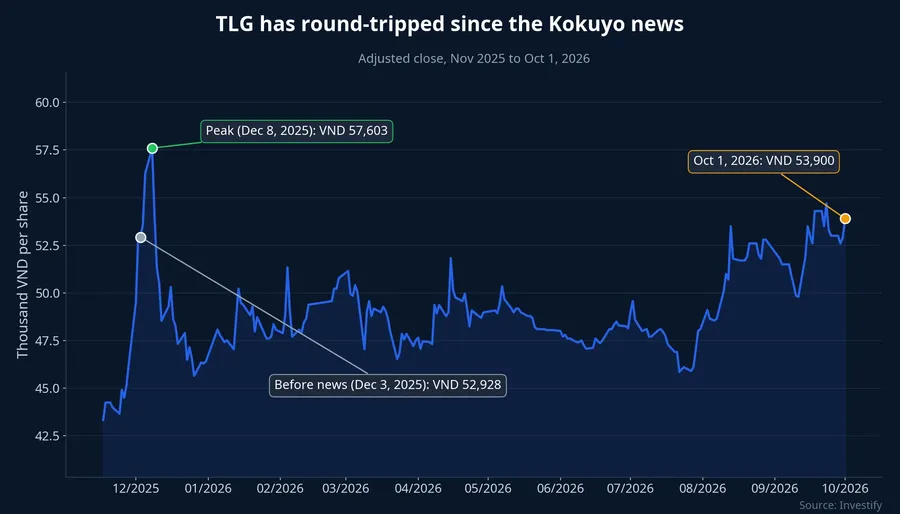
Several explanations could account for the price not tracking the deal's progress. One is that the market is waiting for the offer price: without it, nobody can size the premium. Another is the cap at 18.19%. If many holders tender, each sells only a portion, so any higher price would not apply to their whole position. A third comes from earnings. In the first half of 2026, net revenue rose 15.4% year on year, but net profit grew just 4.9% to VND 315 billion as selling expenses jumped 21.4%. The available data cannot say which factor dominates, but a price that barely moved through two major headlines suggests the market has not yet priced in any specific offer level.
Signals to watch
For Thien Long itself, the destination is fairly clear. The deal has cleared competition review, Kokuyo's board has approved the funding, and the company is on track to become a Kokuyo subsidiary, bound by the commitments in Decision 294/QD-CT. For small shareholders it is different: the evidence is not enough to judge which choice serves them better until the offer price is announced.
The next signal worth watching is a notice that the 46.82% transfer from Thien Long An Thinh has closed, since the tender offer can only follow after that. Once the offer disclosure is published, you will have the three numbers you need: the offer price, the registration window, and the maximum number of shares Kokuyo will buy. At that point, setting the offer price against the market price and the 60-session average, and factoring in the chance of selling only part of your holding if tenders exceed 18.19%, will show you exactly what choice you are facing.