

Say you hold 1,000 HDB shares. On the ex-rights date, expected to be Friday, October 9, you open your brokerage app and see your account worth over VND 6 million less than the day before. You haven't lost a single dong. That is simply how the market re-slices the pie when HDBank pays its 2025 dividend in shares instead of cash.
HDBank has set October 12, 2026 as the record date for a stock dividend plus bonus shares, totalling 30%.CafeF Every 100 shares will receive 30 more. This post covers two things: why the bank chose to keep the money, and what happens to your account at each step between now and late November.
Where the 30 new shares come from
Think of the 30 shares as coming out of two different drawers on the bank's balance sheet.
The larger part is a 25% stock dividend: 25 new shares per 100 held. HDBank will issue up to just over 1.25 billion shares for this, funded from undistributed 2025 profit after tax and fund appropriations, equal to VND 12,513 billion at par.Người Quan Sát This is money the bank could have paid out in cash had it wanted to.
The smaller part is a 5% bonus share issue: up to just over 250 million shares, worth VND 2,502 billion at par, drawn from the charter-capital supplementary reserve.Người Quan Sát That reserve was set aside from earlier years' profits precisely for raising capital, so turning it into shares just puts it to its intended use.
Together, HDBank's charter capital is expected to rise from VND 50,053 billion to more than VND 65,069 billion.CafeF Put simply, the bank's equity does not grow by a single dong from this exercise. Retained earnings and the capital reserve already sit inside equity; the share issue merely relabels them as charter capital. The real difference is that roughly VND 12,513 billion stays in the bank rather than walking out the door as a cash dividend would.
Why HDBank isn't paying cash
According to CafeF, the additional charter capital is earmarked for medium- and long-term lending and working capital.CafeF A bank's equity works a bit like the down payment on a mortgage: the bigger your own stake, the more you can borrow against it. The more a bank lends, the more capital it needs to keep its safety ratios within limits.
And HDBank is lending fast. As of June 30, 2026, outstanding credit reached VND 698,355 billion, up 18.76% year-to-date, while deposits reached VND 932,437 billion, up just 12.1%. Total assets climbed to VND 1.045 quadrillion, up 12.3%.Người Quan Sát When lending outpaces both deposits and the balance sheet, the case for retaining profit as capital is well grounded.

Lending needs aren't the only explanation, though. Paying in shares is also what HDBank did last time. In late 2025, it paid its 2024 dividend as a 25% stock dividend plus 4.69% bonus shares, lifting charter capital from VND 38,594 billion to more than VND 50,053 billion.Vietstock A larger capital base also sets the stage for the private placement that follows. The credit data suggests "keep capital to lend" is the heaviest motive, with a familiar dividend policy and the broader capital-raising roadmap as supporting factors.
A 1,000-share HDB account, step by step
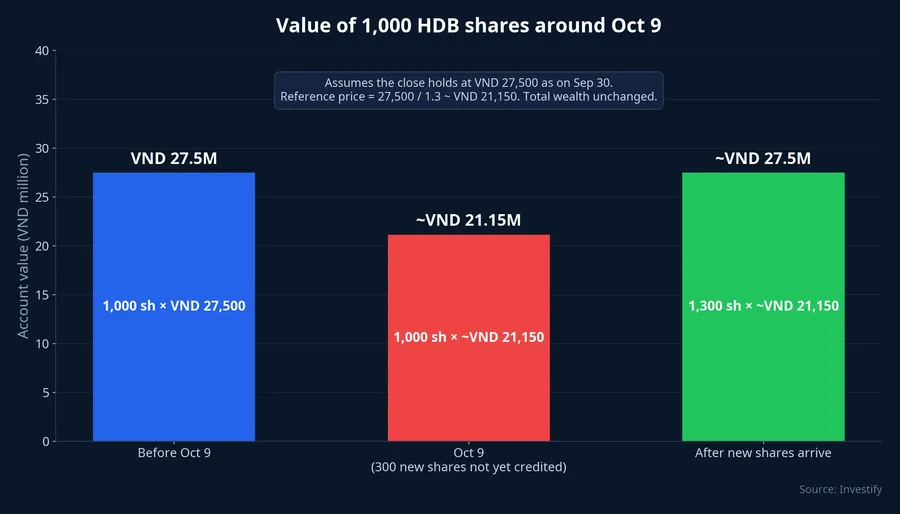
Let's walk through a concrete example. HDB closed at VND 27,500 on September 30, so 1,000 shares were worth VND 27.5 million. To keep things simple, the steps below assume the price holds at that level until the ex-rights date.
Friday, October 9: reference price divided by 1.3
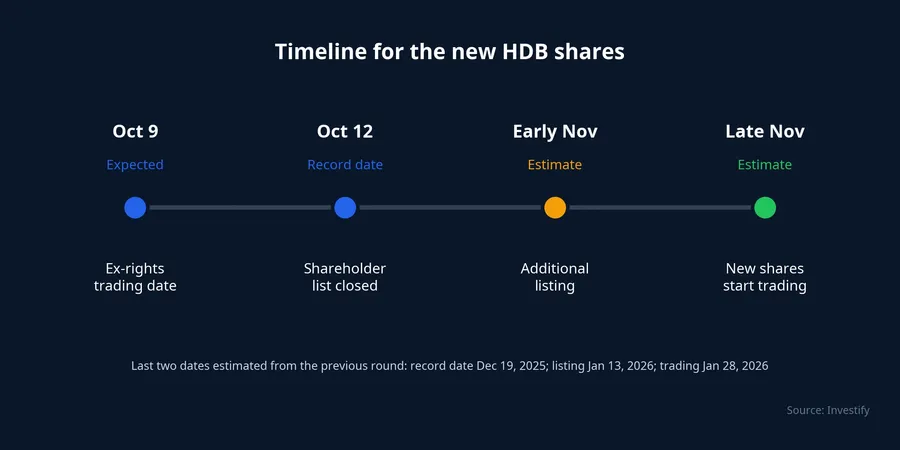
The October 12 record date falls on a Monday, so the ex-rights date is expected to be the session before, Friday, October 9. Double-check this against the official notice from HOSE or the Vietnam Securities Depository and Clearing Corporation (VSDC).
On that day, HDB's reference price is adjusted to the previous close divided by (1 + 25% + 5%), i.e. divided by 1.3. From VND 27,500, the new reference price comes to about VND 21,150. Your 1,000 shares are now worth about VND 21.15 million, because the 300 new shares haven't been credited yet. Depending on your broker, they may show up as "pending entitlements" or not appear at all.
Once those 300 shares arrive, 1,300 shares at about VND 21,150 add back up to roughly VND 27.5 million. Nothing is lost and nothing is gifted. One detail worth remembering: anyone who buys HDB from October 9 onward won't receive the 30%, while anyone who sells from October 9 keeps the entitlement. The lower reference price already accounts for that.
Monday, October 12: record date
VSDC compiles the list of entitled shareholders on this day. If you're on it, there's nothing to do: the shares are credited straight to your custody account.
Around late November: new shares become tradable
The new shares don't arrive immediately. In the previous round, the record date was December 19, 2025.Vietstock Nearly 1.15 billion new shares were listed on January 13, 2026 and began trading on January 28, 2026.DNSE That's roughly 25 days to listing and about 40 days until the shares could be sold.
If this round follows a similar rhythm, the 300 new shares would be listed around early November and become tradable around late November. This is only an estimate based on the last round, as the official schedule hasn't been announced. Meanwhile, your original 1,000 shares trade as usual.
Taxes and fractional shares
Shareholders who receive stock dividends don't pay tax on receipt. Personal income tax only applies when those shares are sold: 5% of par value plus 0.1% of the sale value.KIS At a par value of VND 10,000, the 5% works out to VND 500 per dividend share. For the 250 shares received from the 25% dividend, that's VND 125,000, plus the usual 0.1% on the sale value.
If your holding isn't a round number, say 1,005 shares, your entitlement will include a fraction. Press reports haven't said how HDBank will handle fractional shares this time. The safest route is to read the fractional-share section of the issuance plan or ask the broker where your shares are held.
The earnings picture and the EPS arithmetic
In the first half of 2026, HDBank posted pre-tax profit of VND 13,202 billion, up 31.1% year-on-year, with ROE of 25.4% and ROA of 2.17%.CafeF The full-year target is VND 30,100 billion in pre-tax profit, up 41% from 2025. Six months in, the bank has covered about 43.9% of that goal.
These numbers explain why the bank had enough profit to pay a 25% dividend. They also raise a piece of arithmetic every HDB holder should know. After this issue, the same profit gets split across 30% more shares. If profit stood still, earnings per share (EPS) would fall by about 23% purely from the division.
To keep EPS flat, profit needs to grow by about 30%. First-half growth of 31.1% sits only slightly above that bar, which leaves little cushion. For shareholders, then, the quality of earnings growth in the coming quarters matters more than the 30% ratio itself.
The 700-million-share private placement is a separate story
After the 30% issue, HDBank also plans to sell 700 million shares privately to professional securities investors during 2026–2027. The plan has been approved by the AGM and by the State Bank of Vietnam, and is expected to lift charter capital to more than VND 72,000 billion.CafeF The VND 7,000 billion figure in that roadmap is par value, not the cash raised. The actual proceeds depend on the offer price.
Unlike the 30% issue, which is distributed pro rata to all shareholders, the private placement goes only to a selected group of investors. Against roughly 6.5 billion shares after the 30% issue, 700 million new shares equal about 10.8% of the share count at that point. If fully sold, every existing shareholder's stake would shrink by about 9.7%.
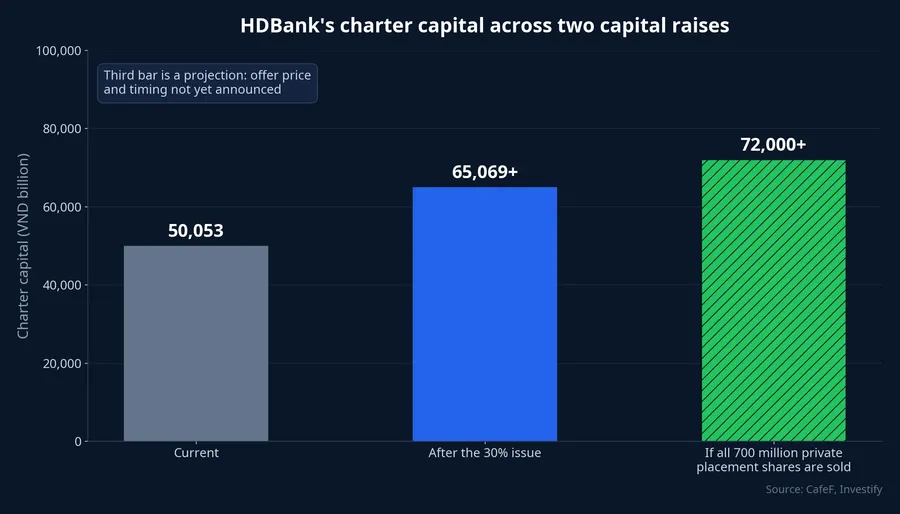
The offer price, the list of buyers and the timing have not been announced. The offer price is the variable that decides whether this round helps or hurts existing shareholders. Sell high, and each existing share gains a slice of the new capital. Sell low, and ownership is diluted without enough capital coming in to compensate.
What HDB shareholders get, and what they don't
On October 9, HDB holders get neither richer nor poorer, because the reference price falls by exactly the value of the incoming shares. On October 12, they're on the list without lifting a finger. Around late November, if the last round's rhythm repeats, they can sell 300 new shares per 1,000 held, paying 5% of par on the dividend portion when they do.
What shareholders don't get is cash. In exchange, more than VND 12,500 billion of profit stays in the bank as lending capital, at a time when credit has grown nearly 19% in just six months. The 30% ratio itself is neutral for your wealth. Whether the choice pays off depends on how productively HDBank deploys the capital it kept.
Two signals will answer that. The Q3 financial statements, expected in October, will show whether profit can keep growing at around 30% to offset the larger share count. The board resolution on the private placement price will show where the 700 million shares are priced relative to book value. Profit holding its pace and a high offer price would mean retaining earnings is working for shareholders. Slowing profit or a low offer price would mean each share's slice gets thinner.