
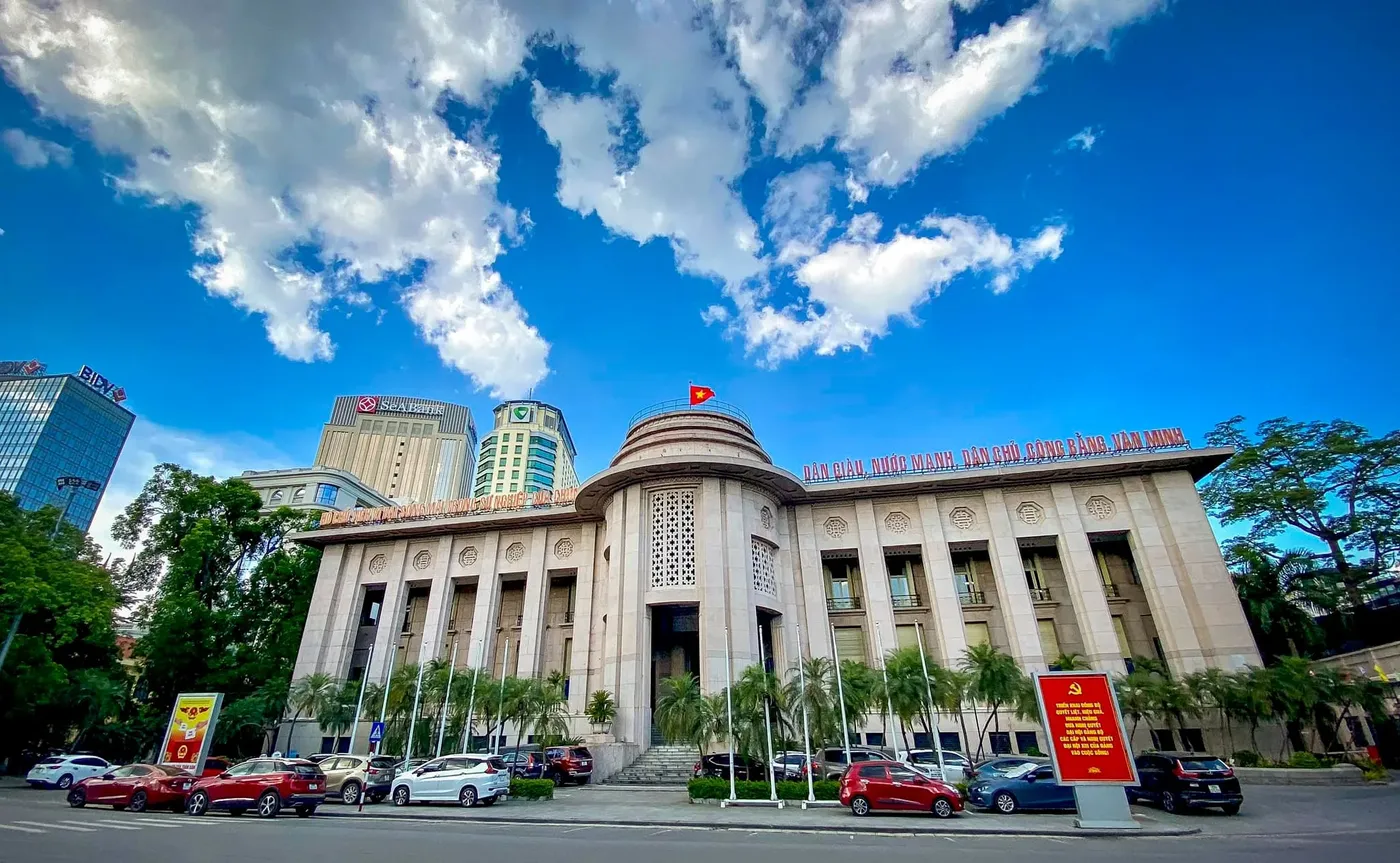

A draft circular on anti-money laundering (AML) supervision has worried many large depositors and priority banking clients in Vietnam over the past week. The reason lies in how the document was reported: VIP customers, bank executives and politically exposed persons were named next to the word "supervision". On the evening of September 29, the State Bank of Vietnam (SBV) sent a response to the press that reframed the story. According to the drafting agency, the party being supervised and risk-rated is the bank, while customers are simply numbers in the reports banks submit.
This piece walks through the draft, the SBV's response, and what may change for depositors, banks and investors holding bank shares. One caveat up front: this is still a draft under public consultation, and the issued version may differ.
Why depositors got worried
On September 25, Thanh Niên reported that bank executives, VIP customers and politically exposed persons "will be brought into the AML supervision data system".Thanh Niên Three days later, Tuổi Trẻ ran the headline "Separate supervision of VIP customers and bank executives to combat money laundering", with a lead saying VIP and priority customers "will be counted and monitored separately".Tuổi Trẻ
The concern was not baseless. The draft really does mention VIP customers, priority customers, politically exposed persons and bank leadership. Banks would have to list members of the board of directors or members' council, the supervisory board and executives from division director upward, with names, nationalities and charter capital ownership, plus information on major shareholders.Tuổi Trẻ Reading that, it is understandable for someone with a large balance to assume their account is about to land on a watchlist.

Ask the reverse question, though (who exactly is being supervised?) and the text gives a different answer.
The SBV's response: supervision targets legal entities
In its response to the press on the evening of September 29, the SBV said the reading that the draft "puts VIP customers, priority customers or bank executives under supervision" does not reflect its legal substance.Dân trí Citing Clause 2 of Article 1 and Clause 2 of Article 2 of the draft, the SBV said the supervised parties are "reporting entities": credit institutions, foreign bank branches and payment intermediaries. All of them are legal entities, not individual customers or individual bank executives.VietNamNet
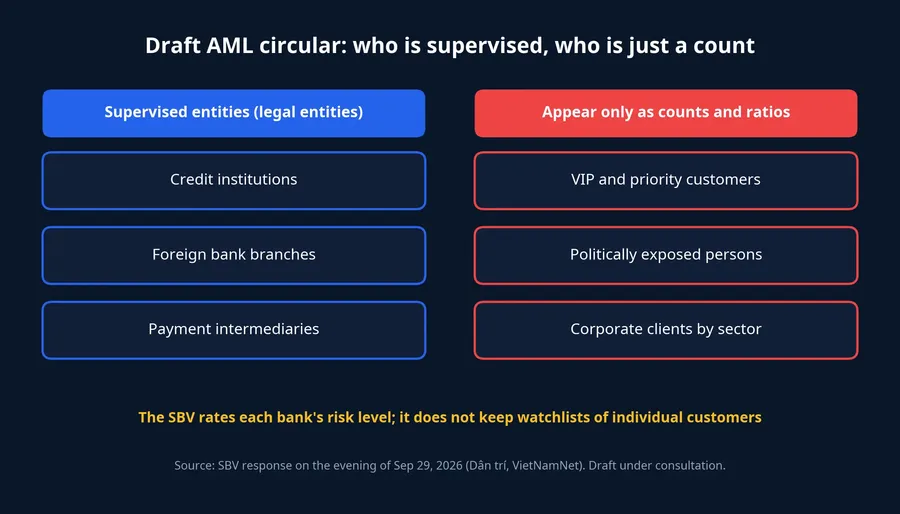
That response addresses depositors' concerns on several fronts. First, banks report counts, not lists. Credit institutions report total customer numbers broken down by group, such as individual customers, corporate customers, VIP customers or businesses in certain sectors. According to the SBV, these figures feed an overall risk assessment, and the regulator "does not supervise or keep watchlists" of VIP customers, priority customers or politically exposed persons.VietNamNet
Second, belonging to a counted group does not mean being treated as a risk. The SBV said a customer falling into one of the counted groups does not become a separately supervised party, nor is that customer presumed risky or in breach of AML rules. It also noted that describing the draft as "extending supervision from bank executives to VIP customers" could suggest large depositors are inherently a criminal-risk group, which is not the draft's aim.Dân trí
Third, the data on executives and shareholders is not a new obligation. According to the SBV, board, management and supervisory board rosters, ownership stakes and major shareholders are already reportable under existing rules, including Circular 08/2022, the Law on Credit Institutions and securities law. The draft simply brings them into one framework for assessing each bank's governance structure and scale.Dân trí
The SBV also said the draft does not widen the scope of reporting or supervised entities beyond the 2022 Law on Anti-Money Laundering. This is the drafting agency's explanation of a document that has not been issued, so readers should treat it as the official interpretation for now rather than the final wording.
The data is used to rate the banks themselves
If the SBV is not tracking individual VIP clients, what does it need these numbers for? The answer lies in the supervision model the draft sets out. Per Tuổi Trẻ, the process has three stages: receiving, collecting and processing data; compliance-based or risk-based supervision; and then reporting and proposing remedies. The outcome places each reporting entity in one of three risk tiers (low, medium or high), which the SBV would use to set the focus, frequency, content and scale of inspections.Tuổi Trẻ
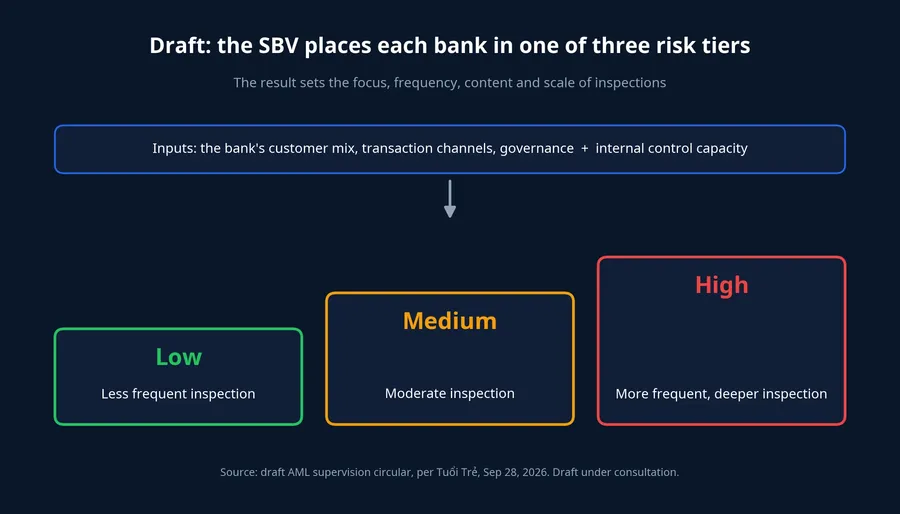
Think of it as grading a shop by the profile of its customers rather than checking every shopper. A bank with many clients in sensitive sectors, heavy exposure to high-risk jurisdictions or many hard-to-verify remote channels carries higher inherent risk. If its internal controls cannot offset that, the bank lands in a higher tier and gets inspected more often. The number of VIP clients or politically exposed persons is just a few lines on that scorecard.
Lawyer Huỳnh Thị Thu Thủy, a member lawyer at Rajah & Tann LCT Lawyers, said the regulator gathers information, assesses each reporting entity's compliance and risk, and then decides how often and how broadly to supervise. In her view, what matters is the quality of customer due diligence, beneficial ownership identification and transaction monitoring, and "this is also the difference between genuinely risk-based supervision and merely filling in report templates".Thanh Niên
The backdrop: the FATF grey list
To see why the SBV wants to change its supervisory approach, look at where Vietnam stands. Since June 2023, Vietnam has been on the grey list of the Financial Action Task Force (FATF), the group of jurisdictions under increased monitoring.Tuổi Trẻ It must carry out a 17-point action plan on anti-money laundering, counter-terrorist financing and countering the financing of weapons of mass destruction. Vietnam's national money laundering risk assessment for 2018–2022 also rated the monetary and banking sector as high risk.Thanh Niên
The gaps identified in the SBV's report line up closely with the draft. Per Tuổi Trẻ, Vietnam lacked a legal framework for supervision and had not rolled out off-site supervision; inspections were mainly compliance-based, their frequency and scope were not driven by risk, and the number of violations detected did not match the risk level.Tuổi Trẻ Put simply, the draft answers the criticism that every bank was being checked on the same schedule, regardless of which ones were riskier.
Suspicious transaction reporting is already up and running. From the start of the year to July 31, 2026, the SBV exchanged or transferred 426 documents covering 1,999 suspicious transaction reports to the competent authorities.Tuổi Trẻ What is missing is a way to measure which banks carry more risk, so inspection resources can be concentrated there.
For depositors: what stays the same
For large depositors and priority clients, the draft adds no new obligations on personal accounts. What banks already do with customers stems from the 2022 AML law: customer due diligence, enhanced measures for politically exposed persons and reporting of large-value transactions. The current large-value reporting threshold is VND 400 million or more, as Dr. Nguyễn Trí Hiếu, an independent banking and finance expert, reminded readers in Thanh Niên, and the draft does not change it.Thanh Niên
For completeness, Hiếu said the rule is necessary even though it may add a little paperwork for both banks and the customers involved.Thanh Niên If extra paperwork does materialise, the incentive would likely come from the banks: a lender worried about a high risk rating has reason to tighten due diligence on the client groups that push its score up. That is an inference from the rating logic, not a provision in the draft. If it happens, the first to feel it would be businesses in the counted sectors, not ordinary savers.
Which banks face more work
According to Dân trí and Thanh Niên, the sectors in which banks must count corporate clients include money transfer services, foreign exchange dealing, casinos and prize-based gaming, real estate business and brokerage, precious metals, gemstones and jewellery, and crypto-asset services. The draft also adds transaction-channel data such as over-the-counter transactions, remote electronic transactions, ATMs, trade finance, electronic transfers, currency exchange and transactions involving high-risk countries and territories.Dân tríThanh Niên
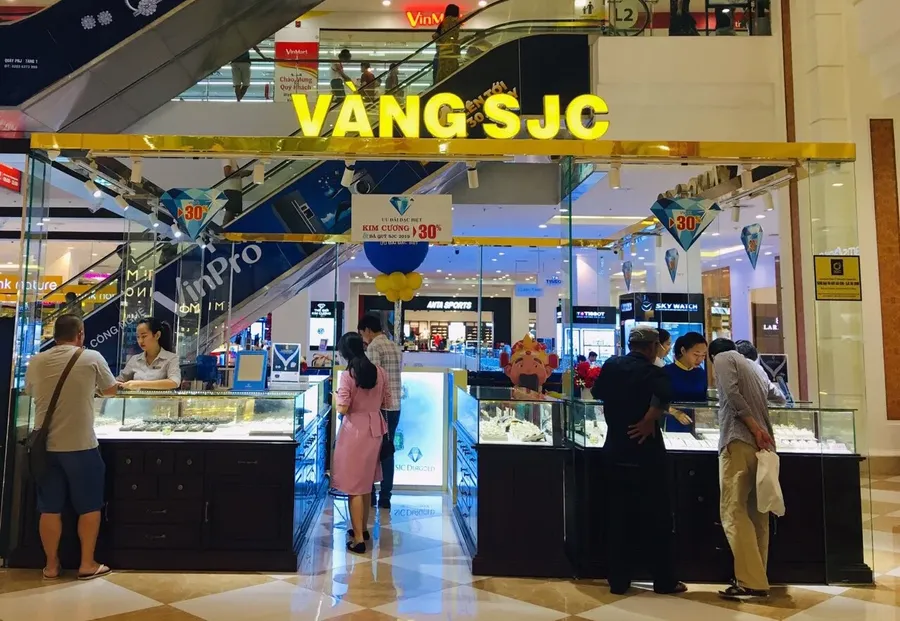
That list sketches the profile of banks that will feel more pressure. Lenders strong in remittances and currency exchange will have more clients in the money-transfer and FX groups. Banks with a dense real estate corporate book, or serving many gold and jewellery businesses, will have large shares in two of the named sectors. None of this means they are in breach, but they will have to show control capacity proportionate to their inherent risk and invest in data systems able to report along multiple dimensions.
For investors holding bank shares, this is an uneven compliance cost that cannot yet be quantified, because the draft has not published score thresholds for each tier. There are two readings. One: costs concentrate on banks with many clients in high-risk sectors. The other: for large banks that have already invested in data systems, the added cost may be small, since much of the governance data is already reported, as the SBV says. The available evidence leans toward the second reading on governance data, and toward the first on sector-based customer classification, which is the part being pulled into a scoring framework for the first time.
Conclusion: the pressure sits with banks, not individual depositors
The reading that "VIP customers are about to be monitored separately" does not match the text. Under the draft and the SBV's September 29 response, VIP customers, priority clients and clients in money transfer, FX, real estate and precious metals appear only as counts and ratios in banks' reports. The party rated low, medium or high, and inspected more or less often on that basis, is the bank itself.
If the draft is issued unchanged, the pressure will fall on banks with a larger share of clients in high-risk sectors, not on individual depositors. Ordinary savers remain within the obligations already set by the 2022 law. What could change this assessment is the final circular after consultation. The first signal to watch is whether the reporting templates for VIP and sector-based customers are kept, narrowed or reworded. The next is whether the SBV publishes quantitative criteria for the three risk tiers, since that will determine which banks bear the heavier compliance cost.