

Say you buy 1,000 shares of PVS on the afternoon of Tuesday, December 22. Normally the shares land in your account two days later and you can sell whenever you like. This time, you'll have to wait until Monday, December 28 to place a sell order, and by then PVS will be listed on a different exchange with a different daily price limit.
The reason is a schedule the Vietnam Exchange (VNX) announced on September 30. Every stock listed on the Hanoi Stock Exchange (HNX) will move to the Ho Chi Minh City Stock Exchange (HoSE) in a single batch rather than in groups.Tuổi Trẻ This post walks through the transfer day by day, as your account will experience it if you hold HNX stocks, and separates what has already been decided from what still awaits guidance.
The schedule VNX has set
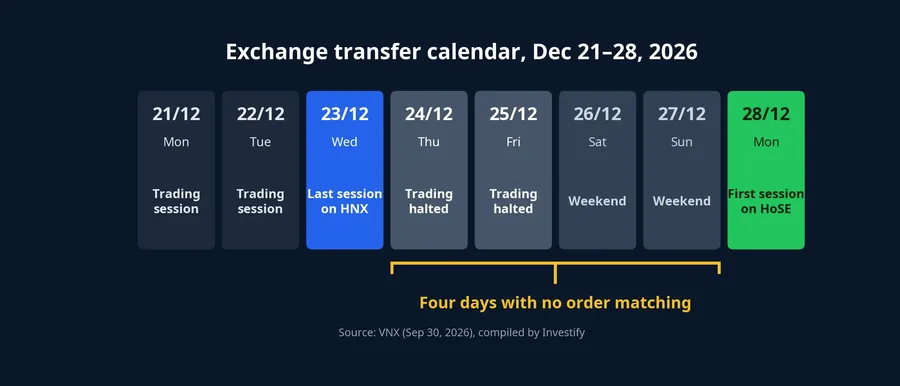
Think of it as a shop moving premises: it closes at the old address, shuts for a few days to move stock, then reopens at the new one. According to VNX, the last trading session for HNX-listed stocks is Wednesday, December 23. On Thursday, December 24 and Friday, December 25, these stocks are halted for the handover. Monday, December 28 is their first session on HoSE, and from then on every listed stock in Vietnam trades on a single exchange.Người Quan Sát
VNX made clear that the halt applies only to HNX-listed stocks being transferred. Stocks already on HoSE trade normally on both days, as do the other markets HNX operates: UPCoM, bonds and derivatives. The transfer is being carried out under Circular 139/2025/TT-BTC, which sets a deadline of December 31, 2026.Thanh Niên
This is not a small move. As of the September 30 session, HNX had 299 listed stocks with a combined market capitalization of nearly VND 463,000 billion.Tuổi Trẻ In August, average trading value on the exchange was close to VND 863 billion per session.Người Quan Sát
Wednesday, December 23: the last match on the Hanoi exchange
Add the two halt days to the weekend and HNX holders face four straight days with no order matching, from Thursday, December 24 through Sunday, December 27. That makes December 23 the final chance to buy or sell on the old exchange.
What happens to unfilled orders is still unclear. So far neither VNX nor HoSE has said whether pending HNX orders will be cancelled after December 23, kept, or carried over to the HoSE system. This matters most if you use multi-day advance orders or conditional orders: your brokerage holds these and submits them to the exchange each morning, so each firm may handle the switch in its own way.
Thursday, December 24 and Friday, December 25: the board keeps moving, your stock does not
These two days have the biggest knock-on effects for your account, because the settlement cycle lands right on them.
Shares you bought
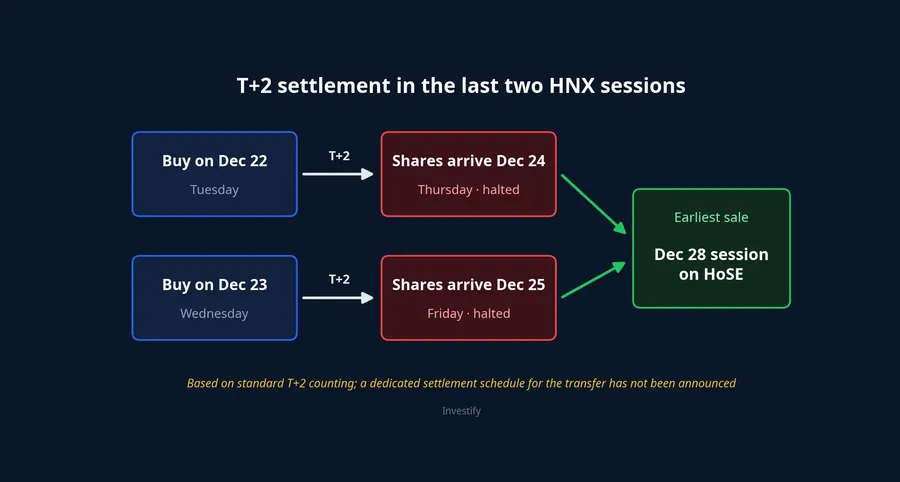
Stock trades in Vietnam settle on T+2, the second business day after the trade date. Counting the usual way, shares bought on December 22 arrive on December 24, and shares bought on December 23 arrive on December 25. Both are halt days, so even once the shares are in your account, the earliest you can sell is the December 28 session, on HoSE.
Sale proceeds
By the same count, proceeds from sales on December 22 arrive on December 24, and proceeds from December 23 sales arrive on December 25. Both are still business days and HoSE is still trading, so in principle the settlement cycle keeps running. Even so, neither the Vietnam Securities Depository and Clearing Corporation (VSDC), VNX nor HoSE has said whether settlement for the transfer will follow the normal schedule. The December 24 and 25 dates above are standard T+2 counting, not a confirmed timetable.
Dividend rights
Rights to dividends or to buy newly issued shares are based on the shareholder list VSDC compiles on the record date. A trading halt does not change how many shares sit in your account, so if you hold through the halt you stay on the list even if the record date falls in that window. The people who face a squeeze are those wanting to buy in order to qualify: if the record date falls between December 24 and 28, the window to buy in time gets pinched between the last HNX session and the first HoSE session. There is no specific guidance for this case yet.
Margin loans
Each brokerage sets its own list of marginable stocks and loan ratios based on internal criteria. No firm has yet said how it will reassess that list when a stock moves from HNX to HoSE. If you are borrowing against an HNX stock, you'll want to know whether it stays marginable after December 28, whether the loan ratio changes, and what price your collateral is valued at during four days with no new matched prices.
Monday, December 28: the first session on HoSE
From December 28, the transferred stocks follow HoSE trading rules. That includes a daily price limit of 7%, narrower than the 10% limit currently used on HNX.Tuổi Trẻ
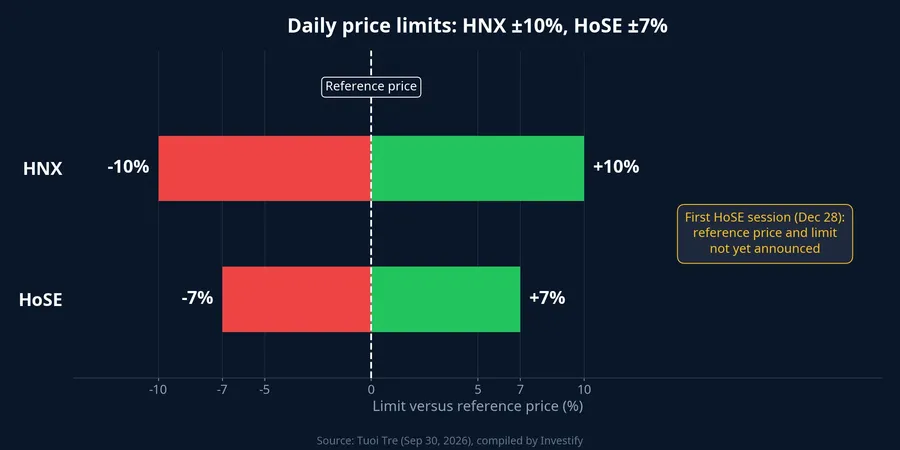
For the first session itself, two questions remain open: where the reference price comes from, and whether the limit that day is the standard 7% or a special one. VNX and HoSE have not announced either. The closest precedent is the move in the opposite direction in 2021. Under a State Securities Commission document dated March 29, 2021, stocks moving from HoSE to HNX used their last closing price on the old exchange as the reference price and took a ±10% limit, the new exchange's normal band.Vietstock That rule covered a different transfer in a different direction, so it can't be treated as the answer for December 28.
What gets less attention is that four days without trading doesn't mean four days without risk. During that stretch, the VN-Index still trades two sessions, global markets keep moving, and companies can still release news. All of that will pile into the December 28 session. The price limit that day decides whether prices can absorb the news in one session or need several, which is why the way HoSE sets the reference price and limit matters in practice to holders, not just as a technical detail.
The Hanoi exchange's indices face a similar question. The HNX-Index closed at 271.64 points on September 30. Once every listed stock leaves HNX, the HNX-Index and HNX30 baskets will have no constituents left on the exchange, and VNX has not said whether the two indices will be maintained differently, redefined or discontinued.
What stays the same
The transfer changes where orders are matched and the trading rules. It doesn't change how many shares you own, because ownership is recorded at VSDC, not at the exchange. The revenue, profit and debt of PVS or SHS on December 28 will be the same figures they were on December 23. Your brokerage account stays open where it is, and you can still trade stocks on HoSE and UPCoM as you do now.
What to check before December 23
There are nearly three months until the last HNX session. Most of the open questions above should be answered in detailed guidance from VNX, HoSE, VSDC and individual brokerages. Once that guidance is out, HNX holders should confirm the following with their brokerage:
- Whether multi-day advance orders and conditional orders on HNX stocks stay valid after December 23 or are cancelled automatically.
- When proceeds from December 22 and 23 sales reach your account, and whether you can get a cash advance.
- Whether your margined stock stays on the lending list after December 28, and whether the loan ratio changes.
- What reference price and price limit apply to your stock on December 28.
The last session on the Hanoi exchange is fixed. The reference price and limit for the first HoSE session are not. Once VNX or HoSE announces them, HNX holders will know whether the risk that builds up over four days without trading gets released within a wide band or a narrow one.