

Most bank debt-sale notices list land, factories and machinery. The notice BIDV (ticker BID) issued in late September for the debt owed by Ba Huan contains one unusual line: inventory made up of eggs, hens and animal feed.CafeF It reads like a quirk, but it is the key to understanding what this debt of nearly VND 625 billion is really worth.
One thing up front: the notice carries no starting price. So this piece does not guess whether BIDV will book a gain or a loss. Instead, it reads the collateral list closely, because the real risk lies in how differently these assets lose value over time.
What is being sold
According to the notice, as reported by CafeF and Tai chinh va Cuoc song on September 30, the outstanding balance as of September 23, 2026 is split between two entities. Ba Huan JSC owes VND 494.51 billion, of which VND 461.86 billion is principal and VND 32.65 billion is interest.CafeF Its subsidiary, Ba Huan Thanh Hoa High-Tech Co., Ltd., owes VND 130.34 billion across two loans: one of nearly VND 77 billion and another of just over VND 53 billion.Tài chính và Cuộc sống
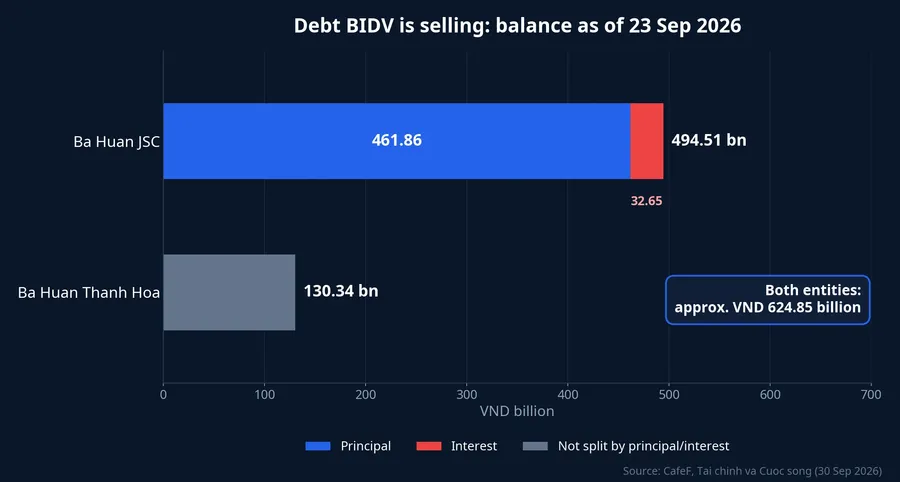
Combined, the debt on offer comes to approximately VND 624.85 billion, and the notice states plainly that the goal is capital recovery.Tài chính và Cuộc sống In other words, the bank has stopped waiting for the borrower to repay out of operating cash flow and is choosing to sell the claim for cash instead.
The collateral is spread across three sites. In Vinh Tan, Binh Duong, there are four adjacent plots totalling 176,070 m² with 22 henhouses, a hatchery and a feed line. In Tan Nhut, Binh Chanh, there is an egg-processing plant on just over 6,364 m², equipped with a MOBA-Omnia FT330 egg grading, candling and packing machine imported from the Netherlands in 2021. In Thanh Hoa, in the former Long An province, there are nine plots covering 244,386 m² with 14 henhouses, a canteen, warehouses and worker housing. That site secures the debts of both companies.CafeF
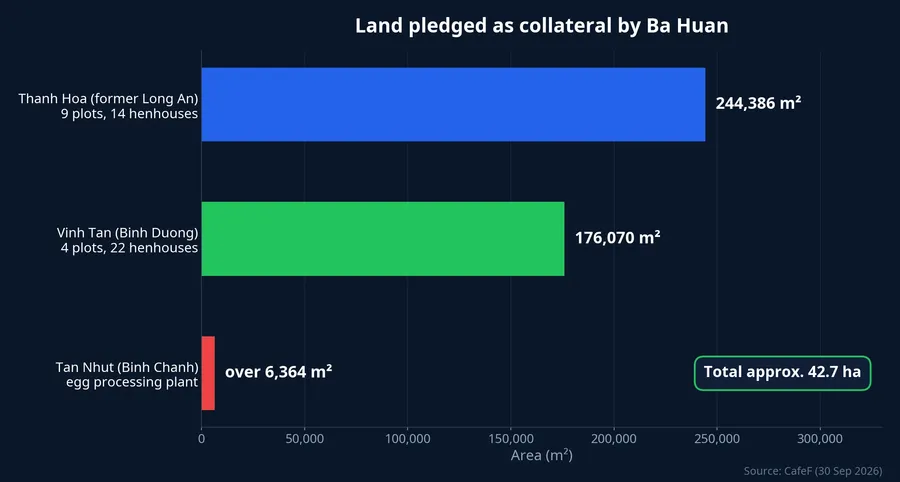
Together the three sites add up to approximately 42.7 hectares. Beyond land and buildings, the list includes receivables from trading partners, Ba Huan's entire 100% stake in Ba Huan Thanh Hoa, the equipment inside 14 farm houses, and inventory.CafeF
What the notice leaves out
What the notice does not say matters as much as what it lists. The September 30 reports give no starting price, no indication of whether the sale is by auction or private negotiation, and no deadline for bids. Nor do they say whether this is the first attempt to sell the debt or one of several rounds.
Each missing detail changes how the VND 624.85 billion figure should be read. The outstanding balance is what the bank wants to recover; the sale price is what the market is willing to pay. Until a price appears, any estimate of BIDV's recovery rate is guesswork.
How it got here

Ba Huan was built by Pham Thi Huan, founder of Ba Huan JSC. Born in 1954, she was named a Hero of Labour of the Doi Moi era, and her company is one of the leading egg producers in Ho Chi Minh City and southern Vietnam.CafeF
Signs of trouble became public in late 2025. In November 2025, the company was hit with an enforcement measure suspending its customs clearance over more than VND 51 billion in overdue taxes. That same month, Ms. Huan told the press that she and her family were no longer involved in running the business. By the end of 2025, Ba Huan had also been flagged for more than VND 6.5 billion in late social insurance contributions.CafeF
The tax debt shrank in 2026 but did not disappear. As of the end of July 2026, Ba Huan still owed VND 30.4 billion in taxes and topped the arrears list of Ho Chi Minh City's Grassroots Tax Office No. 6.CafeF The drop from over VND 51 billion to VND 30.4 billion shows the company was still able to pay some of it. For BIDV, however, putting the entire loan up for sale signals a decision to recover capital rather than keep waiting.
What a debt buyer actually gets
To a newer investor, "selling debt" may sound exotic, but banks do it routinely. Rather than suing or selling off each plot of land themselves, they sell the right to collect to someone else and take cash now. The buyer pays in the hope of collecting more than the purchase price.
Under Article 368 of Vietnam's 2015 Civil Code, when a secured claim is transferred, the security interest transfers with it.Government Portal Put simply, whoever buys this debt steps into BIDV's shoes, with rights over the pledged land, buildings, machinery, receivables and inventory.
That does not mean the buyer can simply show up at the farm and take the assets. Collateral can only be enforced through the method agreed in the security contract, such as an auction, a sale by the secured party, or taking the asset itself in lieu of payment. Absent such an agreement, the asset goes to auction.Government Portal So what a buyer will pay depends not on the balance written on paper, but on how they value the collateral after deducting time, legal costs and enforcement risk.
The real risk sits in assets that lose value by the day
This is where BIDV's list deserves the closest reading, because Ba Huan's collateral falls into two groups that depreciate on entirely different clocks.
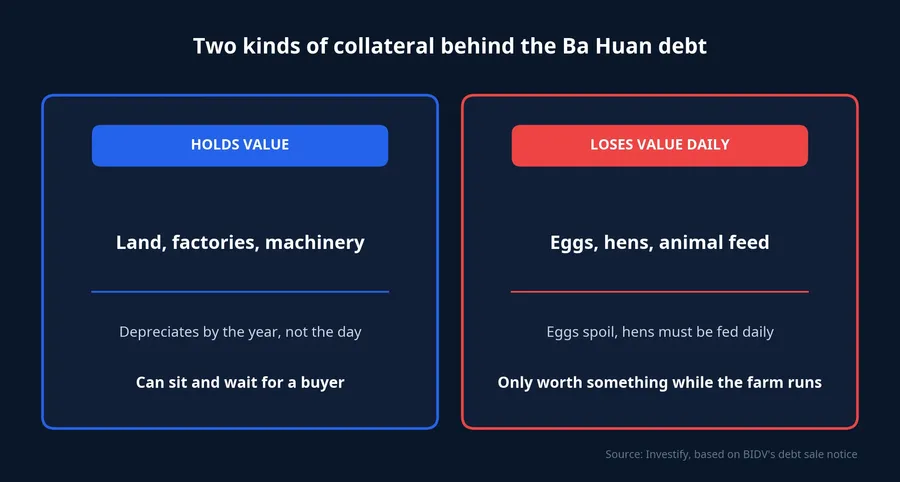
The first group is land, buildings and machinery. The 42-plus hectares in Binh Duong and former Long An, along with the egg plant in Binh Chanh, can sit and wait for a buyer. Their price depends on the industrial and agricultural property market and on the legal status of each plot. The egg grading line imported in 2021 depreciates by the year, not by the day.
The second group is live inventory. Eggs spoil, hens need feeding every day, and a laying hen is only worth something while she lays. The notice describes this as rotating inventory: today's batch of eggs is not next week's.Tài chính và Cuộc sống If the farm stops, the flock must either be sold off or kept at ongoing cost, and the eggs will not wait for anyone.
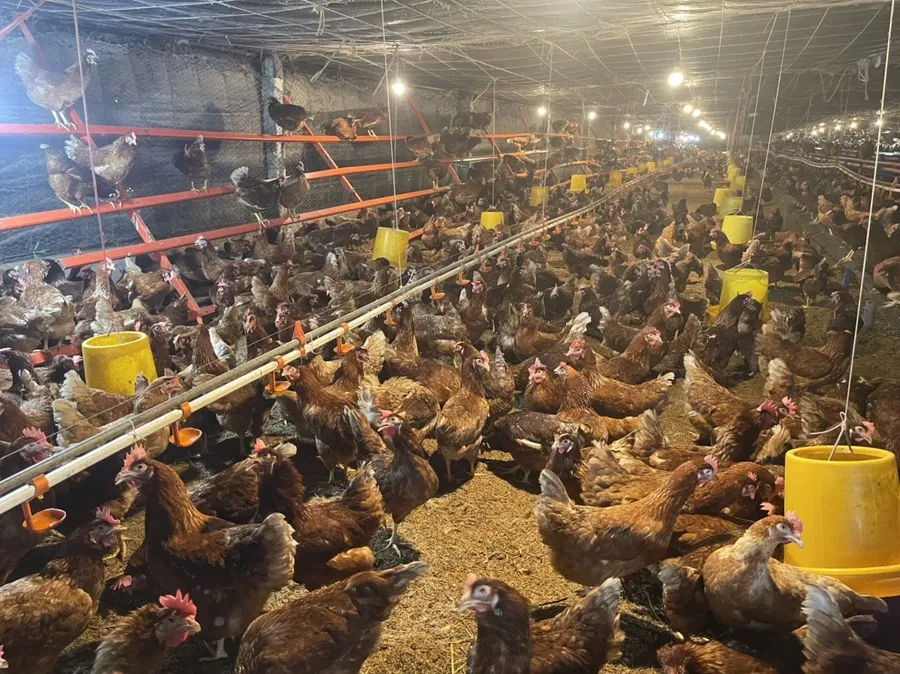
Receivables behave in a similar way, since they are only worth something if Ba Huan's customers actually pay. The 100% stake in Ba Huan Thanh Hoa, meanwhile, is equity in a company that also owes BIDV and shares the Long An site as collateral. Its value is tied tightly to the very debt being sold; it is not an independent asset.
A buyer therefore has to answer two questions at once. First, what are the land and buildings worth if sold separately? Second, will the farm keep running long enough for the live assets to hold their value? A buyer intending to take over and operate the farm will see the flock as a working machine. A buyer who only wants its money back will count little besides the land.
Who is affected
For BIDV shareholders, the number to watch is the ratio of sale proceeds to outstanding balance. If the debt sells below its balance, the gap has to be covered by loan-loss provisions already booked or yet to be booked. BIDV has not disclosed how much it has provisioned against this loan, so there is no basis for putting a figure on any loss. Conversely, if the land in Binh Duong and former Long An is valued well, the proceeds could cover most of the balance.
For Ba Huan's workers and suppliers, a change in creditor does not erase what the company owes them. Unpaid wages, insurance contributions, and bills for feed or breeding stock remain Ba Huan's obligations. What changes is that the secured creditor may become a different name, and how that party handles the assets will decide whether the farm keeps hiring staff and buying feed.
For investors interested in distressed debt and bank-foreclosed assets, the Ba Huan loan is a clear example of why collateral has to be broken into layers before bidding. Land and buildings require a plot-by-plot legal check, while live inventory needs to be valued as part of an operating business. Separated from a running farm, it holds almost no value.
The missing number
BIDV's notice tells us the bank wants to recover roughly VND 624.85 billion and what it holds as security. The missing piece is price, so there is not yet enough evidence to draw a conclusion about recovery.
The signal to watch is the starting price once it is published. A starting price close to the outstanding balance would mean the bank judges the land and plants sufficient to cover most of the debt. A much lower price, or one that has to be cut over several rounds, would mean the market values the collateral below what is written on paper. In that case, the gap will have to come out of BIDV's provisions.