


On September 28 (US time), NVIDIA's board approved an additional $150 billion for its share repurchase program, bringing the total remaining authorization to $235 billion. According to the company's release, it expects to use that amount before the end of fiscal 2028, which falls around late January 2028.Nvidia Nvidia describes it as the largest buyback authorization increase ever, surpassing the $110 billion Apple announced in 2024.Vietstock
The market took the news calmly. Nvidia closed the September 28 session at $228.86, up 1.68%, while the Nasdaq fell 0.9% as Treasury yields and oil prices both climbed.GuruFocus A gain of under 2% suggests investors did not treat the announcement as a turning point.
The $235 billion headline is eye-catching, but on its own it says little. The numbers worth working through sit behind it: where the cash comes from, how much of it actually increases each shareholder's stake, and what could stop the authorization from being used in full.
An authorization is a ceiling, not a commitment
Start with what a buyback announcement actually is. The board approves an authorization: the maximum amount management may spend buying the company's own shares in the open market. When to buy, how much, and whether to use the full amount remain management's call.
That makes pace the key calculation. Nvidia's window covers six unreported quarters, so spreading the amount evenly means buying roughly $39 billion a quarter.CNBC In the first half of fiscal 2027 (ended July 2026), Nvidia repurchased $39 billion in total, or about $19.5 billion per quarter.Yahoo Finance The second quarter alone came to $20 billion.24/7 Wall St.
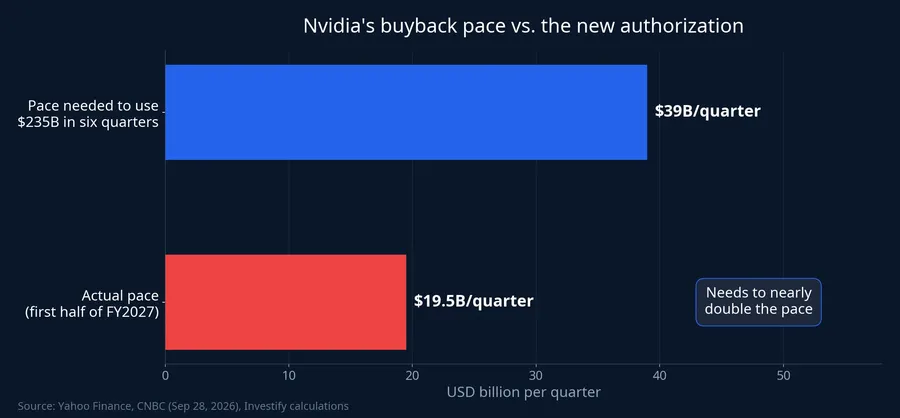
To finish on time, Nvidia would have to buy nearly twice as fast as it does today. Measured against the company's size, $235 billion is about 4.3% of Nvidia's market value of roughly $5,420 billion.CNBC
Where the money comes from: customers' AI budgets
The cash starts with the big cloud providers such as Microsoft, Alphabet, Amazon and Meta. They are racing to build AI data centers, and S&P Global Ratings expects their capital spending to exceed $1,300 billion by 2027.CNBC Not all of that goes into chips, since a large share pays for land, power, buildings and networking gear. Still, AI processors are the most expensive line item in any data center, and Nvidia is the main supplier.
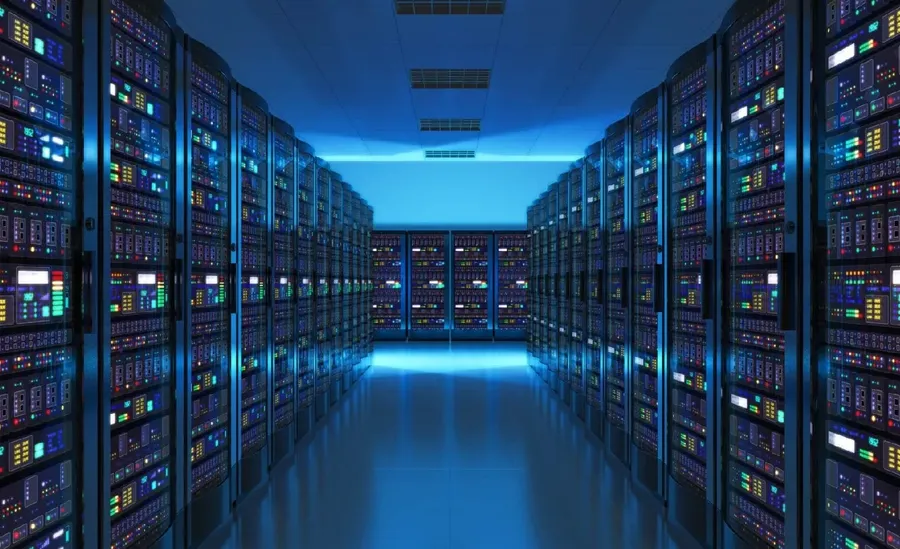
Customer spending becomes Nvidia's revenue. In the second quarter of fiscal 2027, revenue reached $96.22 billion, up 105.8% year on year, and net income came to $59.69 billion. The company guided third-quarter revenue to around $108 billion.24/7 Wall St.
Why cash piles up so quickly: Nvidia doesn't build fabs
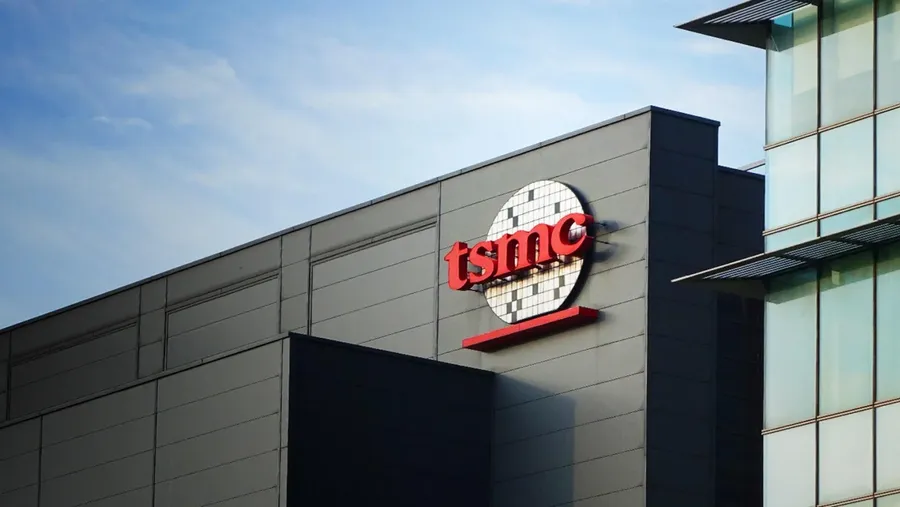
High revenue does not automatically leave much cash behind. A traditional chipmaker has to keep pouring money into building and upgrading factories, so much of what comes in goes straight back out. Nvidia works differently. It designs chips and pays outside partners, mainly Taiwan's TSMC, to manufacture, assemble and package them. The company's own September 28 release lists its reliance on third parties for manufacturing as a key risk.Nvidia
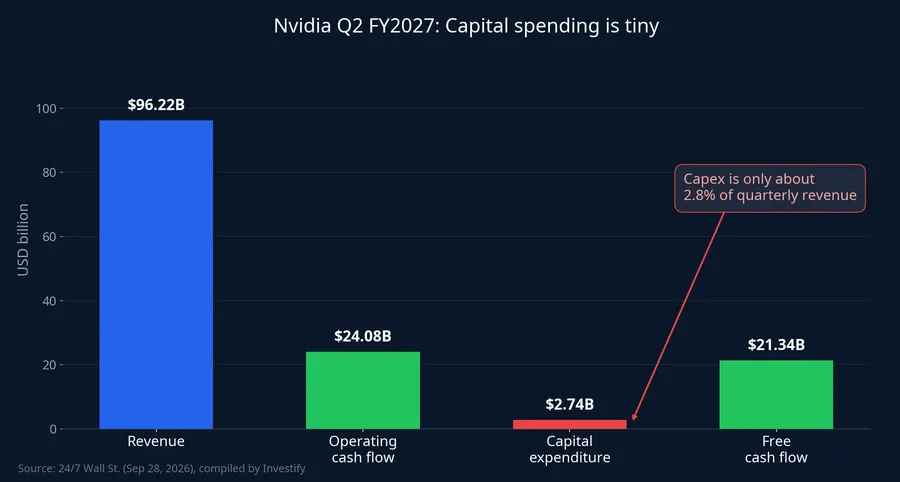
The telling detail in the second-quarter cash flow statement is the gap between two lines. Operating cash flow was $24.08 billion and free cash flow was $21.34 billion.24/7 Wall St. The difference, about $2.74 billion, is capital expenditure, equal to only about 2.8% of quarterly revenue. The burden of building fabs sits with TSMC; Nvidia pays per batch of chips.
That doesn't mean Nvidia spends nothing. It carries about $279 billion in purchase commitments with suppliers and has put nearly $50 billion into AI labs.24/7 Wall St. But the purchase commitments are paid down over time out of chip sales, and the AI lab investments are a choice rather than a cost of keeping the business running.
The result is cash accumulating faster than the business needs it. In the first half of fiscal 2027, operating cash flow totaled $74.4 billion, of which $46.1 billion went back to shareholders through buybacks and dividends.Yahoo Finance
The contrast is sharpest on the buyer's side. Alphabet repurchased $45 billion of stock in 2025 but has bought back nothing this year, channeling cash into AI projects and even issuing new shares to raise capital.Semafor Same investment wave, opposite positions: the spenders count every dollar, while the chip seller has cash to hand back.
Setting $235 billion against expected cash flow
Nvidia's policy is to return at least 50% of free cash flow to shareholders through buybacks and dividends.CNBC Colette Kress, NVIDIA's Chief Financial Officer, said the actual ratio so far this fiscal year is 60%.24/7 Wall St.
Citing FactSet data, CNBC reports that analysts expect Nvidia to generate about $440 billion in free cash flow over the next six quarters.CNBC If that forecast holds, $235 billion in buybacks would be about 53% of it, in line with the policy of returning half. Add dividends and the payout ratio goes higher still.
So the new authorization does not require Nvidia to borrow or drain its cash. It does, however, rest on a big assumption. About $440 billion over six quarters means more than $70 billion a quarter on average, over three times the $21.34 billion generated in the second quarter. Put differently, $235 billion is Nvidia's bet that customers keep spending heavily on AI for at least the next six quarters.
Why now
There are three explanations for the timing, and they are not mutually exclusive.
The first is surplus cash, as laid out above. Jensen Huang, NVIDIA's founder and Chief Executive Officer, wrote in the release that the company's cash generation lets it both invest and return capital to shareholders.Nvidia
The second is valuation. According to LSEG data, Nvidia trades at a forward P/E of about 16.5 times, its lowest since January 2015.Báo Đấu thầu The stock is up about 24% year to date, yet it ranks seventh from the bottom in the 30-stock iShares semiconductor ETF.CNBC When a company buys its own stock at a low P/E, the market usually reads it as management believing the price does not yet reflect the outlook.
The third is outside pressure. Jim Cramer, CNBC's financial TV host, had been urging Nvidia to buy back as much as $500 billion of stock since early September.CNBC
The data points to the first explanation as the foundation: without surplus cash, no valuation, however low, could produce $235 billion. The low valuation explains why the company chose to step up buybacks now rather than leave the cash sitting on the balance sheet.
The share offsetting stock-based pay
Buybacks reduce the number of shares outstanding, so each remaining share gets a larger slice of profit, which lifts EPS. That only holds, though, for repurchases in excess of newly issued shares.
Like many US tech companies, Nvidia pays part of its employees' compensation in stock. Every year, new shares are created and handed to staff. Buyback dollars first have to offset those shares before the total count actually falls. The September 28 announcement does not say how much of the $235 billion will go toward that offset.
That is why the number to watch is shares outstanding, currently about 24.147 billion.24/7 Wall St. At the $228.86 close, $235 billion buys about 1.03 billion shares, roughly 4.3% of the total. That is the maximum reduction on paper; the real reduction will be smaller, depending on how many new shares go to employees and the average purchase price.
For comparison, Apple has bought back more than $800 billion of stock over 15 years and cut its share count by about 40%.CNBC The effect came from buying steadily over a long period, not from a single announcement.
The risk: this cash flow depends on customers
The whole mechanism stands on one leg: the AI budgets of a small group of very large customers. If the cloud providers slow their capital spending, Nvidia's revenue slows, free cash flow thins, and buybacks would have to slow with it. The authorization would still exist, but nothing obliges Nvidia to use all of it.
There is another layer. Nvidia is using its own money to invest in and lend to customers building AI infrastructure, which has raised concerns about circular financing.CNBC Put simply, the company funds its customers, who then use that money to buy its products. Cash that travels down this path is cash that does not return to shareholders.
How to read the signal
My conclusion is that the $235 billion authorization is backed by real cash. The fabless model lets Nvidia keep almost all of its operating cash flow, and the new authorization fits within its policy of returning half of free cash flow. What remains unproven is the pace: the authorization only turns into real buying pressure if Nvidia buys faster than it does now, and that requires free cash flow to grow as strongly as analysts forecast.
For investors who hold Nvidia indirectly through S&P 500 or Nasdaq-100 ETFs, the signal to watch in the third-quarter report is the buyback amount set against the roughly $39 billion quarterly mark. If it moves close to that level, management is doing what it said. If it stays around $20 billion, the $235 billion is mostly a signal rather than money actually flowing into the stock. Alongside that, whether shares outstanding decline will show whether buybacks have outrun stock-based pay.
The same reading works for companies listed in Vietnam. When a local company announces a buyback, compare the registered volume with what it actually buys, check whether the money comes from operating cash flow or borrowing, and see whether it is issuing shares to employees at the same time. A buyback announcement only means something when those answers line up.