


On September 28, MB Securities (MBS) released its Q3/2026 earnings forecasts, and the oil and gas section quickly made headlines: third-quarter profits were "forecast to rise sharply." That reading is accurate. What deserves attention is a second comparison sitting in the same report, one that gets far less coverage and tells a somewhat different story.
This piece does not argue that MBS got its numbers wrong. The goal is to put both comparisons side by side, so that anyone weighing oil and gas stocks knows exactly what they are paying for.
Oil and gas held up while the index slipped
On September 28, the VN-Index fell 4.43 points, or 0.25%, to 1,780.68. In the same session, BSR gained 6.58% to VND 32,400, PVS rose 5.70%, GAS 3.73%, PVD 3.61%, PLX 1.71% and PVT 1.52%. On September 29, the index lost another 2.95 points to 1,777.73, with decliners (185) outnumbering advancers (140). Oil and gas stayed green: PVT added 6.40% to VND 24,950, PLX rose 2.39%, OIL 2.24% and PVS 2.10%.Vietstock
Those two sessions coincided with two forces at once. The first was crude: Brent closed September 29 at USD 106.69 a barrel, roughly 21% above the USD 88.10 it traded at a month earlier. The second was the MBS forecast, which Thị trường Tài chính Tiền tệ put straight into the headline of its oil and gas story.TTTC&TT Because both arrived together, there is no clean way to say how much of the rally belongs to each. This piece focuses on the forecast, because it is the easiest story for new investors to absorb and also the easiest to misread.
Column one: versus the same quarter last year
On the numbers, the "sharp Q3 profit growth" narrative is well founded. MBS expects all six companies to earn more after tax in Q3/2026 than in Q3/2025. BSR is forecast at VND 4,573 billion, up 403.9%, or more than five times last year's figure. PLX is seen at VND 987 billion, up 39.8%, and PVD at VND 291 billion, up 4.7%.Người Quan Sát GAS is expected at VND 2,968 billion (+16.4%), PVS at VND 412 billion (+27.2%) and PVT at VND 363 billion (+38%).MarketTimes
BSR's "five times" figure, however, is mostly a base effect. In Q3/2025 the refiner earned only about VND 908 billion, when the spread between refined product prices and crude input costs was thin.MarketTimes With a small denominator, an ordinary quarter this year is enough to produce growth in the hundreds of percent. That does not make VND 4,573 billion any less real. It simply means the year-on-year rate measures the distance from a weak year, not the current direction of earnings.
Column two: versus the quarter just ended
In the same report, MBS forecasts Q3 profit below Q2/2026 at five of the six companies. The declines range from about 22% to 65%, each with its own explanation.
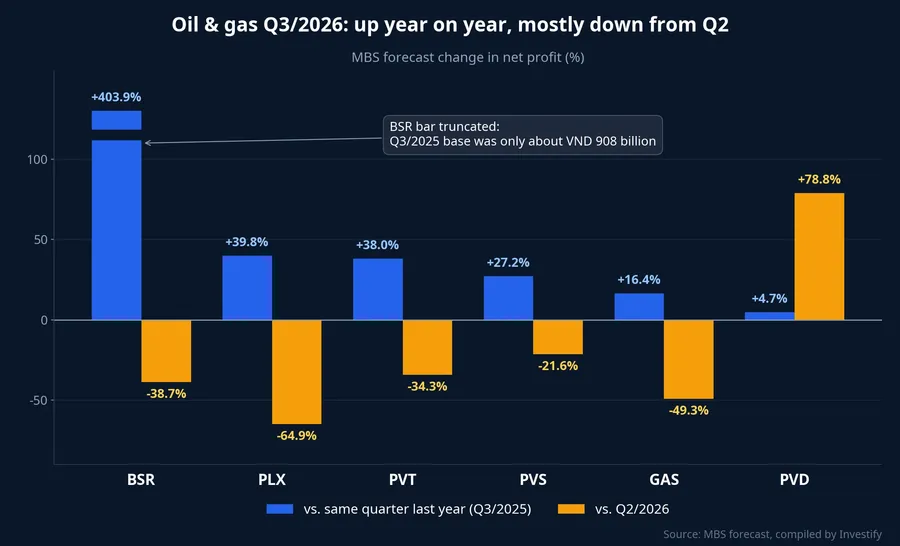
- PLX: down 64.9%. Petrolimex earned VND 2,809 billion in Q2, including a reversal of inventory write-down provisions tied to Q1 oil price swings. That is a one-off, and MBS does not assume it repeats in Q3.TTTC&TT
- GAS: down 49.3%, on a lower average gas price than the previous quarter.
- BSR: down 38.7%. According to MBS, Q2 was an exceptionally high base at the peak of Middle East tensions; refining spreads cooled after Iran and the US reached a preliminary peace deal late in Q2, though they remain above the historical average.
- PVT: down 34.3%, mainly because Q2 had a stronger contribution from shipping and other income.TTTC&TT
- PVS: down 21.6%, against a relatively high prior-quarter base.MarketTimes
Oil price data points the same way. Brent averaged roughly USD 91 a barrel in Q3, below the Q2 average of about USD 96.4. In other words, even though Brent ended Q3 at a high level, the quarter's average price was still lower than the one before.
Taken together, the causes fall into two different categories. The first is one-off items, such as PLX's provision reversal or PVT's other income. These do not recur, so the Q2 profit they generated was never a true baseline. The second is market variables, such as BSR's refining spread or GAS's gas price. Those can move back up, and MBS itself does not rule out a rebound in refining spreads in Q4.MarketTimes
PVS has an extra cushion outside Q3. MBS estimates the company could reverse about VND 635 billion in provisions this year, mostly from the Sao Vàng – Đại Nguyệt project, possibly booked in Q4. If that happens, PVS's Q4 profit will swell on a one-off item, much as PLX's Q2 looked unusually strong.
PVD moves the other way because its base was depressed
PVD is the only company in the group forecast to earn more than in Q2, up 78.8%. The reason has nothing to do with oil prices. In Q2, PVD carried scheduled maintenance and upgrade costs on several rigs plus the cost of bringing its new PVD IX rig into service. In Q3, the rigs returned to full operation and efficiency improved, while day rates stayed firm, with some contracts above USD 100,000 a day.Người Quan Sát

On a year-on-year basis, PVD actually posts the smallest gain in the group at just 4.7%. It is up on the quarter because the previous quarter was dragged down, not because its drilling business has stepped up to a new level. This case shows that quarter-on-quarter comparisons can mislead too when the base quarter carries unusual costs. Neither comparison is enough on its own; readers always need to know what was special about the base period.
What the share prices are paying for
Line up the share prices against these numbers and the divergence is clear. From June 30 to September 29, BSR rose from VND 24,150 to VND 32,500, a gain of about 34.6%. PVT went from VND 19,850 to VND 24,950, up about 25.7%. By contrast, PLX was roughly flat, slipping from VND 36,950 to VND 36,450, while PVS fell about 10.5%, from VND 38,100 to VND 34,100.
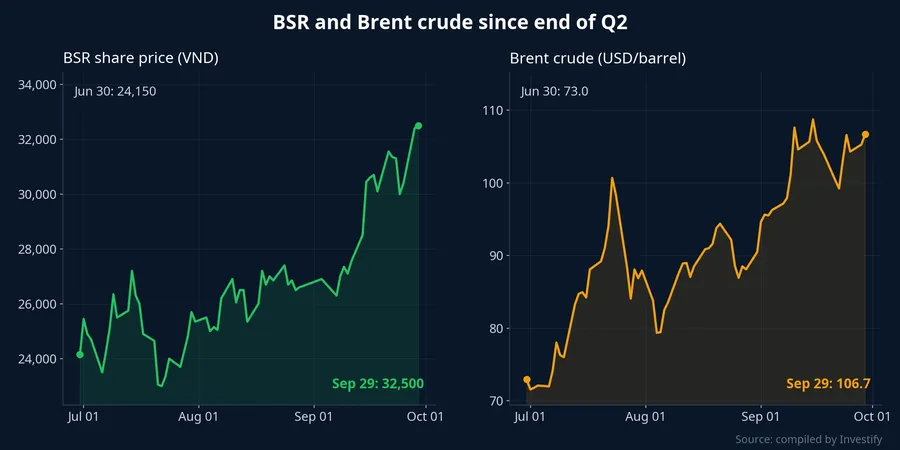
Over the same stretch, Brent climbed from about USD 73 to USD 106.69 a barrel. BSR's price line tracks Brent fairly closely, although that alone is not enough to conclude that oil is the only force behind the stock.
For PLX, the market appears not to have paid for the one-off Q2 reversal. For BSR and PVT, the two strongest performers since the end of Q2, buyers are paying for a broader expectation: that Q2 profit was not a one-time peak but a new baseline held up by high oil prices. That expectation has support while Brent sits around USD 106. Yet MBS's own Q3 forecast shows both companies' profits retreating from Q2, not accelerating.
A more accurate picture
"Q3 profits up sharply" is true against last year. The problem is that it is easily heard as "profits are rising," and by MBS's own numbers that does not hold for five of the six companies. A closer description is that sector earnings peaked in Q2 and are settling back to a level still well above 2025. Anyone buying oil and gas stocks now is betting that high oil prices will hold that level, not buying into accelerating profit growth.
The consequence is that this bet is tied more tightly to crude and refining spreads than the "five times" headline suggests. If oil cools, the new baseline shrinks first, while year-on-year growth may keep looking good for another quarter or two thanks to the weak 2025 base. The same habit works across the whole Q3 reporting season: whenever you see a year-on-year growth rate, open the quarter-on-quarter column as well, and ask what was unusual in each base period.
Signals to watch when Q3 results land
Q3 financial statements are expected in October. A few indicators will show whether earnings are sitting on a new baseline or past their peak:
- BSR: Q3 gross margin versus Q2. A margin close to Q2 supports the new-baseline thesis; a clear contraction marks Q2 as the peak.
- PLX: profit excluding the provision reversal. If core profit still grows about 40% year on year as MBS forecasts, the retail volume story is real.
- GAS: average gas price and sales volume for the quarter, since that is the cause MBS cites for the drop versus Q2.
- PVT: the share of other income in profit. If earnings come mainly from shipping, high freight rates are genuinely reaching the bottom line.
- PVS: which quarter the roughly VND 635 billion reversal lands in, so it can be separated from profit on engineering and construction contracts.
If actual Q3 profit at BSR and GAS beats MBS's forecast while Brent holds above USD 100, the new-baseline thesis gets stronger. If it falls short, current prices for the strongest gainers are running ahead of earnings.