
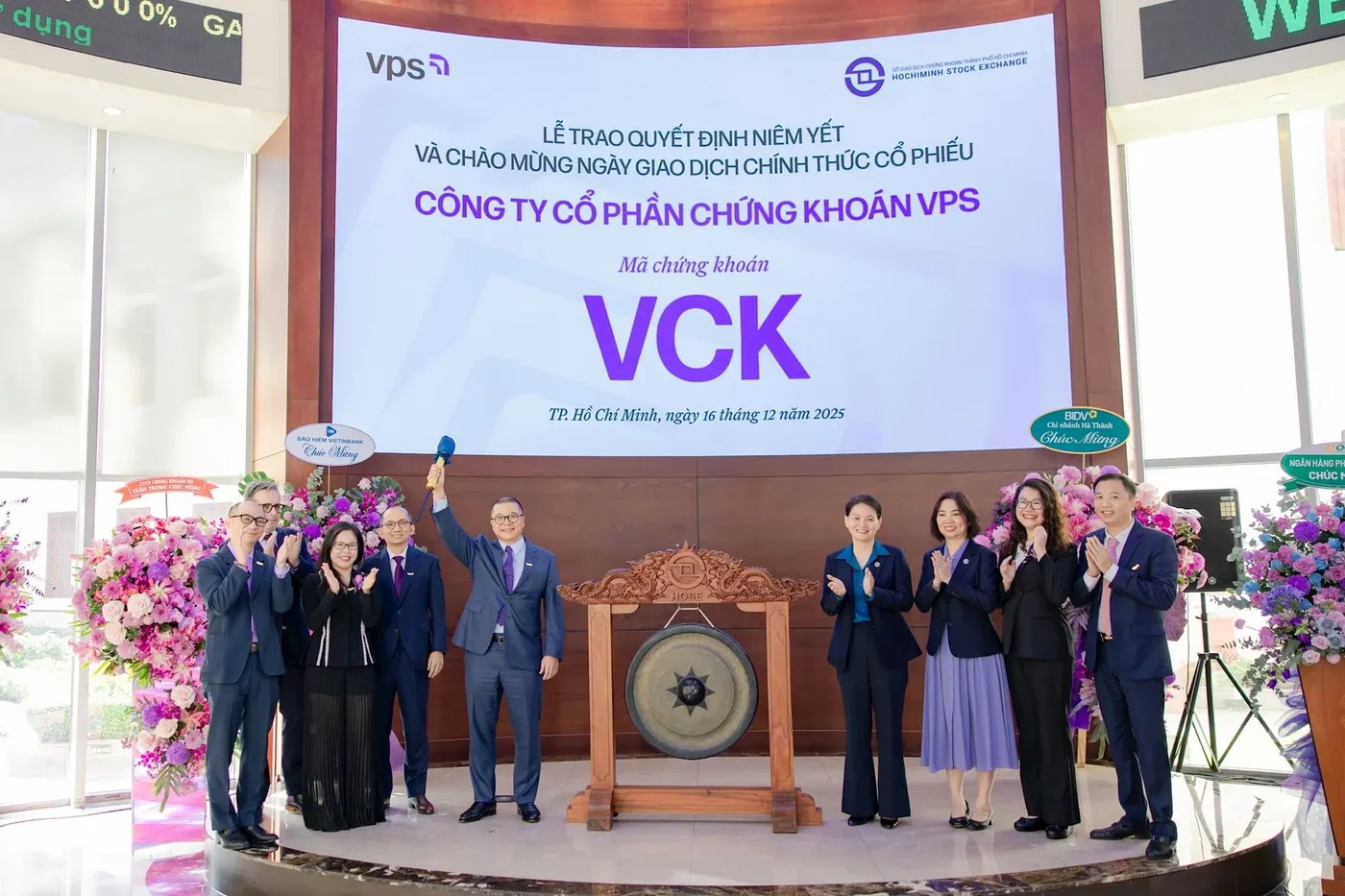

LPS, the listed arm of LPBank Securities, fell for a fifth straight session on September 29 and closed at VND 19,900 a share.CafeF The IPO was priced at VND 30,000, so anyone who bought in the offering is sitting on a loss of about 33.7% just six weeks after listing.Markettimes
LPS is not alone. TCX (TCBS), VPX (VPBank Securities) and VCK (VPS Securities), the other brokers that listed on HoSE since October 2025, are all trading below their offer prices too. The puzzle is that the VN-Index closed at 1,777.73 on September 29, above its level on each of the four listing days. The index is higher; the new listings are lower. The numbers suggest the answer is not that every IPO was overpriced, but that these prices were set at a particular moment in the cycle.
What IPO buyers have actually lost
Before looking for causes, it is worth getting the losses right. Put the current quote next to the IPO price on a trading screen and the picture looks worse than it is, because two of the four stocks have since handed out extra shares.
VCK debuted on December 16, 2025 at a reference price of VND 60,000.VnEconomy VPS then issued more than 913 million bonus shares at a 100:60 ratio, so 100 IPO shares have become 160.Doanh Nhân At the September 29 close of VND 28,100, the adjusted IPO price is VND 37,500 and the real loss is about 25.1%, not the 53% a naive comparison implies.
TCX tells a similar story. TCBS listed on October 21, 2025 at an IPO price of VND 46,800.Báo Mới It later paid a 5% cash dividend and a 20% stock dividend.Vietstock So 100 IPO shares are now 120 shares plus VND 50,000 in cash. At the VND 29,200 close, the all-in loss for IPO buyers is about 24%.
The other two had no adjustments. VPX was offered at VND 33,900 and closed at VND 25,000 on September 29, roughly 26.3% lower.Báo Mới LPS is down about 33.7%, as noted above.
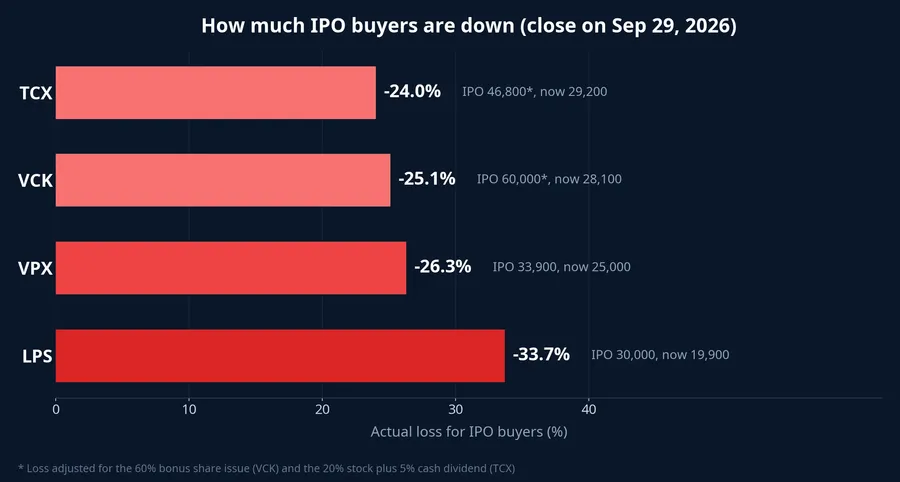
The real range is therefore roughly 24% to 34%. That is still a heavy loss, but meaningfully smaller than what many trading apps display. Anyone holding TCX or VCK from the IPO should recompute their cost basis using the share count actually in their account before judging the damage.
A sector cycle, not a new-listing problem
The easy explanation is that IPOs get priced too richly. That is partly true, but the data points to a broader cause for most of the decline.
Look at brokers that have been listed for years and had nothing to do with any of these offerings. From October 21, 2025, the day TCX debuted, to September 29, 2026, SSI's adjusted price fell from VND 35,159 to VND 20,200, a drop of about 42.5%. VNDirect's VND slid from VND 20,459 to VND 14,050, about 31.3%. Over the same stretch the VN-Index rose from 1,663.43 to 1,777.73, a gain of about 6.9%.
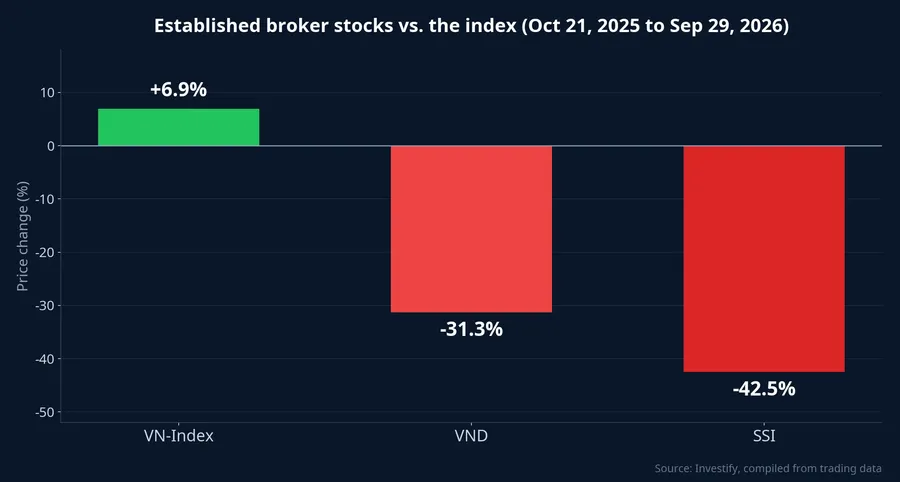
In other words, the established broker stocks lost as much as the new listings, or more. The index rose on the back of other sectors while brokers moved the other way. IPO buyers did not pick an unusually bad stock. They bought the whole sector at the top of its cycle.
Broker earnings track market turnover
A securities firm makes money in three main ways. The first is brokerage commissions when investors trade. The second is interest on margin loans. The third is proprietary trading, where the firm invests its own capital. All three move with the market: high turnover means more commissions, more demand for margin, and an easier time for the proprietary book.
Every one of these IPOs was priced while turnover was strong. Average matched value on HoSE was VND 19,408 billion per session in December 2025. By September 2026 it had fallen to VND 13,367.7 billion, down about 31.1%. On September 29 alone, matched value was only about VND 10,320 billion. LPS set its IPO price back in February 2026, when the market was still busy, even though the shares did not list until August.
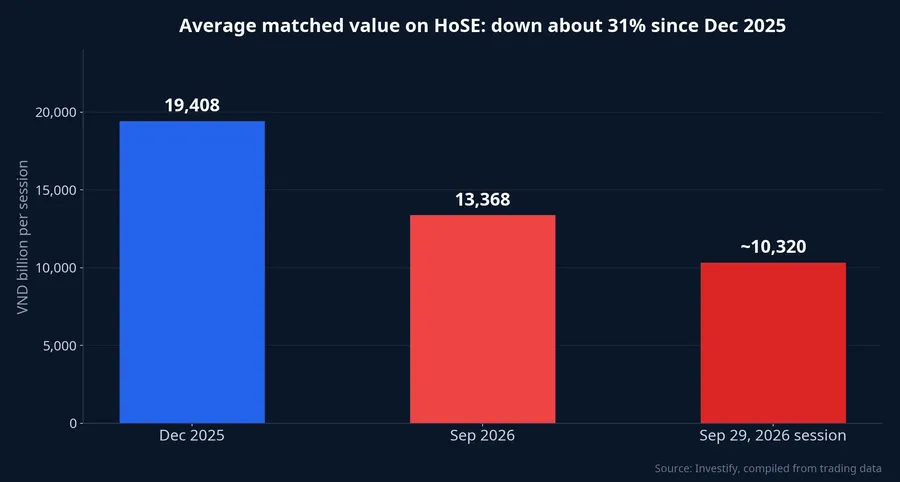
The year-on-year comparison is starker. Vietcombank Securities (VCBS) projects that average daily turnover in Q3 2026 is down about 55–60% from a year earlier, and expects most brokers to report weaker results than in Q3 2025.CafeF In VCBS's view, brokerage revenue takes the direct hit, margin lending spreads may narrow in a high-rate environment, and proprietary trading profits hinge on where the VN-Index goes.
Strong first-half profits, falling share prices
This is what confuses many IPO buyers. The first-half 2026 financial statements of all four firms showed rising profits. TCX posted net profit of VND 2,839.5 billion, up about 16.8% year on year. VPX earned VND 2,168.6 billion, roughly triple the prior year. VCK made VND 2,339.6 billion, up about 62.7%. LPS earned VND 574.7 billion, up about 133.1%.
Two things explain why those numbers have not held up the stocks. First, the market pays for the profits of the coming quarters, not the half-year already booked. With Q3 turnover less than half of last year's, investors are pricing in a downturn in earnings, exactly what VCBS is forecasting.
Second, much of the growth came from proprietary trading, the least repeatable source of income. At VPX, Q2 pre-tax profit rose about 293.2% year on year, driven mainly by gains on financial assets measured at fair value through profit or loss, which were up about 227.3% over six months. That kind of gain can reverse quickly when the index stalls or falls, so the market rarely pays the multiple it would for steady commission income.
New supply and high rates deepen the fall
Based on offer sizes and prices, these IPOs absorbed roughly VND 40,000 billion from the market. TCBS sold 231.15 million shares at VND 46,800, about VND 10,818 billion. VPBank Securities sold 375 million shares at VND 33,900, about VND 12,713 billion. VPS offered 202.31 million shares at a floor price of VND 60,000, about VND 12,139 billion.CafeF LPBank Securities offered 141.86 million shares at VND 30,000, about VND 4,256 billion.
Bonus shares and stock dividends followed. VCK's 913 million-plus bonus shares alone carry no transfer restrictions.Doanh Nhân Bonus shares do not change what a company is worth, but they do increase the number of shares available to sell. When market-wide turnover is shrinking, a larger float needs new buyers, and the price has to fall to find them.
Interest rates add to the pressure. According to CafeF's analysis, more attractive deposit rates and bond yields are pulling some money out of equities while raising the funding cost of margin lending.CafeF That affects the whole market, but brokers get hit twice: lower turnover and thinner lending margins.
Weighing the causes
The liquidity cycle, new share supply and high rates are all pulling prices down. The data points to the liquidity cycle as the main driver. The clearest evidence is SSI and VND: with no recent IPO or large bonus issue, both still lost more than 30% over the same period. New supply and rates made the decline deeper, but they cannot explain why long-listed broker stocks fell by a similar amount.
The takeaway for IPO buyers is fairly clear. The offer prices were not wrong because the companies are weak; they were set on peak-cycle earnings. Put differently, buyers paid boom-year prices for businesses whose profits rise and fall with the market.
Below the IPO price is not the same as cheap
An IPO price is simply the price at one moment, set by the seller when conditions suited the seller best. It is not a measure of value. Treating it as a breakeven line is a psychological anchor that can keep investors holding just to get their money back, or buying more simply because the stock is "cheaper than at the IPO".
For a broker, a more useful yardstick is price-to-book set against ROE. P/B tells you how much you pay for each dong of equity; ROE tells you how much that dong earns in a year. Based on the latest reporting period, using first-half ROE annualized:
| Ticker | P/B | Annualized ROE |
|---|---|---|
| TCX | about 1.77x | about 12.6% |
| VPX | about 1.34x | about 12.5% |
| VCK | about 1.37x | about 15.6% |
| LPS | insufficient data | about 7.4% |
Read this way, at a similar ROE of around 12.5%, TCX commands about a third more per dong of equity than VPX. VCK has the highest ROE of the three with full data, at a P/B in line with VPX. The caveat is that these ROE figures come from the first half, when proprietary trading was highly profitable. If Q3 earnings fall as VCBS expects, ROE will come down and today's P/B will look more expensive even if prices stay flat.
What to watch
The thesis here is that these IPOs were priced on peak-cycle earnings, and that most of the decline comes from the sector's liquidity cycle. What could change the picture is Q3 2026 earnings, due in October. They will be the first results to reflect a full quarter of thin turnover.
If Q3 profits fall much less than the 55–60% drop in turnover, meaning lending and commissions held a floor, current prices already reflect most of the bad news. If profits fall in step with turnover, or proprietary trading swings to a loss, ROE will shrink and today's P/B is not yet a low.
For anyone holding shares from the IPO, the useful question is not when the price will return to the offer level. It is how much the company earns on each dong of equity once the market is no longer booming. The Q3 reports will start to answer that.