


Nine months into 2026, the VN-Index has a strange scorecard. It closed the September 25 session at 1,785.11 points, almost exactly where it finished 2025 at 1,784.49. If you only watched the headline index, you would conclude the market went nowhere, up about 0.03% for the year.
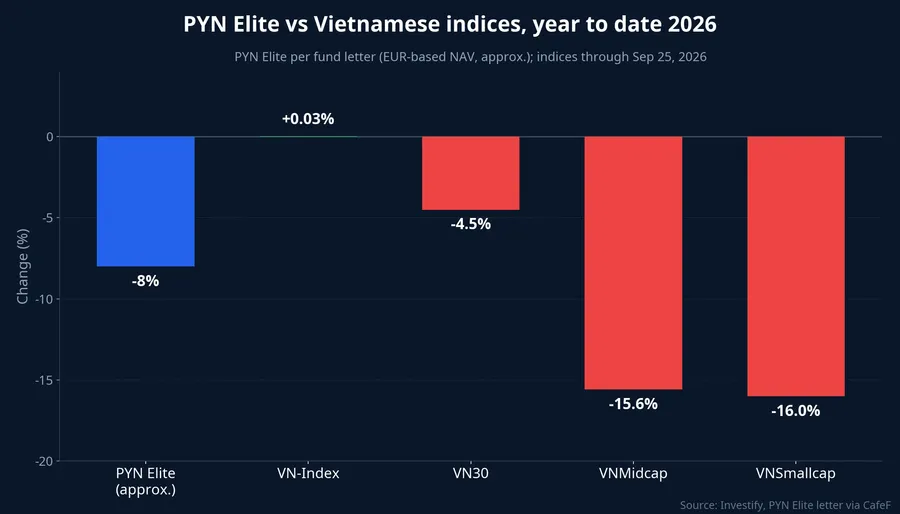
Over the same stretch, the NAV of PYN Elite Fund, one of the longest-running and largest foreign funds in Vietnam, fell about 8%.CafeF In his latest letter to investors, Petri Deryng, founder and portfolio manager of PYN Elite at Finland's PYN Fund Management, did not soften it: "In hindsight, staying out of both VIC and Vietnam's oil and gas stocks was clearly a very unfavorable decision in the short term."
That letter is worth reading closely if you own any equity fund. When a fund "underperforms the VN-Index", what is that number actually measuring? This year, the answer is not what most people assume.
What PYN Elite owns, and what it skipped
PYN Elite is an active, concentrated fund. Its latest portfolio report, as of end-August, lists Sacombank (STB), Hoa Phat (HPG), Mobile World (MWG), FPT and Vietnam Airlines (HVN) among its largest holdings.Tin nhanh Chứng khoán
What the fund does not hold matters just as much. Back in early January 2026, it explained why it stays out of VIC: Vingroup's future cash flows are hard to model, its leverage is high, and the group structure is complicated, with the EV business absorbing much of the profit generated by real estate.FireAnt Think of a landlord who only buys properties whose rent he can calculate. If the numbers do not add up, he passes, even while that property's price keeps rising.
On oil and gas, the fund held back because it expected tensions in the Middle East to ease fairly quickly.CafeF Oil also explains the second drag, HVN. Airline stocks tend to move against oil prices, so when crude climbed, HVN came under pressure.

Where each bet ended up
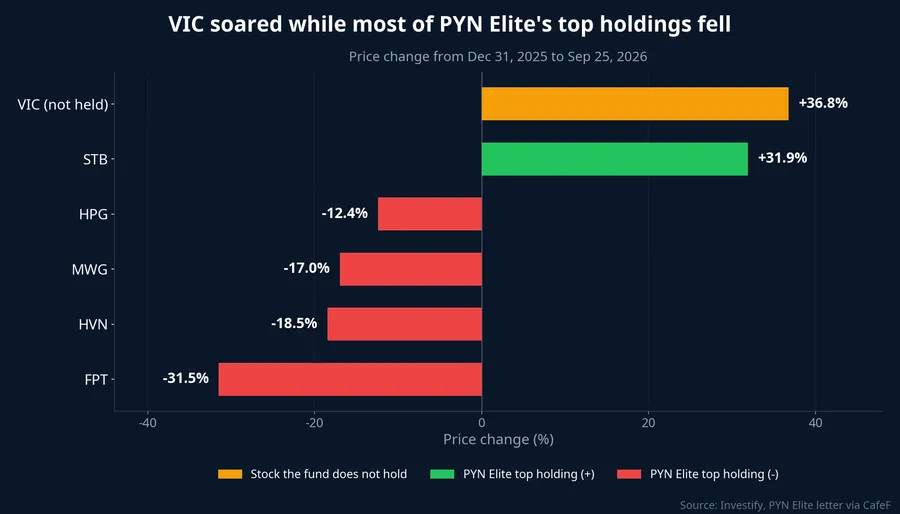
Put the September 25 prices next to year-end 2025 and the picture is clear. VIC, the stock the fund does not own, rose from VND 169,600 to VND 232,000, roughly 36.8%. STB, the fund's largest position, was the rare bright spot, climbing from VND 58,000 to VND 76,500, about 31.9%.
The other four large holdings all fell. HPG lost about 12.4%, MWG about 17% and HVN about 18.5%. FPT fell hardest, about 31.5%, from VND 94,498 to VND 64,700.
The striking part is that these companies are not doing badly. According to PYN Elite, listed-company earnings grew as much as 46% in the first half, and even excluding one-offs, full-year growth could still land around 20-25%.CafeF Deryng calls it a paradox: solid earnings are not showing up in the prices of most of the market, while a few large caps dominate the VN-Index.
A flat index, a falling market
This is where newer investors most often get tripped up. A flat VN-Index does not mean stocks were flat this year. Look at HOSE's other indices over the same period and the story changes completely.
The VN30 fell about 4.5%, from 2,030.63 to 1,938.50 points. The VNMidcap, which tracks mid-sized companies, dropped about 15.6%. The VNSmallcap lost about 16%, and the VNIT technology index about 24.7%.
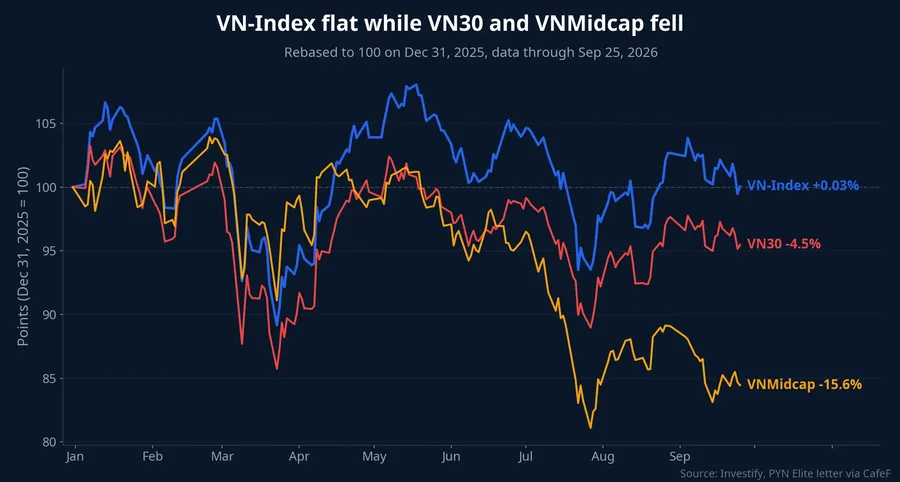
So why did the VN-Index hold up? Mostly because of VIC. The index is weighted by market capitalization, like a scale where each stock weighs as much as its market value. One very large stock gaining nearly 37% is enough to offset a long list of smaller stocks going down.
The VN30 works differently. It caps the weight of each stock and of groups of related stocks, which limits how much VIC can pull it up, so the VN30 still fell.Chứng khoán Online To be fair, not every Vingroup stock rose. VHM fell about 42%, from VND 119,407 to VND 69,100, so the group's combined lift was smaller than VIC's gain alone.
Losing money and trailing the index are different questions
These two questions sound alike but have different answers. Separating them makes fund reports much easier to read.
Why did the fund lose money? Because most of what it owns went down, like most of the market. PYN Elite's roughly 8% decline is far milder than the mid- and small-cap indices, but about 3.5 percentage points worse than the VN30. That gap to the VN30 comes from specific choices: FPT's steep fall, HVN's oil exposure and the decision to skip oil and gas.
Why did it trail the VN-Index? The fund is about 8 percentage points behind the index, and most of that gap is simply not owning VIC. An active fund cannot just buy VIC to match the index without abandoning its own method. PYN Elite picks stocks based on cash flows and earnings it can estimate, and it has said plainly why Vingroup does not pass that filter.
One more technical detail that investors in foreign funds often miss: PYN Elite's NAV is in euros. From end-2025 to September 25, EUR/USD slipped from about 1.17 to 1.14, while USD/VND eased from 26,300 to 25,980.5. In other words, the euro weakened against the dollar while the dong firmed slightly, so in dong terms the fund's loss is no smaller than the roughly 8% headline figure.
What the fund says comes next
PYN Elite has no plans to buy VIC, although it continues to follow Vingroup's business and share price.CafeF Its bet is that as corporate earnings keep growing, prices in the rest of the market will eventually catch up.
On size, subscriptions and redemptions since January have roughly offset each other, so assets under management are almost unchanged. Deryng noted that some other large funds were less fortunate: clients pulled money because of performance below the VN-Index, and some asset managers have had to cut staff or shut down. "We are of course disappointed with our relative returns so far and are not trying to hide that fact," he wrote.
The risk in this stance is real. Nothing guarantees VIC stops rising, and nothing guarantees the market will soon reprice non-Vingroup stocks on earnings. Staying out of VIC could keep looking wrong for longer than the fund expects. On the other hand, if money rotates back into names whose earnings grew while their prices fell sharply, such as HPG, MWG and FPT, a fund like PYN Elite stands to benefit more than one that hugs the VN-Index.
How to read "underperforming the index"
This year, comparing an equity fund with the VN-Index largely comes down to whether the fund owns VIC. That comparison still has value, but it is not enough to judge a manager's stock-picking skill. When a fund trails the VN-Index, a few extra questions help.
- Does it also trail the indices closest to its portfolio? A large-cap fund should be compared with the VN30 as well. A fund tilted toward mid and small caps should be compared with the VNMidcap and VNSmallcap. If it lags the VN-Index but beats these, the shortfall is mostly a VIC story.
- Does the fund explain its choices? PYN Elite laid out why it avoids VIC at the start of the year and has kept that view since. A fund that changes its reasoning with the seasons is more worrying than one that is wrong but consistent.
- Which currency, and over how many years? A fund with a foreign-currency NAV carries extra exchange-rate swings. One year of deviation from the index says less than results across several cycles.
It is worth looking at the flip side too. When an index leans heavily on a few stocks, an index fund or ETF tracking the VN-Index is less diversified than many people think. Owning an index fund this year meant carrying a meaningful slice of single-stock risk, which affects your wallet even if you never bought VIC yourself.
The clearest takeaway from PYN Elite's letter is that "underperforming the VN-Index" in 2026 mostly measures one decision about VIC, not a full verdict on stock-picking ability. The signal to watch in the coming months is the gap between the VN-Index and the VN30 and VNMidcap. If it narrows because non-Vingroup stocks rise, the market is starting to validate the fund's argument. If it keeps widening, the cost of staying out of VIC is still adding up.