

On the morning of Sept 28, Novaland's NVL shares sat at the daily limit-down price of VND 11,050, off 6.8%.CafeF At one point more than 45 million shares were queued to sell at the floor, while only about 9 million had traded. NVL had already closed lower for five straight sessions and lost 12.65% in a week.Người Đưa Tin
The selling lands in record-date week. Sept 30 is the ex-rights date and Oct 1 is the record date for shareholders entitled to buy nearly 800.7 million new shares at VND 10,000 each, on a 3-for-1 basis.CafeF Anyone who wants to sell with the rights attached has only the Sept 28 and Sept 29 sessions left. This piece walks through the mechanics: why shareholders tend to sell before a record date, how the price gets adjusted, and why the distance between the market price and VND 10,000 matters both to shareholders and to Novaland itself.

How the rights work
Put simply: at 3-for-1, anyone holding 3 NVL shares on Oct 1 can buy 1 new share at VND 10,000. Someone with 3,000 shares, for example, needs VND 10 million to take up all 1,000 new shares during the subscription and payment window from Oct 8 to Oct 29.CafeF
In theory, a rights offering doesn't take a single dong from shareholders. The share price is marked down on the ex-rights date, but those who pay for their full allotment are compensated for exactly that markdown. The problem is shareholders who don't want to, or can't, put in more cash. For them, holding through the record date means eating the price adjustment and then finding someone to buy their rights.
Selling rights is also harder than selling shares. They can be transferred only once, between Oct 8 and Oct 26, through a brokerage rather than on the order book.VnFinvest Shareholders who neither sell their rights nor subscribe simply lose the value of the markdown. Compared with all that paperwork, selling the shares before Sept 30 is the easy way out, which is why selling tends to bunch up in the last few sessions before the ex-rights date.
Trading volumes fit that pattern. NVL turned over about 106 million shares in the week of Sept 21 to 25, more than double the roughly 46 million traded in the week of Aug 24 to 28. Two other forces add to the selling. If the offering is fully subscribed, shares outstanding rise from about 2.402 billion to about 3.203 billion, so future profits get split across a third more shares.VnFinvest And as the price falls, margin loans secured by NVL may be force-sold, piling more orders onto the floor.Người Quan Sát
The math after Sept 30
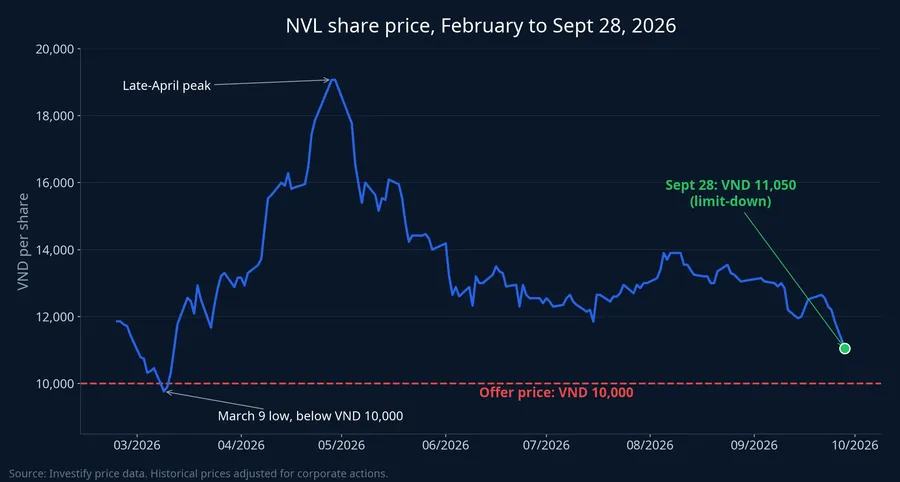
On the ex-rights date, NVL's reference price is adjusted with a simple formula: three times the previous close, plus VND 10,000, divided by 4. It is the average price of 4 shares after the issue: 3 old shares plus 1 new share bought at VND 10,000.
If NVL closes Sept 29 at exactly VND 11,050, the Sept 30 reference price comes out at about VND 10,790. The cushion above the offer price shrinks from VND 1,050 to about VND 790. This is only an illustration, since the official figure depends on the actual Sept 29 close.
That cushion is thinner than it looks. HoSE's daily price band is 7%, so from a reference of about VND 10,790, one more limit-down session would take NVL to around VND 10,050. If Sept 29 also closes limit-down (about VND 10,300), the Sept 30 reference price would be only about VND 10,225, less than VND 300 above the offer price.
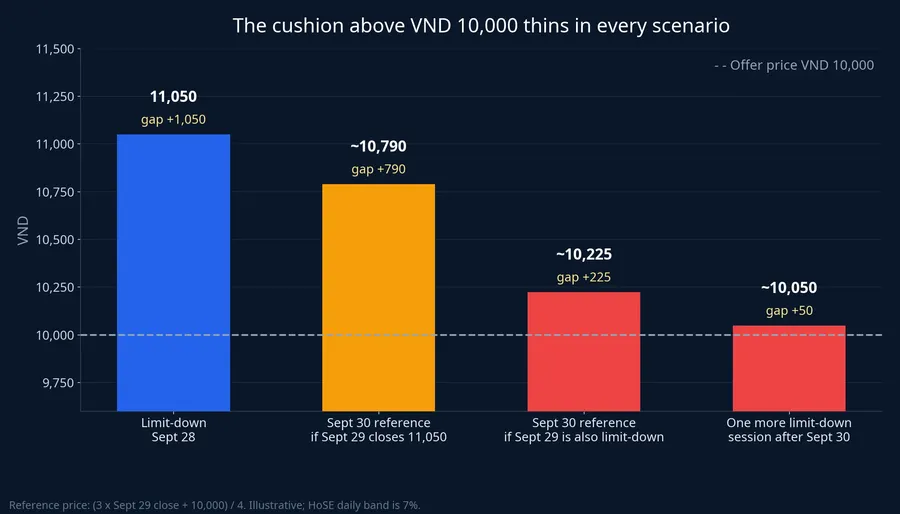
Trading below VND 10,000 isn't new territory for NVL either. Over the past 52 weeks it fell to VND 9,787 on March 9, 2026, before peaking at VND 19,108 on April 28. The stock is now down about 40% from its early-May levels.Người Đưa Tin
A thin cushion makes the rights nearly worthless
The theoretical value of one right equals the gap between the adjusted price and the offer price, divided by 3, since it takes 3 rights to buy 1 new share. At a reference of about VND 10,790, each right is worth about VND 260. At about VND 10,225, that drops to about VND 75. When rights are that cheap, sellers struggle to find buyers, and would-be subscribers have a reason to hold off: they can buy shares on the exchange at nearly the same price without waiting.
If the market price drops below VND 10,000 during the subscription period, the rights are effectively worthless. No rational shareholder pays VND 10,000 for a share that trades for less on the exchange.
Any shares shareholders don't take up will be offered by the board to other investors at no less than VND 10,000, and those shares carry a one-year lock-up.VnFinvest With the exchange price below VND 10,000, finding anyone willing to pay that much and accept a year's lock-up would be very hard. The VND 10,000 floor protects existing shareholders from dilution at a cheaper price, but it also leaves the raise exposed to a shortfall if the stock keeps sliding.
Which debts the money is meant to repay
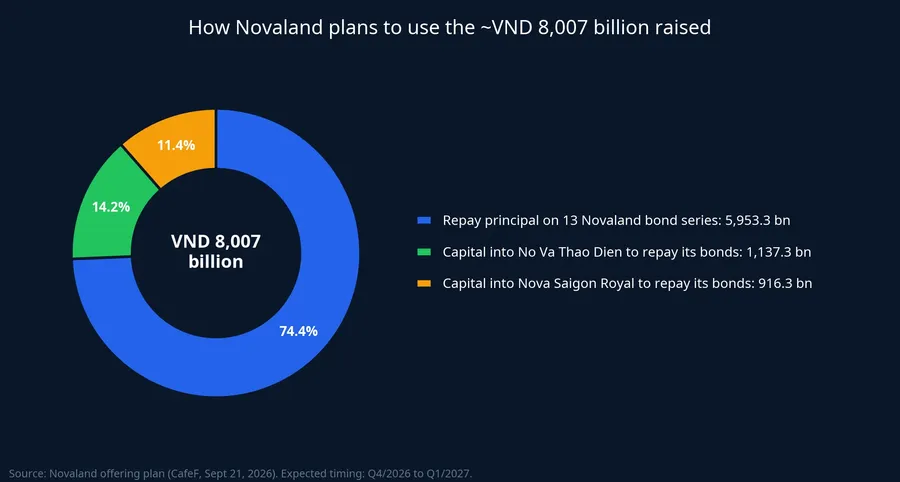
This is why the cushion matters to Novaland, not just to its shareholders. Under the published plan, of the nearly VND 8,007 billion it expects to raise, VND 5,953.3 billion goes toward repaying part or all of the principal on 13 bond series issued by Novaland, depending on agreements with bondholders. Another VND 916.3 billion will be injected into subsidiary Nova Saigon Royal and VND 1,137.3 billion into No Va Thao Dien, both to repay those companies' bond principal. Repayments are scheduled from Q4 2026 through Q1 2027.CafeF In other words, almost all of the money swaps bond debt for shareholder equity. None of it is earmarked for new projects.
Novaland's cash needs are far larger. As of June 30, 2026, it had about VND 30,500 billion of borrowings due within 12 months, including VND 13,200 billion in bonds, against just VND 4,879 billion of cash and equivalents.Người Quan Sát First-half net revenue reached VND 5,096 billion and net profit VND 1,772 billion, versus a loss of more than VND 666 billion a year earlier. Operating cash flow, however, was still negative at VND 3,595 billion.Người Đưa Tin Accounting profit has yet to turn into cash that can pay down debt, which keeps this offering an important source of funds.
The rights offering is only the first step. Shareholders have also approved a private placement of up to 800 million shares to no more than 20 professional investors, plus more than 111.7 million ESOP shares.CafeF Whatever price this first round holds will serve as the benchmark for the rounds that follow.
Insider-linked sales are only part of the picture
Two recent sale registrations have drawn attention. Diamond Properties JSC, an entity related to Bui Cao Nhat Quan, Chairman of Novaland's Board of Directors, registered to sell 2.7 million shares from Sept 29 to Oct 9 to rebalance its portfolio. Novaland's trade union also registered to sell 2.5 million shares via negotiated deals from Sept 28 to Oct 26, nearly 59% of its holding.CafeF
Set against more than 45 million shares queued at the floor, those registrations are small. Together they total 5.2 million shares, less than the roughly 16.6 million traded on Sept 25 alone. Diamond Properties can't start selling until Sept 29, and the union is selling via negotiated trades rather than resting orders on the matching board. Most of the floor-price sell queue on Sept 28 therefore came from other investors.
What the registrations do tell us is that parties linked to management are not adding to their holdings right before the offering. What they don't tell us is whether those parties will subscribe to their rights; the disclosures so far are silent on that. Also on the morning of Sept 28, Bui Thanh Nhon, Founding Chairman of NovaGroup, sent a message marking the group's 34th anniversary, saying it is moving past the peak of an exceptionally difficult period.Người Quan Sát
In short, the selling comes from several sources at once: shareholders unwilling to put in more cash, dilution worries, possible margin liquidations, and the signal from insider-linked parties. The timing, with pressure peaking in the final week before the ex-rights date and before the insider-linked sales could even start, points mainly to the first, though public data isn't enough to pin down each source's exact share.
Every way of handling the rights has a cost
The mechanics below apply to any rights offering to existing shareholders, not just NVL's.
Hold through the record date and subscribe. Subscribers avoid dilution, but they put more capital into a company with total liabilities of about VND 193,420 billion.Người Đưa Tin
Hold through the record date and sell the rights. This recovers part of the value, but how much depends entirely on the cushion. The thinner it gets, the cheaper and less sellable the rights become.
Sell the shares before Sept 30. The floor-price sell queue shows many are taking this route. The cost is selling at an already deeply depressed price.
Hold through the record date and do nothing. This is the worst outcome. The holder absorbs the full price adjustment with no new shares or rights proceeds to offset it.
Dates to watch
NVL's story this week isn't about who is selling. It's about the cushion above VND 10,000. The Sept 29 close sets the Sept 30 reference price and the starting cushion. From Oct 8, the price at which rights change hands will show how the market values that cushion. And up to the Oct 29 payment deadline, where the stock trades relative to VND 10,000 is the most direct gauge of whether Novaland can raise the full VND 8,007 billion or so.
If NVL holds clearly above VND 10,000 throughout the subscription period, the offering has a reasonable basis to raise most of the planned amount. If the price slips below VND 10,000 before Oct 29, the leftover shares will be hard to place, and less bond debt will be repaid in Q4 2026 than planned.