
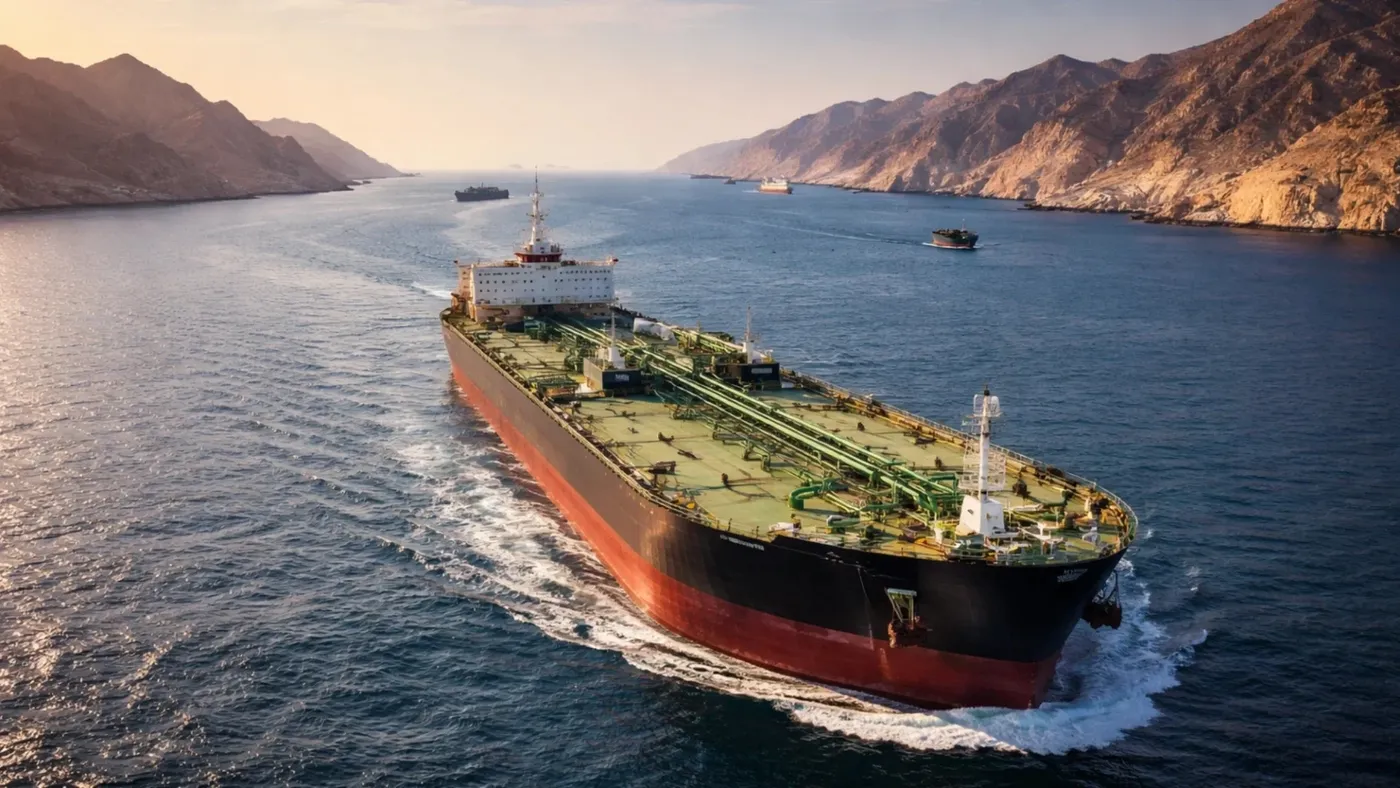

The oil market just got something it has lacked for weeks: a specific date. According to the Wall Street Journal, US President Donald Trump has told associates he expects to resume airstrikes on Iran after the US midterm elections on November 3.CNBC That says nothing about where oil goes next. It does say how long the standoff around the Strait of Hormuz is likely to last.
So the big picture is better read as a decision tree than a forecast. This piece maps three branches from now until after election day, the signals that would trigger each one, and how each would feed into Vietnam's fuel prices, inflation and oil and gas stocks.
What Washington said no to
On Friday, Iranian Foreign Minister Abbas Araghchi proposed reopening the Strait of Hormuz and resuming nuclear talks with the US within seven days, provided Washington accepted Tehran's terms. Those terms: an end to what Iran calls US "aggression," the lifting of the naval blockade and economic warfare, and the release of Iranian assets.CNBC
Trump told reporters he had turned it down: "They made an offer, but I rejected it." Per the WSJ, the core of the offer was to swap a reopened Hormuz for the US lifting its blockade of Iranian ports. In public, Trump says Tehran wants a deal. Privately, according to US officials cited by the WSJ, he remains skeptical that Iran will meet his demands on its nuclear program.Iran International
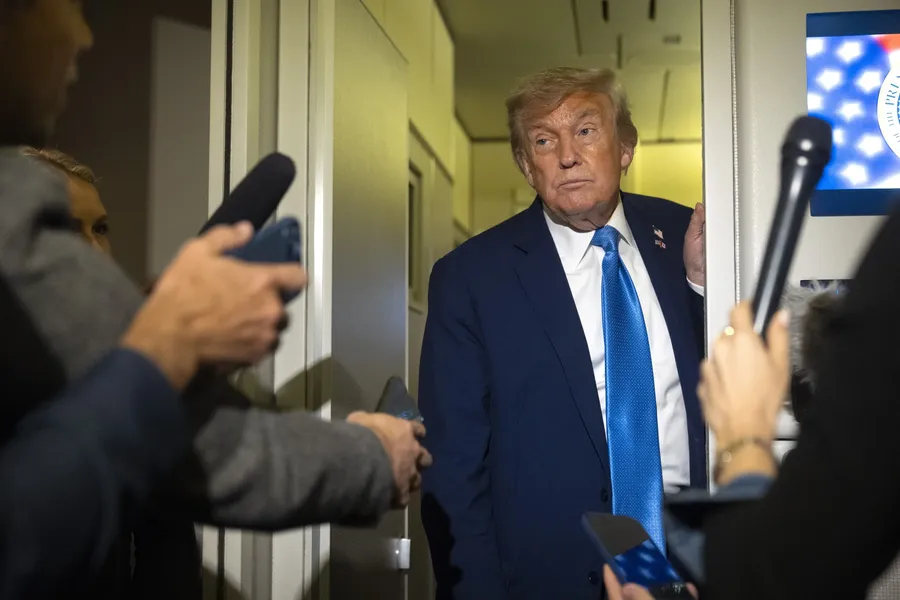
Iran isn't backing down either. Araghchi said Tehran's conditions are clear and Iran will not make concessions, adding that it is still waiting for a definitive US response via intermediaries.Japan Times Both sides are holding their ground, and the strait stays shut.
Oil rose this morning, but mostly to recover lost ground
In Asian trading on Monday morning, Brent rose about 1.8% to USD 106.31 a barrel, while November WTI gained 1.3% to USD 93.62.CNBC In isolation, that looks like a reaction to Washington's rejection. Set against last week, the story changes.
Brent closed at USD 106.60 on September 24. On September 25, as Iran's seven-day offer surfaced, it fell 1.57%. This morning's move largely erases Friday's drop and puts prices roughly back where they were. In other words, the market had already priced in most of the chance of a US "no" before the rejection was confirmed.
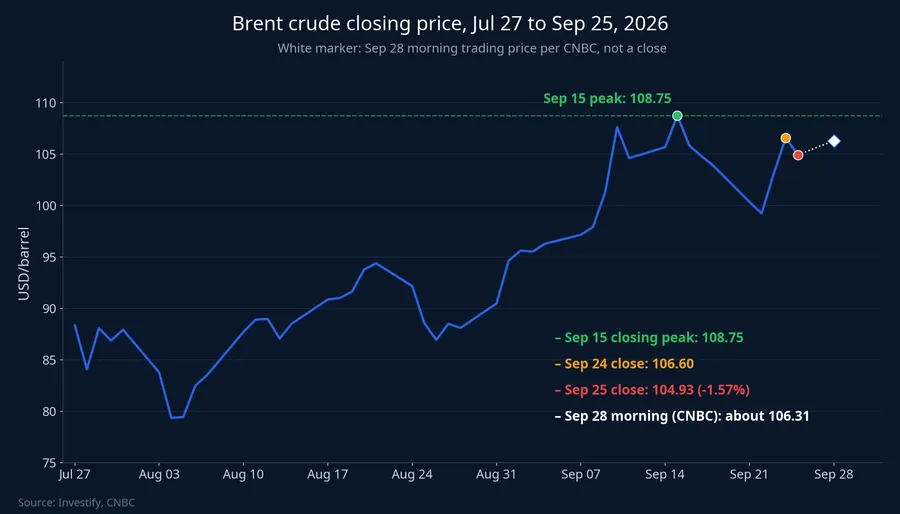
Zooming out, from September 9 to 25 Brent closed in a range from just above USD 99 to USD 108.75, with the peak on September 15. Compared with August 26, Brent is about 20.7% higher. That range is the level the market is using to price a closed Hormuz. The question for the next five weeks is whether prices stay inside it, break above, or fall below.
Branch one: a standoff that drags into November
This is the branch the available information supports most. The US keeps its blockade of Iranian ports, Iran keeps its conditions, and per the WSJ, Trump is looking past the election to decide his next military step. Over the next five weeks or so, neither side has a clear reason to change course.
The confirming signals are simple: no new round of exchanges through intermediaries, no easing of the blockade, and no major attack on tankers or oil infrastructure in the Gulf. In that case, Brent will likely keep trading within its late-September range, moving on each headline from the mediators but lacking the force to break out.
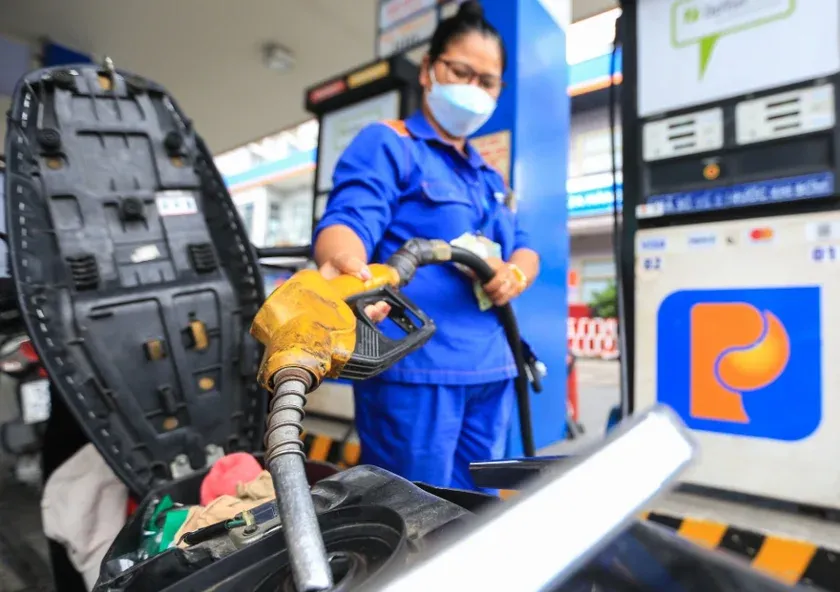
For Vietnam, the clearest transmission channel is pump prices. In the September 24 pricing round, the Ministries of Industry and Trade and Finance neither set aside nor drew on the fuel price stabilization fund, lifting E5 RON92 gasoline to VND 26,390 per liter.Công dân & Khuyến học That is about 20.9% above the August 20 round. With the fund no longer cushioning prices, domestic retail prices track world refined-product prices round by round. A prolonged standoff therefore means pump prices staying high for longer, not necessarily rising further.
Branch two: escalation after the election
This is the branch the WSJ report points to directly. Yet the same report shows Washington is still hesitant. According to officials cited by the WSJ, Trump is wary of relaunching a major campaign, partly because the US wants to preserve dwindling munitions stockpiles for other contingencies.Iran International The scale of any new strikes is unclear, and his position could shift in the coming weeks.
The trigger would be renewed US strikes, or a rise in attacks on tankers and oil infrastructure in the Gulf. One early signal worth watching is the Houthis. On September 26, the Saudi-led coalition said it had intercepted two drones headed for Riyadh and two ballistic missiles aimed at the Khamis Mushait area.CNBC
If the conflict spreads to oil infrastructure in Gulf states beyond Iran, Brent could break above its current range. The level to watch is the September 15 closing high of USD 108.75. In Vietnam, with the stabilization fund no longer absorbing shocks, every step up in world product prices would pass straight into the next pump price, then into transport costs and inflation. The currency is stable for now, with USD/VND around 25,980 on September 25. Still, a bigger fuel import bill would lift demand for foreign currency if this branch drags on.
Branch three: someone blinks
Even after the rejection, both sides are sending signals that keep this branch alive. Trump said he expects talks to resume as early as this week, despite having just turned down the offer.Japan Times On the Iranian side, President Masoud Pezeshkian told Fox News that Iran is ready to cut enrichment levels, dilute its stockpile of 60%-enriched uranium and accept international verification. He also said Tehran wants a deal before the US midterms.Iran International Those remarks drew strong pushback from hardliners at home, so they cannot yet be treated as Iran's official position.
The trigger here would be a partial US easing of the port blockade, or Iran agreeing to put the nuclear file on the table before demanding the blockade be lifted. The market has already shown how fast it reacts to de-escalation: a mere conditional offer knocked Brent down 1.57% on September 25. A real deal with a timetable to reopen the strait would pull much harder, because the premium reflecting a closed Hormuz would have to come out. Vietnamese pump prices would then fall in the following rounds, through the very mechanism now pushing them up.
Reading oil and gas stocks in the sessions ahead
Expect plenty of "oil jumps as US rejects offer" headlines today. As shown above, USD 106.31 is mostly Brent returning to where it was after one down session. It is not a signal of escalation.
Vietnam's oil and gas stocks have also priced in part of the Hormuz story. In the month to September 25, BSR gained 10.95% and PVT rose 11.86%, while PLX fell 8.02%. A 1.8% rise in oil following a 1.57% drop carries no new information strong enough to change how these companies are valued.
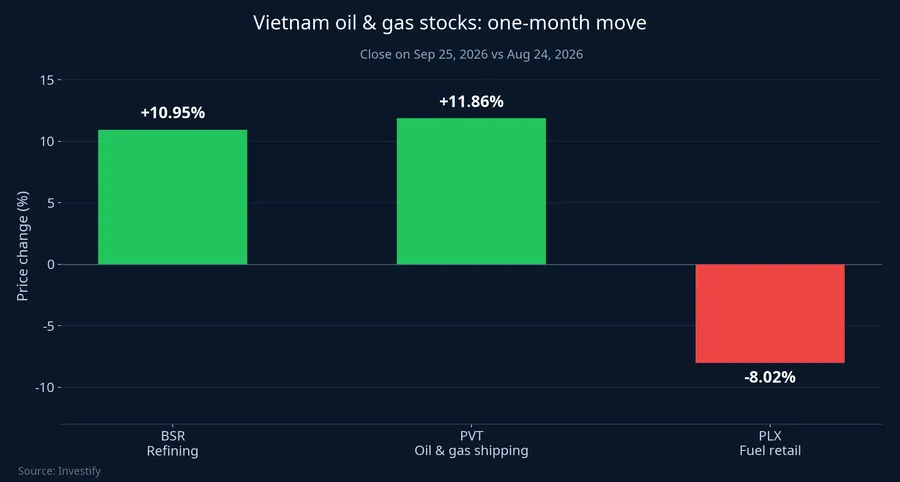
A more useful approach is to read these share prices against the branch signals above rather than against the day's headlines. If oil and gas stocks rally hard while Brent sits around USD 106 with no real escalation, that is money chasing headlines. If Brent closes above USD 108.75 alongside news of attacks on Gulf oil infrastructure, a new price floor is taking shape.
Bottom line: a standoff until after Nov 3 is the base case
On current information, a standoff lasting past election day is the main branch. In that scenario, Brent stays anchored in its late-September range, and Vietnamese pump prices remain high round after round because the stabilization fund has stopped cushioning them. Escalation needs a concrete military move to trigger it, and the munitions hesitancy reported by the WSJ is why it is not yet the default. Concession has signals from statements on both sides, but no action on the ground so far.
Markers to watch over the coming weeks:
- A new round of talks: whether an exchange through intermediaries happens this week, as Trump says. If it does, the concession branch strengthens; if not, the standoff branch firms up.
- Brent's close versus the USD 108.75 peak of September 15: a break above, paired with attacks on oil infrastructure, signals escalation.
- The next domestic fuel pricing round: this is where swings in world oil prices reach Vietnamese consumers' wallets fastest.