


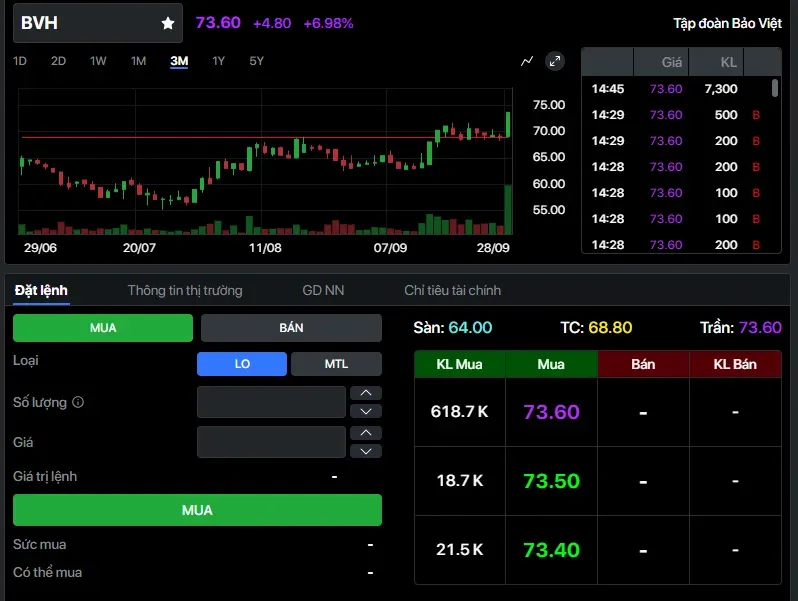
The September 28 session produced two numbers pointing in opposite directions. The VN-Index closed at 1,780.68, down 4.43 points, with 248 decliners against just 104 advancers.Nhân Dân In the same session, shares of Bao Viet Holdings (BVH) rose the full 6.98% daily limit to VND 73,600, their highest since mid-April 2026, on more than 3.4 million shares traded, the heaviest volume in about four years.CafeF
Local press that day pointed to one common weight on the market: interest rates that remain stubbornly high.MarketTimes The twist is that those same rates are feeding Bao Viet's profits. For most listed companies, interest is a cost of capital. For the listed company with the largest bank deposits on the exchange, interest is revenue.
How high rates hold most stocks back
The first channel is money flow. According to MarketTimes, Petri Deryng, founder and fund manager of PYN Elite Fund, argues that Vietnamese deposit rates have climbed sharply alongside government bond yields, prompting domestic investors to shift money out of equities and into bank deposits.MarketTimes When a savings account offers a guaranteed return, a stock has to promise more to hold on to capital. The most visible result is thin trading, which makes it hard for most sectors to break higher.
The second channel is the cost of capital. Companies that borrow to expand pay more interest, leaving a thinner slice of profit for shareholders. Investors trading on margin also pay more to borrow, which weakens leveraged buying power. On September 28, selling concentrated in banks and brokerages, two sectors highly sensitive to liquidity and funding costs.Nhân Dân
So the familiar rule that "rising rates are bad for stocks" holds for most of the market. But some business models run the other way, and insurance is the clearest example.
For Bao Viet, interest is income
Insurers collect premiums up front, set aside technical reserves, and invest that pool of money in income-generating assets.CafeF Bank deposits and bonds therefore make up a large share of the portfolio. Put simply, a big insurer behaves like a very large saver: the higher the rate, the more interest it earns.
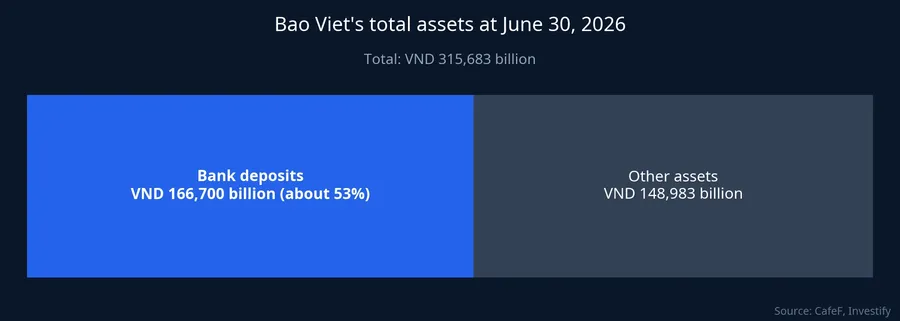
At the end of June 2026, Bao Viet held VND 166,700 billion on deposit with credit institutions, up nearly VND 18,900 billion from the start of the year.CafeF Against total assets of VND 315,683 billion, deposits alone account for about 53%. The notes to the financial statements also show some short-term deposits earning up to 8.9% a year and long-term deposits up to 8.6%.CafeF
First-half numbers show the mechanism at work
In the first six months of 2026, Bao Viet's deposit interest income reached VND 4,926 billion, up 42.3% year on year. Total financial income came to VND 8,430 billion, up 27.9%.CafeF Net profit attributable to parent-company shareholders was VND 1,831.55 billion, up 35.83%, while pre-tax profit was VND 2,289.25 billion.
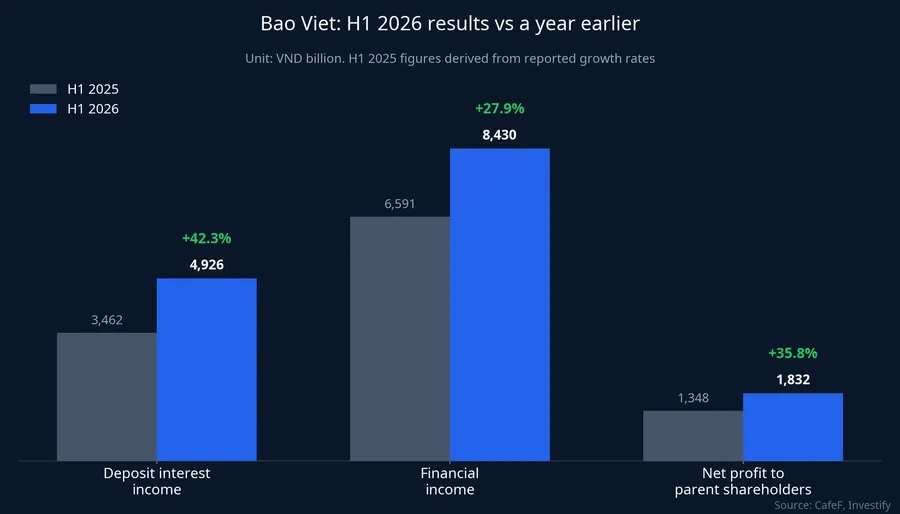
One comparison puts the scale in perspective. Deposit interest income alone in the first half was more than twice the group's entire pre-tax profit. Not all of that interest turns into profit, since an insurer must also set aside reserves for policyholder benefits. Still, the relative sizes make it clear that the investment book is carrying most of Bao Viet's profit growth.
The limit-up session: rates are the main explanation, not the only one
Two things need to be kept apart. That first-half profit grew on deposit interest is documented in the financial statements. Why BVH hit its limit on September 28 specifically has no single answer. CafeF did not identify any Bao Viet-specific event in the session, and there was no new official information around that date about the State reducing its stake in the group.CafeF
The data points more to a sector story than a single-stock one. MIG rose 3.18% to VND 16,200, BMI gained 1.43% to VND 14,150, and PVI and BIC also moved higher.CafeF When a whole group that benefits from high rates rallies on a red day, the most reasonable reading is that money is seeking shelter in the companies that gain from the very force weighing on the market.
That said, BVH far outpaced its peers. Its volume of 3,430,700 shares on September 28 was more than five times the average of the previous 20 sessions, which ran at roughly 667,000 shares a day. The gap could reflect Bao Viet's much larger deposit base, BVH's status as a large-cap that institutional money favors when turning defensive, or longer-term expectations such as restructuring of its subsidiaries. The available data is not enough to separate how much each factor contributed.
Up about 30% in two months
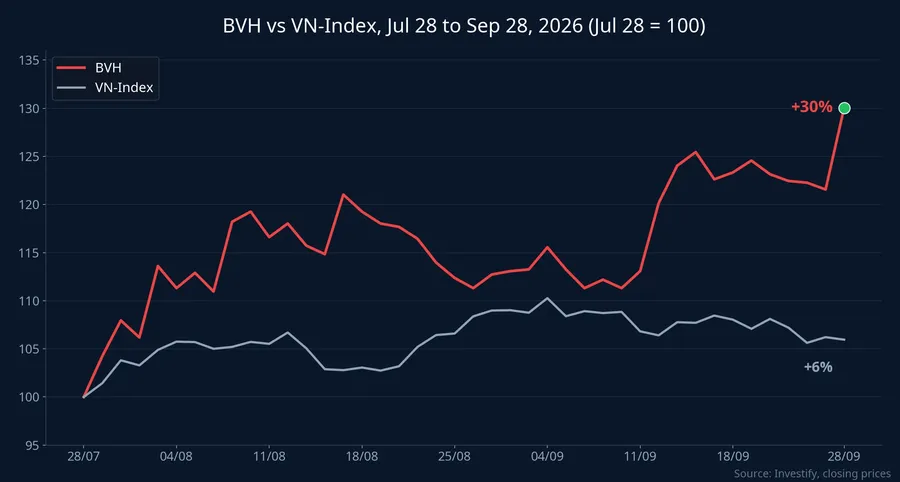
From a close of VND 56,600 on July 28, BVH has risen about 30% to VND 73,600. Over the same period, the VN-Index gained only about 6%, from 1,680.62 to 1,780.68. The "rate beneficiary" story is therefore not new to the market. First-half results were published in late July, and a meaningful part of the expectations is already in the price.
What remains rests on forecasts. Vietcap Securities projects Bao Viet's ROE rising from 12.1% in 2025 to 15.7% in 2026 and 18% in 2027, driven by higher investment yields and lower provisioning costs.CafeF That is a broker's forecast, not a reported result.
There is one mechanical detail newer investors often miss. Market rates do not flow into Bao Viet's income immediately, because only new deposits, or deposits rolled over at maturity, earn the new rate.CafeF That lag cuts both ways. Rates held high today will keep lifting financial income over the next few quarters. Conversely, when rates start to fall, income will not drop right away, but share prices usually move before the financial statements do.
If rates cool
The same force pushing BVH higher could pull it back down. As rates decline, the investment book gradually loses its edge, and the part of the valuation built on high financial income would have to adjust.
The picture is not entirely one-sided. According to Vietcap, the life insurance business is still recovering and could rebound more strongly from 2028, as rates ease and household incomes improve.CafeF In other words, lower rates would take something away from the investment side while potentially giving some back on the insurance side. The two effects just don't move at the same speed. Investment income follows the maturity schedule of deposits, while life insurance sales recover with household incomes, which is usually slower.
How to read September 28
BVH's limit-up session is a clear example of one macro variable pushing different companies in opposite directions. For stocks in general, high rates are a drag. For a company holding about 53% of its assets in bank deposits, high rates are income.
On the numbers, Bao Viet's profits are currently tightly linked to interest rates, and after a gain of about 30% in two months, BVH's share price is essentially pricing in the expectation that rates stay high. Risks around life insurance or valuation do not overturn that thesis unless deposit rates turn clearly lower.
Signals worth watching over the coming months:
- Q3 financial statements, usually released in October: whether deposit interest income keeps growing at a pace close to the 42.3% seen in the first half.
- Banks' 12-month deposit rates toward year-end: a clear turn lower would put pressure on the rate-driven part of the rally before the financial statements have time to reflect it.