

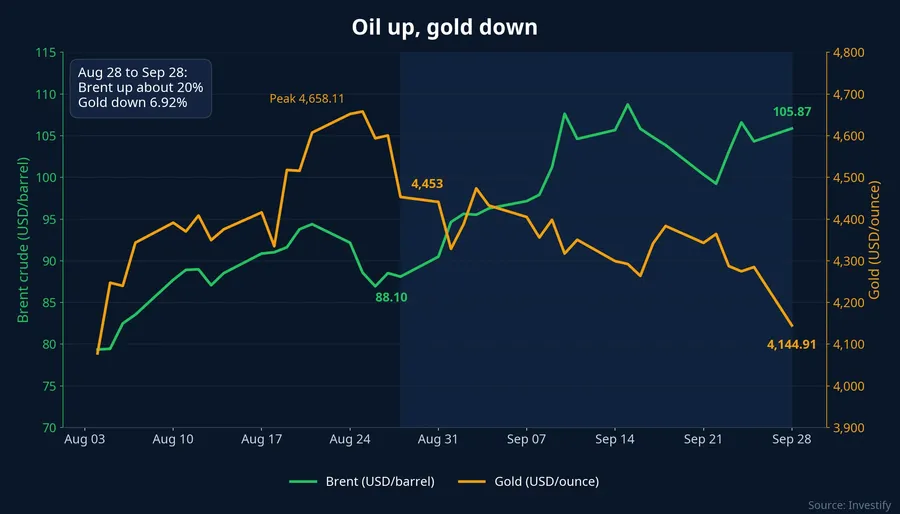
Over one month, from August 28 to September 28, Brent crude rose about 20%, from USD 88.10 to USD 105.87 a barrel. Over the same stretch, spot gold fell 6.92%, from USD 4,453 to USD 4,144.91 an ounce. Measured from its most recent peak of USD 4,658.11 on August 25, gold has given up about 11%.
The two prices have moved in opposite directions while the conflict around the Strait of Hormuz shows no exit. For many investors that is hard to square with the old rule that war is good for gold. The bigger picture says the rule is only half right. The other half is being written in the US Treasury market.
September 28: bad news from the Gulf, gold still falls
Over the weekend, US President Donald Trump said he had rejected Iran's proposal to reopen the Strait of Hormuz and restart talks within seven days.NPR By the usual reflex, that headline should have sent safe-haven money into gold.
On September 28, the first session after the news, gold went the other way. Spot prices fell about 3% to around USD 4,156 an ounce, the lowest since August 5.Yahoo Finance Investify's data put gold at USD 4,144.91 on the evening of September 28 (Vietnam time), down 3.27% from the September 25 session.
On the same day, the 10-year US Treasury yield climbed back above 5.2%. The CME FedWatch tool showed markets pricing a 70.3% probability of another Fed hike in October, up from 64.2% a day earlier.Yahoo Finance Those two numbers explain the session better than any dispatch from the Gulf.
Where "war is good for gold" gets it right
The belief deserves a fair hearing, because it rests on something real. Gold does not depend on anyone's promise to repay, so when geopolitical risk flares, safe-haven money tends to reach for it first. In 2022, after Russia invaded Ukraine, gold climbed to about USD 2,070 an ounce on March 8, roughly two weeks into the war.Investing News
The problem is that the rule only describes the first reaction. It says nothing about what happens when a conflict lasts long enough to feed into energy prices, and from energy into inflation and interest rates. The Hormuz conflict is now in exactly that second phase.
The chain from a barrel of oil to an ounce of gold
Rising oil and falling gold are not two separate stories. Expensive oil is what is pulling gold down, through a chain of linked steps.
The first link is inflation. The blockade of Hormuz keeps energy costs high, and energy prices flow straight into the US consumer price index. According to CNBC, that pressure led the Fed to raise rates by 25 basis points on September 16, to a range of 3.75% to 4%, its first hike since 2023.CNBC
The second link is expectations. When Washington turned down Iran's offer, markets read it as a sign that high oil prices will persist, handing the Fed another reason to hike. The odds of a move at the late-October meeting jumped from 64.2% to 70.3% in a single day.
The third link is bond yields. Higher rate expectations push Treasury yields up. On September 28, alongside the 10-year above 5.2%, the 30-year yield topped 5.3%.Yahoo Finance
The final link is opportunity cost. Gold pays no interest. When US government bonds, among the safest assets in the world, pay more than 5% a year, anyone holding gold is giving up that income in exchange for the chance that gold goes up. The higher the yield, the more expensive it becomes to wait.

Giovanni Staunovo, an analyst at UBS, told Reuters that higher oil prices and expectations of further Fed hikes have been the two main forces weighing on gold recently, because that environment keeps real yields and the dollar elevated.Yahoo Finance
Other explanations, and why yields still dominate
Yields are not the only explanation for the sell-off. At least two other factors are at work, and ignoring them would make the picture too tidy.
The first is profit-taking after a hot rally. Between August 4 and August 25, gold gained about 14%, from USD 4,077.86 to USD 4,658.11 an ounce. Part of September's selling is money locking in gains from that run, which is common after any steep climb.
The second is demand for cash. Ole Hansen, Head of Commodity Strategy at Saxo Bank, warned that when financial conditions tighten, gold can be sold to raise cash precisely because it is easy to sell.Yahoo Finance
The evidence still points to yields as the main force. Gold's worst session landed on the very day the odds of a Fed hike rose and the 10-year yield crossed back above 5.2%. The cash demand Hansen describes also stems from tighter financial conditions, which brings the story back to rates. Profit-taking can explain part of the drop from the peak, but it struggles to explain why gold kept falling as the war news got worse.
The last time this happened was 2022
This script has played out before. After the March 2022 peak, the war in Ukraine ground on, but the Fed launched its most aggressive tightening cycle in decades, hiking seven times that year and taking its policy rate to a range of 4.25% to 4.5%.CNBC
Gold slid through the rest of 2022 and dropped below USD 1,650 an ounce in October, roughly 20% under its March peak, while the fighting had not stopped.Investing News The lesson is fairly clear. Geopolitical risk delivers the initial jump. Interest rates decide the trend over the months that follow.
SJC gold is falling more slowly, and that is a separate risk
The domestic story in Vietnam adds another layer. On September 28, SJC gold bars were quoted at VND 139.4 million per tael to buy and VND 142.4 million to sell, down VND 2 million from the previous session.Báo Đà Nẵng
Compared with August 28, the SJC selling price is down 5.19%, from VND 150.2 million to VND 142.4 million per tael. Over the same period, the world gold price converted into dong fell about 7.3%, from about VND 140.1 million to about VND 129.8 million per tael. The conversion uses the USD/VND rate in Investify's database and excludes taxes and fees.
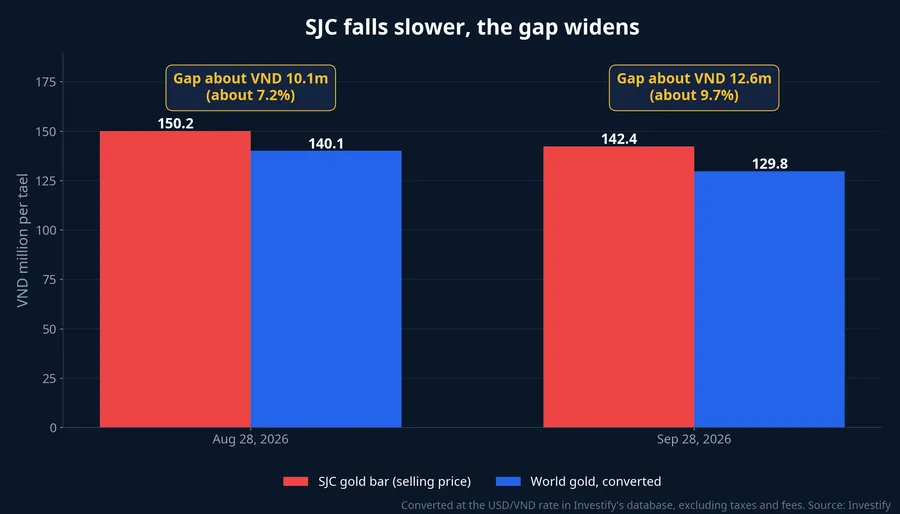
Because SJC has fallen more slowly, the gap between the SJC selling price and the converted world price has widened from about VND 10.1 million per tael (about 7.2%) at the end of August to about VND 12.6 million (about 9.7%) on September 28. In other words, anyone buying gold bars today pays a bigger premium over the world price than a month ago.
That creates a double risk for anyone holding or planning to buy gold bars. The first is that world prices keep falling if US rates keep rising. The second is that the gap narrows back toward its old level, in which case SJC could fall faster than world gold. Add the VND 3 million per tael spread between buying and selling prices, and a buyer today needs a fairly large rebound just to break even.
Two numbers to watch instead of war headlines
The belief that war lifts gold needs an amendment: war only pushes gold higher when it does not drag interest rates up with it. In this conflict, the main channel runs through oil, inflation and the Fed, so worsening war news is currently bad news for gold.
For anyone holding gold as a hedge, then, two numbers matter more than the headlines: the 10-year US Treasury yield and the probability of a Fed hike at the October 27-28 meeting. While the yield stays above 5.2% and the hike odds stay above 70%, the pressure on gold shows no sign of easing.
The same chain also opens up a possibility that sounds backwards. According to CBS News, Trump said he expects talks with Iran to resume this week despite rejecting the latest offer.CBS News If talks make progress and oil cools, inflation expectations and yields could ease with it. Good news for peace could then turn out to be good news for gold. That is an inference from the transmission chain, not something that has happened.
For SJC gold bars, buyers should also watch the gap against the converted world price. It is far wider than at the end of August, so even if rate pressure eases, SJC may recover more slowly than world gold. The Fed's late-October meeting will be the clearest test of this whole line of reasoning.