

A bank wants to sell new shares at a price 62% above where its stock trades. Many investors instinctively read that the other way round: if insiders are confident enough to ask that much, the listed shares must be cheap. PVcomBank (UPCoM: PCB) is a good case for testing that logic, because the numbers needed to check it are already in the bank's financial statements.
On September 25, PVcomBank's board issued a resolution setting the private placement price at VND 13,628 per share.CafeF PCB closed that same session at VND 8,400, putting the offer price roughly 62.2% above the market.Người Quan Sát On its face, that is a wide gap. Put VND 13,628 next to the bank's own book value, though, and the picture changes considerably.
Why "selling high means it's cheap" is partly right
The argument has a real basis. Issuers always know more than the market, and management that believes its stock is undervalued will not want to sell new equity cheaply. Selling cheap means handing a slice of existing shareholders' assets to newcomers at a bargain.
PVcomBank's recent results also lend the story some weight. The bank reported pre-tax profit of VND 1,023 billion in the first half of 2026, up 25.9% year on year.CafeF Its non-performing loan ratio stood at 2.83% at end-June, which the bank says is its lowest in five years.Người Quan Sát The State Bank of Vietnam approved this capital increase plan on July 20.CafeF
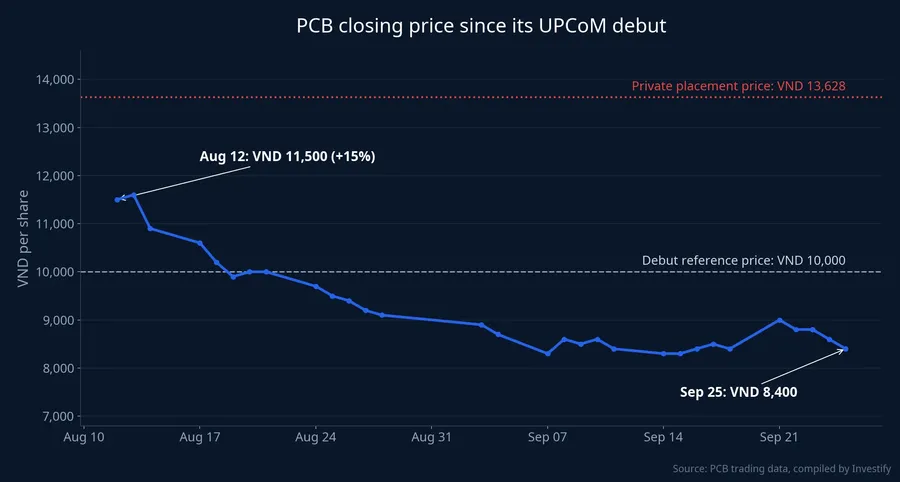
Meanwhile, PCB's share price has drifted lower almost without pause since listing. Stop there, and it is easy to conclude the market is overlooking a sound bank. The problem is that the offer price and the market price are not produced by the same calculation.
Putting VND 13,628 next to book value
The telling figure in the financial statements is equity. PVcomBank's shareholders' equity was VND 13,250.9 billion at June 30, 2026. Divided by 900 million shares outstanding, that works out to book value of roughly VND 14,720 per share. This is Investify's own calculation from the financial statements, not a figure the bank has published separately.
So the VND 13,628 offer price is still about 7.4% below book value. In price-to-book (P/B) terms, placement buyers would pay about 0.93x book. Buyers on the exchange at VND 8,400 are paying only about 0.57x.
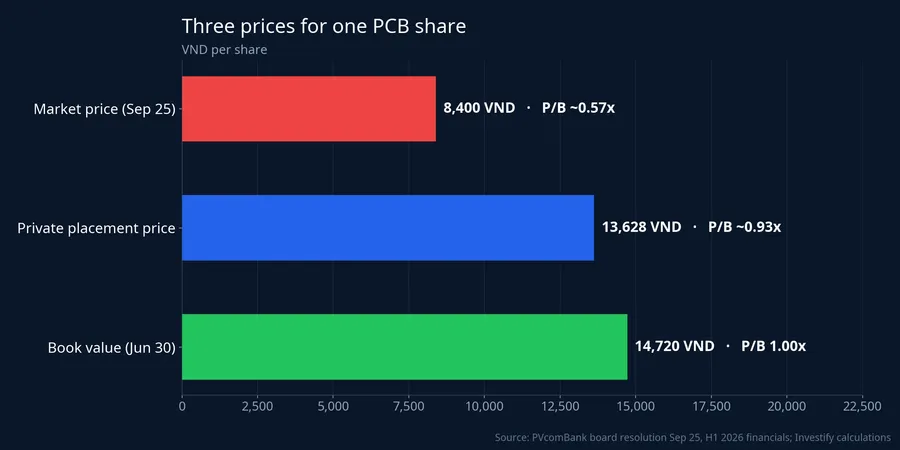
Seen this way, the question shifts. The bank is not valuing its shares above book. It simply does not want to sell new equity too far below book, while the market is paying less than 60% of that value.
How the bank arrived at such a precise figure has not been disclosed; press coverage of the resolution gives only the price. That leaves several plausible explanations. The price may be anchored to an internal valuation close to book value. It may reflect the position of the controlling shareholder, the Vietnam National Industry – Energy Group (Petrovietnam), which holds 52% of the bank.Vietstock Issuing new shares well below book would dilute the per-share value of the state shareholder's stake. It is also possible that interested investors are already lined up at this price, although no list has been published. The available data leans toward the first explanation, since a price this close to book is hard to put down to coincidence. The bank, however, has not confirmed this.
Why the market pays only 0.57x book
The exchange price answers a different question: how much profit do those assets generate, and how durable is it? On that front, PVcomBank's first-half results cut both ways.
On the plus side, net interest income rose from VND 1,707.4 billion to VND 2,716.6 billion, up about 59.1% year on year. Yet total operating income fell from VND 3,861.8 billion to VND 3,482.1 billion, a drop of about 9.8%. Profit still grew, mainly because credit loss provisions shrank from VND 1,277.9 billion to VND 181.6 billion, a decline of roughly 85.8%.
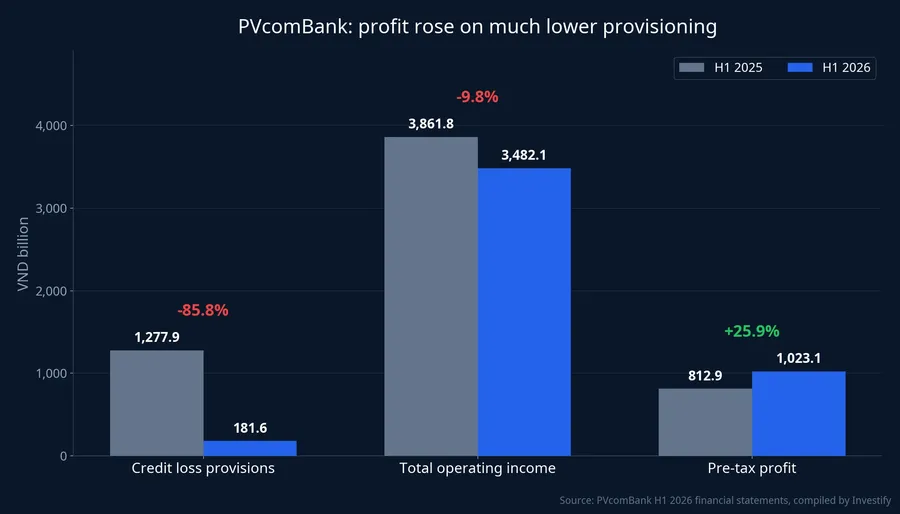
In other words, most of the profit growth came from setting aside far less for bad loans than a year earlier, not from earning more across the business. Falling bad debt is a legitimate reason to provision less. But investors on the exchange are reluctant to bet that provisions will stay this low for years, and a P/B of around 0.57x reflects that caution.
Thin liquidity also weighs on the price. Outside a handful of sessions with unusually large volumes, PCB typically trades only a few hundred thousand shares a day, a tiny fraction of its 900 million shares outstanding. On its August 12 debut, PCB rose 15% to VND 11,500 from a reference price of VND 10,000.Vietstock By September 25, it was about 16% below that reference price and about 27% below its debut-day close.
What buyers of the 300 million shares sign up for
Under the plan approved at the 2026 annual general meeting, PVcomBank will offer 300 million shares to professional securities investors, with issuance expected between Q4 2026 and Q1 2027.CafeF All of these shares carry a one-year transfer restriction.
From the buyer's side, those are demanding terms. A professional investor can simply buy PCB on the exchange at VND 8,400 and sell whenever they like. Choosing the placement instead means paying about VND 5,228 more per share and accepting a one-year lock-up. Only a narrow group of buyers has a reason to do that: those who need a large block that a thinly traded market cannot supply, or those with strategic goals at the bank, such as a board seat or a business partnership.
The deal is not small either. If fully sold, PVcomBank would raise about VND 4,088 billion, and its charter capital would rise by VND 3,000 billion to VND 12,000 billion.Người Quan Sát The new buyers would hold about a quarter of the shares outstanding after the issue.
A price in a resolution is not a price anyone has paid
Private placements priced above market are nothing new, and they do not always go smoothly. In March 2024, Licogi 13 (LIG) offered 22.5 million shares privately at VND 10,000 while its stock traded at around VND 4,000. Nine professional investors were on the provisional list, yet none subscribed and the entire offering was cancelled.CafeF
PVcomBank differs from LIG in size, industry and controlling shareholder, so no similar outcome can be inferred. The only common thread is the mechanism: a price written into a resolution does not mean anyone has agreed to pay it.
What existing shareholders get if the deal sells out
One detail is easy to miss. Because the offer price is below book value, the issue would slightly lower book value per share rather than raise it.
Assuming a full sale and everything else unchanged, equity would rise from VND 13,250.9 billion to about VND 17,339 billion. Spread across 1.2 billion shares, book value would come to roughly VND 14,450 per share, about 1.9% below the pre-issue VND 14,720. That dilution is modest, and in exchange the bank gets more capital to grow its loan book. But it shows that, on a book-value basis, placement buyers are getting a better price than existing shareholders, not overpaying.

For buyers on the exchange at VND 8,400, the math is even more favorable: after the issue, they would still be paying only about 0.58x book. That discount only matters, however, if the bank's earnings prove durable enough to lift P/B over time. That is precisely what the market doubts.
The real signal is the placement result
The VND 13,628 price tells us PVcomBank's terms for selling new equity: close to book value, not far below it. It is not an independent estimate of what the shares are worth, nor evidence that the listed stock is cheap. The 62% gap should therefore not be read as a buy signal. A better reading is to treat it as a test: will any professional investor pay around 0.93x book and lock up capital for a year in this bank?
The answer will come when PVcomBank reports the placement result, expected between Q4 2026 and Q1 2027. If all 300 million shares go to recognizable buyers, the market will have grounds to reassess the 0.57x discount. If the offering drags on, falls short or needs a price cut, the exchange price is the more accurate read.
Until then, two figures in the Q3 report are worth watching: provisions and non-interest income. If provisions climb again while non-interest income keeps falling, the first-half profit growth will be hard to repeat.