


Speaking on Fmarket's Fund Insider program, Lê Chí Phúc, CEO of SGI Capital, said the cash he has not yet invested sits mostly in 1–3 month deposits. Only a very small share goes into 6–12 month terms, even though the rate gap between short and long terms can reach 2–3 percentage points. He said he values flexibility over "locking money into 8–9%, or above 9% as it is now".CafeF
When a fund manager says something like that, it is easy to hear it as advice. It is really a choice with a price tag, and the price can be counted in dong. This post puts three ways of holding cash while you wait for an opportunity side by side, using the same VND 1 billion, and asks the same three questions of each: how much interest you earn over a year, what you give up if you need the money early, and who the approach suits.
Why short-term rates are stuck at 4.75%
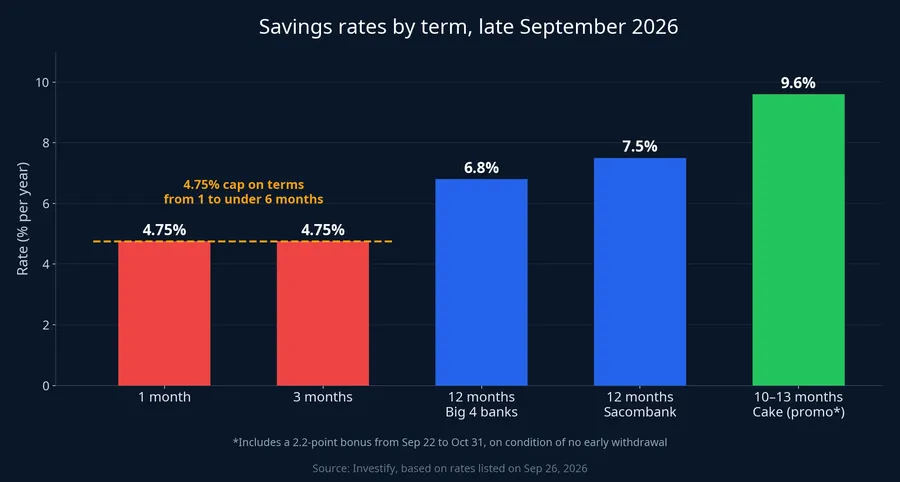
First, it helps to understand why short and long terms pay so differently. Under the State Bank of Vietnam's Decision 2411/QĐ-NHNN, effective November 20, 2024, deposits from 1 month to under 6 months are capped at 4.75% a year, while demand deposits and terms under one month are capped at 0.5%.DIV From six months up, banks set their own rates based on funding supply and demand.
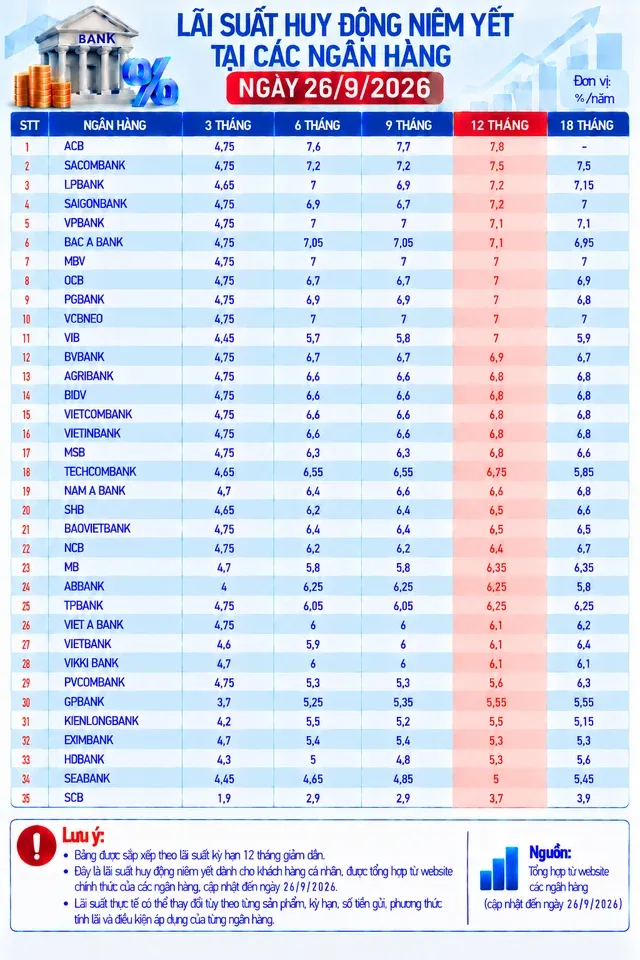
Think of the short end as a room with a low ceiling: however badly a bank needs funding, the rate cannot climb any higher. A survey on September 26 found many banks listing exactly 4.75% for three-month deposits, right at the cap. When banks need to attract money, their only lever is the long end. That is why 12-month rates have reached 6.8% at the Big 4 state-owned banks and 7.5% at Sacombank.Soha
The "above 9%" Phúc mentioned is real, but it comes with strings. Cake by VPBank lists 7.4% for 10–24 month terms and adds a 2.2-point bonus from September 22 through October 31, taking 10–13 month deposits to 9.6%. For first-time depositors, the condition is no early withdrawal.Ngôi Sao Put simply, the highest rate on the market is also the one that ties your money down the hardest.
What happens if you withdraw early
This is the variable that decides the whole comparison. Under Circular 04/2022/TT-NHNN, if you withdraw the full amount before maturity, the bank pays interest for the entire period at no more than its own lowest demand-deposit rate. If you withdraw only part, the withdrawn portion earns that rate while the rest keeps its original rate.Báo Chính phủ
Demand deposits pay at most 0.5% a year, and many banks pay less. Breaking a deposit halfway therefore wipes out almost all the interest built up so far. The calculations below assume 0.5%, which is the most generous assumption for someone who breaks a deposit. If your bank pays less, the penalty is slightly bigger.
Option one: rolling 1–3 month deposits
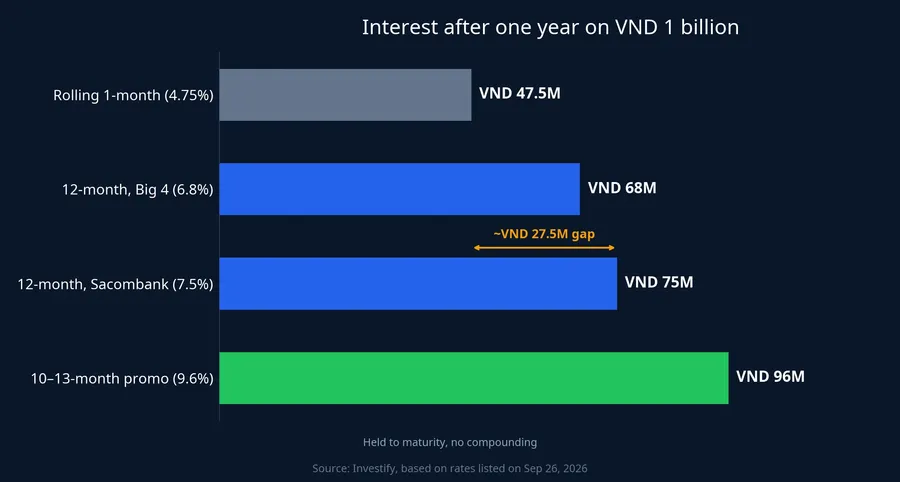
This is what Phúc does. On VND 1 billion at 4.75%, a year's interest comes to about VND 47.5 million, a little more if interest is rolled into principal each period.
Compared with locking in 12 months at the Big 4's 6.8% (about VND 68 million), you leave behind about VND 20.5 million. Against Sacombank's 7.5% (about VND 75 million), the gap is about VND 27.5 million. That is the cost of being ready, paid in real money every year.
In return, needing cash in a hurry costs you almost nothing: wait at most one to three months for the deposit to mature, or give up one short period's interest. This approach suits people who already know what they want to buy, at what price, and who watch the market closely enough to act when the price arrives. Phúc fits that profile. He still sees the stock market in an unfavorable phase, but many stocks have fallen 30–50%, and SGI Capital may raise its allocation when conditions line up.CafeF For him, missing a buying window costs far more than a few points of interest.
Option two: lock in 12 months, break it if needed
Held to maturity, VND 1 billion at 7.5% earns about VND 75 million, roughly VND 27.5 million more than option one. At the 9.6% promotional rate, it rises to about VND 96 million.
The risk is a single early withdrawal. Say you need all the money in month six. At a 0.5% demand-deposit rate, six months earns only about VND 2.5 million, while the rolling approach would have earned about VND 23.75 million over the same period. One mid-year withdrawal costs you about VND 21 million relative to rolling over, almost the entire extra interest the 12-month deposit promised. On a promotional deposit that bars early withdrawal, you also lose the bonus.
Phúc himself acknowledges that when the market turns favorable, the opportunities are usually big enough that investors need not agonize over breaking a deposit early.CafeF Still, he chooses not to wait until then to sort things out. Locking everything into one deposit works best for money you are nearly certain you will not touch for 12 months.
Option three: split into several smaller deposits
Instead of one VND 1 billion deposit, you open five 12-month deposits of VND 200 million each. When you need cash, you break only as many as you need, and the rest keep their rate. The rules already allow partial withdrawals, but not every product supports them, so separate deposits give you more control. Think of it as keeping money in several envelopes rather than one safe.
The numbers show why this is worth considering. Suppose that in month six you need VND 400 million to buy stocks:
- Five VND 200 million deposits at 7.5%: three held to maturity earn about VND 45 million, two broken mid-year earn about VND 1 million. Total: about VND 46 million.
- Rolling 1-month deposits at 4.75%: VND 600 million kept all year earns about VND 28.5 million, VND 400 million kept six months earns about VND 9.5 million. Total: about VND 38 million.
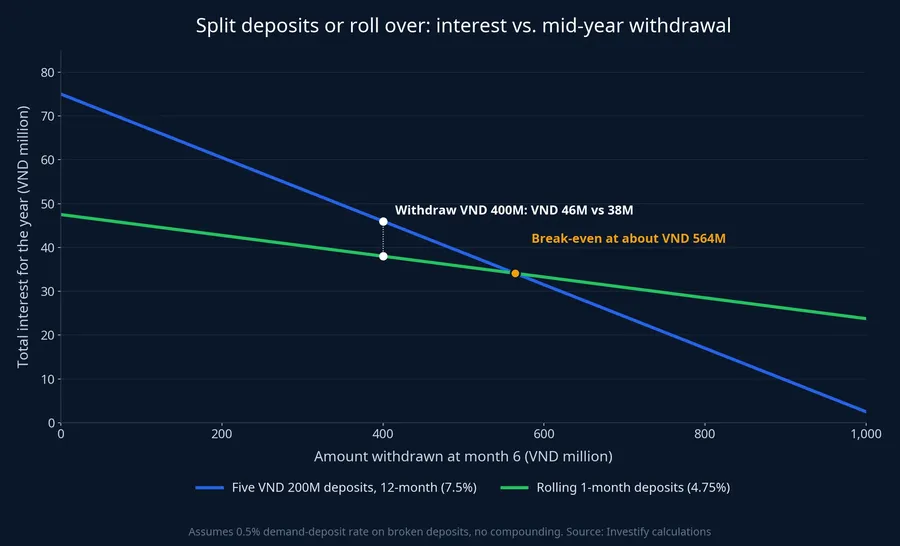
Even after breaking two deposits, splitting still beats rolling over by about VND 8 million. The break-even point sits at a little over half the money, around VND 560 million: only if you must pull out more than that mid-year does rolling over earn more. If you never need a single dong, the five deposits still earn the full VND 75 million or so, just like option two. This approach suits people who want cash on standby but do not know when or how much they will need, which describes most retail investors.
The three options side by side
| Criteria (VND 1 billion, 12 months) | Rolling 1–3 months | One 12-month deposit | Five VND 200M deposits |
|---|---|---|---|
| Interest if no withdrawal | ~VND 47.5M | ~VND 68–75M | ~VND 68–75M |
| Need VND 400M in month 6 | ~VND 38M | Must break the whole deposit if partial withdrawal is not offered | ~VND 46M (at 7.5%) |
| Best for | Clear deployment plan, close monitoring | Money certain to stay untouched all year | Waiting for opportunities with unclear timing and size |
Figures are based on rates listed on September 26, assume a 0.5% demand-deposit rate, and exclude compounding.
One secondary factor is worth noting. Long-term rates are currently high. If they keep rising, someone rolling short deposits could lock in a better 12-month rate later. If they fall, those who lock in now keep today's rate. Nobody knows which way it will go, so this factor is not enough to change the ranking above.
Should new investors copy the fund manager?
Phúc's choice makes sense for his situation: a professional who follows the market daily and already has a list of companies he is waiting to buy at the right price. For someone without a concrete buying plan, the roughly VND 20–27 million of interest left on the table per billion is a real cost. It does not become wise just because a fund manager does the same.
For most retail investors, then, splitting cash into several 12-month deposits is a more sensible starting point than rolling short deposits. The portion with a clear deployment plan over the next few months belongs in short terms. Promotional rates that bar early withdrawal should be reserved for money you are sure to hold to maturity. This conclusion only flips if you know in advance that you will need more than half the money in the first half of the year. And if you carry high-interest debt, Phúc himself suggests paying it down before thinking about investing.CafeF
The question that sets the split is this: over the next 12 months, for how much of this money do you already have specific tickers and target prices? That portion deserves to stay in short terms. For the rest, the 12-month rate is paying you a clear sum to wait.