


In October 2020, a retired army officer in Hanoi walked into her bank. By her own account in court, she went there to put money into a savings deposit. On October 19, 2020, Ms. Nguyen Thi V. signed a life insurance policy with a company that the press identified only as "Company B."VietnamNet The policy required premiums of more than VND 60 million a year for eight years.Tiền Phong
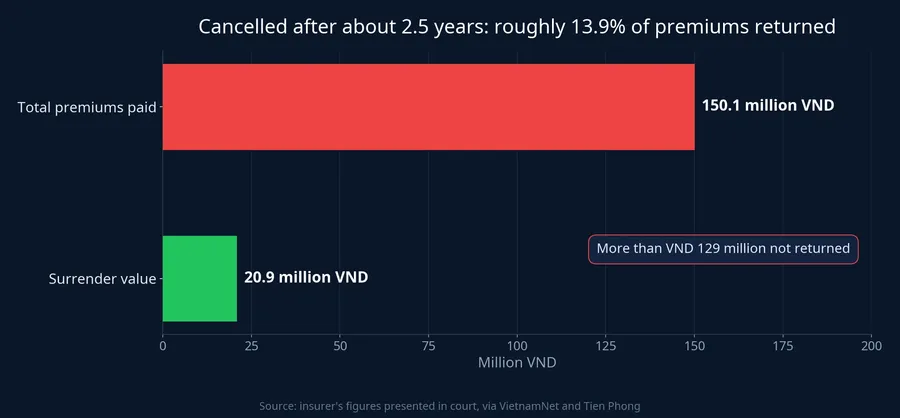
About two and a half years later, she had paid in more than VND 150.1 million and wanted out. The insurer offered her just over VND 20.9 million. This is not a fraud case in the legal sense: courts at two levels upheld the contract as valid. The more useful question is where the other VND 129 million-plus went, given that the court record mentions no investment losses at all.
From the bank counter to the appeals court
The product was a "flexible investment" life policy with a sum assured of VND 672 million, plus a critical illness benefit of VND 200 million. It matures when she turns 99.VietnamNet Ms. V. says the sales adviser told her that after eight years of payments she would get back her principal plus roughly 16% a year. The insurer maintains that neither the benefit illustration nor the product terms mention any such return.
On April 11, 2023, she asked to cancel the policy and get back everything she had paid. The insurer replied that the policy's surrender value at that point was just over VND 20.9 million, about 13.9% of her premiums.VietnamNet She sued to have the contract declared void. On August 14, 2024, the Dong Da District People's Court rejected that claim and ordered the insurer to pay only the VND 20.9 million. Appellate judgment No. 766/2024/DS-PT of the Hanoi People's Court, dated December 27, 2024, upheld the ruling.Tiền Phong
Year one: most of the premium never reached the investment account
To make sense of the VND 20.9 million, it helps to know how this kind of policy works. Picture every premium payment going through a funnel that splits it two ways. One stream flows into an investment account in the policyholder's name. The other pays the policy's charges. According to Company B.'s submissions in court, the share allocated to the investment fund varies by year and rises in later years.VietnamNet
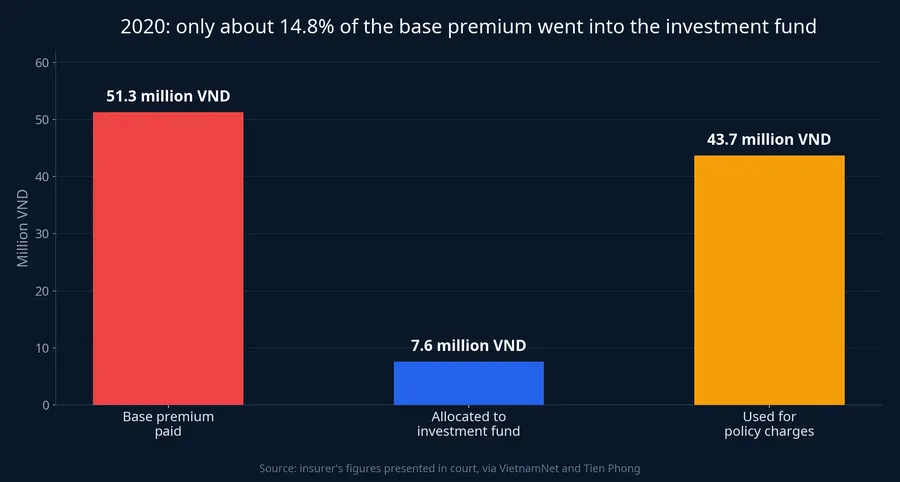
The figures from this very policy show how narrow that funnel is in year one. In 2020, Ms. V. paid more than VND 51.3 million in premiums for the base product. Only a little over VND 7.6 million of that, roughly 14.8%, went into the investment fund. The remaining VND 43.7 million or so went to policy charges.VietnamNet
After further charges and contractual adjustments, her account stood at just over VND 5.3 million at the end of 2020. By the end of 2021 it was a little over VND 8 million. By the end of 2022 it had reached more than VND 20.3 million.VietnamNet
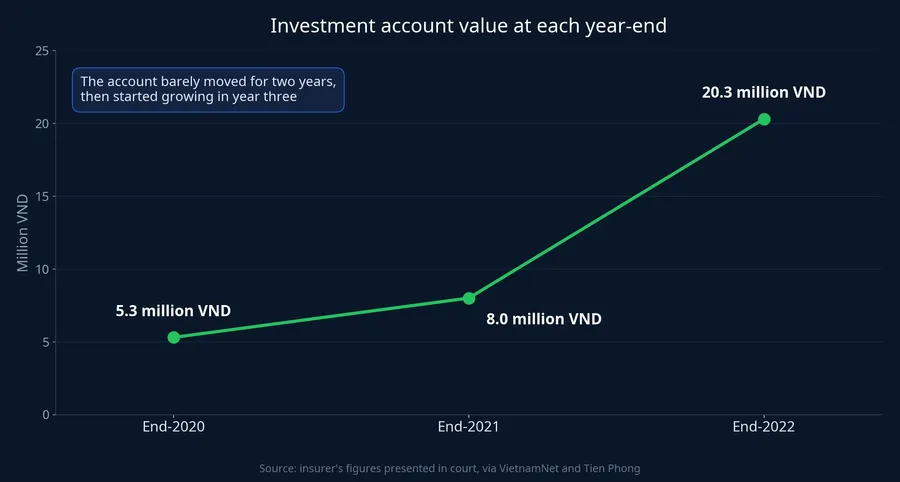
Put simply, the account barely moved for two years and only started growing in year three, which is when the allocation rate went up. Ms. V. walked away just as the account was starting to build, after the heaviest charges of the early years had already been taken.
Surrender value is not what you paid in
This is the single most important idea in the story. When you cancel early, you do not get your premiums back. You get the surrender value. For policies with an investment account, that equals the account value minus any surrender charge and any outstanding loans.AIA Vietnam The appeals court relied on the product terms themselves: the policyholder may terminate early, but in that case receives only the surrender value.
That is why surrender values tend to be lowest in the first few years, when two forces pull in the same direction. The account is still small because most premiums have not yet been allocated to it. Surrender charges, where a product has them, are usually highest in this period too. The exact levels vary by product and insurer, so the only figure worth trusting is the surrender value table printed in your own policy.
In fairness, the VND 129 million-plus that did not come back was not all wasted. For two and a half years, Ms. V. was covered for VND 672 million, plus the VND 200 million critical illness benefit. Part of the premium paid for that protection, even though no claim ever arose. The problem is that someone who only wanted to save money never needed that protection in the first place.
Why the courts did not void the contract
Ms. V. argued that the contract was a standard form, that the two parties never signed in person, and that the wording was long and unclear. The file also listed her personal income as VND 50 million a month, which she said was untrue for a retired army officer.VietnamNet

Company B. answered with paperwork. It said that on October 12, 2020, she had confirmed the application using an electronic signature and a one-time password, and had filled in her own health, financial and occupational details. The policy gave her a 21-day free-look period to amend or cancel at no cost, and she raised no objection during that window. Annual account statements for 2020, 2021 and 2022 were all sent, and she received each one.
The appeals court found that she had full legal capacity, had performed the contract continuously from 2020 to 2023, and had produced no evidence of deception or mis-selling. The 16% promise existed only in her testimony, never on paper. The lesson is blunt: in a contract dispute, an OTP and an electronic signature carry the same weight as a handwritten one, while verbal advice at a bank counter, if nobody recorded it, proves almost nothing.
Savings deposit versus insurance policy
The two products may be pitched at the same counter, but they are fundamentally different.
- Access to your money: a savings deposit is your money. Withdraw early and you usually forfeit only the term interest; the principal stays intact. With an investment-linked policy, early cancellation gets you only the surrender value, which can be far below total premiums paid.
- Payment commitment: a savings account never requires you to deposit more. Ms. V.'s policy committed her to more than VND 60 million a year for eight years, and the heavy early charges are only gradually offset if you stay the full course.
- Needing cash midway: with a deposit, you just withdraw. With an insurance policy, needing money in the first few years means exiting exactly when the surrender value is at its lowest.
The simplest way to think about it: a savings deposit is a place to keep money, while an investment-linked policy is a long-term commitment to buy protection, with some savings attached. Spare cash you may need within a few years belongs in a deposit. A policy only makes sense if you genuinely need the protection and are confident you can keep paying for many years.
The rules changed in 2023
Ms. V. signed in 2020, before the current rules took effect. Since then, people buying insurance through banks have gained several layers of protection.
The 2022 Law on Insurance Business, effective January 1, 2023, wrote the 21-day free-look period into Article 35. For policies longer than one year, the buyer may decline to continue within 21 days of receiving the policy and get premiums refunded, minus reasonable costs if any.Dân trí
Ministry of Finance Circular 67/2023/TT-BTC requires advice on investment-linked insurance products to be audio-recorded and kept for at least five years.VietnamPlus The circular also bars banks from offering investment-linked insurance within 60 days before and after the date a loan is fully disbursed.Tạp chí Tài chính
The 2024 Law on Credit Institutions, effective July 1, 2024, prohibits banks from tying the sale of non-mandatory insurance to any banking product or service in any form.Báo Đồng Nai In other words, buying insurance cannot be a condition for depositing or borrowing.
For Ms. V., the recording requirement might have changed the outcome, because the 16% promise, if it was made, would be on tape. For anyone buying today, that recording is the most important piece of evidence should a dispute arise later.
Holding a similar policy: what to read before cancelling
Whether to cancel or keep paying depends on each person's situation, but the numbers to check are the same.
First, the year-by-year surrender value table in your benefit illustration or policy terms. It shows what you would get back if you cancelled in year three, five or eight. In any year where the surrender value is still far below total premiums paid, cancelling locks in the gap at its widest.
Next, the annual account statement your insurer sends. Put that figure next to your total premiums to see how the account is tracking against the original illustration.
Finally, how many more years the surrender charge applies. Good questions to ask the insurer are when that charge drops to zero, and what options the policy offers besides outright cancellation.
Looking back at Ms. V.'s case, the insurer's own figures in court show that the shortfall came mainly from a charge structure written into the contract, combined with cancelling in exactly the years when that structure bites hardest. For new policyholders, the 21-day free-look period is the only window to walk away at little or no cost. After that, any decision to cancel should be checked against the surrender value table before you sign anything.