

Rubber futures closed at 254 US cents/kg on September 25, above the 13-year high set earlier in the month.DN&HN The next day, rubber futures in Osaka briefly touched their highest level in 15 years.Thời báo TCVN In Ho Chi Minh City's morning session on September 25, GVR gained 2.4%, DRI 4% and PHR 1.9%, while the VN-Index hovered around its reference level.Người Quan Sát
On the quote board, the whole rubber group is trading on the same headline. The half-year financial statements tell a different story. Some of these companies live mainly off selling latex. For others, the biggest profit item in the first half was compensation for handing rubber land over to industrial parks. The same latex rally will therefore hit each stock's earnings with very different force.
What is driving rubber prices
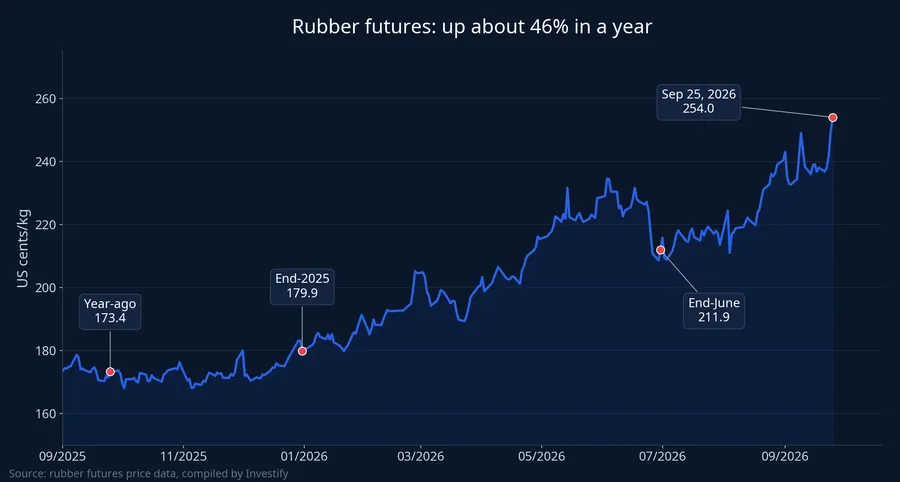
The numbers are substantial. Since the end of 2025, rubber futures have risen about 41%, from 179.9 to 254 US cents/kg. Against the same day last year (173.4 US cents/kg), the gain is about 46%. Since end-June alone, prices have added nearly 20%, from 211.9 to 254 US cents/kg.
The main push comes from supply. Heavy rain in Thailand has disrupted tapping across key growing regions, lifting the local price of cup lump rubber to 73.8 baht/kg on September 21, 44.56% higher than a year earlier. Concern that El Niño will cut Asian output is also helping keep prices elevated.DN&HN
Oil is the second link in the chain, but it needs to be put in its proper place. Synthetic rubber is made from petrochemical feedstock, so when oil is expensive, synthetic rubber is too, and tyre and glove makers have less reason to switch away from natural rubber. Synthetic rubber in China now trades at CNY 15,566.67 per tonne, about 28% above a year ago, while Brent closed at USD 104.93 a barrel on September 25. Still, oil is a supporting factor rather than the main driver. On some days weaker crude has dragged synthetic rubber lower, and natural rubber merely lost some momentum while supply worries kept it supported.DN&HN
Demand is less convincing. China imported only 486,000 tonnes of natural rubber in August, down 6.7% year on year and the lowest in six years.DN&HN That figure can be read two ways: either supply is scarce, or the world's largest buyer is holding back. Even MBS Research, which is bullish on the sector, flags downside risk if car demand in China and the US weakens or if more certified supply arrives from Africa.Người Quan Sát
Side by side: where the profit comes from
The figures below come from the 2026 half-year financial statements. They are the latest available and reflect the first six months, when rubber prices were still well below today's levels. The line worth watching in this group's filings is "other income", where land compensation and orchard liquidation gains are booked.
PHR: mostly a land story
Phuoc Hoa Rubber (PHR) earned VND 655 billion after tax in the first half, 3.3 times the year-earlier figure. According to the company's explanation, operating profit rose by only VND 80 billion, while other income jumped by VND 492 billion. That increase includes VND 323 billion of compensation at the VSIP III industrial park and VND 172 billion from a Thaco project (Bac Tan Uyen 1 industrial park).Tuổi Trẻ
PHR's rubber and wood business is still growing, with first-half revenue of VND 832 billion, up 34.6%. The bigger story, though, is its land bank. Mirae Asset estimates PHR could book more than VND 3,500 billion of compensation over 2026–2027, including about VND 1,500 billion in 2026.Báo Pháp luật Next to that, the extra profit from higher latex prices is small.
TRC: gross profit down, other income doing the lifting
Tay Ninh Rubber (TRC) posted first-half net profit of VND 141.76 billion, up 34.7%.Báo Pháp luật The growth did not come from latex. Gross profit fell 9.2%, while other income rose from VND 1 billion to VND 50 billion, mostly from orchard liquidation. MBS attributes the weaker latex margin to the company selling more low-grade field latex.Tuổi Trẻ
TRC's full-year plan leans on land even more heavily. Management expects compensation at the Hiep Thanh industrial park (about 495 ha) to bring in about VND 500 billion in the second half, taking full-year profit to VND 636 billion. After six months, the company had delivered only 28.9% of its profit target.Báo Pháp luật For TRC, when the compensation is booked matters more than the latex price.
GVR: two sources of roughly equal weight
Vietnam Rubber Group (GVR) earned VND 4,947 billion after tax, up 69%. Of the VND 2,308 billion increase in pre-tax profit, other income contributed VND 1,286 billion, more than the VND 1,062 billion rise in gross profit from sales. Compensation and damage support reached VND 956 billion, versus just VND 89 billion a year earlier. Income from liquidating rubber trees also climbed from VND 737 billion to VND 1,028 billion.Tuổi Trẻ
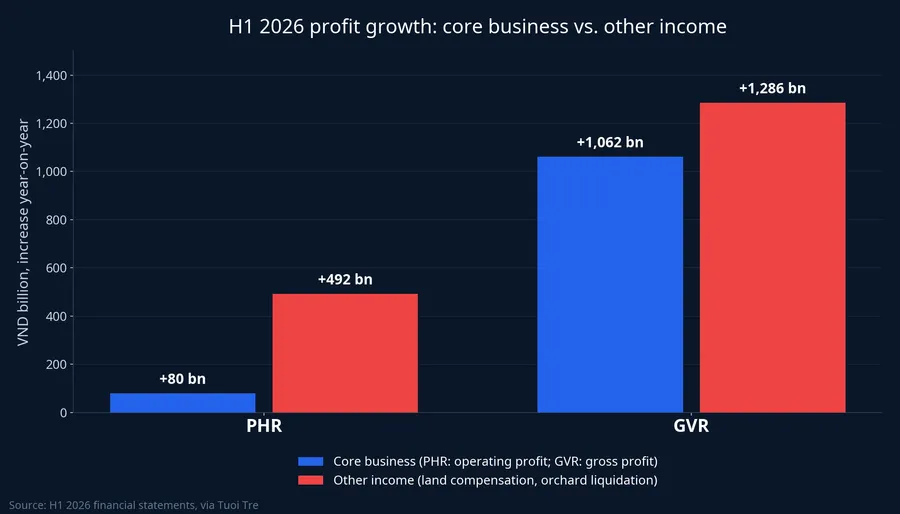
That puts GVR between the two camps. Latex prices genuinely move the group's earnings, but land and orchard liquidation account for the other half of the story. MBS adds a separate driver: in the broker's view, the already-issued Decision 40/2026/QD-TTg raises the prospect of the state reducing its stake in GVR over 2026–2030.Người Quan Sát
DRI and DPR: profit sits in sales
At the other end, Dak Lak Rubber (DRI) and Dong Phu Rubber (DPR) reported almost no other income in the period; their profit growth came from sales. For DRI, MBS says latex revenue rose sharply because the company sold 2025 inventory in early 2026 at good prices.Tuổi Trẻ Of the group, DRI's profit is the most directly tied to latex prices.
DPR is a little more complicated. First-half net profit reached VND 146.1 billion, up 40.2%. Sales volume was 5,779.89 tonnes, 92% higher than a year earlier, but the average selling price was 3.85% lower. The company also booked more than VND 158 billion from liquidating rubber orchards.Tin nhanh CK In other words, DPR records its tree-liquidation income within the business line rather than under other income, as TRC and GVR do.
What the comparison shows
DPR's average selling price is the detail investors tend to miss. Futures move first; the price a company actually receives lags, because it depends on when contracts were signed, the grade of latex and how much was sold in the period. In the first half, world prices had already risen, yet DPR's average price was still below last year's. The nearly 20% gain since end-June is not in the half-year numbers at all. If prices hold around current levels, the effect on latex profits should become clearer in the third- and fourth-quarter reports.
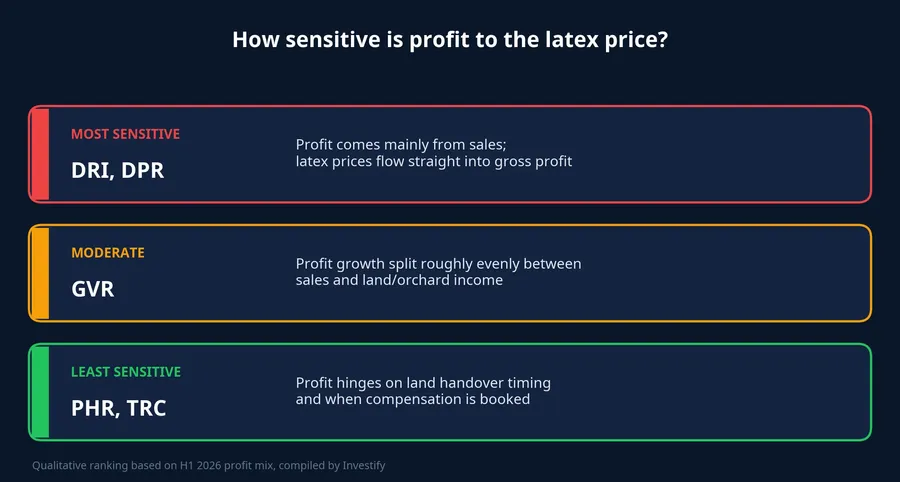
On that basis, the stocks can be ranked by sensitivity to latex prices:
- Most sensitive: DRI, followed by DPR. Their profit sits mainly in sales, so sustained high latex prices flow straight into gross profit.
- Moderate: GVR, where profit growth from sales and from land and orchard liquidation is roughly equal.
- Least sensitive: PHR and TRC. Their earnings depend more on the pace of land handover and the timing of compensation bookings than on latex prices, and TRC's latex margin is also shrinking.
So are the land-driven names safer if rubber prices turn? In one sense, yes. For industrial parks or projects not developed by the state, compensation rates are negotiated and paid in a single lump sum, independent of rubber futures.Người Quan Sát In another, that income does not recur, its recognition can slip behind plan, and once booked it sets a high base for the following year. The risk for the land group lies in legal procedures and handover schedules, not in Thai weather.
Each group tells a different story
The comparison points to a clear conclusion: the current rubber rally is mainly an earnings story for DRI and DPR, partly one for GVR, and a side note for PHR and TRC. DRI and DPR's profits reflect rubber prices most directly. By the same token, they are the most exposed if Southeast Asian weather improves or weak Chinese demand drags prices lower.
For PHR and TRC, the key question is not the latex price but the date compensation actually arrives and lands in the financial statements. TRC's roughly VND 500 billion from Hiep Thanh in the second half is the most concrete milestone to check. GVR sits in the middle, drawing on both sources without either dominating.
This ranking reflects positioning in the current price cycle, not a permanent advantage. If rubber cools, the order of sensitivity stays the same but the direction of impact flips: latex sellers take the hit first, while land-driven names are less affected. Third-quarter reports, expected in October, will be the first to reflect the nearly 20% rise in rubber prices since end-June. The signals to watch are whether DRI and DPR's average selling prices catch up with futures, and whether TRC's compensation arrives on schedule.