

On September 24, Vietnam's interbank market put two very different prices on the same dong. Banks could borrow from each other overnight for just 1% a year, while one-month money still cost 6.15%.CafeBiz That is a gap of more than 5 percentage points, on the same day, in the same market.
Several local headlines last week described the overnight rate as "plunging to 1%". Skim those and it is easy to conclude that the banking system is awash with cash and that deposit rates are about to follow. The logic is not unreasonable: interbank rates are the base cost of funding for banks. But lay the tenors side by side and the picture becomes far narrower than the 1% figure suggests.
Overnight rate: from 7% to 1% in three sessions
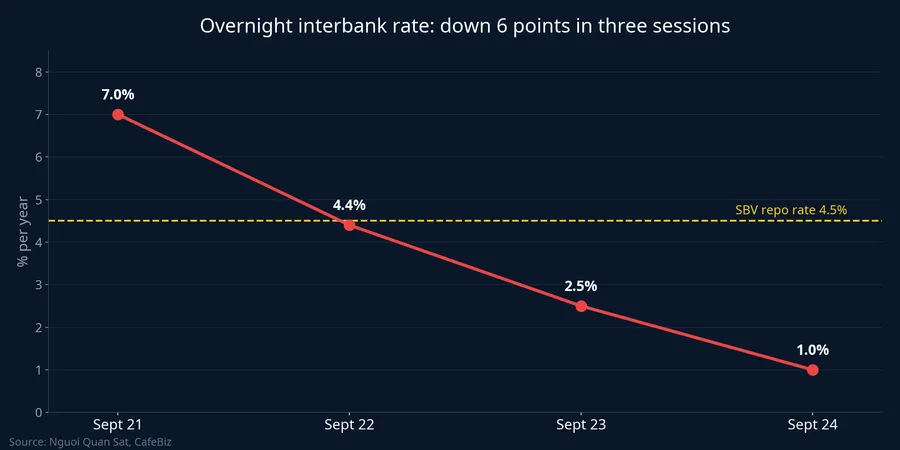
The overnight rate is what banks pay to borrow from each other for a single night, usually to cover temporary gaps in payments or reserve requirements. During the week of September 21–25 it swung hard: 7% on the 21st, 4.4% on the 22nd, 2.5% on the 23rd and 1% on the 24th.Người Quan Sát In three sessions it shed 6 percentage points.
That drop followed a cash squeeze. In the week of September 14–18, the State Bank of Vietnam (SBV) withdrew a net of roughly VND 62,543 billion through open market operations, bringing outstanding repo lending against valuable papers down to around VND 152,488 billion.CafeF The shortfall built up over the week and surfaced as a 7% overnight rate when the new week opened.
On September 21, the SBV offered a total of VND 63,000 billion through the repo channel. Credit institutions took up about VND 57,066 billion, and the SBV injected a net of nearly VND 47,915 billion in a single session.CafeBiz The same day, it opened a 7-day FX swap window capped at USD 2 billion.CafeF Note that USD 2 billion is only the ceiling; how much banks actually drew has not been disclosed.
From September 22, the flow reversed. The SBV withdrew a net of VND 650 billion, VND 3,116 billion and roughly VND 4,518 billion over the sessions of the 22nd, 23rd and 24th. On the 24th it offered only VND 1,000 billion per tenor, with the rate unchanged at 4.5%.CafeBiz Outstanding repo lending fell from about VND 200,403 billion after the September 21 session to about VND 192,119 billion after the 24th, and to about VND 186,817 billion after the 25th.Người Quan Sát
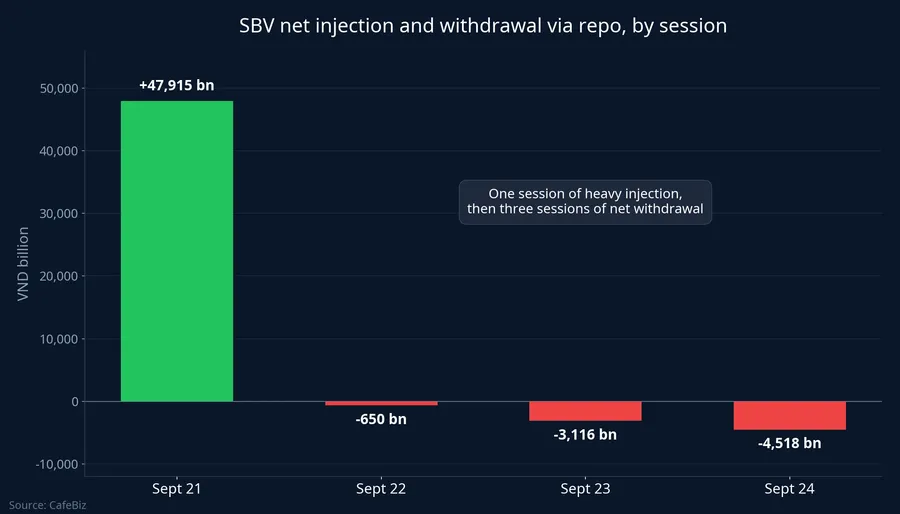
Read in sequence, the 1% print is the result of a large injection aimed squarely at where the shortage was. More cash went in than overnight borrowers needed, so banks holding a one-night surplus were willing to lend it out at a very low price rather than let it sit idle.
Longer tenors barely moved
If money had truly become cheap, one-week, two-week and one-month rates should have followed. The September 24 data shows otherwise: 5.1% for one week, 5.2% for two weeks and 6.15% for one month.CafeBiz
The contrast is sharper against September 21, when the overnight rate peaked. That day, one-week money was 4.8%, two-week 6.0% and one-month 6.5%.CafeF So while the overnight rate fell 6 points, the one-month rate eased by just 0.35 points. The one-week rate on the 24th was actually higher than on the 21st.
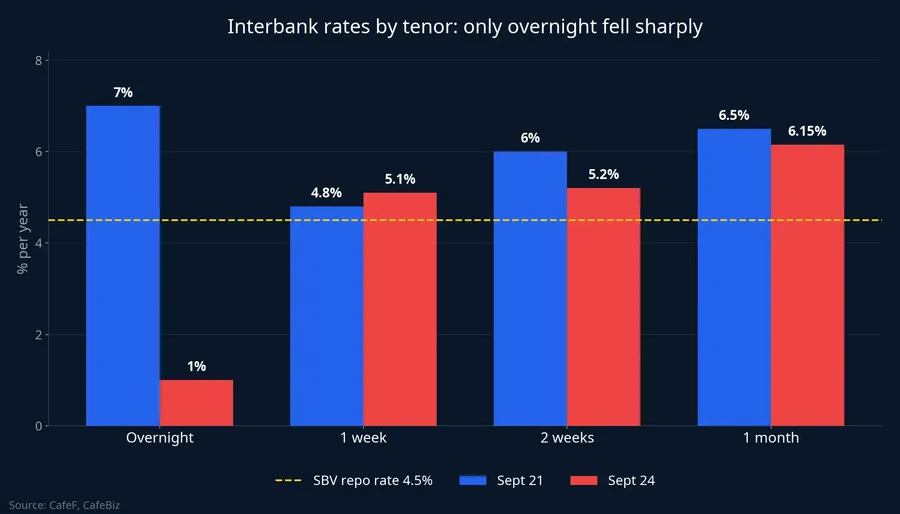
A useful reference point is the SBV's repo lending rate of 4.5%. At 1%, overnight money sits far below it, which means one-night cash is plentiful. The one-week, two-week and one-month rates, however, all sit above 4.5%. To hold funds for more than a few days, banks are still willing to pay more than it costs to borrow from the central bank.
Three ways to explain the gap
The available data cannot say which factor dominates, but three explanations are worth weighing.
A quarter-end premium. A one-month loan taken on September 24 runs past September 30, a quarter-end date when banks' cash needs typically rise. Part of the elevated price may simply be a seasonal cost.
Support money with a due date. Repo funds from the SBV carry terms of 7 to 91 days, and the FX swaps run for 7 days. According to CafeF, the dong supplied through the swap window will be withdrawn after 7 days.CafeF Banks that know the money has to be returned are unlikely to treat it as a source for longer-term lending.
Underlying demand for funds remains strong. Bank executives quoted by VnExpress said deposit-raising pressure is unlikely to ease in the short term as funding needs for large infrastructure projects grow.VnExpress
Whichever factor carries the most weight, all three lead to the same place. The 1% figure describes the price of one night's money. It does not describe what banks pay for funds they can lend out over several weeks.
1% has shown up before, and never for long
This is not the first time the overnight rate has touched 1% in recent months. According to Thời báo Ngân hàng, it fell to 0.7% on July 30, rebounded, then dropped to 1.19% on August 27.Thời báo Ngân hàng Less than four weeks after that, it was back at 7%.
That history does not prove the overnight rate will spike again. What it shows is that readings around 1% tend to appear right after an injection, between bouts of sharp increases, rather than marking a new, stable floor.
On the depositor side, banks are still fighting for every dong
If funding were cheap, banks would have no reason to pay up for deposits. The retail deposit market at the end of September says the opposite.
A VnExpress survey up to September 21 found close to 10 banks offering savings rates of 9% or more on deposits of a few hundred million dong, mostly through negotiated rates and staff referral codes, with the highest at 9.35%. By contrast, the highest publicly posted rate for deposits under VND 1 billion was just 7.9%, and only VPBank, Sacombank, UOB and SeABank raised their posted rates during the month.VnExpress In the very week the SBV was draining cash, Cake by VPBank launched a 2.2-point bonus for first-time depositors, running from September 22 to October 31.VietNamNet
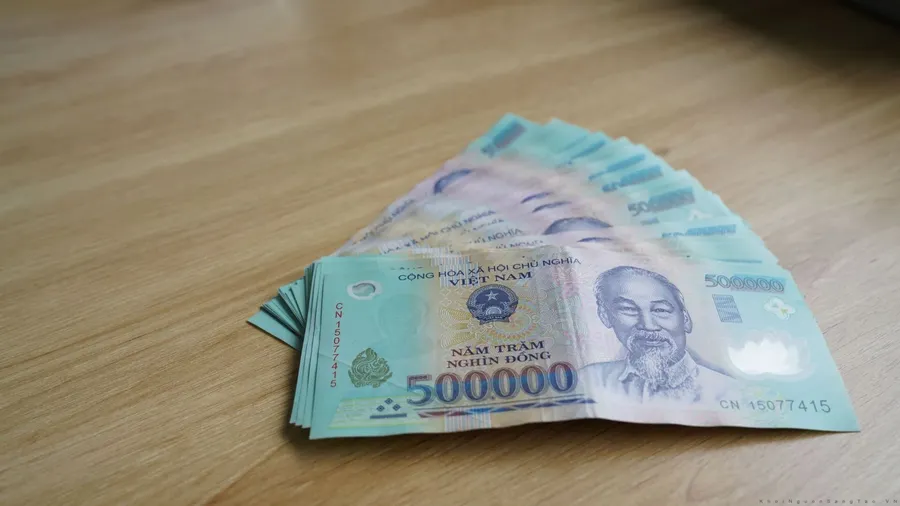
Posted rate sheets have barely moved, but the rates actually on offer keep climbing. Competition for deposits is still hot; it is just happening more quietly than a round of public rate hikes would.
Reading the 1% correctly
The more accurate reading is this: the 1% overnight rate shows that the early-week shortage of one-night cash has been resolved, thanks to the net injection of nearly VND 47,915 billion on September 21. It does not show that term funding costs are falling. One-month money is still above 6%, higher than the SBV's 4.5% repo rate, and many banks are still paying above 9% to keep depositors.
For people holding savings, with deposits coming due, or weighing fixed-rate products, the implication is concrete. Rates on these products track weekly and monthly funding costs, not the price of a single night. As long as one-month interbank money stays above 6% and banks keep offering negotiated rates around 9%, deposit rates are unlikely to fall over the next few weeks.
This view could change, and two signals are worth watching. The first comes in the first week of October, after the September 30 quarter-end and once the 7-day FX swaps have matured. If the one-month rate then drifts back toward 4.5% and holds there for several sessions, this week's gap was mostly a quarter-end premium, and pressure to raise deposit rates should ease. If it stays above 6% even after quarter-end, expensive funding is a system-wide issue rather than a one-week blip.
The second signal is the posted rate sheet. Only when banks start cutting their posted rates and pulling back on negotiated offers will there be solid ground to say money has genuinely become cheaper.