

On September 25, Vietnam's 5% broken white rice was quoted at USD 420–424 per tonne, while the same Thai grade stood at USD 466–470.VFA That leaves Vietnamese rice about USD 46 per tonne cheaper. The gap persists in the very year that the Philippines, Vietnam's largest customer, is projected to import around 5 million tonnes, a level the Vietnam Food Association (VFA) describes as a record.InfoArroz
Intuition says that when your biggest buyer buys more, prices should rise. The bigger picture says otherwise: what matters is not only how much the Philippines buys, but when. This piece walks through the three forces holding Vietnamese white rice prices down, identifies which one weighs most, and sets out the conditions under which the gap with Thai rice could start to close.
Compare like with like first
Several domestic price reports last week put two figures side by side: Vietnam's 5% broken fragrant rice at USD 440–445 per tonne and Thailand's 5% broken white rice at USD 477–481.Báo Công Thương These are different products. Fragrant rice sits in a higher tier than ordinary white rice, so that comparison makes the real gap look narrower than it is.
The VFA price table, compiled from Oryza, allows a proper comparison. In 5% broken white rice, Vietnam does not sit near Thailand or Myanmar. It sits right next to Pakistan (USD 422–426) and only about USD 38 above India (USD 382–386).VFA In the mass-market white rice segment, Vietnamese rice is effectively priced against India and Pakistan, not against Thailand.
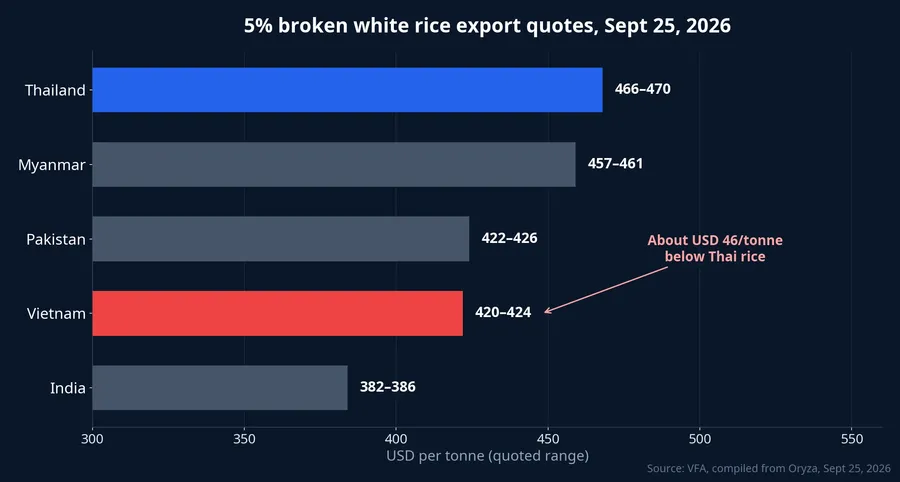
It is also worth being clear that Thai rice did not rise this week. On September 21, Thai 5% broken white was at USD 475–479; by September 25 it had eased to USD 466–470, while the Vietnamese equivalent slipped only slightly from USD 422–426.VFA The roughly 5.9% weekly gain shown on some commodity boards is rough rice futures in Chicago, which rose from USD 15.64 to USD 16.57 per hundredweight between the September 18 and 24 sessions. That is US paddy, not Asian export rice, and says nothing directly about Vietnamese grain.
The biggest customer bought early
The heaviest force is the pace of Philippine buying. In the first eight months of the year, the Philippines took 43.2% of Vietnam's rice exports, far ahead of China (18.4%) and Ghana (11%).Thời báo Tài chính In the other direction, Vietnamese rice made up about 74% of Philippine rice imports as of August 13.InfoArroz The two sides are deeply dependent on each other, which is why Vietnamese white rice prices react so strongly to one customer's purchasing calendar.
The Philippines is buying heavily this year because of a domestic shortfall. The VFA estimates its output is down about 900,000 tonnes due to El Niño, on top of stockpiling needs for early 2027. But most of the buying happened early. By August 13, the Philippines had already imported 3.46 million tonnes, more than its entire 2025 total.InfoArroz
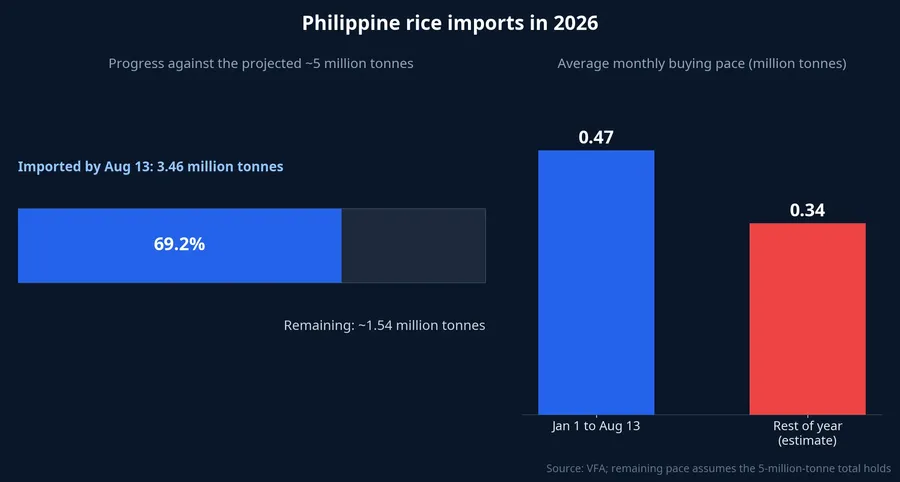
Simple subtraction shows the problem. If the full-year figure of around 5 million tonnes holds, only about 1.54 million tonnes remain for the last four and a half months. The average pace from January to August 13 was about 0.47 million tonnes a month; spreading the remainder evenly gives only about 0.34 million tonnes a month. The largest buyer is still buying, just without the urgency of the first half, and a buyer in no hurry holds the bargaining power.
The Philippines is also weighing tighter import rules. It has launched a safeguard investigation into imported rice, and a working delegation led by Vietnam's Ministry of Industry and Trade visited in late August to help keep the supply chain stable.InfoArroz As long as the investigation is unresolved, Philippine importers have one more reason not to rush into higher-priced contracts.
India sets the ceiling for ordinary white rice
The second force comes from the competition. Quoted at USD 382–386 per tonne, India's 5% broken white rice is about USD 38 cheaper than Vietnam's.VFA For buyers of ordinary white rice, especially in Africa, that gap is enough to switch suppliers. The more Vietnam raises its price, the wider the gap with India becomes, and price-sensitive orders are the first to leave.
This explains why Vietnamese rice can follow part of the way when demand improves but struggles to keep pace with Thai rice. Thai rice has its own customer base willing to pay more. Vietnamese white rice, by contrast, competes largely among buyers who choose on price.
The autumn-winter harvest keeps domestic supply ample
The third force is out in the Mekong Delta fields. According to Báo Công Thương on September 25, the summer-autumn crop has largely been harvested, while autumn-winter paddy is being offered in fair volumes against relatively slow demand. The same day, fresh OM 5451 and IR 50404 paddy fell VND 150 per kg, with IR 50404 at VND 5,800–6,000 per kg.Báo Công Thương
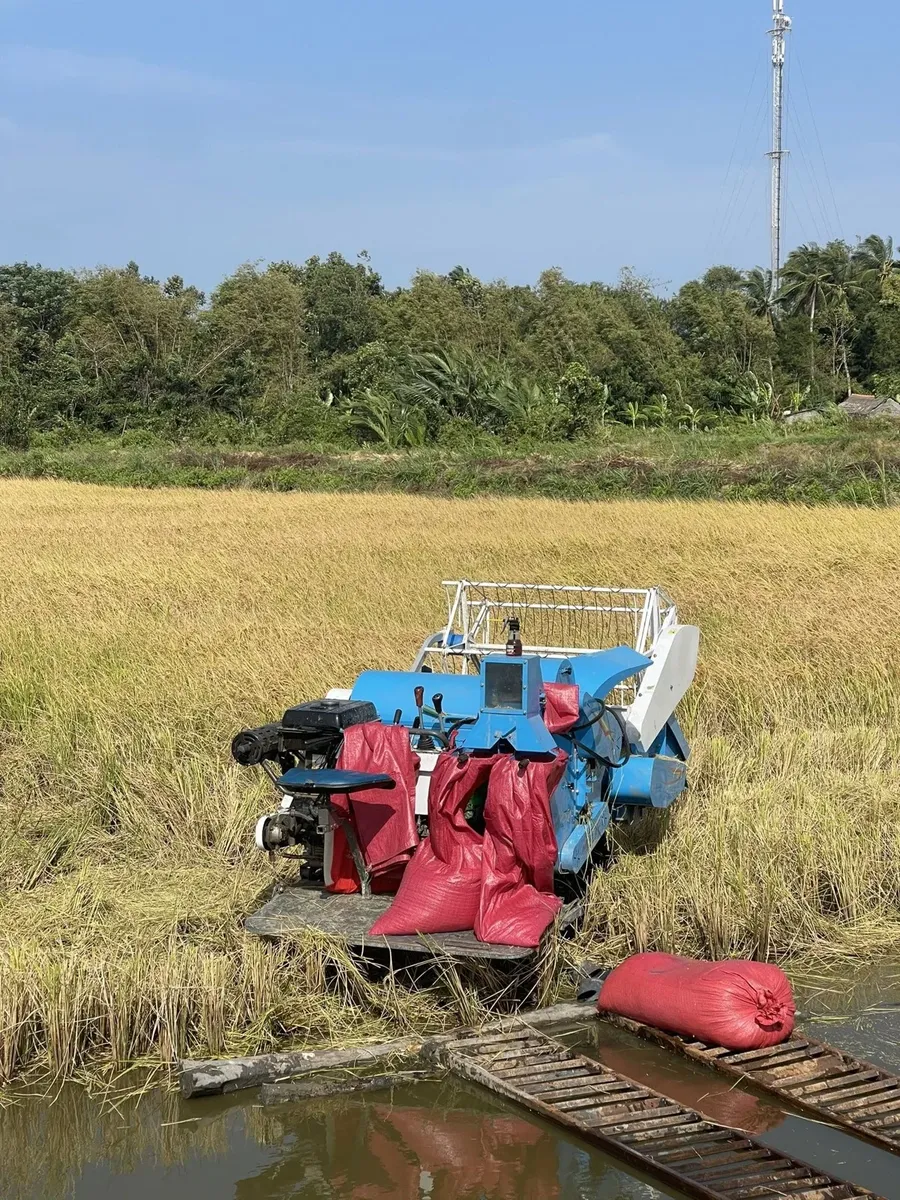
There is one small signal pointing the other way. On September 26, CL 555 raw rice rose about VND 100 per kg to VND 8,700–8,800, and IR 504 gained about VND 50 per kg. Still, the increase was confined to two varieties, and fresh paddy has not followed because autumn-winter supply keeps arriving.Báo Văn Hóa With plentiful domestic supply, exporters can source cheaply and can also afford to quote low to win orders.
Which force weighs most
The three forces are not equal. Autumn-winter supply is seasonal and will pass after a few weeks of peak harvest. India's price acts as a long-term ceiling, but that ceiling existed before and cannot explain why this year looks different. The factor that has shifted most this year is the Philippine buying pace: front-loaded in the first half, slower in the second, with a safeguard investigation still pending. Given that it absorbs 43.2% of Vietnam's exports, that pace moves short-term white rice prices more than the other two factors.
This reading has limits. Public sources do not disclose actual contract prices signed with the Philippines, and port quotes do not always match transaction prices. With contract data, the picture might tilt further toward competition with India.
Exports are down, but average prices show signs of recovery
The eight-month results reflect price pressure since the start of the year. According to the Ministry of Agriculture and Environment, Vietnam exported more than 6 million tonnes of rice worth nearly USD 2.91 billion, down about 5% in volume and 10.7% in value year on year.InfoArroz Value falling faster than volume means each tonne sold for less than last year; dividing the two gives an eight-month average of roughly USD 483 per tonne.
Notably, July's average export price reached USD 511 per tonne, up 5.8% year on year, the first month this year with prices above the prior year. The ministry forecasts full-year export revenue of about USD 3.94 billion, down 4%.InfoArroz A smaller full-year decline than the eight-month decline implies expectations of a better finish to the year, though that remains a forecast.
At the company level, margins at listed rice firms are razor thin. According to Q2 2026 financial statements, Vinafood 2 (VSF) posted first-half net profit of VND 27.37 billion on revenue of VND 8,282.44 billion, a net margin of about 0.33%. Trung An (TAR) lost VND 24.05 billion over six months, with revenue down 42.3% year on year. With margins that thin, a few tens of dollars per tonne can change the profit picture, but only when selling prices actually rise, not when headlines say Thai rice is getting more expensive.
What it takes for Vietnamese rice to catch up
Looking to next year, forecasts diverge. The USDA projects the Philippines could import as much as 5.7 million tonnes in 2027 to stockpile against El Niño risk.Philstar The VFA, however, expects 2027 imports to return to a more normal 3.8–4 million tonnes. Meanwhile, the FAO forecasts global rice output for 2026–2027 at 553.1 million tonnes, down 1.9%, largely because of El Niño-related weather.InfoArroz
On this evidence, my view is that Vietnamese white rice will struggle to narrow its discount to Thai rice as long as the Philippines keeps buying at a slow pace and the autumn-winter harvest remains in full swing. The gap has a basis to close only when two conditions are met. First, the Philippines places a new round of orders for the final quarter or early 2027 without safeguard duties attached. Second, domestic fresh paddy prices start rising once the autumn-winter harvest passes its peak.
For anyone tracking rice stocks or Mekong farm incomes, the markers worth watching in the coming weeks are the outcome of the Philippine safeguard investigation, Vietnam's 5% broken white rice quote against today's USD 420–424 per tonne, and fresh IR 50404 paddy against the VND 5,800–6,000 per kg range. Only when these move up together will Vietnamese rice prices have truly turned. A headline saying "Asian rice prices rise" is not enough.