


On September 22, the board of HSC Securities (ticker: HCM) approved moving ahead with a plan to privately place up to 200 million shares at VND 23,000 each with professional investors. If the placement fills, HSC raises VND 4,600 billion, all of it earmarked for margin lending and disbursed across 2026 and 2027.Tin nhanh Chứng khoán It is still a plan. The offering is expected in Q3 and/or Q4 2026, once the State Securities Commission approves the filing.MarketTimes
The numbers make one thing clear: this is not about HSC being short of cash. It is about HSC being short of equity, because its margin business is running close to the maximum the rules allow.
Why bank borrowing does not solve the problem
Many newer investors assume margin money is simply bank debt that a broker re-lends to clients. That is only half the story, because the size of a broker's margin book is not set by how much it can borrow. Under Circular 121/2020/TT-BTC, a securities company's total margin loans may not exceed 200% of its owner's equity, with a cap of 3% of equity per client and 10% of equity per security.Thời báo Tài chính
Think of equity as the capacity of the margin business. More bank debt puts more cash on hand, but the ceiling does not move. To raise the ceiling, a broker has to grow its equity, and the fastest way to do that is to sell new shares.
HSC is sitting right under that ceiling. At the end of Q2 2026, its margin loans were approximately VND 29,023 billion, up 115% year on year and fifth-largest in the market after VPS, VPBankS, SSI and TCBS.Tin nhanh Chứng khoán Based on the Q2 financial statements, that balance was equivalent to about 198% of equity.Người Quan Sát
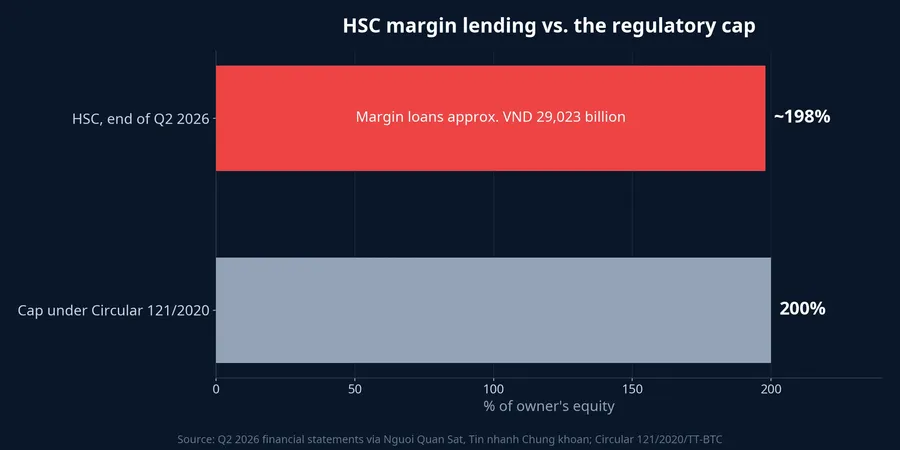
At a 2x ratio, each new dong of equity opens up to two dong of lending capacity. If the full VND 4,600 billion comes in, the lending ceiling rises by up to roughly VND 9,200 billion. That is why none of the money is going to proprietary trading or underwriting.
The third raise in a single year
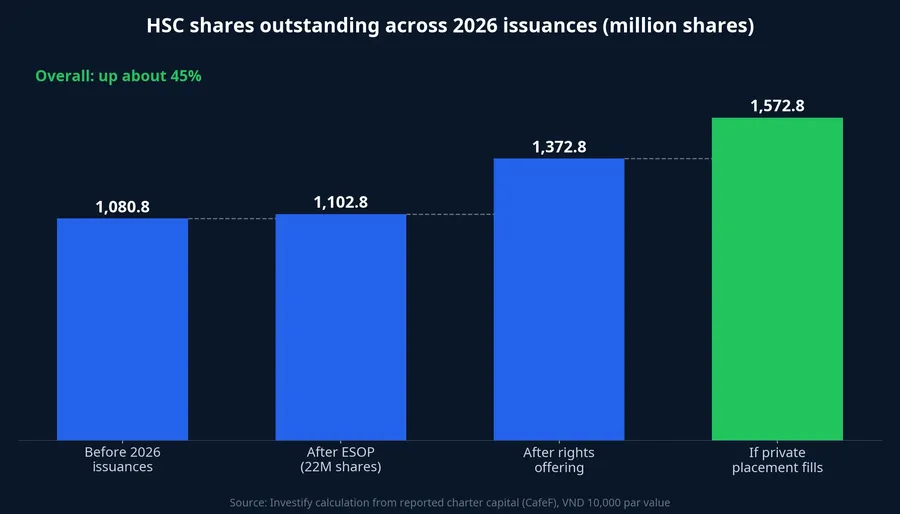
The placement does not stand alone. On September 15, HSC completed the sale of 22 million employee shares (ESOP) at VND 10,000, raising about VND 220 billion and lifting charter capital from nearly VND 10,808 billion to VND 11,028 billion.CafeF
In parallel, the company ran a rights offering of nearly 270 million shares on a 4-for-1 basis, also at VND 10,000. Shareholders subscribed and paid for almost 268.2 million shares, a 99.33% take-up, and those proceeds are also going to margin lending.Người Quan Sát Once that round closes, charter capital reaches VND 13,728 billion, or about 1,372.8 million shares.CafeF
Across all three rounds, HSC could raise more than VND 7,500 billion in 2026.Người Quan Sát If the private placement fills, shares outstanding would be about 1,572.8 million, roughly 45% more than at the start of the year.
Who is buying, and why accept a one-year lock-up
The board-approved list has 9 professional investors: one institution and eight individuals, with no foreign investors.Người Đưa Tin
The sole institution is Ho Chi Minh City Finance and Investment State-owned Company (HFIC), which registered for 23 million shares, taking its stake to more than 175 million shares, or 11.13% of charter capital.Người Đưa Tin Working backwards, HFIC held about 152 million shares beforehand, roughly 11.07% of the 1,372.8 million base. In other words, HFIC is buying just enough to hold its stake steady, not to gain more control.
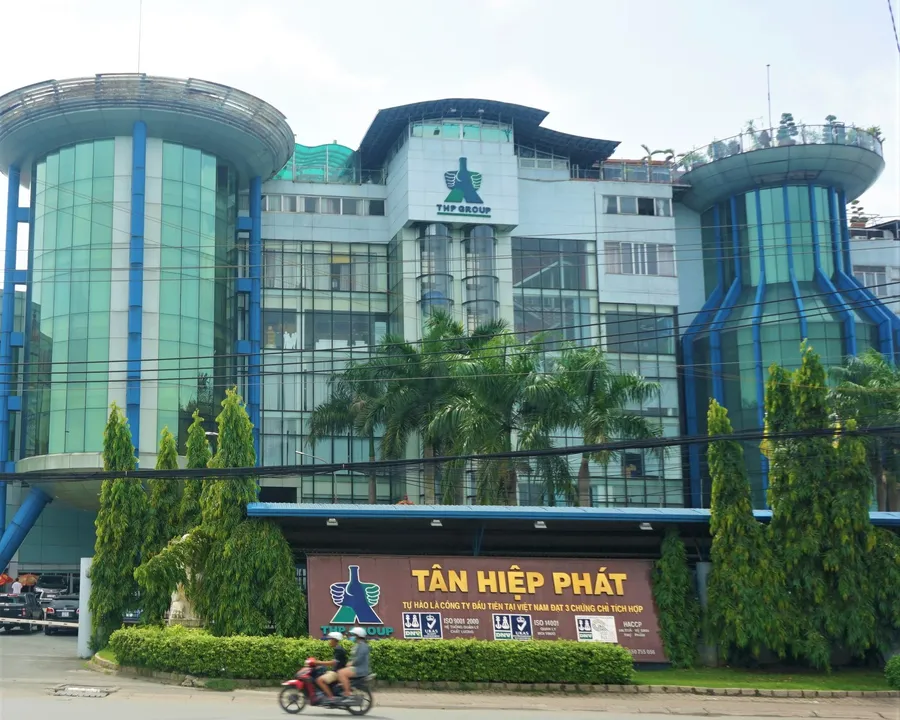
The name drawing the most attention is Mr. Trần Quí Thanh, founder of Tân Hiệp Phát Group and currently Chairman and CEO of Ngãi Giao – Sài Gòn Urban Industrial JSC.Soha Mr. Thanh registered for 40 million shares, about VND 920 billion, raising his holding from 1.25 million to 41.25 million shares, or 2.62% of the enlarged capital. He holds no governance or executive role at HSC, so this is a personal financial investment rather than a move into management.Người Quan Sát
The other seven individuals take most of the shares. The largest buyer registered for 40.5 million shares, two others for 40 million each, and the rest for between 1 million and 10 million.CafeF
The one-year lock-up is a legal requirement for privately placed shares, not a choice made by HFIC or Mr. Thanh. The shares cannot be transferred for one year after the offering closes, except between professional investors or under a court ruling or inheritance.MarketTimes The discount to market is the compensation for 12 months of not being able to sell. Buyers take the risk that HCM falls over that period, in exchange for coming in VND 2,500 per share below the VND 25,500 close on September 23.
What existing HCM shareholders gain and lose
The effects on existing shareholders point in three different directions, so it helps to take them one at a time.
Ownership shrinks. If you hold HCM and do not take part in the placement, your stake shrinks by the ratio of 1,372.8 to 1,572.8 million shares, a loss of about 12.7% of your ownership share.
EPS has to catch up. The placement alone adds about 14.6% to the share count, so profit has to grow at least that much just to keep EPS flat. HSC's 2026 plan targets pre-tax profit of VND 2,302 billion, up 56%, with margin lending expected to bring in more than VND 3,800 billion of revenue, about 58% of planned total revenue.Tin nhanh Chứng khoán The placement money, however, will be disbursed into 2027, so the earnings on the new capital will arrive later than the new shares.
Book value per share actually improves. The VND 23,000 offer price is well above book value, which was about VND 13,466 per share at December 31, 2025.Mekong Asean Selling shares above book raises book value per share for existing holders. The deal is cheap relative to the market price, not relative to the books.
So how much do existing holders give up versus the market? With 200 million shares each priced VND 2,500 below the September 23 close, the gap is about VND 500 billion. Spread over roughly 1,372.8 million existing shares, that is about VND 364 per share, or around 1.4% of the market price. That is far smaller than the "almost 10% below market" headline implies.
How the market reacted
HCM fell 1.57% on September 24 to VND 25,100, then another 0.8% on September 25 to VND 24,900. At that price, the gap to the offer price has narrowed to about 7.6%.
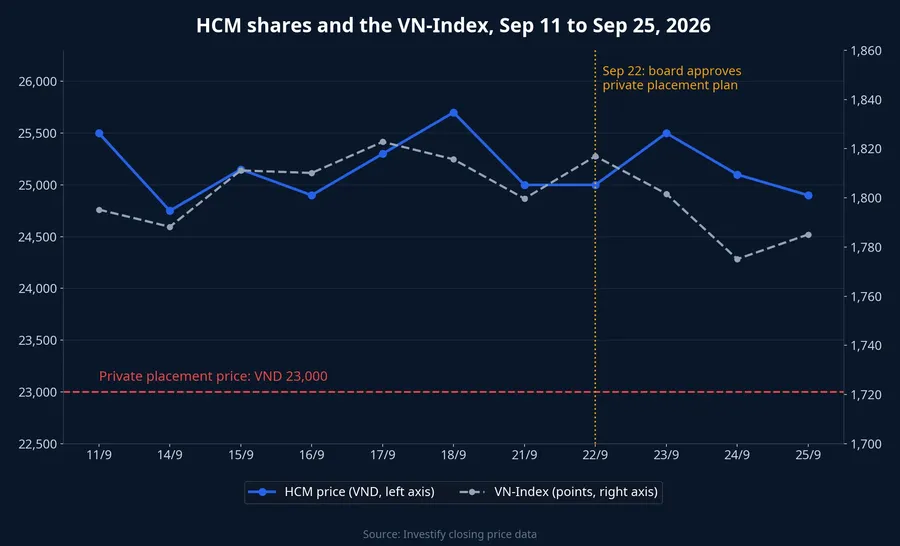
It is hard to pin the whole decline on the share sale. On September 24, the VN-Index also fell 1.47%, close to HCM's drop. On September 25, the VN-Index rose 0.56% while HCM slipped, but SSI lost 0.72% and VIX lost 0.78% in the same session, so brokerage stocks as a group were weak. The data lean toward the broader market being the main driver, with the issuance news adding to it, though two sessions are too few to separate the effects precisely.
From the start of the year to September 23, HCM was still up about 34.3%, trading at a P/B of about 2.4x.Tin nhanh Chứng khoán Investors are paying well above book value, and that price only holds up if the new capital earns what is expected.
Risks as the margin book grows
Putting all new capital into margin lending makes HSC's earnings more dependent on loan demand and loan quality. On demand, a higher ceiling does not mean the loan book grows automatically. If market liquidity weakens and investors borrow less, the new capital sits idle while the share count has already risen. EPS is then diluted with nothing yet to offset it.
On quality, the bigger the loan book, the more margin calls and forced selling a sharp market drop will trigger. The 3%-per-client and 10%-per-security limits help spread the risk, but they also expand along with equity.

What to watch
Taken as a whole, this is a capital raise with clear logic: the offer price is above book, the cost versus market price is only about 1.4%, and the money goes straight into the business running just below its regulatory cap. The real cost to existing shareholders sits in EPS, and it is only recovered if the loan book grows into the new capital.
The first milestone is State Securities Commission approval and the placement's final allocation. The second is the Q3 financial statements, once the rights-offering proceeds are on the books. The ratio to watch is margin loans against equity. If it climbs back toward 200% in coming quarters, the new capital is being fully used. If it drops sharply and stays low, the dilution pressure on EPS will become more visible in 2027.