

A container terminal pays for its berths, yards, cranes and core operating crew regardless of how many ships call in a given month. That sounds like a dry accounting detail, but it is the key to reading the Q3 forecasts that just hit Vietnam's financial headlines. Take Viconship (VSC): cargo volume across its port system is forecast to grow only about 6% year on year, excluding VIMC Dinh Vu port.Kinh tế Chứng khoán In the same quarter, net profit attributable to parent shareholders is forecast at VND 146 billion, up more than 80%.Mekong ASEAN
Volume up by a single digit, profit up by more than tenfold that rate. That is not a typo; it is how a port business makes money. Outlets citing the forecast disagree on the last digit, with some reporting 82% and others 85%.24HMoney One caveat up front: these figures come from a logistics sector outlook published by MB Securities (MBS) on September 24. They are broker forecasts, not reported results.CafeF The companies will publish their Q3 financial statements in October.
The "nearly 22%" figure is a national number
Many headlines say port throughput is up nearly 22%. That is MBS's forecast for total cargo through Vietnam's entire seaport system in Q3, up 21.7% year on year. The two port clusters where Gemadept (GMD), Hai Phong Port (PHP) and Viconship operate are growing much more slowly: the Hai Phong cluster is estimated at +9.7% and the Ho Chi Minh City cluster at +8.6%.Mekong ASEAN
MBS ties the growth to manufacturing shifting out of China, recovery in key export markets and inventory building ahead of the year-end shopping season. Congestion at several large transshipment hubs in the region has also led shipping lines to add services to Hai Phong and Ho Chi Minh City.
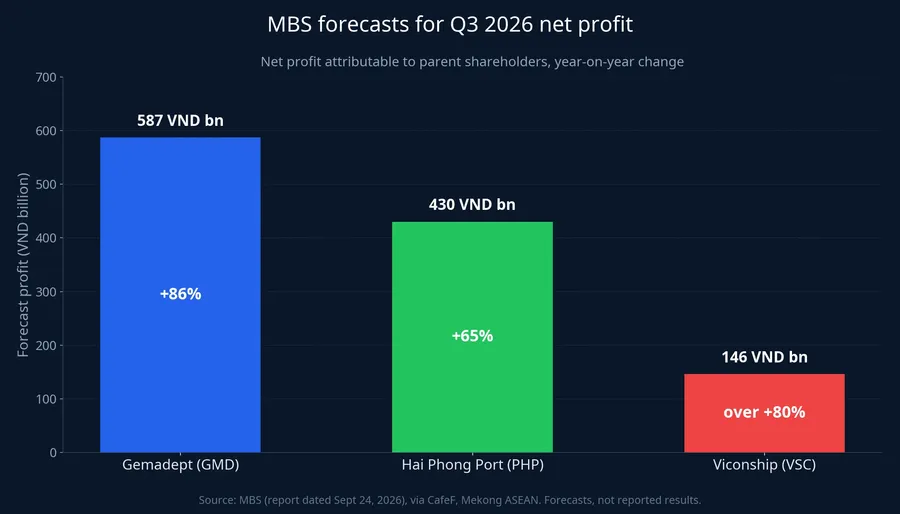
For the other two companies, MBS forecasts Q3 profit of VND 587 billion at Gemadept, up 86%, and VND 430 billion at Hai Phong Port, up 65%.CafeF Gemadept's system-wide volume growth is reported as about 6% by one outlet and 16.3% by another. Whichever figure is right, profit is still growing several times faster than cargo. For PHP, an accompanying 17% figure is described by some outlets as volume growth and by others as tariff growth, so this piece does not use it in any calculation.
Fixed costs: the base mechanism at all three
Depreciation on berths and equipment does not fall when cargo is light, nor does it rise when cargo is heavy. That is a fixed cost. Costs that vary with each container, such as forklift fuel or overtime labor, are smaller. When revenue barely covers the fixed base, a port earns thin margins. Once it clears breakeven, each additional container brings only its variable cost, and the rest flows straight to profit. Analysts call this operating leverage.
A hypothetical example makes the arithmetic concrete. Suppose a port has revenue of 100, fixed costs of 60, variable costs of 25 and profit of 15. Apply the two MBS forecasts for VSC, volume up about 6% and average tariffs up about 6.5%, and revenue rises to roughly 112.9.Kinh tế Chứng khoán Variable costs grow only with volume, to about 26.5, while fixed costs stay put. Profit becomes about 26.4, an increase of roughly 76%, on revenue growth of under 13%.
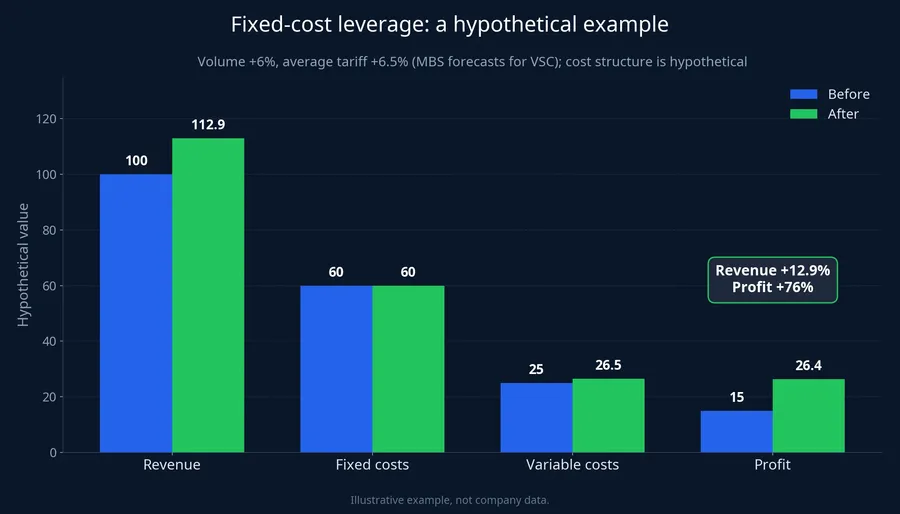
The cost structure in that example is hypothetical, not VSC's. Actual data shows the three companies carry different weights. Over the eight quarters from Q3 2024 to Q2 2026, cost of goods sold was about 53.7% of revenue at GMD, 53.1% at PHP and 64.7% at VSC. Depreciation as a share of revenue over the last six quarters was 7.3% at GMD, 9.2% at PHP and 12.0% at VSC. These ratios deserve caution: depreciation is only part of fixed costs, and the data does not separate operating wages or infrastructure leases.
Higher tariffs: almost all of the increase is profit
Volume growth still brings some variable cost. Tariff increases bring almost none. Same container, same crane lift, more revenue.
From February 1, 2026, the tariff framework for container handling at the Lach Huyen (Hai Phong) and Cai Mep - Thi Vai deep-water port areas was raised by about 10%, under Decision 2506/QĐ-BXD issued by the Ministry of Construction.Báo Xây dựng It is a framework, which does not mean every contract rose by exactly 10%.
The benefit varies. Gemalink sits in the Cai Mep - Thi Vai area and is directly affected. Hai Phong Port benefits through its joint venture operating berths 3 and 4 at Lach Huyen. For VSC, no source confirms that its two main ports fall under the deep-water tariff framework, although MBS still forecasts its average tariff to rise about 6.5% and its Q3 gross margin to improve by about 3.9 percentage points.24HMoney
Income from joint ventures and associates
This is where "system-wide" volume figures can mislead. A meaningful part of the forecast profit growth comes not from the ports these companies run themselves but from ports they only hold stakes in.
For Gemadept, Gemalink is an associate. The terminal is expected to keep operating well above its design capacity.CafeF Gemalink's cargo volume is forecast to grow 27.3%.Mekong ASEAN With Gemalink handling more boxes and charging under the new framework, Gemadept's share of its profit rises too. That line sits below gross profit, so it does not show up if you only look at volumes at the ports Gemadept operates directly.
For Hai Phong Port, MBS estimates berths 3 and 4 at Lach Huyen reached utilization of about 48% after nine months, helped by MSC adding services.CafeF At 48%, more than half the capacity is still idle. The investment is already sunk, so every new service lands in the post-breakeven zone.
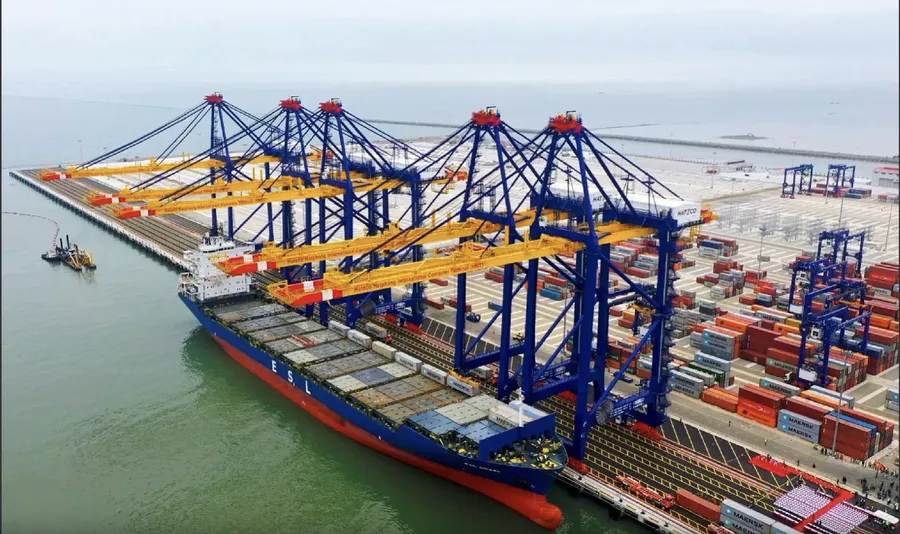
For VSC, MBS expects a larger contribution from its associate Hai An (HAH), alongside utilization at Nam Hai Dinh Vu port forecast to reach 73.6%, up from 51.5% in the first nine months of 2025.Mekong ASEAN
So the 65-86% growth has no single cause. Fixed-cost leverage is the base mechanism at all three. On top of it, Gemadept leans on Gemalink's combination of more cargo and higher tariffs, Hai Phong Port on spare capacity at Lach Huyen, and VSC on Nam Hai Dinh Vu and its share of Hai An's profit.
The Q3 2025 base differs across the three
Year-on-year growth also depends on how high or low last year's quarter was. The figures below are consolidated net profit, while MBS forecasts the portion attributable to parent shareholders, so they cannot be used to directly check MBS's math.
Gemadept earned VND 432.4 billion in Q3 2025, down 3.6% year on year, and absorbed net other income of minus VND 107.4 billion. That base is not unusually low; if anything, a negative item dragged it down. If the forecast holds, most of the growth will come from core operations.
Hai Phong Port earned VND 296.4 billion, down 20.7%, partly because Q3 2024 included VND 213.3 billion of net other income. The Q3 2025 base is genuinely lower, so part of the 65% growth will be a base effect.
VSC earned VND 113.4 billion, up 45%. That is a high base, not a low one. More telling, MBS forecasts VSC's full-year 2026 profit at just VND 370 billion, up 8.5%.Kinh tế Chứng khoán One quarter up more than 80% inside a year up 8.5% implies the other quarters are considerably weaker. Gemadept and Hai Phong Port are forecast to grow more evenly, reaching VND 2,726 billion (up 55%) and VND 1,240 billion (up 50.6%) respectively.CafeF
The same mechanism in reverse
Operating leverage cuts both ways. Fixed costs that stay flat when cargo rises also stay flat when it falls. If volumes stall, depreciation, operating wages and infrastructure leases still have to be paid in full, so profit shrinks several times faster than revenue.
Some of the drivers MBS cites are seasonal or temporary. Pre-holiday inventory building usually fades after Q4. Congestion at regional transshipment hubs could ease, and the extra services routed to Hai Phong and Ho Chi Minh City may not stay. Gemalink is already running above design capacity, so its near-term room for volume growth is limited, and its growth will depend more on tariffs until the expansion phase comes online.
How much the share prices already reflect
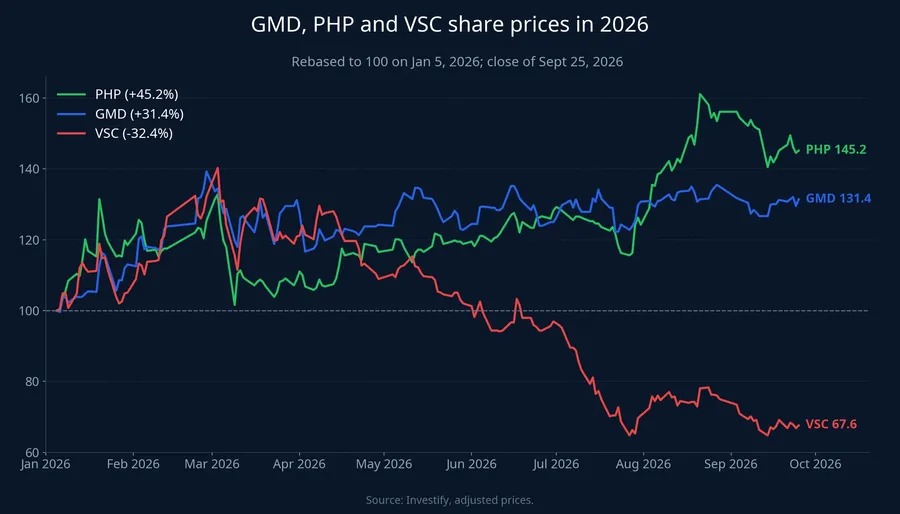
From January 5 to the September 25 close, GMD rose 31.4% and PHP rose 45.2%. VSC, by contrast, fell 32.4% to VND 13,250 per share. For GMD and PHP, part of the Q3 expectations is likely already priced in. For VSC, the market is far more cautious, consistent with a full-year forecast of just 8.5% growth.
How to read the Q3 reports
The forecast profit growth rests on a real mechanism: heavy fixed costs combined with higher tariffs. But the quality of that growth is uneven. Gemadept has the cleanest comparison base and the clearest driver in Gemalink. Hai Phong Port gets part of its lift from a low base. VSC is a case of one standout quarter in a slow year.
When the Q3 financial statements come out in October, a few lines are worth checking before the bottom-line profit figure:
- Gross margin: if it widens clearly year on year, fixed-cost leverage and tariffs are genuinely at work. If profit rises while gross margin stays flat, the driver lies elsewhere.
- Share of profit from joint ventures and associates: this line shows how much of the growth comes from Gemalink, Lach Huyen or Hai An.
- Comparison with Q2 2026, not just the prior-year quarter: the sequential comparison strips out last year's base effects and shows current business momentum.
If gross margin and joint-venture income both rise as forecast, the 65-86% growth has an operating foundation. If profit rises mainly on a low base or other income, the headline figure deserves a heavier discount. And the same mechanism is a reminder that when port volumes slow, profits will fall just as fast as they rose.