

Put two numbers side by side and it is hard not to get excited. The contract PVS just announced carries an expected value of over USD 3 billion, roughly VND 78,000 billion at the September 25 exchange rate of VND 25,980 per dollar. On that same day, PVS's entire market capitalization was only about VND 16,200 billion. A single contract nearly five times the size of the company invites an obvious conclusion: profits are about to jump.
The USD 3 billion figure, though, is the value of the whole package, not the cash that ends up with shareholders. To get from the headline to net profit, that number has to pass through three filters, and each one takes a meaningful bite. This piece walks through them one at a time, using the brokerage estimates currently cited in the Vietnamese press.
The largest award PTSC M&C has ever received
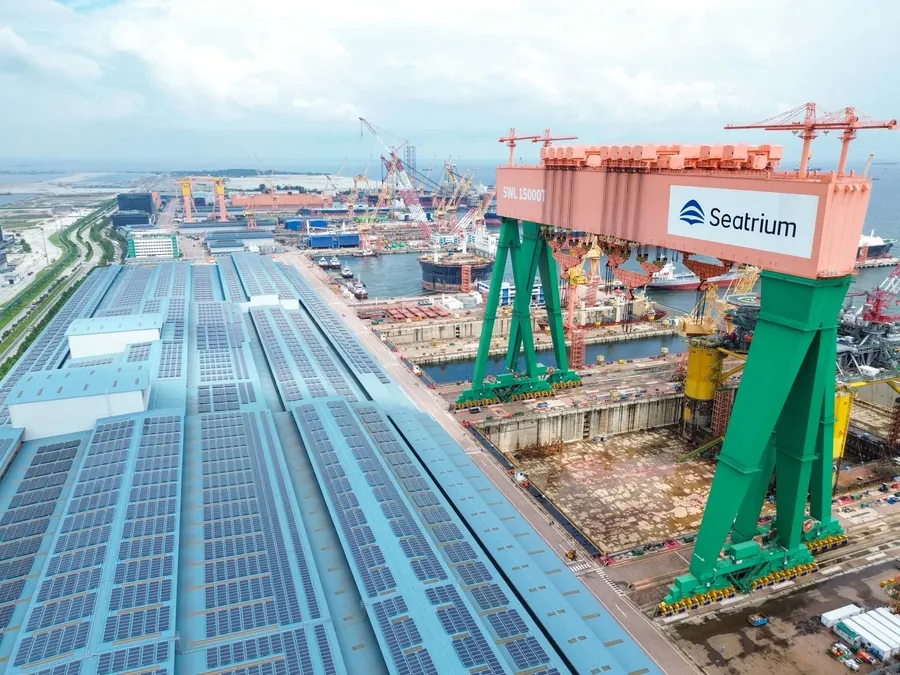
On September 13, QatarEnergy issued a letter of award for the EPIC-1 package of the Maydan Mahzam oil field redevelopment to PTSC Mechanical & Construction (PTSC M&C), a wholly owned subsidiary of PVS. PTSC M&C did not win it alone. It bid in a consortium with Seatrium, the Singapore-based rig builder and shipbuilder. On September 25, PVS made its official disclosure, citing an expected contract value of more than USD 3 billion.Người Quan Sát
By scope of work, this is the largest package PTSC M&C has ever been awarded.CafeF Maydan Mahzam is an offshore field roughly 110 km northeast of mainland Qatar.Ocean Energy Resources Treating this as good news is entirely reasonable. The better question is how good the news is once it is translated into earnings.

Filter one: a letter of award is not a contract
What PTSC M&C holds today is a letter of award, meaning the client has notified the contractor that it has been selected. The definitive contract is expected to be signed in October 2026.Ocean Energy Resources According to analyst reports cited by CafeF, neither the final contract value nor the work split between consortium partners has been disclosed.CafeF
Even the scope is being described two different ways. PTSC's own information refers to 8 new structures with a combined weight of more than 100,000 tonnes.CafeF A report from VCBS Securities instead describes EPIC-1 as 7 new topsides weighing over 78,000 tonnes plus modifications to 5 existing topsides, along with bridges, pipelines and cables.CafeF
The gap may simply reflect how items are grouped. Still, it signals that the details are not yet final. The risk at this first filter is straightforward: the number on the signed contract may differ from the number circulating in the press.
Filter two: one package, two contractors
The USD 3 billion-plus is the value of the whole package awarded to the consortium. PVS's own share has not been disclosed, and the available estimates are far apart. Vietcap Securities estimates the contract value attributable to PVS could reach as much as USD 3 billion.Người Quan Sát
VCBS is more conservative. It expects PVS's portion to account for at least 50% of the package, yet it only builds about USD 1.25 billion of Maydan Mahzam revenue into its 2026–2030 forecast for PVS's fabrication segment.CafeF Some headlines have reported that USD 1.25 billion as the "contract value". It is actually the revenue VCBS expects PVS to book in the first five years.
The two estimates are not necessarily in conflict. They rest on different assumptions about how much of the work goes to PVS, and how much of that work falls before 2031. The gap between USD 1.25 billion and USD 3 billion is about USD 1.75 billion, or more than VND 45,000 billion of revenue. That is the single biggest unknown in this story, and it will only close once the contract is signed and the work split is published.
Filter three: revenue spread over years, thin margins
Even with PVS's share settled, the revenue will not arrive all at once. The project is scheduled to run from Q4 2026 to the end of 2031, and according to Vietcap, work ramps up mainly from mid-2027.Người Quan Sát EPC contracts recognize revenue by percentage of completion, so revenue only shows up in the quarters when the work actually gets done.
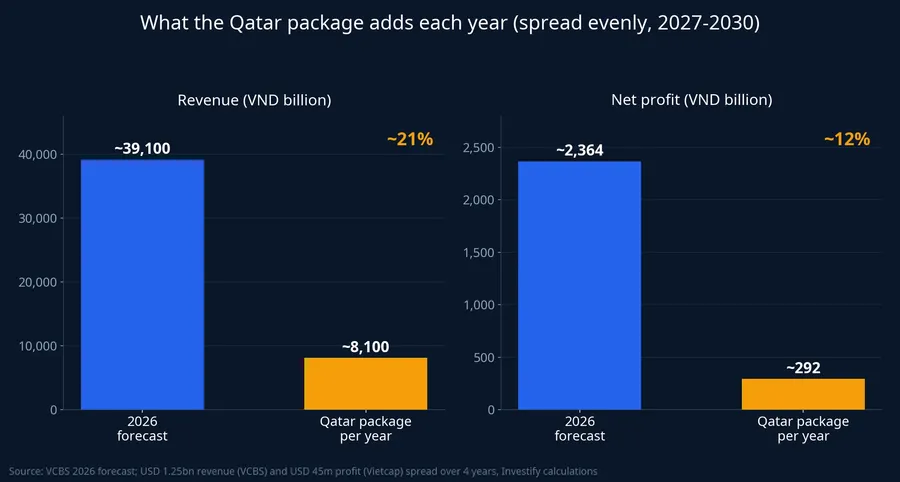
Take VCBS's estimate to get a sense of scale. If roughly USD 1.25 billion is spread evenly over 2027–2030, PVS would book about USD 312 million a year, or around VND 8,100 billion. VCBS forecasts PVS's full-year 2026 revenue at about VND 39,100 billion.CafeF The Qatar package could therefore add roughly a fifth of today's revenue base each year. In terms of workload, that is a big contribution.
The profit line tells a very different story. Vietcap estimates the contract could deliver about USD 45 million in net profit to PVS over 2027–2030.Người Quan Sát That is only about 1.5% of USD 3 billion. Put differently, every 100 dong of contract value leaves roughly 1.5 dong of net profit for shareholders.
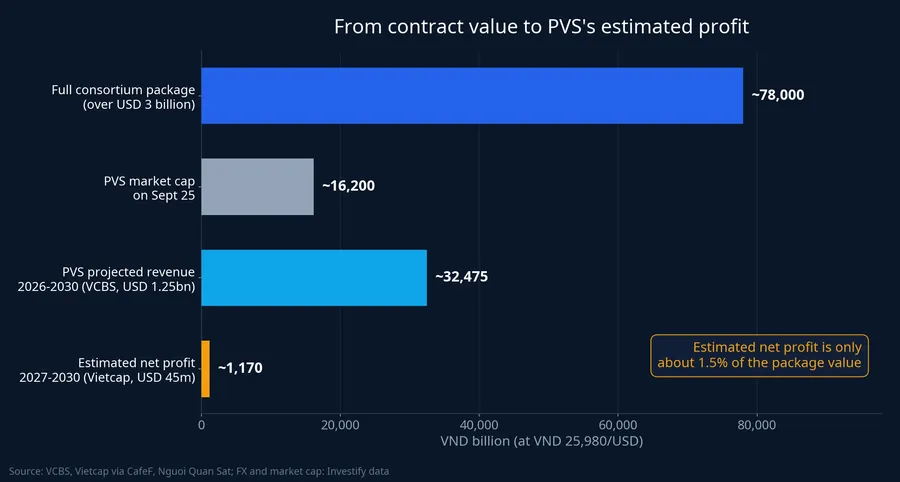
In local currency, about USD 45 million comes to roughly VND 1,170 billion over four years, or just under VND 300 billion a year on average. VCBS forecasts PVS's 2026 net profit at about VND 2,364 billion.CafeF The Qatar profit contribution is thus around one eighth of the current year's earnings. That matters, but it is a long way from the "profits about to soar" picture that VND 78,000 billion conjures up.
Thin margins are a feature of offshore EPC work in general. The contractor has to buy steel and equipment, charter installation vessels and pay thousands of engineers and workers, so most of the contract value simply passes through to suppliers. Analysts see the 1.5% margin as a conservative assumption. If PVS keeps costs tight, profit could come in higher. If, on the other hand, PVS's share is only about half the package as VCBS assumes and margins stay at this level, the profit figure shrinks accordingly.
Execution risk sits in cost control
On a contract running to the end of 2031, the biggest risk usually lies in holding costs down across five years of construction. Sharp swings in steel and materials prices can eat into an already thin margin, especially since EPC contracts are typically lump-sum. A delay on a single structure can trigger contractual penalties and longer vessel charters.
The site is in the Gulf, where tensions around the Strait of Hormuz remain elevated. Prolonged tension could raise insurance and transport costs for moving structures from the fabrication yard to the field. It is a risk worth noting, although there is no sign yet that it is directly affecting this package.
How the market has reacted
On September 15, when the award news spread across the domestic press, PVS shares rose 4.91% to VND 34,200 on more than 8.1 million shares matched, the highest volume in over a month. The gain did not hold. On September 25, PVS closed at VND 31,600, about 3.1% below the VND 32,600 close of September 14, before the news broke.
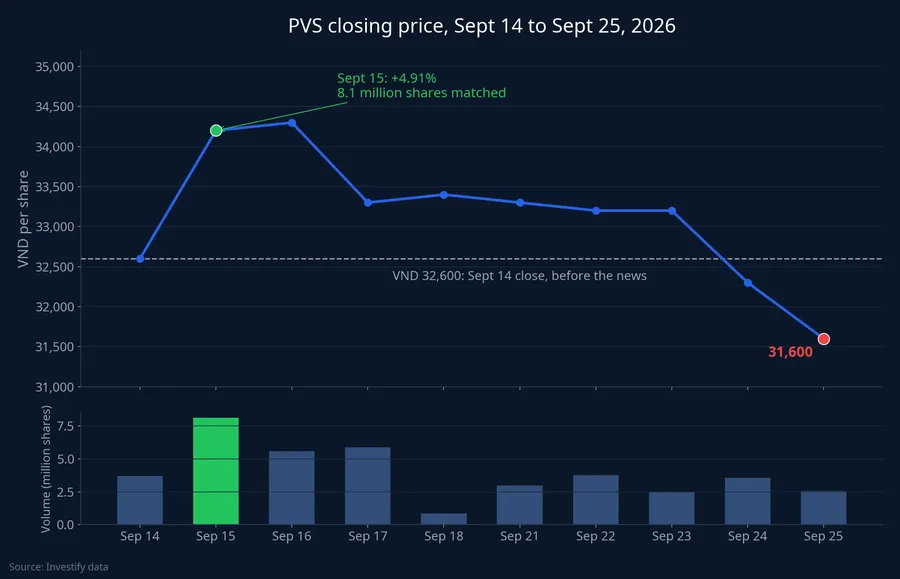
There are at least two plausible readings. One is that, after the initial headline-driven buying, the market filtered the USD 3 billion figure much as outlined above. The other is broader market weakness over the same period, which also weighed on many large caps. The available data is not enough to separate the two. What is clearer is that the award, large as it is, was not enough to keep the stock near its September 15 level.
The real value is workload, not a profit windfall
The Qatar package is not a profit jump. Its real value is workload. According to Vietcap, USD 3 billion equals about 143% of PVS's current signed backlog for 2026–2030, and is more than 2.7 times the combined value of the three EPC packages PVS won in phase 1 of the Block B project.Người Quan Sát For a contract-driven business like PVS, a fabrication yard filled through 2031 means steadier revenue and less pressure to win bids at any price. It is also further proof of capability in the Middle East, where PVS has carried out several EPC projects in Qatar since 2018.CafeF
The most sensible way to read this award is as multi-year job security rather than a one-off earnings windfall. The base case, on current estimates, is an extra few hundred billion dong of profit a year from mid-2027, on top of a base of roughly VND 2,300–2,400 billion. That view only changes if one of two signals appears: PVS's share of the work comes in well below 50%, or fabrication margins deteriorate clearly in the first quarters of construction.
The milestones that will fill in the gaps, in order:
- October 2026: the definitive contract is signed, possibly with a final value.
- After signing: the work split between PTSC M&C and Seatrium reveals PVS's real revenue share.
- Upcoming financial statements: unexecuted backlog and fabrication gross margin will show how fast the Qatar package is turning into profit.