

Japan's SMBC wants to raise its stake in VPBank to about 20%, and the route it is now weighing would not bring a single new dong of capital into the bank. That is the most telling detail in the Reuters report published on September 25. One caveat up front: Reuters relied on unnamed sources, and neither VPBank nor SMBC responded to its requests for comment.CafeF So this piece does not try to predict whether the deal happens. The more useful question, judging by the numbers, is where the deal stands today and what each possible path leaves for minority shareholders.
The sticking point is price
According to Reuters, Sumitomo Mitsui Banking Corp (SMBC) is in talks to raise its VPBank holding from 15% to about 20%. Negotiations have run for several months, and both sides are aiming to close within this year.Vietstock What remains unresolved is price.
VPBank wants a price well above market, as in the 2023 deal. Back then, SMBC paid about USD 1.5 billion for 15% of the bank, roughly a 40% premium to the market price.Vietstock This time, SMBC is reluctant to pay a similar premium and has discussed internally whether to buy additional shares on the exchange instead of subscribing to a private placement.

The 20% figure is not arbitrary. Under general rules, a single foreign investor together with its related parties can usually hold no more than 20% of a Vietnamese bank.CafeF In other words, SMBC is aiming for the ceiling that applies to an individual foreign shareholder.
A share tranche VPBank has already prepared
Even before the Reuters report, VPBank had laid the groundwork for a stake sale. Its 2026 annual general meeting approved a two-stage capital increase. The first stage is a 26.04104% stock dividend that lifts charter capital to VND 100,000 billion, with September 25 as the record date. The second is a private placement of more than 624 million shares to a foreign investor, raising charter capital to over VND 106,200 billion.DNSE VPBank has not named that investor.
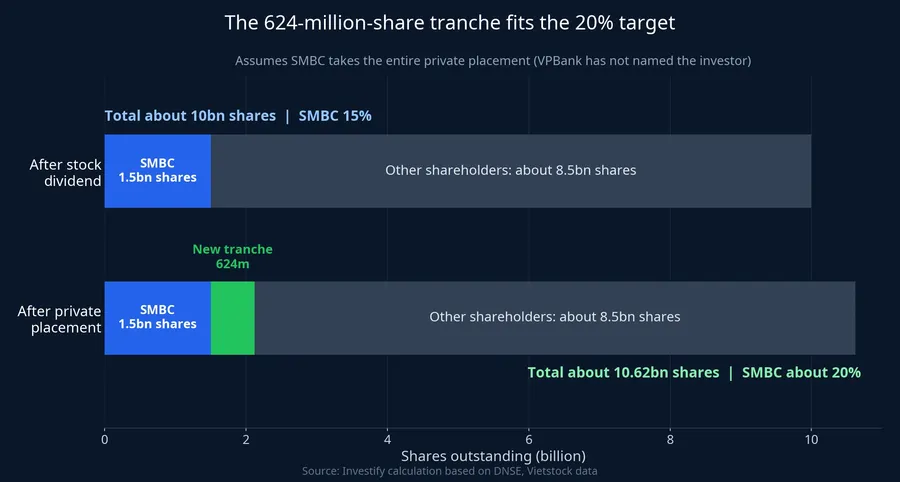
Put the numbers side by side and the arithmetic is striking. With charter capital of VND 100,000 billion and a par value of VND 10,000, VPBank will have about 10 billion shares after the dividend, of which SMBC holds about 1.5 billion. If SMBC took the entire 624-million-share tranche, its holding would rise to about 2.12 billion out of roughly 10.62 billion shares, or about 20%. This is our own calculation, not something VPBank has confirmed. Still, the size of the tranche matches the target Reuters described almost exactly.
The tranche is also sizeable. At the September 24 closing price, the shares on offer are worth nearly VND 13,800 billion.CafeF Swiss advisory firm Turicum Investment Management, meanwhile, estimates that VPBank could raise about USD 700–900 million, or VND 18,200–23,400 billion.VietTimes The gap between those two figures is precisely the premium being negotiated. Applying the 2023-style 40% premium to the September 24 price of VND 22,100 gives about VND 30,900 per share, or roughly VND 19,300 billion in total. That sits comfortably within Turicum's range.
Path one: SMBC buys on the market
This path requires SMBC to accept a gradual build-up, and the market to have enough room left for foreign investors.
On room, data through September 24 show foreign investors holding 22.84% of VPB, with about 7.19% of room remaining. The two add up to roughly 30%, meaning trading data still apply the standard cap, even though VPBank is allowed a foreign ownership limit of up to 49% after taking over GPBank under a compulsory transfer.Vietstock Even under the 30% cap, the 5% SMBC needs fits within the remaining room. The catch is that this room is shared with every other foreign investor.
The real constraint is liquidity. After the dividend, reaching 20% of about 10 billion shares means buying roughly 500 million more. Year to date, VPB has averaged about 17.45 million shares matched per session.CafeF Adjusted for the 26% increase in share count, that is about 22 million shares a day. So even if SMBC bought every share traded, it would need around 23 sessions. No single buyer takes all the volume, so in practice the process would likely stretch over months.
For minority shareholders, steady buying across many sessions could support VPB's price, and because the share count does not change, there is no dilution. The trade-off is that VPBank receives no new capital. SMBC's money goes to the selling shareholders, and the bank still has to find capital elsewhere. That need is real: at the end of Q2 2026, parent-bank lending reached nearly VND 1.06 million billion, up 24.6% from end-2025.DNSE Credit growth at that pace requires equity to grow accordingly to maintain capital adequacy.
For SMBC, the benefit is obvious. At current prices, a 5% stake in VPBank is worth about USD 425 million.Vietstock Buying on the market lets SMBC avoid the premium VPBank is holding out for.
Path two: a private placement at a premium
This path requires the two sides to agree on a price above market, and VPBank to name the investor and complete its filings with regulators. The framework was already approved at the AGM, so what remains is mostly the price.
The 624 million new shares would lift the share count from about 10 billion to about 10.62 billion, diluting each existing shareholder's ownership by about 5.9%. But dilution at a high price is very different from dilution at a low one. If new shares are sold above book value and above market, each existing share gets a claim on a correspondingly larger equity base. 2023 is the precedent: after the SMBC deal, VPBank's equity rose from about VND 103,500 billion to about VND 140,000 billion.The Investor
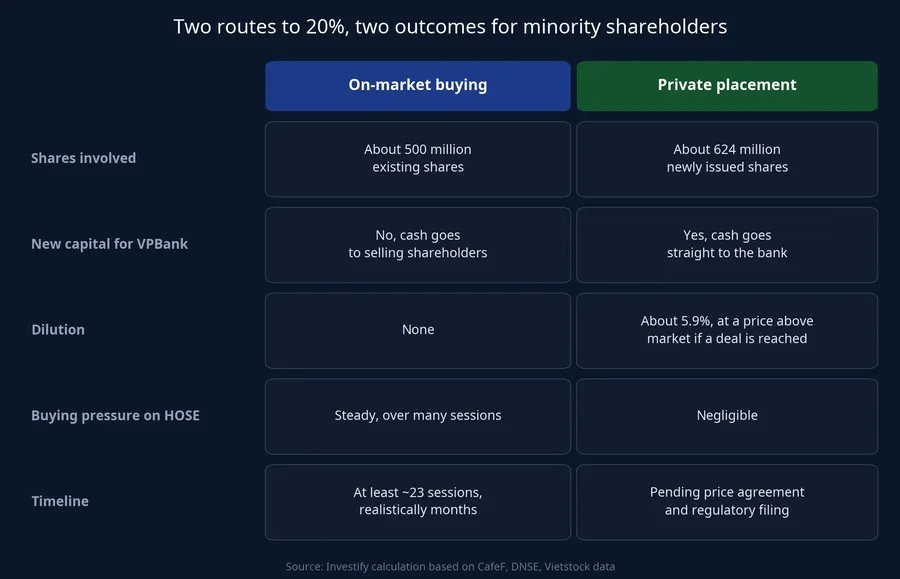
This path does not create on-market buying pressure the way path one does. The share price after an announcement would mostly depend on the agreed price. The further above market it is, the more the market gains a reference point for re-rating VPB.
Path three: talks drag past year-end
This path plays out if the two sides cannot close the price gap and SMBC has not started buying on the market either. In that case, gains built on deal expectations could be given back.
On September 25, VPB closed at VND 23,000, up 4.07%, on volume of about 46.8 million shares. That was the highest in 30 sessions and roughly 2.7 times the year-to-date average. In the early afternoon the stock briefly touched its ceiling price of VND 23,600 before cooling off into the close.DNSE
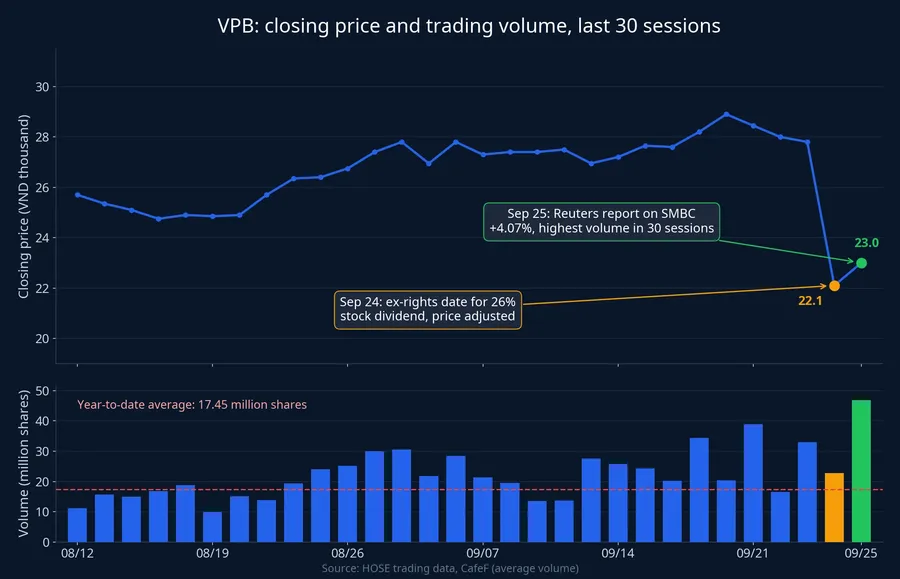
It would be a mistake to credit the whole move to the SMBC news. FTSE Russell upgraded Vietnam to emerging-market status this week, and September 25 was also the record date for the stock dividend.CafeF Even so, the evidence points to the Reuters report as the main driver of the session. The price rose most sharply in the early afternoon, after domestic outlets republished the story from around 11:26 a.m., and volume surged within the same session. Expectations of post-upgrade inflows may provide a floor, but they struggle to explain a large-cap stock hitting its ceiling on the very day of the news. If path three materialises, this session's gain is the part most likely to be given back.
New investors should also watch out for a common misreading. VPB's VND 22,100 close on September 24 had been adjusted because that was the ex-rights date for the stock dividend. Compared naively with the VND 27,800 close on September 23, it looks like VPB fell more than 20%. In reality, eligible shareholders will receive about 26 new shares for every 100 they hold, so the value of their holdings is essentially unchanged.
Signals that will show which path is unfolding
Each path leaves its own footprint, and all of them will be observable in the sessions ahead.
If SMBC buys on the market, the first sign will be sustained foreign net buying in VPB across many sessions, on a scale clearly larger than index-fund purchases. VPB's remaining foreign room would shrink alongside it. As a major shareholder, SMBC must disclose any trades that change its ownership level.
If the two sides settle on a private placement, the signal will come on paper: a VPBank board resolution naming the investor, the issue price and the regulatory filing. The issue price relative to the market at that point is what will determine how favourable the dilution is for minority shareholders.
If talks drag on, the tell is the absence of both signals as the year draws to a close, just as the within-the-year target cited by Reuters approaches.
Taken together, the same 20% target could produce opposite outcomes for minority shareholders. One is on-market buying pressure but no new capital for the bank. The other is fresh capital that comes with dilution at a premium. The available data are not enough to say which path will win, since everything so far comes from unnamed sources. Until one of these footprints appears, the September 25 rally is the price of an expectation, not the price of a signed deal.