

On the morning of September 25, shares of Kosy JSC (ticker KOS) sat at the floor price of VND 21,000, their fifth limit-down session in a row. The same company's reviewed half-year report shows after-tax profit more than doubling. The two facts look contradictory, but they aren't. The risk weighing on KOS isn't in the financial statements. It sits in a simpler question: how many of the insiders' shares are pledged as collateral, and with whom.
The useful part for individual investors is that this kind of risk can be checked before buying, using public data and a few minutes of searching.
Four brokerages in 16 days
According to a CafeF round-up, notices of forced sales of KOS shares came not from one lender but from at least four different securities firms.CafeF
- September 8, Funan Securities announced plans to sell 900,000 KOS shares belonging to Mr. Nguyen Viet Cuong, Chairman of the Board of Kosy JSC, along with Leo Regulus Investment JSC and another individual shareholder.
- September 22, Capital Securities planned to sell 605,600 shares held by Ms. Nguyen Thi Hang, Vice Chairwoman of the Board, and Ms. Nguyen Thi Phuong Thao, Deputy CEO of Kosy. Ms. Thao's portion alone was 309,400 shares.CafeF
- Also on September 22, Finhay Securities issued a forced-sale notice on KOS, though the volume has not been reported.
- September 23, Nhat Viet Securities (VFS) published a batch of notices covering Mr. Cuong, Ms. Thao, Leo Regulus and one individual shareholder, totaling more than 2.02 million shares.
Adding up the three notices with disclosed volumes gives more than 3.5 million shares slated for forced sale, before counting Finhay. These are planned sales, not executed trades. Separately, Mr. Cuong registered to sell 5 million KOS shares between August 27 and September 24. As of the morning of September 24, no results report had been filed, so it is unclear how many he actually sold.DNSE
Five floor sessions and a sell queue of over 10 million shares
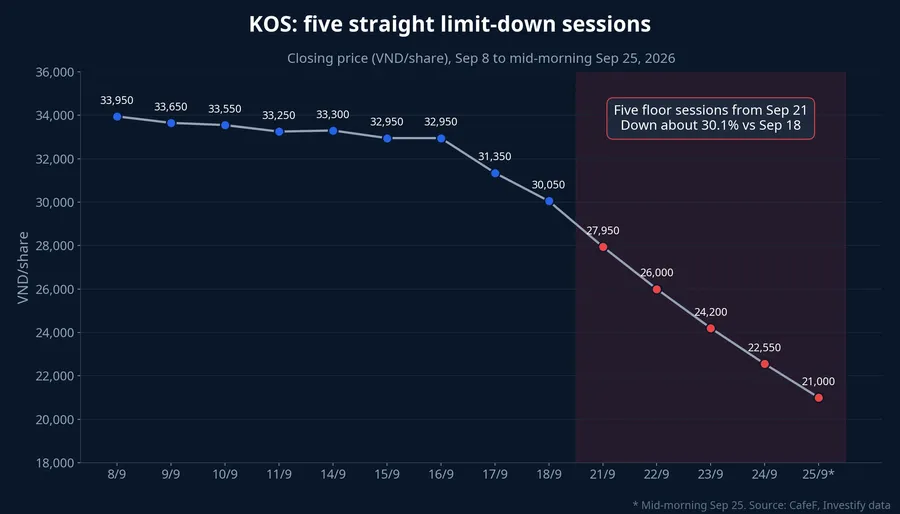
KOS closed at VND 30,050 on September 18. From September 21 it fell the full 7% daily limit every session, reaching VND 21,000 by the morning of September 25, about 30.1% lower in just five sessions.CafeF Zooming out, the stock was trading around VND 35,000 on August 6, so the slide began before the wave of forced-sale notices.DNSE
The price drop isn't the most worrying part, though. At the September 24 morning close, only 8,300 KOS shares had changed hands, while sell orders stacked at the floor price reached 10.38 million shares.DNSE By mid-morning on September 25, matched volume stood at roughly 1,600 shares.
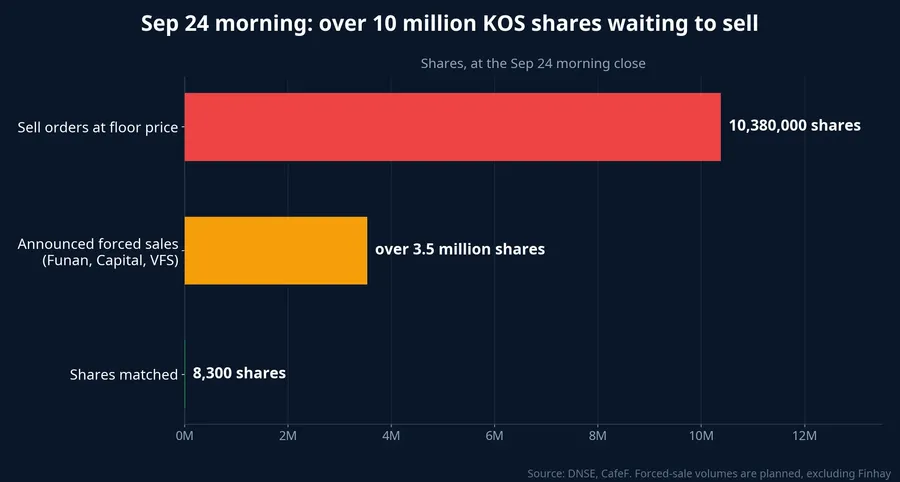
Two consequences follow that newer investors often miss. First, anyone holding KOS who wants out has to queue behind more than 10 million other shares, so even a floor-price sell order may never fill. Second, the sell queue is nearly three times the total forced-sale volume announced so far. The queue is not just the insiders' pledged shares. Other investors, likely including margin borrowers, appear to be heading for the same exit.
How pledged shares fall like dominoes
Share pledging works simply. A borrower puts up shares as collateral and receives a loan worth a set percentage of their value. When the price falls, so does the collateral. If it drops below the agreed threshold and the borrower doesn't top up with cash or other assets, the lender can sell the shares to recover the loan.
The real danger comes when several lenders hold pledges on the same stock. A sale at the first lender pushes the price down. The lower price pushes the pledge at a second lender to its threshold, the second lender issues its own sale notice, and the loop continues. Consecutive floor sessions speed it up. Each limit-down day cuts collateral value by another 7% at every lender simultaneously, while very few shares actually get sold.
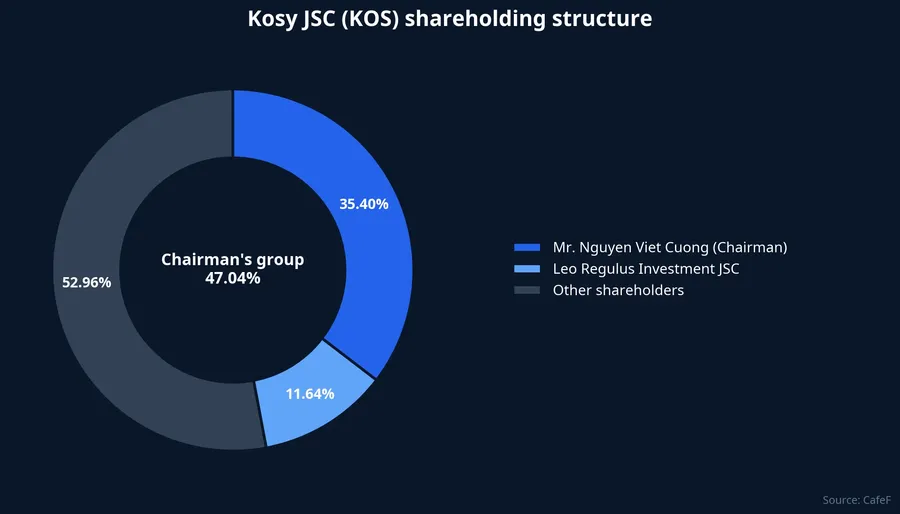
How dangerous this loop becomes depends on ownership concentration. According to CafeF, Mr. Cuong directly holds 35.40% of Kosy and Leo Regulus holds 11.64%, together approximately 47.04%, or nearly 101.84 million shares. Kosy's half-year report identifies Leo Regulus as a related party because the two share the same Chairman.CafeF
What the filings don't show is the total number of shares currently pledged. Kosy hasn't disclosed it, so the market has no way of knowing how many more shares could be dumped. That information gap is exactly what keeps buyers on the sidelines.
Kosy's explanation and the other drivers
In a written explanation dated September 23, Kosy said several securities firms with links to Korean investors and institutions had cut their collateral valuations and demanded the pledged assets be handled within about two days. The company did not name them.CafeF Kosy has also asked the brokerages to consider extending or restructuring the obligations to match its actual cash-flow timeline.DNSE
That account fits the cluster of notices on September 22 and 23. It doesn't explain everything, however. KOS had been falling since August, before the flurry of notices, and the sell queue far exceeds the forced-sale volume. The available data points to forced selling as the direct trigger of the limit-down run, with other investors' retreat amplifying it. There isn't enough evidence to pin down exactly how much each factor contributed.
Why doubled profit couldn't hold the price
According to the reviewed consolidated half-year financial statements, Kosy booked net revenue of VND 722.66 billion in the first six months of 2026, up 9.03%, and after-tax profit of VND 15.36 billion, up 120.67% year on year. Part of that jump reflects a low base: profit in the same period last year was only about VND 6.96 billion.DNSE
Profit offers no shield here, for two reasons. First, forced selling ignores earnings: the brokerage sells to recover its loan whether the company is profitable or not. Second, the profit is small relative to the capital tied up in projects. Six-month interest expense was VND 47.36 billion, roughly three times after-tax profit. As of June 30, inventory stood at VND 2,778.49 billion, nearly 55% of total assets of VND 5,078 billion, while cash and cash equivalents were just VND 13.96 billion.DNSE Total borrowings and finance lease liabilities were approximately VND 1,998 billion.CafeF

By Kosy's own account, meaningful revenue and cash flow from its real estate projects are only expected from early 2027.DNSE None of these figures indicate that Kosy is insolvent, and this piece makes no judgment on whether the company is good or bad. What they do show is that when major shareholders urgently need cash to defend their pledges, the company has little spare money to help.
What individual investors can check themselves
Most of the steps below take a few minutes with public data.
Search for forced-sale notices by ticker. Search the ticker together with "giải chấp" (forced sale) on financial news sites, or check the stock's news tab in your brokerage app. One regulatory detail matters here: when a brokerage force-sells an insider's shares, the insider is exempt from the usual pre-registration and post-trade reporting.SSI The brokerage's own notice is therefore the earliest signal you will see. One notice on its own says little. Several notices from different firms in a short window suggest the same group's shares are pledged across multiple lenders.
Add up insider ownership. Open the governance report or major-shareholder list and sum the stakes of executives, their relatives and affiliated companies. When that group holds nearly half the company, as at Kosy, the volume that could hit the market in a forced-sale scenario is huge relative to the free float.
Watch for indirect signs of pledging. Pledged-share counts are rarely disclosed in full. Indirect signs include insiders registering large sales just as the price is falling, affiliated companies holding big stakes, and a company with little cash relative to its debt.
Compare floor-price sell orders with matched volume. This measures the risk of getting stuck. When millions of shares are waiting to sell and only a few thousand trade, even someone buying at the floor may be unable to sell for several sessions.
Signs the selling pressure is easing
For KOS, and for any stock with a similar ownership setup, these are the signals worth watching in the coming sessions:
- Floor-price sell orders shrinking session by session, alongside rising matched volume.
- No new forced-sale notices from any brokerage for several sessions in a row.
- Mr. Cuong's trading results report for his 5-million-share sale registration, showing how many shares the Chairman has left.
- The outcome of talks between Kosy and the brokerages on extending or restructuring obligations. An agreement would directly remove the pressure to sell in a hurry.
If the sell queue contracts and no new notices appear, the forced-selling cycle is slowing. If new notices keep arriving while the queue stays in the millions, the overhang hasn't cleared, even after a drop of more than 30%.
The lesson from KOS isn't about profit or loss. A company with rising earnings can still see its stock pinned at the floor for days when most of its equity sits with a group of shareholders borrowing against those very shares. Before buying any stock, a few minutes spent checking who owns it, and whether those shares are sitting in someone's pledge account, can keep you out of a sell queue like the 10-million-share line at KOS.