


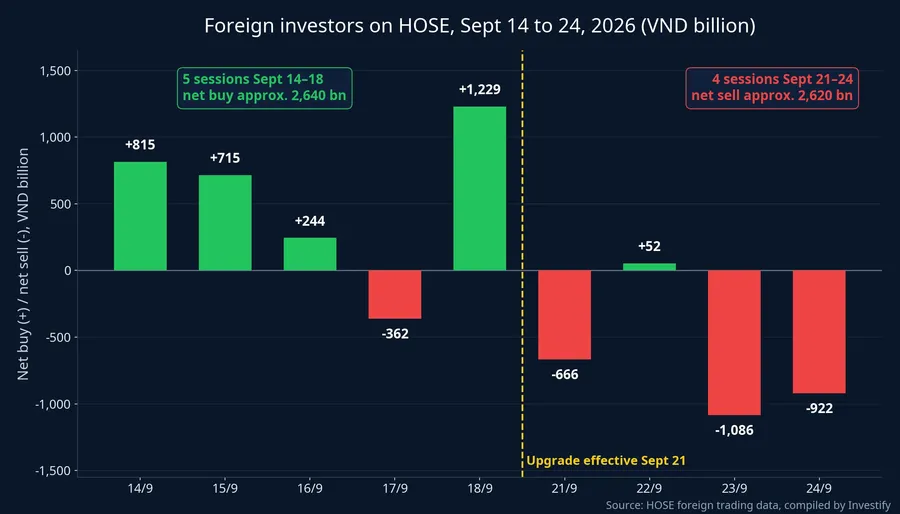
Add up the nine HOSE sessions from September 14 to 24, and foreign investors barely moved. In the five sessions before Vietnam's market upgrade took effect, they were net buyers of roughly VND 2,640 billion. In the four sessions after, they were net sellers of roughly VND 2,620 billion. The gap is under VND 20 billion, a rounding error against weekly turnover in the tens of trillions of dong.
Yet the number circulating on investor forums is only the second half of that sum. In Vietnam's first four sessions as an FTSE Russell Secondary Emerging market, foreign investors sold a net VND 2,600 billion or so, pausing on just one day.CafeF The bigger picture says this is not foreign money turning its back on the upgrade. It is about how index money moves on a calendar, and about an outflow trend that has been running since January.
Why many read it as a rejection
The worry is understandable. Ahead of the effective date, forecasts floated inflows of up to USD 6 billion as Vietnam entered emerging-market indices. Instead, on the very first session, September 21, foreign investors sold a net of nearly VND 670 billion on HOSE.Người Quan Sát
The following sessions reinforced the impression. On September 23, they sold a net VND 1,048 billion across the whole market.CafeF On September 24, they added another VND 867.9 billion.Tin nhanh Chứng khoán That same day the VN-Index fell 26.56 points, or 1.47%, to 1,775.09. Set against the USD 6 billion headline, it is easy to conclude that foreign money does not buy the upgrade story. To see why that conclusion is premature, step back one week.
The first half of the sum: September 14–18
In the week of September 14–18, foreign investors were net buyers of VND 2,638 billion across the market, with heavy buying in banks.Tin nhanh Chứng khoán On September 18 alone, the last session before the effective date, they bought a net VND 1,200 billion or so.Báo Mới HOSE trading data show foreigners bought VND 10,501 billion and sold VND 9,272 billion that day, three to four times their own volume on other days that week.
This matters for how the numbers should be read. An index-tracking fund must hold the exact basket on the exact day the index changes. Buying one session late means drifting from the benchmark it has promised to follow. So funds tracking FTSE's emerging-market indices had to finish buying Vietnamese stocks before the open on September 21, and typically concentrated orders into the September 18 close. An analyst at VNDIRECT likewise noted that passive money may already have been repositioned by ETFs before the effective date, and that net selling afterwards does not contradict the upgrade story.Người Quan Sát
At the same time, flows in the opposite direction were also on schedule. Changes to FTSE's frontier indices took effect right after the September 18 session, with 126 Vietnamese stocks leaving them.VietnamFinance Frontier trackers had to cut Vietnam to zero in the same window. The net buying figure for September 14–18 is therefore already what was left after two scheduled order flows offset each other.
After September 21, there are no more scheduled buy orders for this round. FTSE's roadmap phases the inclusion in several steps, and the next one takes effect on March 22, 2027.CafeF The six-month gap in between is where active money, not index money, decides which way foreign flows go.
Who is selling after September 21
One limitation needs stating plainly. Session-level data cannot tell us whether the sellers after September 21 are the same funds that bought before it, and no source has confirmed a literal "hand-back" of shares. Three explanations are all plausible.
The first is that active funds investing in frontier markets are gradually exiting. Unlike index funds, they were not forced to sell before September 18, so they can unwind more slowly. CafeF cited a view that selling pressure may continue, including possible withdrawals by such funds.CafeF There is, however, no measurable data on how large this component is.
The second is that the year-long selling trend has simply resumed after a one-week interruption. Since the start of 2026, foreign investors have sold a net of approximately VND 95,000 billion.CafeF Spread over roughly 38 weeks, that is about VND 2,500 billion of net selling in an average week. In other words, the four sessions described as a "sell-off" are about the size of an ordinary week this year. It was the net-buying week of September 14–18 that was the anomaly.
The third is that foreigners are selling a specific group of stocks. The two Vingroup names have been sold relentlessly, even during the net-buying week: in September 14–18, VIC saw net selling of VND 1,073 billion and VHM VND 771 billion.Tin nhanh Chứng khoán On September 24, VHM saw net selling of VND 349.3 billion and VIC VND 176.7 billion, while foreigners were still net buyers of VND 182.1 billion in MSN.Tin nhanh Chứng khoán
The data lean toward the second and third explanations. The size of the selling matches the year's average pace, and most of the pressure is concentrated in a few large names that were already being sold before the upgrade. Still, September 23 carried a different signal: pressure shifted to banks, with net selling of about VND 289 billion in VPB and VND 142 billion in ACB.CafeF If that pattern repeats over more sessions, the "selective selling" explanation weakens.
The longer-term context explains why net selling is the default state. According to Lê Chí Phúc, CEO of SGI Capital, years of outflows have cut foreign ownership of the Vietnamese market from around 24% to 12%.CafeF Phúc argues that in many markets upgraded by FTSE Russell, the most positive phase came before the effective date, followed by a period of divergence and consolidation lasting roughly three to six months.
Redemptions at the VN Diamond ETF: a separate story
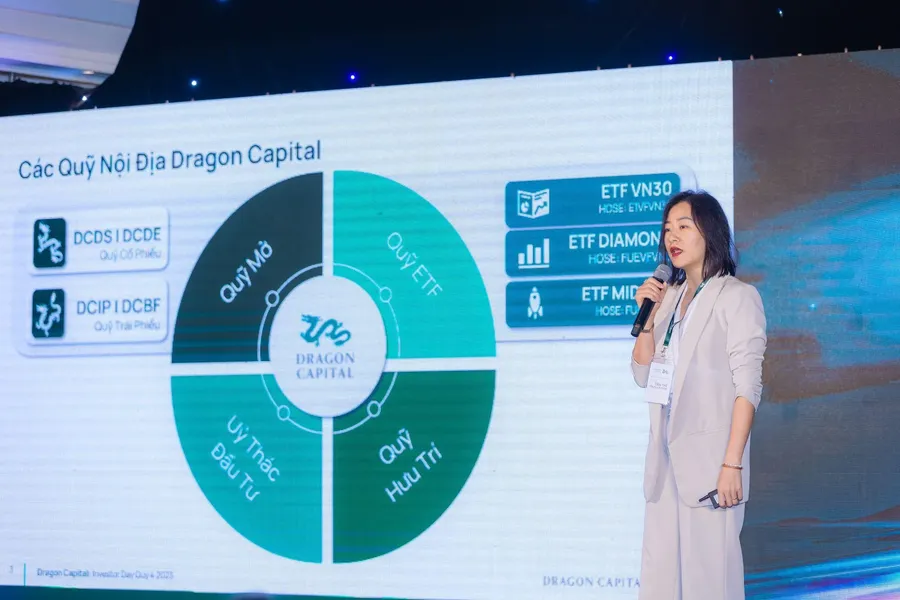
The second headline worrying investors is that the DCVFMVN DIAMOND ETF (ticker FUEVFVND), managed by Dragon Capital, saw net redemptions on all three sessions of September 21, 22 and 23. On September 23 alone, net redemptions reached nearly VND 48 billion, the largest in months.Chuyển động Thị trường
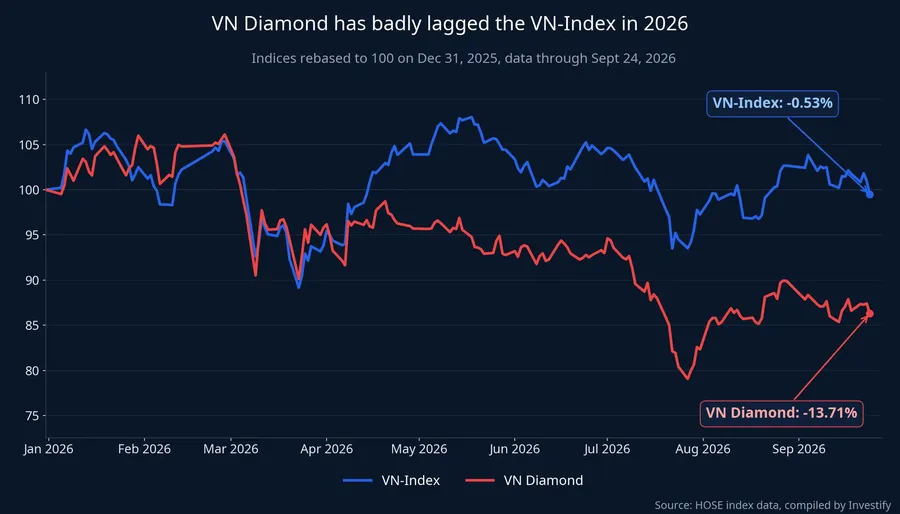
The timing coincides with the upgrade, but the fund's own data point to its basket. Since the start of 2026, the fund has seen net redemptions of about VND 913 billion, most of it before the upgrade took effect.Chuyển động Thị trường The VN Diamond index it tracks fell 13.71% from the end of 2025 to September 24, while the VN-Index slipped just 0.53% over the same period. A gap of more than 13 percentage points is reason enough for some investors to pull out, upgrade or no upgrade.
It helps to know why this basket exists. VN Diamond groups quality stocks that have reached or are close to their foreign ownership limits.DNSE The ETF works as a side door for foreign investors to hold those sold-out names indirectly. In July and August the fund still recorded net inflows, meaning demand for this basket rises and falls with performance, not with the upgrade calendar.Chuyển động Thị trường On September 23, the day Diamond saw its heaviest redemption, foreigners bought a net of about VND 70 billion of FUESSVFL units on the exchange.CafeF They are not abandoning domestic ETFs across the board.
How much pressure on FPT, MWG and the banks
When redeemed, an ETF sells its holdings in proportion to their weights. As of August 31, the Diamond fund was heaviest in banks at 40.1% of assets, followed by retail at 22.5% and IT at 16%. Its three largest holdings were FPT at 16% of NAV, MWG at 14.4% and GMD at 9.7%.Chuyển động Thị trường
In practical terms, that pressure is small. The fund's total NAV stands at VND 11,134 billion, so the nearly VND 48 billion redemption on September 23 was only about 0.4% of assets. At a 16% weight, FPT's share comes to roughly VND 7–8 billion. For comparison, in the week of September 14–18 alone, foreigners bought a net VND 508 billion of FPT.Tin nhanh Chứng khoán For holders of FPT, MWG or bank stocks, Diamond redemptions are a real source of selling, but not large enough to set the price trend on their own. They only become an issue if redemptions persist for weeks at a much larger scale.
A more accurate picture
The "upgrade done, foreigners walk away" reading does not fit the data. The scheduled money for the first tranche arrived before September 21. The roughly VND 2,600 billion of net selling since then almost exactly matches what was bought beforehand, and is in line with 2026's average weekly outflow. Foreign investors are reverting to their pattern for the year, not reacting anew to the upgrade. Redemptions at VN Diamond, meanwhile, are about the performance of one specific basket.
The practical takeaway is that daily foreign net-selling figures over the coming weeks are not a scorecard for the upgrade. They reflect an outflow trend that predates it and has shown no sign of reversing. This thesis would only be overturned if one of the three signals below changes direction.
Weekly net-selling size. The benchmark is the year's average of about VND 2,500 billion. If weekly figures drift below that, pressure is easing, as SGI Capital expects. If they run well above it for several weeks in a row, only then is there a case for talking about foreigners walking away.
Breadth of selling. As long as net selling stays concentrated in VIC and VHM, it is a story about those two stocks. If selling spreads across banks, retail and tech for several sessions running, as it first hinted on September 23, that would be a broad-based withdrawal.
Net-buying weeks with no index event. September 14–18 saw net buying because of fund calendars. A net-buying week with no calendar behind it would be the first sign of long-term active money coming back. The next index milestone is March 22, 2027, and until then, whether foreign money comes in or goes out is each fund's choice, not the calendar's.