
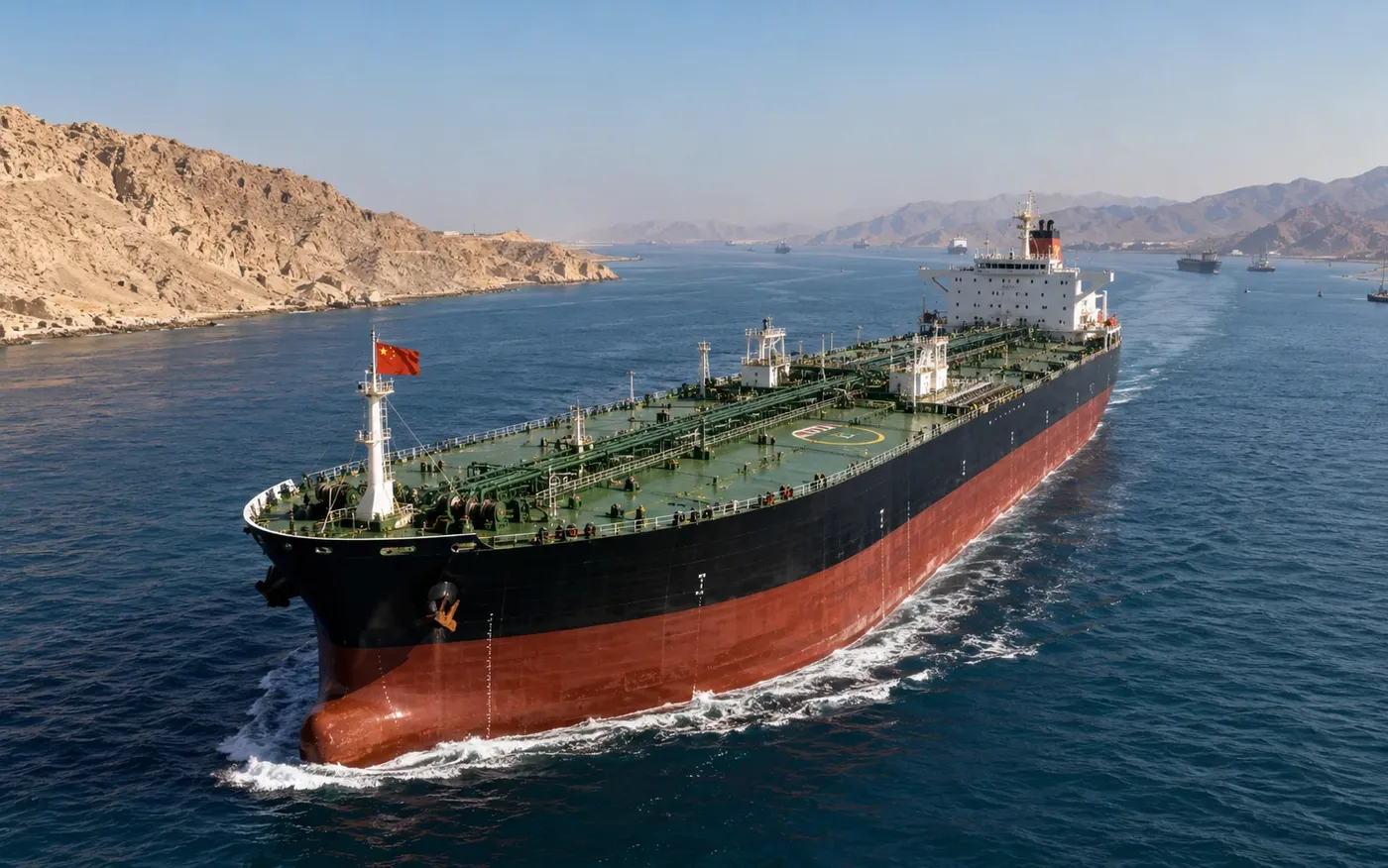

The last time Washington and Tehran promised to reopen the Strait of Hormuz, the promise lasted less than a month. Now Iran has put forward a new plan: the strait reopens at the end of day seven, provided the US moves first. Iran's own foreign minister says the proposal resembles the June memorandum.
The oil market's response has been cautious. As of the evening of September 25 (Vietnam time), Brent crude was trading around $104.93 a barrel, roughly 1% above the previous week's close of $103.87. To see why an offer to reopen the world's most important oil shipping lane has not pulled prices down, it helps to retrace the journey from the start.
June 17: a promise with an expiry date
On June 17, US President Donald Trump and Iranian President Masoud Pezeshkian signed a 14-point memorandum brokered by Pakistan. Under Article 5, Iran pledged to make "every effort" to let commercial ships through the strait toll-free for 60 days, and to clear mines and military obstacles within 30 days. In return, the US would end its naval blockade within 30 days, grant sanctions waivers for Iranian oil exports and give Tehran access to frozen funds abroad.Al Jazeera
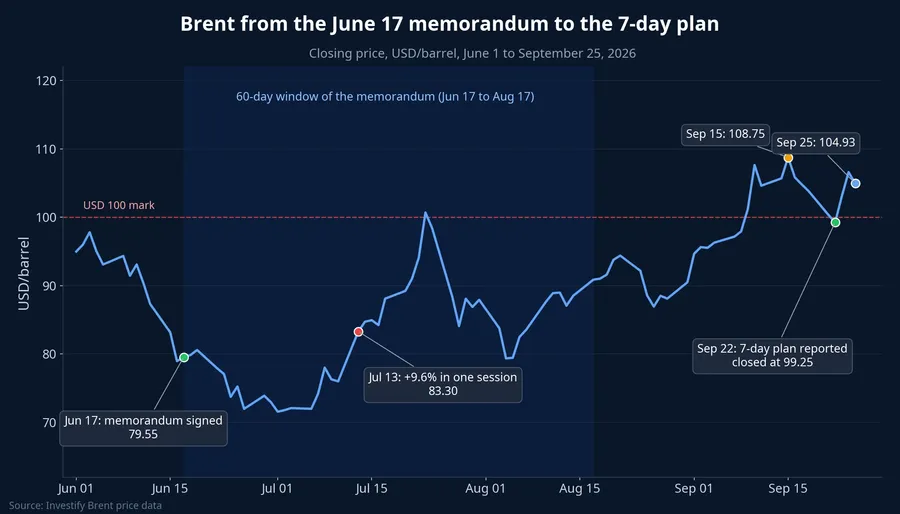
Brent closed the signing day at $79.55 and fell to $71.99 by June 26, a drop of about 9.5% in just over a week. The slide had started earlier, though. In early June, Brent was still trading between $95 and $98. The geopolitical risk premium was being priced out both before and after the signing, as traders came to believe tankers would soon move freely again.
Early July: the deal breaks where it was vaguest
The memorandum's weak spot showed up almost immediately. It never said who gets to decide the shipping lanes. Oman, whose territorial waters lie inside the strait, published a US-backed route hugging the Omani coast. Iran had already issued its own map, steering ships toward its shore and declaring the Omani side a restricted zone. In late June, several vessels using the Omani route came under attack.Al Jazeera
By early July, the US accused Iran of attacking merchant shipping, revoked the oil waivers and resumed airstrikes. Iran, for its part, called those strikes the real violation. According to Al Jazeera, Trump declared the memorandum "over" less than a month after signing it. On August 17, the 60-day window expired with no final agreement.
Oil reacted to bad news far faster than it had to good news. Brent climbed from $71.99 on July 6 to $83.30 on July 13, a gain of about 15.7% in a week, including a 9.6% jump on July 13 alone. The lesson for traders was plain: a promise to reopen the strait can lose its value within days, so oil falls slowly on good headlines and rises quickly on bad ones.
From a low of $79.45 on August 5, Brent ground higher through August, crossed $100 in September and reached $108.75 on September 15. That is above even the July closing peak of $100.69. The supply risk the market is pricing today is larger than it was when the memorandum first collapsed.
September 22 to 25: one session below $100
On September 22, reports began to circulate that Iran could reopen the strait within seven days if Washington eased the pressure. Brent dipped as low as $97.36 intraday and closed at $99.25. The dip did not last. Brent closed at $103.08 on September 23 and touched $108.23 intraday on September 24.
It would be a mistake, however, to read that whole rebound as the market "rejecting" Iran's offer. In the same days, Trump used his UN General Assembly speech to call for Iran's complete economic isolation.gCaptain The sanctions round Washington calls "economic D-Day" also took effect, grounding Iranian flights to Gulf neighbors.Al-Monitor The price series alone cannot separate how much came from sanctions, how much from tough rhetoric and how much from doubts about the proposal. The only firm conclusion is that the 7-day plan kept Brent below $100 for exactly one daily close.
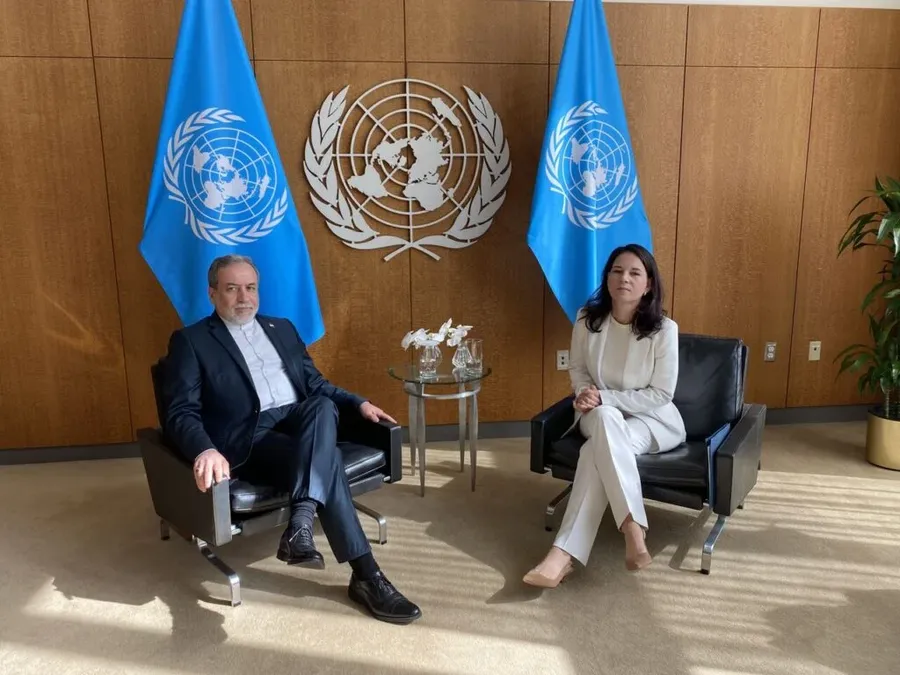
On September 24, New York time, Iranian Foreign Minister Abbas Araghchi laid out the proposal in more detail on the sidelines of the General Assembly. "If the conditions are met, the Strait of Hormuz will be open by the end of the seventh day and negotiations will resume," he said. The clock only starts the day after the US accepts, so there is no fixed reopening date.Al Jazeera
The sequence runs as follows. First comes a ceasefire on all fronts, including Lebanon. The US lifts its naval blockade and oil sanctions and releases Iran's frozen assets, estimated at no less than $12 billion. After seven days the strait reopens, and only then do talks on the nuclear program begin.Inquirer
Two promises: what changed and what did not
Al Jazeera's correspondent described Iran's approach as "compressing the timeline and changing the order." The first difference is time: seven days instead of a 30-day clearance schedule plus 60 toll-free days. The second is who moves first. The June memorandum had both sides acting in parallel. The new plan requires the US to lift the blockade and oil sanctions before the strait reopens.
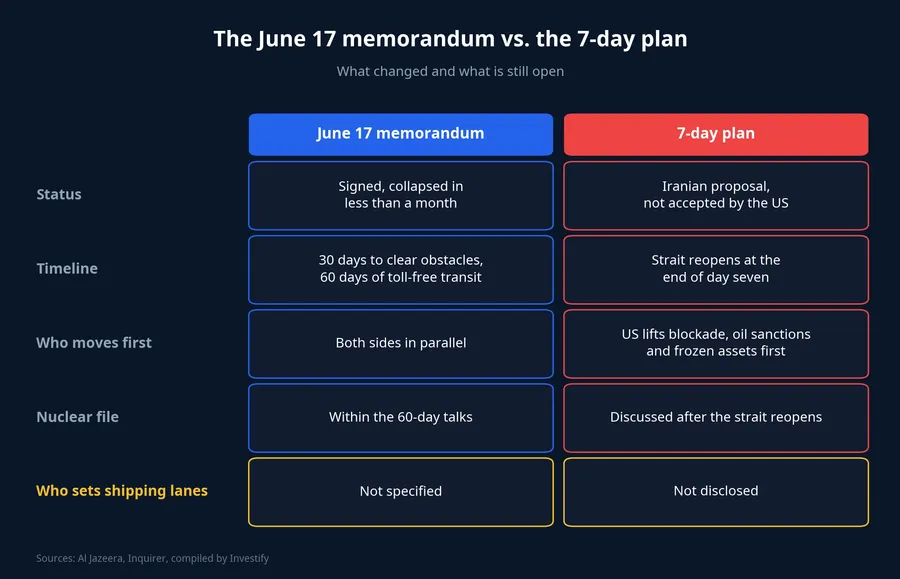
The similarity is what worries the market. According to analysts cited by Al Jazeera, Iran still favors its earlier approach, in which Iran and Oman take the lead in managing the strait. Araghchi disclosed nothing on transit fees, shipping lanes or monitoring. That is exactly the gap that brought down the June memorandum.Al Jazeera
Washington's sticking point lies elsewhere. It wants the nuclear program on the table now, with everything negotiated as one package rather than carving out the strait first. US Secretary of State Marco Rubio said he would not describe the Qatar-mediated contact as a major breakthrough, even if the fact that the two sides are talking matters.Al-Monitor
The US election calendar and escorted tankers
Even so, this proposal is not easy to dismiss. According to AP, Araghchi suggested that a quick deal would help Trump ahead of the November midterms, with high oil prices feeding US inflation and living costs. Trita Parsi, Executive Vice President of the Quincy Institute, who attended the meeting, said Washington might show more flexibility if Trump sees political upside. He also noted deep suspicion that Iran simply wants to buy time to sell more oil. Trump, for his part, said he is in no rush to reach a deal.AP
Meanwhile, ships are still moving through the strait under US escort. A US defense official said about 60 commercial vessels transited Hormuz on September 23, around 40 of them coordinating with the US military. Together they carried about 22 million barrels of oil out of the chokepoint, the highest daily volume since early July. Reuters noted it could not independently verify those figures.Asharq Al-Awsat The lane is not fully shut, but traffic depends on military escorts rather than on any agreement.
Vietnam: fuel prices are not waiting for New York
Vietnam's retail fuel prices do not track Brent session by session. They follow average refined-product prices over each pricing period. From 3 p.m. on September 24, E5 RON92 gasoline rose to VND 26,390 per liter.Báo Chính phủ In this period, the Ministries of Industry and Trade and of Finance neither set aside money for nor drew on the fuel price stabilization fund.Báo Tin tức Reduced environmental protection tax and VAT rates on fuel currently apply through September 30.Ministry of Industry and Trade
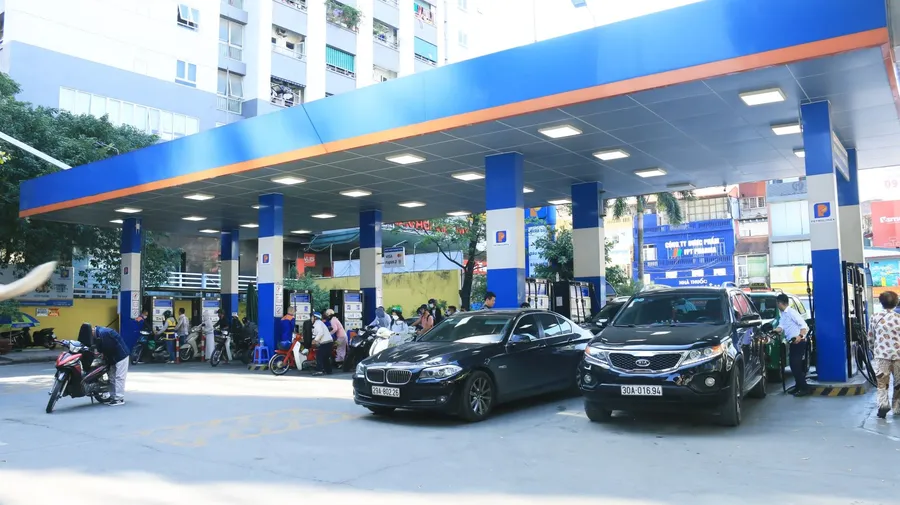
That changes how Vietnamese readers should take the headlines. Without the stabilization fund cushioning prices, global moves pass more directly into retail prices in coming periods. An offer that has not been accepted will not lower the next pump price. Fuel costs, transport costs and domestic inflation only ease once the strait actually reopens and stays open.
Signals that this time is different
The big picture is that the oil market is pricing one thing correctly: a promise to open the strait is not an open strait. The June memorandum taught that lesson at the cost of a roughly 15.7% jump in a single week of July. As long as neither side gives ground on the two key sticking points, the risk premium in Brent stays, however upbeat the diplomatic headlines.
The first signal is whether Washington agrees to set the nuclear file aside for later. If the US keeps insisting on a single package, the 7-day plan will struggle to get started. If it accepts phased talks, the seven-day clock actually starts.
The second signal is whether any final text spells out who decides the shipping lanes. The June memorandum broke down over precisely that question. A new deal that leaves it open carries the same old risk, even if the strait reopens on schedule.
The third signal is daily ship traffic through the strait. If traffic near the September 23 level of about 60 vessels holds and grows without escorts, that would be real evidence the route is returning to normal. For Vietnamese investors, the early-October fuel pricing period will be the first place to see how heavily global oil is weighing on living costs, especially if the tax cuts are not extended past September 30.