
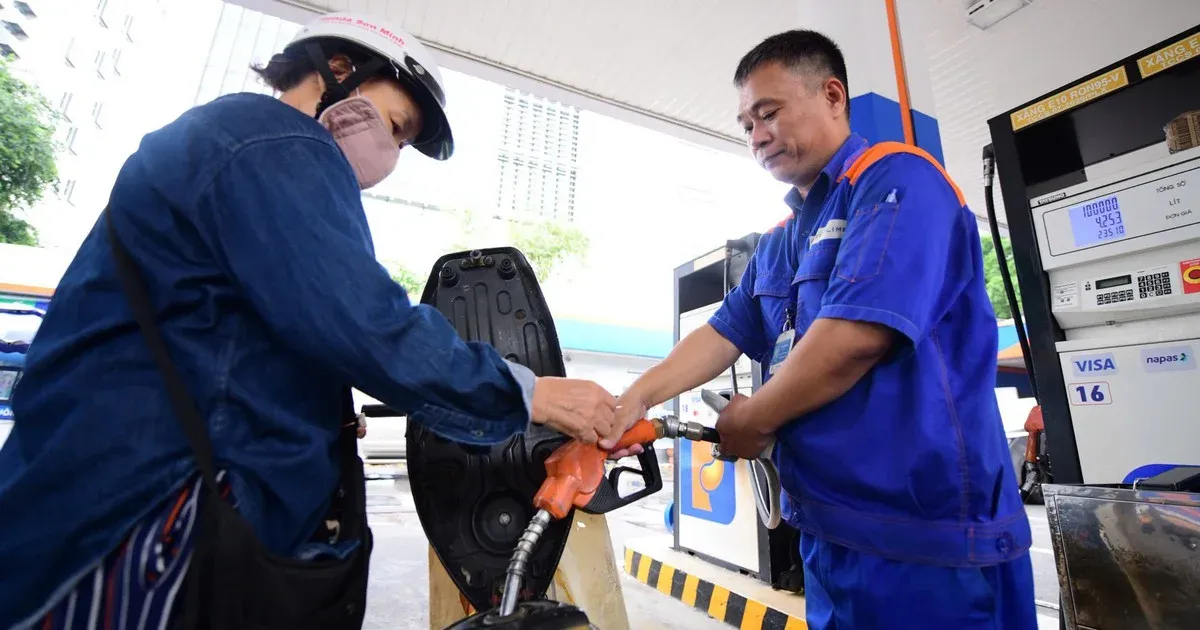

From 3 p.m. on 24 September, a litre of E5RON92 petrol in Vietnam sells for at most VND 26,397, up VND 1,258 from the previous round.Báo Công Thương That figure sits almost on top of the VND 1,250 per litre that the fuel price stabilisation fund spent on biofuel petrol in the 17 September pricing round.Dân trí This time, the fund was not drawn on for any product.Tuổi Trẻ
Plenty of people are puzzled. The news said oil fell below USD 100 at one point this week, so why is filling up more expensive? The answer lies in how retail prices are calculated, and in a cushion that drivers never see at the pump, which has just been pulled away. Once you understand the mechanism, the next few pricing rounds become readable rather than surprising.
Pump prices don't follow a single day's oil price
Put simply, the price at the pump is not derived from the Brent crude price on any particular day. The Ministries of Industry and Trade and of Finance take the price of refined petrol on world markets, average it over the whole window between two pricing rounds, then add operating costs, a standard profit margin and taxes, and finally either set money aside for the stabilisation fund or draw from it. The framework rests on Decree 83/2014 and the decrees that later amended it.
That is why watching Brent day by day is misleading. Brent closed at USD 104.82 a barrel on 17 September, dipped to USD 99.25 on 22 September, and was back at USD 104.99 on 24 September. The "oil below USD 100" headlines were accurate, but the dip lasted a session or two, and the two ends of the period were almost level.
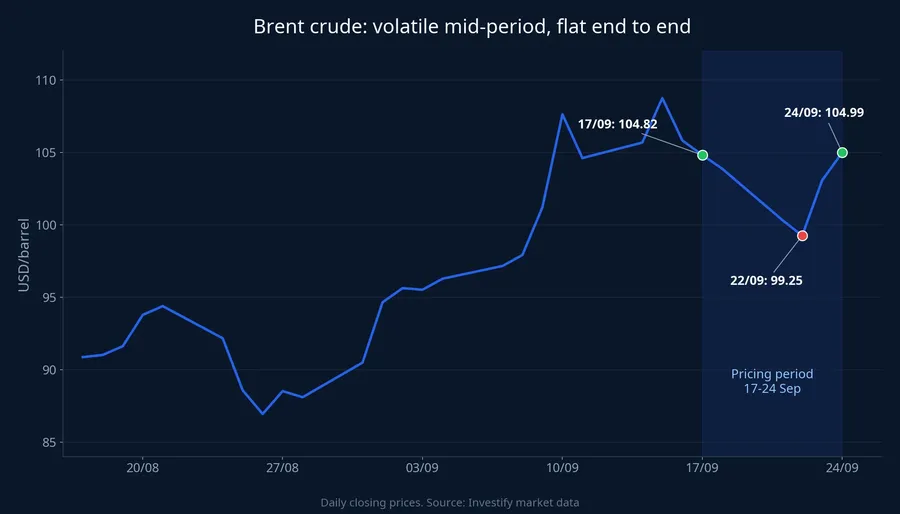
What actually enters the formula is the average price of refined product over the full period. Between the 17 and 24 September rounds, RON92 used to blend E5 fell 0.18%, RON95 used for E10 rose 0.66%, diesel fell 5.10% and fuel oil fell 5.57%.Báo Công Thương In other words, the input cost of E5 petrol was essentially flat this round.
A simple subtraction shows where the increase came from
If the input cost barely moved while the retail price rose about 5%, the gap has to come from another component of the formula. The one that changed most visibly is the stabilisation fund.
In the 17 September round, the ministries drew VND 1,250 per litre from the fund for petrol, VND 2,000 per litre for diesel and VND 1,250 per kg for fuel oil. Dân trí calculated that without that spending, petrol would have risen by more than VND 2,600 a litre in that round.Dân trí By 24 September the subsidy was gone, so retail prices had to absorb the amount the fund had been carrying.
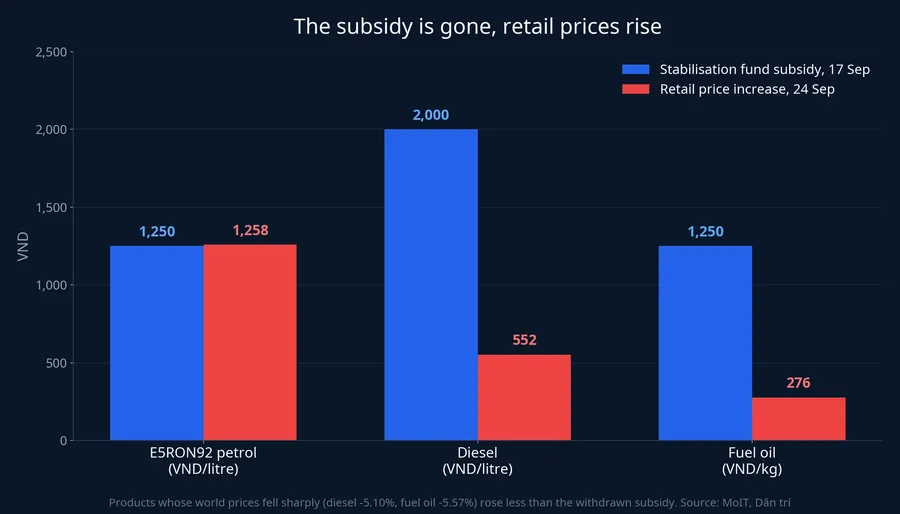
The other products follow the same logic. Diesel lost a VND 2,000 subsidy, but its world price fell 5.10%, so the retail price rose only VND 552 a litre, to VND 30,497. Fuel oil lost VND 1,250 per kg while its world price fell 5.57%, so it rose just VND 276 per kg. E10RON95-III lost its subsidy and faced a 0.66% rise in RON95, so it climbed the most: VND 1,451 a litre, to VND 27,087.Báo Công Thương
The arithmetic doesn't reconcile to the last dong. The formula is also affected by the USD/VND exchange rate and by the cost of the ethanol blended into petrol, neither of which can be isolated from public data. Still, when the source price of petrol fell 0.18% and the retail price rose VND 1,258, matching the size of the VND 1,250 subsidy just withdrawn, the evidence points clearly to the stabilisation fund as the main driver.
This also shows what the fund really is. Think of it as a cushion: it cannot erase a price rise, only push it into a later round. The 24 September increase was the fourth in four weeks. Since the 27 August round, E5 petrol has risen by more than VND 4,600 a litre, close to 20%, and diesel by nearly VND 2,500 a litre, close to 9%.Tuổi Trẻ
How thin the remaining cushion is
The stabilisation fund is not a single pooled account. Each licensed fuel wholesaler manages its own share, made up of money set aside from sales and advances from the state budget. So the numbers have to be read company by company.
According to Petrolimex's own disclosure, in the cycle from 17 September to just before the 24 September adjustment alone, the group estimates it spent VND 276 billion from state-budget advances. That advance account is now VND 263 billion in the red, while the total fund balance Petrolimex manages stands at approximately VND 1,075 billion. PVOIL is in a very different position: as of 3 p.m. on 24 September its fund balance was negative VND 1,766.41 billion, of which the non-advance portion was negative VND 1,437.74 billion and the budget-advance portion negative VND 328.67 billion.Tuổi Trẻ
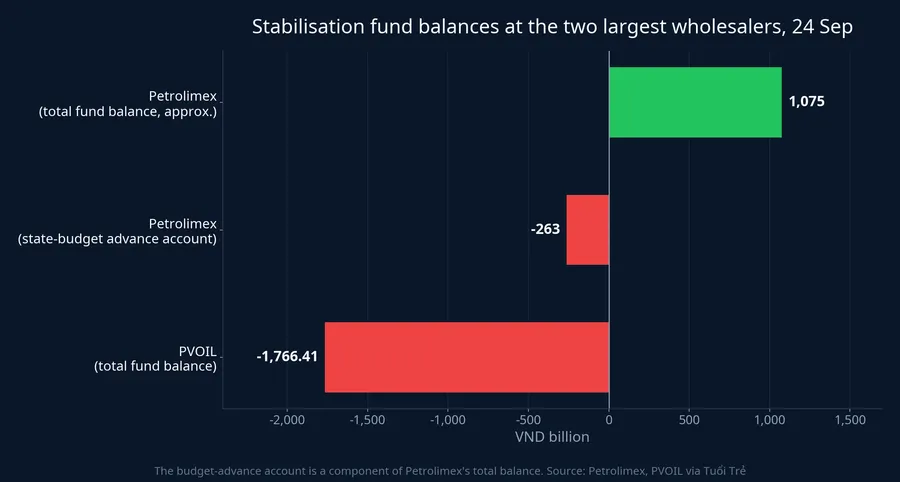
A negative balance means the company has paid out more in subsidies than it has set aside. Under the contribution mechanism, the shortfall is refilled by adding contributions to the price in later rounds. That touches your wallet directly: when world prices turn lower, domestic prices may fall more slowly, because part of the decline is held back to rebuild the fund.
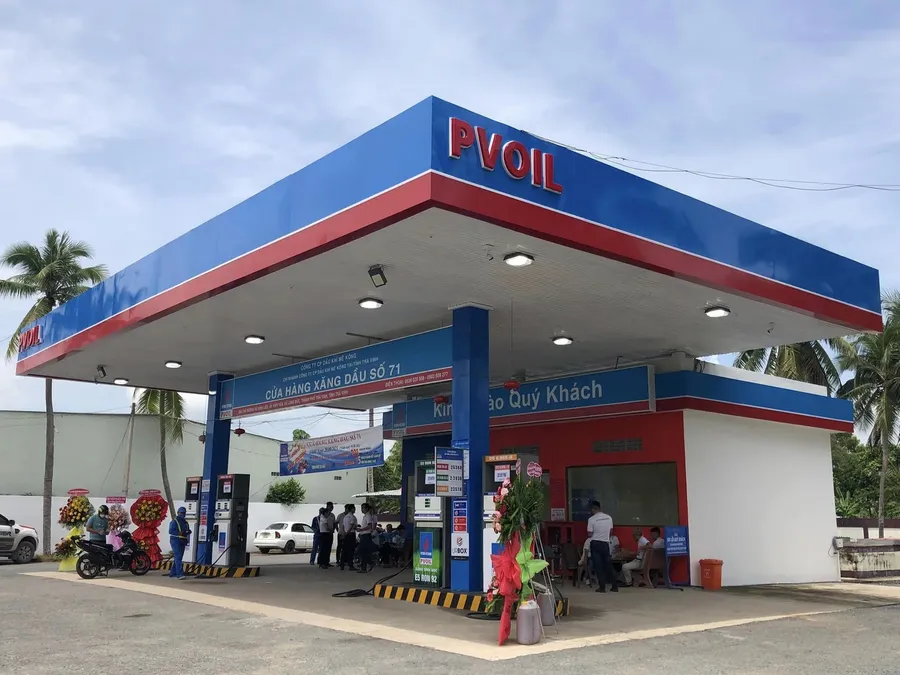
The most recent system-wide picture dates from the end of the second quarter. According to Ministry of Finance data cited by Vietstock, the total fund balance stood at more than VND 1,911 billion on 30 June, and companies used nearly VND 900 billion during the quarter.Vietstock That figure is nearly three months old and cannot be added to the company-level numbers from 24 September. What can be said with confidence is that the two largest wholesalers have little room left to hold prices down: one is down to its own contributions, the other is already negative.
30 September: the second cushion is about to expire
Beyond the fund, pump prices are also being held down by tax relief. Government Resolution 34/2026/NQ-CP, issued on 30 June, extended preferential import duties, environmental protection tax relief and VAT relief on fuel. The resolution is in effect from 1 July until the end of 30 September 2026.Báo Chính phủ Special consumption tax on petrol was not part of the extension and has applied under the law since 1 July.
Without a new document, the environmental protection tax reverts to the 2026 rates set in Resolution 109/2025/UBTVQH15: VND 2,000 a litre for petrol and VND 1,000 a litre for diesel.VietnamPlus That tax alone is larger than the VND 1,250 subsidy just removed from petrol prices, before counting VAT and import duty.
As of the evening of 24 September, no extension had been announced. One wholesaler told Tuổi Trẻ that prices are under heavy pressure as the tax relief nears expiry.Tuổi Trẻ On the other side, Thanh Niên reported that at a meeting of the price management steering committee, the government instructed the Ministry of Finance to keep implementing tax exemptions and reductions that remain appropriate, particularly for fuel and fertiliser.Thanh Niên That is a policy direction, not a decision to extend.
From the pump to the consumer price index
Fuel was already the biggest driver of August inflation. According to the General Statistics Office, CPI rose 0.47% from July and 4.89% year on year in August. The transport group rose 4.09%, mainly on fuel prices, contributing 0.41 percentage points to the headline increase. Over the first eight months, CPI averaged 4.45%, the highest for that period since 2021, against a full-year target of around 4.5%.Thanh Niên
The Ministry of Finance has updated its 2026 inflation scenarios to average CPI of 4.5%, 5% and 5.5%.Thanh Niên The new 24 September prices apply only to the last few days of September, so most of the impact will show up in October's CPI. If the taxes also return on 1 October, both forces land in the same month.
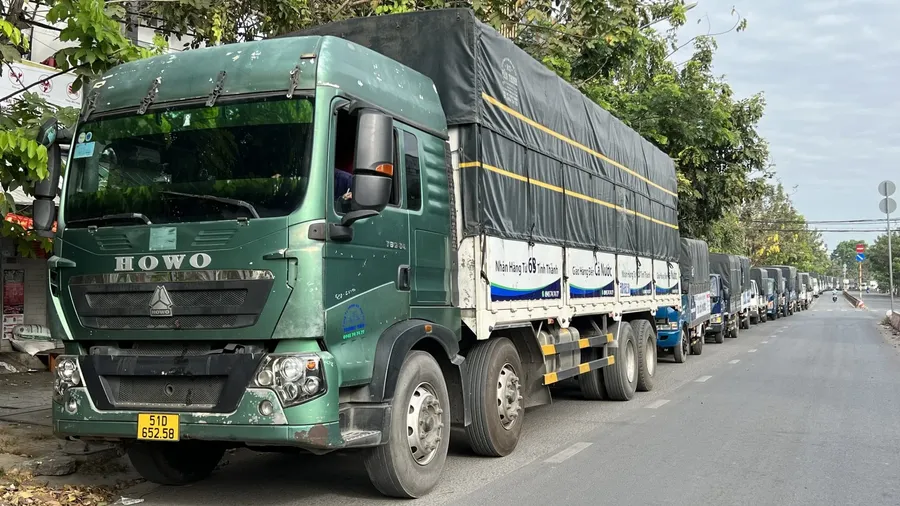
For investors, inflation running close to target narrows the room to keep interest rates low through year-end. Fuel costs also pass through to transport and logistics fees with a lag. An expert quoted by Thanh Niên noted that even when fuel prices start to fall, freight rates may not follow right away.
Signals worth watching
The conclusion here is fairly clear: from now on, retail petrol prices will track world prices more closely, because both cushions, the stabilisation fund and the tax relief, are thinning at the same time. The one thing that could change this view is an extension of the tax relief, and even then, the wholesalers' funds have little left to absorb price rises.
The nearest milestone is the tax decision around 30 September. If the environmental protection tax returns to VND 2,000 a litre while world petrol prices move sideways, the first October pricing round faces clear upward pressure. If the relief is extended, the pressure comes from world prices alone.
The second signal is the fund contribution and spending line in each round's pricing notice. If the fund keeps sitting idle, retail prices directly reflect the average price of refined product. If the fund starts collecting contributions when world prices fall, wholesalers are refilling their shortfall, and domestic prices will fall more slowly than world prices.
Further out are the September and October CPI releases from the General Statistics Office, published at the start of each month. The transport group's contribution to the headline figure will show how far fuel is pushing inflation relative to the roughly 4.5% target.