

The yield on the 10-year US Treasury rose 15 basis points on September 23 to close at 5.11%, after touching 5.14% during the session. CNN reports that this is the highest level since 2007. At the start of the year, the same yield was just 4.15%.CNN
Vietnamese investors should pay attention because the 10-year Treasury yield is effectively the world's price of money. When it rises, holding gold, which pays no interest, gets more expensive. The dollar becomes more attractive, and foreign investors have one more reason to hesitate before putting money into emerging markets like Vietnam.
The 2007 comparison is easy to misread, though. The yield may be the same, but the backdrop is close to the opposite of what it was then.
Same yield, very different backdrop from 2007
In 2007, the Fed's policy rate stood at 5.25%. That September, the Fed cut by half a percentage point to 4.75% on fears that the housing credit crisis would spread.Fed The policy rate was then higher than the 10-year yield, and markets were bracing for an easing cycle.
This year the picture has almost flipped. The Fed has just raised rates to a 3.75–4% range, its first hike since 2023. The top of that range sits more than a percentage point below the 10-year yield. Markets are not waiting for cuts either. According to the CME FedWatch tool, the probability of another hike in October rose to roughly 66%, up from 55% a day earlier.CNN
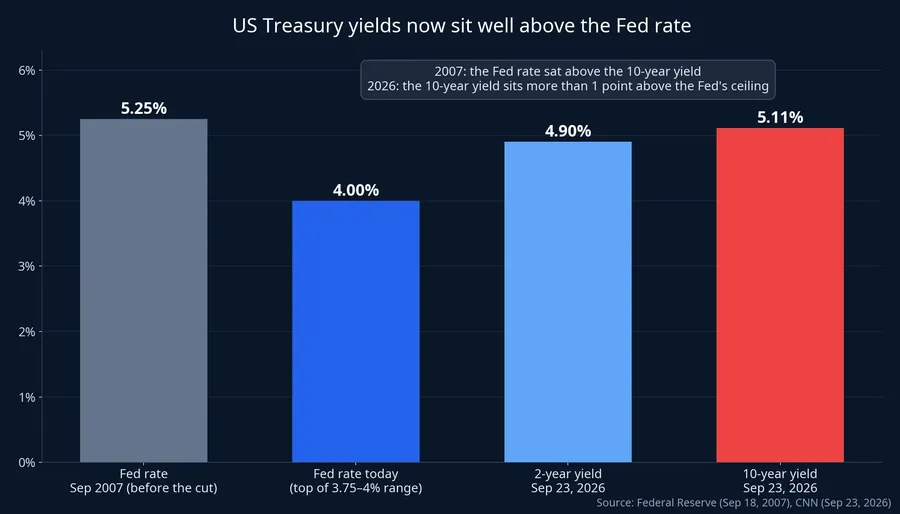
That gap of more than a percentage point has two components. One is the expectation of further Fed hikes. The other is the extra compensation buyers demand for holding long-dated bonds while both US inflation and US public debt are high. Public data cannot separate the two precisely. But both point the same way: high yields today are not a sign that markets are waiting for the Fed to ride to the rescue, as they were in 2007. Using 2007 to forecast a similar crisis is therefore a flawed comparison.
What pushed yields higher on September 23
Several forces converged on the 23rd, each working through a different channel.
US business data ran hotter than expected. S&P Global's flash survey showed US business activity in September growing at its fastest pace since July 2021.CNN The more worrying part was costs: companies reported input prices rising at the fastest rate in four years, driven mainly by fuel and freight following oil higher.Wolf Street US inflation for August had already come in at 3.4% year on year, well above the Fed's 2% target.Fortune
Hawkish remarks from the Fed. Speaking in Chicago on September 23, Michael Barr, a member of the Federal Reserve Board of Governors, said further policy adjustments are likely to be needed to bring inflation back to target in a timely way.American Banker Barr noted that inflation remains above 2% with no clear sign of heading back down. His remarks reinforced expectations of another hike at the October 27–28 meeting.Fed
A weak 5-year auction. The Treasury sold USD 70 billion of 5-year notes at 5.033%, 3.1 basis points above where they traded just before the auction. The bid-to-cover ratio was only 2.212, the lowest since December 2018. Indirect bidders, typically foreign central banks and large institutions, took 54.31%, down from 61.51% at the previous sale.TFTC After the auction, the 5-year yield rose above 5% for the first time since 2007.CNN
Oil bounced. Brent crude rose 3.86% to USD 103.08 a barrel, snapping a five-session losing streak.CNN The move followed a statement at the United Nations by Iranian President Masoud Pezeshkian that Iran would not surrender to the US.CNBC
So which force mattered most? The 2-year yield, the maturity most tied to Fed expectations, rose about 16 basis points to 4.9%, in line with the move in the 10-year.CNN That suggests that on this particular day, expectations of more Fed hikes, fed by hot data and Barr's remarks, were the main driver. Oil and the weak auction amplified the move. Their bigger role is in the longer-term question of why the 10-year yield sits so far above the Fed's rate.
Gold falls, the dollar firms, the dong barely moves
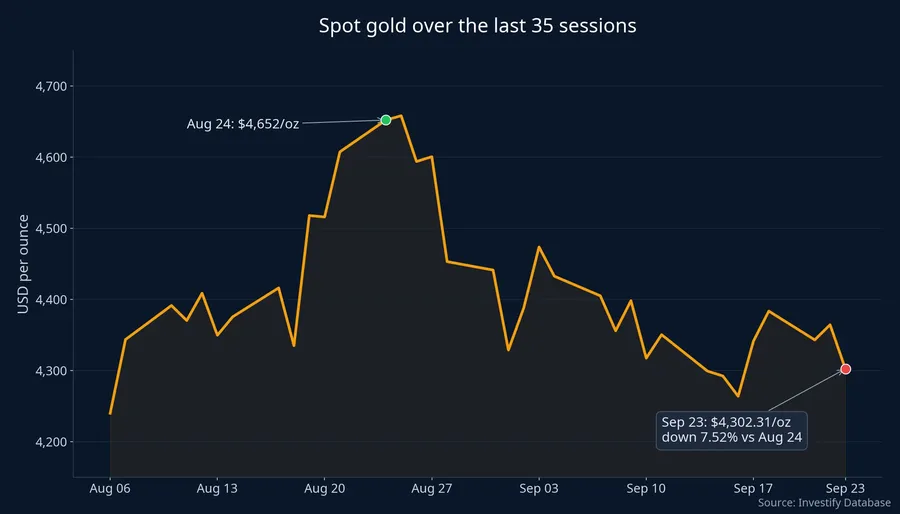
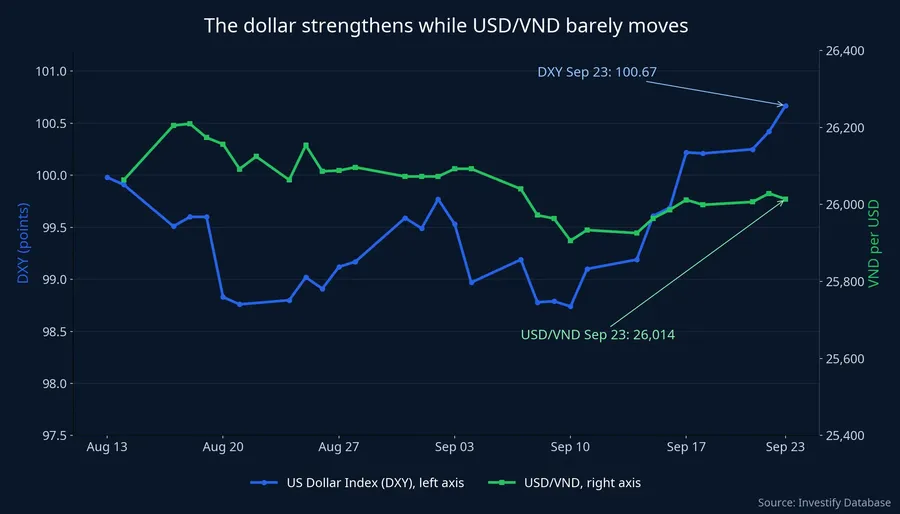
Spot gold fell 1.42% on September 23 to USD 4,302.31 an ounce, down 7.52% from USD 4,652 on August 24. The US Dollar Index (DXY) rose to 100.67, up from around 99.1 on September 11. US stocks slipped as well, with the S&P 500 down 0.75% and the Nasdaq down 1.1%.CNN
In Vietnam, USD/VND closed on September 23 at 26,014, down a slight 0.19% from 26,063.5 on August 24. The dollar's global strength has not yet pushed the local exchange rate higher.
Foreign investors told a different story. On September 23 they were net sellers of VND 1,048 billion across the market, concentrated in banks such as VPB (about VND 289 billion), ACB (VND 142 billion) and TCB (VND 86 billion), while the VN-Index fell more than 15 points to 1,801.65.Markettimes The timing matters here. Vietnam's market closed on the 23rd before US yields climbed to 5.11% that evening, so this selling was not a reaction to the new level. It reflects pressure that had built up while the 10-year yield hovered around 5% for weeks. September 24 is the first session in which local markets can respond to 5.11%.
Scenario A: the Fed keeps hiking and data stays hot
The trigger would be US inflation for September, due in mid-October, showing no cooling from August's 3.4%, followed by another 25-basis-point hike at the meeting ending October 28.
A higher policy rate would lift the whole yield curve and give the 10-year a basis to stay above 5%. That said, if markets are already pricing roughly a 66% chance of this hike, much of it is already in the price. Yields would only climb sharply further if the Fed signals more hikes beyond October.
The dollar would stay strong, and gold would remain under pressure as the opportunity cost of holding a non-yielding asset rises. For Vietnam, pressure on the exchange rate would build gradually, and foreign investors would have more reason to be cautious on richly valued stocks.
Scenario B: US–Iran tensions ease and oil falls
The trigger would be the Strait of Hormuz reopening and Brent settling sustainably below USD 100 a barrel. Some early signs are already there. US President Donald Trump said the US delegation had a "very good" meeting of about three hours with Iran.CNBC Reuters also reported that Iran could reopen the strait within a week if the US eases military pressure and lifts its blockade of Iranian ports.

The mechanism is straightforward. Cheaper oil lowers fuel and freight costs, easing the input-cost pressure that is currently running at a four-year high. Inflation expectations would come down, the Fed would face less pressure to keep hiking, and yields would have room to cool.
The dollar would weaken and gold would get relief from yields. But gold would also lose some of its geopolitical safe-haven support, so the two forces could offset each other. For Vietnam, lower oil means less imported inflation, and lower US yields give foreign capital room to return. The biggest risk is that talks can reverse quickly, as Pezeshkian's hard-line remarks on the very same day showed.
Scenario C: the Fed pauses, but bond buyers still want more
The trigger would be the Fed holding rates in October while upcoming Treasury auctions stay weak, with low bid-to-cover ratios and yields clearing above pre-auction levels. The 7-year auction on September 24 is the nearest test.TFTC
What sets this scenario apart is that it is independent of the Fed. Even with the policy rate on hold, long-term yields stay high because buyers demand more compensation for persistent inflation risk and a growing pile of US government debt. The Treasury is buying back long-dated bonds to slow the rise in yields, with the next operation capped at USD 6 billion. Analysts cited by CNN say that is far too small relative to a US Treasury market of more than USD 30 trillion to change the trend.CNN
Here short-term yields could ease while long-term yields stay elevated, keeping long-term borrowing costs expensive around the world. This is the scenario with the longest-lasting pressure on gold and on capital flows into emerging markets, because no single event would bring it to an end.
Signals worth watching
The scenarios are not entirely mutually exclusive. Still, one pair of signals separates them fairly clearly: Brent crude and the 10-year yield.
- Brent below USD 100 and the 10-year back under 5%: Scenario B is playing out, and pressure on gold and the exchange rate should ease gradually.
- Brent below USD 100 but the 10-year still above 5%: the driver is no longer oil but bond buyers, which points to Scenario C. Pressure on gold and foreign flows would then last longer.
- Hot September inflation and a Fed hike on October 28: Scenario A, with the dollar staying strong at least through year-end.
At home, the indicator to put next to these signals is USD/VND. As long as the rate stays flat around 26,000 as it has over the past month, US yields are working through sentiment and foreign flows rather than threatening macro stability. A clear move higher in the exchange rate would be the sign that pressure has reached Vietnam's financial system.
For anyone holding bonds or bond funds, one basic principle applies: when yields rise, the prices of existing bonds fall, and the longer the maturity, the bigger the drop. On the other side, new buyers lock in higher yields. The big picture is that 5.11% is both a squeeze on existing portfolios and a yield that global bond investors have not been paid in many years. The 7-year auction on September 24 and September inflation data in mid-October will be the first two markers of which scenario is gaining the upper hand.