


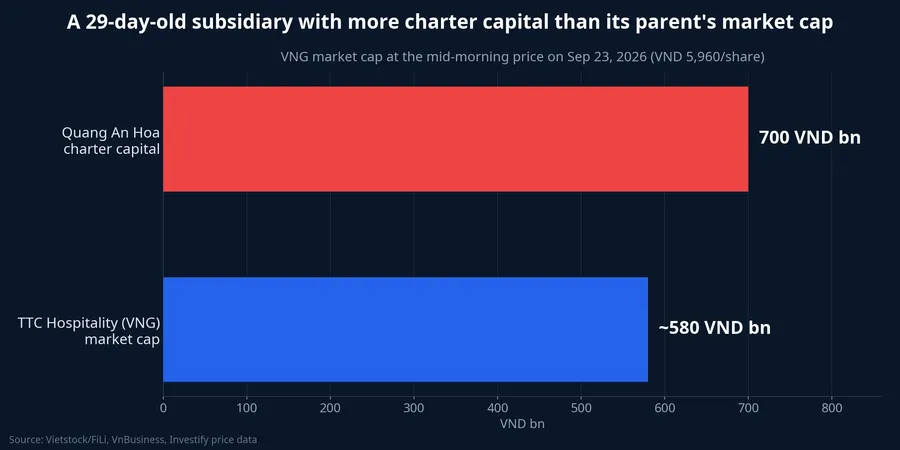
Two numbers in this story are worth reading twice. Quang An Hoa Investment & Trading Services Co., Ltd. was incorporated on August 25, 2026, registered for short-stay accommodation, with charter capital of VND 700 billion.FiLi Meanwhile, with about 97.3 million shares outstanding and a price of VND 5,960 in mid-morning trading on September 23, Thanh Thanh Cong Tourism JSC (TTC Hospitality, HOSE: VNG) is valued by the market at around VND 580 billion.VnBusiness A subsidiary less than a month old has more charter capital than its listed parent's entire market value.
On September 23, exactly 29 days after Quang An Hoa was set up, VNG published a board resolution approving a plan to sell its full stake in the company. To understand why, the deal has to be read alongside VNG's half-year financial statements, which tell a far more coherent story than the headlines.
What is actually for sale
According to the disclosure reported by Vietstock/FiLi, VNG is not Quang An Hoa's direct owner. That role belongs to Thanh Thanh Cong Lam Dong Tourism Co., Ltd. (TTC Lam Dong), a wholly owned VNG subsidiary. What is up for sale is TTC Lam Dong's entire capital contribution in Quang An Hoa.FiLi
The board tasked Mr. Tran Men, a member of TTC Hospitality's Board of Directors and the legal representative of TTC Lam Dong, with finding and vetting a buyer, signing the contract and setting the price. There is only one pricing condition: the price cannot be lower than the capital TTC Lam Dong has actually contributed to Quang An Hoa.
That detail matters more than it looks. Charter capital is what the owner commits to contribute; contributed capital is the cash or assets actually put into the company. Vietnam's 2020 Law on Enterprises gives owners of a limited liability company 90 days from the date of registration to contribute the full amount.Việt Úc Quang An Hoa is only 29 days old, and the disclosure does not say whether TTC Lam Dong has paid in the full VND 700 billion, or whether it contributed cash or assets. The "no less than VND 700 billion" floor cited in many news reports only holds if the capital has been fully contributed.
The stage of the deal also needs to be clear. This is a board-level plan. There is no buyer yet, no contract and no agreed price.
A playbook VNG has used before
"Set up a new company, then sell the stake" is not new at VNG. In December 2024, the company sold its entire stake in Palace Binh Thuan Co., Ltd., equal to 95% of charter capital, to Nui Ta Cu Tourism JSC for VND 76 billion. Palace Binh Thuan had been incorporated in September 2024, about three months earlier.FiLi
In late June 2026, VNG sold more than 10 million shares, or 3.22% of Toan Hai Van JSC, again to Nui Ta Cu, for more than VND 300 billion. The deal produced a financial gain of more than VND 38 billion in the first half. The catch: of the more than VND 300 billion owed, Nui Ta Cu had paid only VND 210 billion.FiLi The remaining 90-plus billion still sits on the books as a receivable.
Why sell a stake in a legal entity rather than the hotel or land itself? Think of the entity as a box. Once the assets are inside, the buyer only needs to take over the capital contribution; licenses, land-use rights and contracts travel with the entity, so there is no need to re-register each asset. This is common practice in real estate and tourism deals, and it is perfectly legal. It does, however, make it hard for outside investors to see what is inside the box. The Quang An Hoa disclosure does not specify which assets back the VND 700 billion in charter capital.
The half-year report explains the need for cash
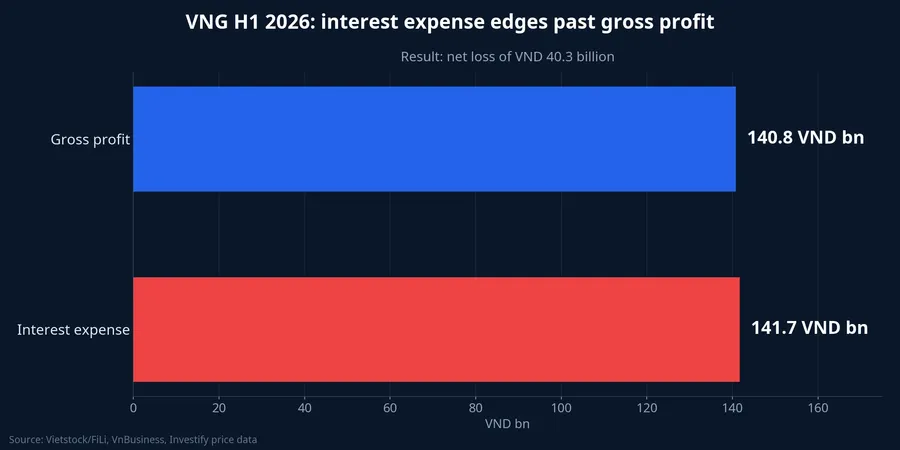
According to VNG's reviewed consolidated half-year statements, as compiled by VnBusiness, first-half 2026 net revenue reached VND 380.1 billion, up 16.1% year on year. Gross profit came in at VND 140.8 billion, up 75.5%.VnBusiness The hotel and resort business is genuinely improving, and that positive side deserves credit.
The problem sits one line further down the income statement. Interest expense over the same six months was VND 141.7 billion, slightly more than the entire gross profit. Put simply, every dong earned from rooms and entrance tickets went to banks and bondholders, and it still was not enough. VNG posted a net loss of VND 40.3 billion, although that is 57.4% narrower than the VND 94.6 billion loss a year earlier.VnBusiness Without the gain of more than VND 38 billion from the Toan Hai Van sale, the loss would have been considerably deeper.
The balance sheet shows the pressure even more clearly. As of June 30, 2026, short-term borrowings and finance leases stood at VND 926.2 billion and long-term at VND 1,950.5 billion. That totals about VND 2,876.8 billion, roughly 2.6 times equity of VND 1,092.9 billion. Cash and equivalents, meanwhile, were just VND 11.7 billion.VnBusiness
Cash flow tells the same story. Operating cash flow was negative VND 118.9 billion over the six months, and the company took on VND 1,024.9 billion in new loans to repay VND 931.9 billion of principal.VnBusiness Borrowing new money to pay off old debt only works as long as lenders stay willing.
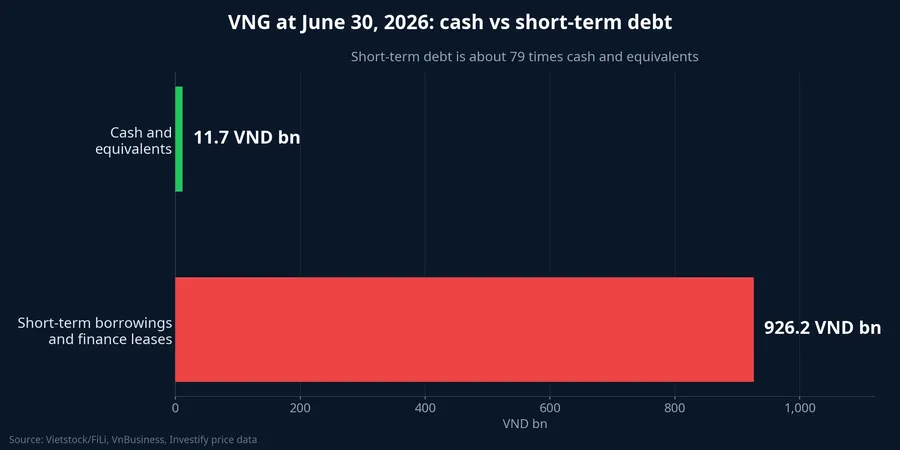
Against that backdrop, the Palace Binh Thuan, Toan Hai Van and Quang An Hoa deals can be read as a cash-raising channel running alongside the core business. To be clear, that is a reading of the numbers, not a purpose the company has disclosed. The deals may also serve to reshuffle assets within the Thanh Thanh Cong ecosystem. Still, with VND 11.7 billion in cash against VND 926.2 billion of short-term debt, the need to raise cash is hard to ignore when assessing any of VNG's stake sales.
The Da Lat portfolio behind TTC Lam Dong
TTC Lam Dong, Quang An Hoa's owner, is VNG's largest recent investment. In late 2025, VNG paid more than VND 619 billion to own 100% of the company. TTC Lam Dong holds some of Da Lat's best-known attractions, including the Valley of Love, Mong Mo Hill and the Thong Nhat Hill resort.FiLi
The Thong Nhat Hill resort alone covers more than 70.5 hectares with a total investment of nearly VND 500 billion. As of June 30, 2026, it carried more than VND 427 billion in construction in progress.FiLi That is money already spent that has yet to generate revenue.
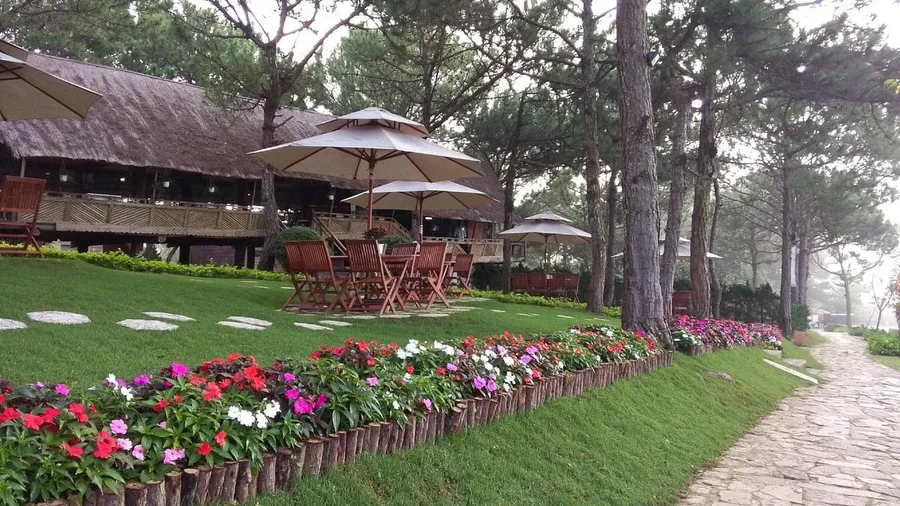
The disclosure does not say which TTC Lam Dong assets, if any, were contributed to Quang An Hoa. So it is too early to say whether this deal is an indirect sale of part of the Da Lat portfolio. That is a question the transfer contract will have to answer once it is disclosed.
The share price says little so far
By mid-morning on September 23, VNG shares were up 6.43% at VND 5,960, while the VN-Index was roughly flat around 1,818 points. The Quang An Hoa news came out the same day, but the move is hard to read as the market's verdict on the deal.
Liquidity is the reason. Only about 100 VNG shares had changed hands by mid-morning. Over the past 25 sessions, most sessions saw a few hundred to a few thousand shares traded, and 6-7% single-day swings were common. On September 7, for example, the stock rose 6.67%, then fell 6.25% on September 8. In a stock this thinly traded, a few small orders can move the price a long way. The news, odd-lot orders or the stock's usual volatility could all explain today's gain, and the available data cannot isolate the effect of the announcement.
Valuation is the more telling signal. VNG trades at a P/B of about 0.52x, well below its book value of VND 11,240 per share.VnBusiness That gap reflects the market's discount for the debt load, and for the uncertainty over turning the assets on the books into real cash.
Cash collected is the real yardstick
My read of the numbers is this: for a company whose interest expense exceeds its gross profit, the value of the Quang An Hoa deal lies not in the VND 700 billion figure on the resolution, but in how much cash actually arrives and how it gets used. Signals worth watching as the deal progresses:
Who the buyer is. Both previous deals went to Nui Ta Cu. If Quang An Hoa also ends up with a familiar name in the Thanh Thanh Cong ecosystem, the money may simply circulate within the group. An outside buyer would make the price more of a market price.
The final price versus contributed capital. Selling at exactly the contributed amount creates no profit; it only turns assets into cash. Only a premium over contributed capital, if any, shows up as a gain in the accounts.
How much cash comes in. More than VND 90 billion from the Toan Hai Van deal remains unpaid. The Q3 report will show whether that money has arrived, and whether operating cash flow has become less negative.
If the proceeds from Quang An Hoa go toward cutting the VND 926.2 billion of short-term debt, VNG's interest burden will genuinely ease. If instead the money mostly sits as a receivable, as it did with Toan Hai Van, the company's financial picture remains essentially unchanged.